

What Is Surfboard Rocker and How It Shapes Your Ride


TL;DR:
Rocker is the nose-to-tail curvature of a surfboard that affects speed, control, and maneuverability. It comprises three sections—nose, mid, and tail rocker—that each influence wave performance and response. Understanding and matching rocker profiles to wave conditions enhances surfing efficiency and enjoyment.
Most surfers spend hours debating fin setups and board length but walk past the single design element that controls everything from drop-ins to tight carves: rocker. Understanding what is surfboard rocker means understanding how much curve your board has from nose to tail, and that curve changes how the board interacts with every wave you ride. Get it right and your board feels locked in and alive. Get it wrong and you’re fighting the equipment instead of the ocean.
Table of Contents
Key takeaways
Point | Details |
Rocker is the nose-to-tail curve | Measured by the board’s longitudinal bend, it directly affects speed, drag, and control. |
Three sections to know | Nose, mid, and tail rocker each play a distinct role in drop-ins, glide, and turning. |
More rocker trades speed for control | Higher rocker suits steep, powerful waves; flatter rocker works best in small, weak surf. |
Continuous vs staged profiles differ | Continuous rocker fits hollow waves; staged rocker improves paddling in mushier conditions. |
Match rocker to your local break | Choosing the right profile based on wave type is as important as board length or volume. |
What surfboard rocker actually means
Surfboard rocker is the nose-to-tail curve of the board when viewed from the side. Set your board on a flat surface and look at the gap between the surface and the board’s bottom. That arch is your rocker. A board with heavy rocker looks almost banana-shaped. A flat board sits almost entirely flush with the surface.
Most people think of rocker as a single measurement. In reality, shapers break it into three distinct sections, and each one does a different job:
Nose rocker: The curve in the front third of the board. Controls how the nose lifts during steep drops and protects against pearling.
Mid or center rocker: The curve through the middle of the board. Sets the overall speed and planing efficiency baseline.
Tail rocker: The curve in the back third. Governs how the board pivots in turns and releases off the wave face.
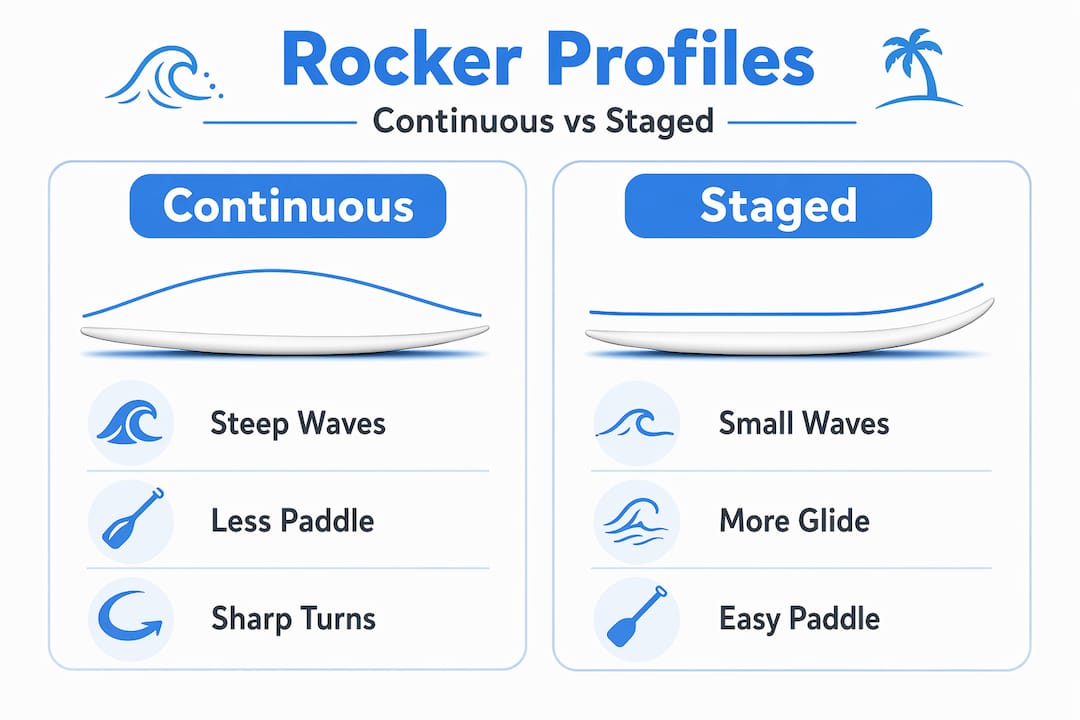
Beyond these sections, you also need to know the difference between two rocker types: continuous and staged. A continuous rocker flows in one smooth arc from nose to tail. A staged rocker, sometimes called a flat rocker or step rocker, has a flatter center section with more pronounced curves at the nose and tail. These two profiles behave very differently on the water.
Rocker is a balance between paddling ease, speed, control, and maneuverability depending on wave conditions and surfing style. Understanding the sections gives you the vocabulary to diagnose why a board feels right or wrong for a given situation.
How rocker affects performance on the wave
Think of rocker as the interface between your board’s geometry and the wave’s shape. Rocker changes how much of the board’s bottom contacts the wave, which directly impacts speed, drag, control, and maneuverability. More contact means more glide. Less contact means more agility.
Here is how each section cashes in on that principle:
Nose rocker and takeoffs: Steeper nose rocker helps with steep wave control and prevents the nose from digging into the water on drops, a wipeout surfers call pearling. Flatter nose rocker aids paddling and early wave catch but gets punished on steep faces.
Tail rocker and turning: More tail rocker enhances pivot and control in tight maneuvers, while a flatter tail rocker keeps you moving down the line with more drive and speed in smaller surf.
Overall rocker and board personality: The total curve across all three sections shapes how a board feels under your feet. High overall rocker creates a surfy, loose feeling. Low overall rocker creates a fast, drivey feeling.
The trade-off is real and unavoidable. More rocker means better maneuverability but less glide. Flatter rocker means more glide and speed but less control on steep waves. No single rocker setting is best for all conditions. That’s the core tension every surfer has to resolve.
Pro Tip: If you keep losing speed on your bottom turn but your turns feel sharp, your board may have too much tail rocker for your local wave. Try a board with a slightly flatter tail section and see if the drive improves.
Continuous vs staged: choosing your rocker profile
This is where surfboard rocker explained in simple terms gets genuinely practical. The shape of your rocker curve matters as much as the measurements at each section.
Profile | Best wave conditions | Paddle efficiency | Turn response | Speed and glide |
Continuous rocker | Steep, hollow, powerful waves | Lower | High | Lower |
Staged (flat) rocker | Small, mushy, weak waves | Higher | Moderate | Higher |
Medium/balanced | Everyday beach break | Good | Good | Good |
Continuous rocker is a smooth, unbroken curve ideal for steep, powerful waves, though it reduces paddling efficiency and makes wave-catching harder in weaker surf. The board matches the curvature of a hollow wave naturally, which is exactly why performance shortboards ridden at powerful breaks favor it.
Staged rocker flips those priorities. The flatter center section gives you a planing surface that catches small waves easily and builds speed quickly. The raised nose and tail still give you some arc for turns, but the overall feel is more driven and less responsive compared to continuous rocker. Continuous rocker fits better with steep wave curvature; staged rocker benefits paddling and planing in smaller waves.
The practical takeaway: if you mostly surf beach breaks with inconsistent, smaller waves, a staged or medium rocker board will reward you with easier paddle-outs and better wave count. If you travel to reef breaks or surf spots with heavy, powerful waves, continuous rocker will keep you in control on drops that would send you over the falls on a flat board.
Pro Tip: Not sure which profile suits your home break? Look at what the best local surfers are riding regularly, not what pros use in competition footage. Competition boards are built for elite surfers in specific conditions, not everyday surf.
Picking the right rocker for your surfing
Understanding rocker profiles is only useful if you can apply it. Here is a practical process for matching rocker to your surfing:
Assess your local wave. Is your home break steep and hollow, or slow and mushy? Steep breaks need more rocker. Slow breaks need less. More rocker suits steeper and hollower waves; less rocker fits smaller and mushier waves.
Identify your main frustration. If you pearl constantly on drops, your nose rocker is probably too flat. Excessive pearling can be reduced by choosing boards with more pronounced nose rocker. If your turns feel stiff, the issue may be insufficient tail rocker.
Consider your skill level. Beginners benefit from flatter overall rocker because it makes paddling and wave-catching easier. More rocker demands better timing and positioning to get value out of it.
Look at the board visually. Place the board flat on the ground and measure the gap under the nose. A gap of four to five inches or more at the nose signals significant rocker. Under three inches is relatively flat.
Test before you commit. Renting different boards is the fastest way to understand how rocker affects your surfing in real conditions. Checking out a surfboard rental guide before you travel helps you know what to ask for.
Match rocker to board type. Longboards run very flat rocker for nose riding and stability. Performance shortboards run high rocker for responsiveness. Fish designs use flat to moderate rocker for speed and drive. Understanding your board type’s design tells you a lot about the rocker already baked in.
Medium or balanced rocker profiles preserve paddle and wave-catching ease while enabling control and comfortable turning at beach breaks. For most surfers surfing most breaks, a medium rocker board is the safest starting point. From there you can push toward more or less based on what you feel.
Pro Tip: When talking to a shaper or shop about rocker, ask specifically about nose rocker and tail rocker measurements separately. A board described as “medium rocker” overall can still have a very aggressive tail kick that changes how it surfs completely.
My honest take on rocker and what surfers get wrong
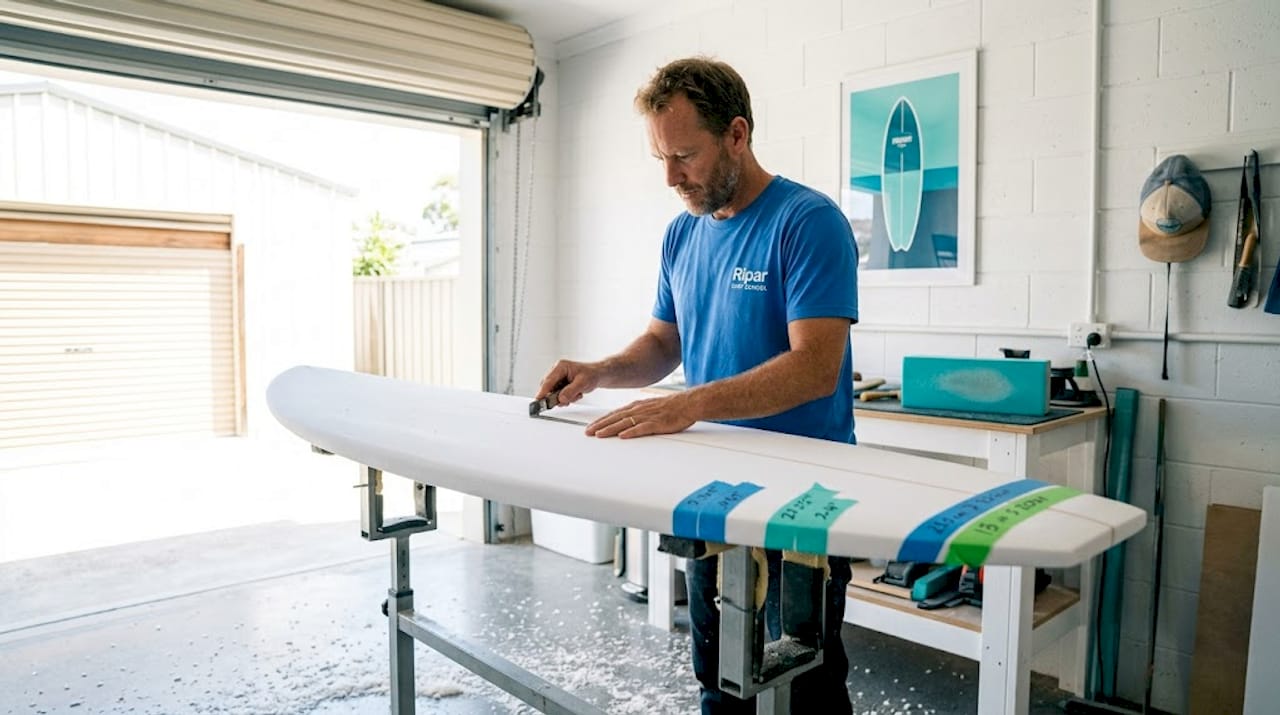
I’ve seen surfers blame rocker for problems that had nothing to do with their board. A student pearling on every drop blames too little nose rocker. In reality, technique interacts with rocker directly, and poor weight distribution on the takeoff will cause pearling even on a board with plenty of nose lift. Rocker works best when your technique meets it halfway.
What I’ve found after working with surfers at all levels is that most board issues trace back to a mismatch between tail rocker and wave type. A surfer on a high-performance board with aggressive tail rocker at a weak beach break will fight for every turn because the wave doesn’t give enough power to drive through that pivot. Switch them to a flatter tail rocker and their surfing opens up immediately.
Diagnosing surfboard feel issues requires looking beyond overall rocker to nose and tail rocker individually. The two sections interact differently with the wave at different points in the ride. That nuance is what separates a surfer who understands their equipment from one who just guesses.
My advice: resist the urge to chase extreme rocker in either direction. A common misconception equates rocker directly with speed or turning alone, but it’s a trade-off that requires balance. Medium rocker with correct technique beats any extreme profile with sloppy fundamentals. Learn the feeling first, then dial in the details.
— Fernando
Try different rockers at Riparsurfschool in Portugal
Understanding rocker in theory is one thing. Feeling it under your feet on a real wave is something else entirely. At Riparsurfschool, based at Praia Areia Branca near Peniche and Ericeira, you get access to a range of boards with different rocker profiles and certified instructors who can help you understand why each one feels the way it does.

Whether you’re working through takeoff problems or trying to unlock tighter turns, a private surf lesson gives you focused time with an instructor who can pair you with the right board for the conditions that day. You can also book surf lessons online to reserve your spot at one of Portugal’s best surf locations. The waves at Areia Branca offer a natural testing ground for understanding exactly how rocker changes your ride.
FAQ
What is surfboard rocker in simple terms?
Surfboard rocker is the curve of the board from nose to tail when viewed from the side. More curve means more control and maneuverability; less curve means more speed and easier paddling.
Does more rocker make a board faster or slower?
More rocker generally reduces speed and paddle efficiency because less of the board contacts the wave surface. Flatter rocker increases glide and speed but reduces control in steep conditions.
What is the difference between nose rocker and tail rocker?
Nose rocker controls how the board handles steep drop-ins and prevents pearling. Tail rocker controls how the board pivots and releases through turns.
What type of rocker is best for beginners?
Beginners benefit most from flatter or medium rocker profiles because they make paddling easier and improve wave-catching in smaller, weaker surf.
What is continuous rocker vs staged rocker?
Continuous rocker is a smooth arc from nose to tail, best for powerful and hollow waves. Staged rocker has a flatter center section, which improves planing speed and paddling in smaller surf.
Recommended
Comments