

How to Navigate Surf Towns Like a Local
- Fernando Antunes

- 7 hours ago
- 9 min read

TL;DR:
Understanding a surf town’s layout is essential for efficient navigation and choosing the right transport mode. Using offline maps, surf forecast apps, and local forums helps you plan effectively in areas with unreliable cell service or remote locations. Staying near a main surf break simplifies access, reduces stress, and enhances your overall surf experience.
Surf towns look simple on a map until you actually arrive. Parking lots fill up before sunrise, unmarked beach paths lead nowhere, and the best breaks sit a mile past where your GPS gives up. Knowing how to navigate surf towns makes the difference between spending your morning stuck in traffic and paddling out by 7 a.m. with the right crowd. This guide covers town layouts, transport options, digital tools, parking tactics, surf etiquette, and pre-trip prep so you arrive ready to read the town as well as the waves.
Table of Contents
Key Takeaways
Point | Details |
Know your town’s layout first | Identify whether it’s a walkable hub or a spread-out linear coast to choose the right transport. |
Use offline maps as backup | Download maps before arrival since cell reception in many surf towns is unreliable. |
Treat parking as surf planning | Factor in arrival time, overflow walking, and app tools before you leave your lodging. |
Respect local surf etiquette | Right-of-way rules and local hierarchy are non-negotiable in crowded lineups. |
Stay near a surf hub | Lodging close to the main break or transit node cuts daily navigation stress dramatically. |
How to navigate surf towns starts with reading the layout
Before you book anything, you need to understand how the town is physically structured. Surf towns fall into two broad types: hub-and-spoke layouts where a central area connects to multiple breaks, and linear coast strings where small beach clusters run along a single road. That distinction changes everything about your transport plan.
Encinitas, California, is the textbook hub town. Moonlight State Beach and Coast Highway 101 form an accessible, walkable core where you can grab coffee, rent a board, and hit the sand without a car. That kind of layout rewards staying close to the center and walking everywhere.
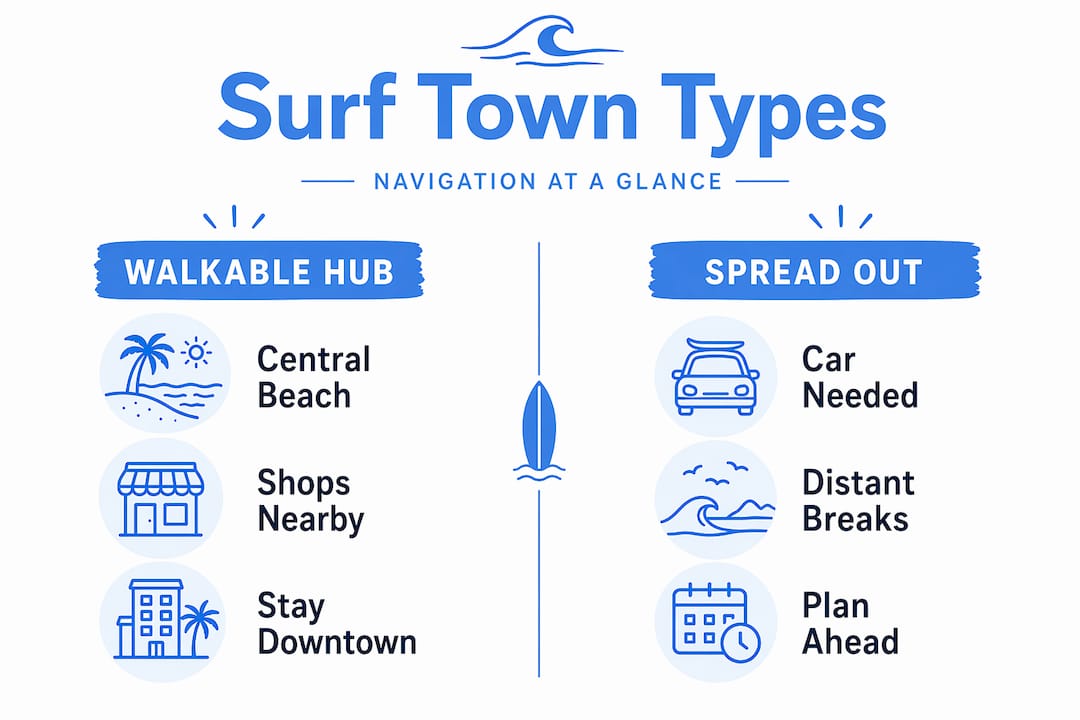
Providenciales in the Turks and Caicos is the opposite. Its spread-out geography makes car rental necessary; taxis cost more than expected and rideshares disappear after dark. Driving on the left is required, and planning your evening transport before you need it is the kind of detail that separates a smooth trip from a frustrating one.
Then there is Nazaré in Portugal. It blends both structures: a compact lower town near the beach, a clifftop Sítio area with dramatic viewpoints, and a funicular connecting both levels quickly for those who do not want to hike. Knowing about that funicular before you arrive saves 20 minutes and a lot of sweat.
Pro Tip: Research your target town’s layout using Google Maps satellite view before you travel. Zoom out enough to see how the breaks, parking areas, and main streets relate to each other. It takes five minutes and gives you a mental model that GPS alone cannot provide.
Your transport choice flows directly from the layout. Walkable hub towns reward centrally located lodging. Spread-out linear towns require a rental car or scooter. Somewhere in between, like Portugal’s surf-friendly villages, often offer a mix of both.
Digital and physical tools that actually help
The navigation tools that work best in surf towns are not always the ones you use at home. Urban apps assume reliable cell service and consistent street grids. Surf towns often have neither.
Here is what actually belongs in your toolkit:
Offline maps: Apps like Maps.me or Google Maps with downloaded regions are non-negotiable. Printed maps remain essential in remote areas like the Oregon coast where mobile reception drops out on the roads closest to the water.
Surf forecast apps: Surfline, Magic Seaweed, and Windguru tell you which break to target, but they also help you time your arrival. Checking conditions the night before lets you pick the right beach and leave at the right moment.
Parking apps: Malibu’s Surfrider Beach uses a live parking app showing real-time availability, which sounds like a luxury until you realize that arriving after 7 a.m. on a weekend commonly means zero spaces. Matching your drive time to app data eliminates the maddening loop of searching for a spot while the tide drops.
Local Facebook groups and forums: These hold the information that no app publishes: which lot is closed, when the shuttle runs, where the unmarked path to the reef break begins.
Tool | Best use | Works offline? |
Google Maps (downloaded) | General navigation and routing | Yes |
Surfline / Magic Seaweed | Conditions and break selection | No |
Malibu parking app | Real-time lot availability | No |
Detailed local maps in remote areas | Yes | |
WhatsApp local groups | Insider tips and real-time updates | No |
Pro Tip: Download offline maps for a 30-mile radius around your surf town the night before you leave. Storage is cheap. Driving blind on a cliffside road because your signal dropped is not a problem you want to solve in the moment.
Getting to the break on busy days
Peak surf days are logistical tests. Big-wave events, holiday weekends, and a well-timed swell forecast can flood a small town’s parking infrastructure before most visitors have finished breakfast.
Here is a step-by-step approach that works regardless of the town:
Check conditions the evening before. Decide which break you are targeting and what time the tide supports it. Committing to a plan the night before removes decision lag in the morning.
Arrive early, and mean it. In Nazaré on XXL swell days, controlled-access parking fills quickly and overflow lots require a genuine walk. Carry water, wear real shoes, and do not expect to park close to the sand.
Identify overflow parking in advance. Look at satellite maps to find secondary lots, church parking areas, and roadside strips that locals know. Mark them before you leave lodging.
Use funiculars and shuttles where available. Nazaré’s funicular is not just a tourist attraction. It is a practical transport link that saves a steep uphill walk when you are carrying a board and a wetsuit bag.
Walk the connections. In compact towns, the best strategy is often to park once at the edge of town and walk between breaks, cafes, and gear shops on foot. You see more, spend less time moving the car, and arrive at the water far less stressed.
Plan your exit. Leaving at the same time as every other surfer after a morning session creates the same gridlock as the arrival. Staying for a post-surf lunch or coffee at a local spot lets the worst of the traffic clear.
“Navigation in a surf town is not just about getting to the water. It is about everything you do between waking up and paddling out.” This mindset shift treats parking, walking, and timing as part of the session itself.
For surfboard rental logistics on days when you are moving between spots, keep your rental shop’s location in your offline map so you are not hunting for it after a session when you are tired.
Surf etiquette and cultural navigation

Physical navigation gets you to the water. Social navigation determines what happens when you get there. These are not soft skills. In many surf towns, getting them wrong results in real conflict.
The core rules of surf etiquette hold across virtually every break in the world:
Right of way: The surfer closest to the peak has priority. Dropping in on someone already riding a wave is the most common source of lineup conflict.
No snaking: Paddling around someone to cut in front of them in the priority queue is disrespectful and widely recognized as a violation of lineup norms.
Communicate: A simple call of “left” or “right” when taking off tells others where you are going and prevents collisions.
Observe before paddling out. At unfamiliar breaks, sit on the beach for ten minutes first. Identify the peak, the channel, and where most surfers are sitting before you enter the water.
Respect local hierarchy. At breaks in Hawaii, for example, giving priority to locals and elders is not optional. It is an embedded part of the culture that visitors who ignore often regret.
“The best surfers in the water are not always the most talented. They are the ones who know when to go and when to wait.” Understanding that principle makes you a better guest in any surf community.
Environmental respect belongs in this category too. Never leave gear, wax wrappers, or single-use plastics on the beach. In small surf towns, the sand is the community’s living room.
For a deeper read on how local surf culture shapes how you should behave at the break and around town, understanding the unwritten rules pays off every time.
Preparing before you arrive
Preparation done a few days before departure saves hours of frustration once you land. This is where most travelers skip steps they later wish they had not.
The pre-trip checklist that actually matters:
Download offline maps for the town and surrounding coast, including parking areas and beach access points.
Check transport options specific to your town. Is there a local bus? A bike rental near your lodging? A shuttle service that runs on weekends?
Book lodging near a surf hub. Staying five minutes from the main break changes your daily experience entirely. Surf accommodation choices near key breaks cut out the daily commute that grinds down your energy.
Identify your backup breaks. When your primary spot is crowded or closed, having a second option mapped and researched means you spend ten seconds rerouting instead of thirty minutes searching.
Connect with locals early. Your surf instructor, lodging host, or a local shop owner will tell you things no guidebook includes: which lot the rangers skip on busy days, which path the experienced surfers use, which break has rip currents nobody posted about online.
Pro Tip: Email or message your lodging host before you arrive and ask one specific question: “Where do most surfers park on a busy weekend morning?” The answer you get will be more useful than anything on a travel blog.
Packing a small printed map of the town alongside your charged devices costs nothing and has saved more than a few sessions when phones died or signals dropped.
My honest take after years in surf towns
I have wasted more mornings than I care to count in surf towns that I should have understood better before arriving. Parking circles that cost me the best hour of tide. Breaks I did not know existed because I never asked. Conflicts in lineups that came from not reading the room.
The lesson I keep relearning is that lodging choice is the single highest-leverage decision you make. When I stay within walking distance of the break I care about, everything else becomes simpler. I do not need to solve the parking problem. I do not need to rush. I can check the conditions from the front step and decide whether to go now or wait an hour.
The second thing I have learned is that surf towns reward patience and curiosity in equal measure. Showing up early, watching the lineup before paddling out, talking to the person renting boards or pulling espresso shots at the local cafe. Those conversations have given me more useful navigation information than any app I have downloaded.
And about etiquette: the times I have gotten it wrong in crowded breaks were the times I was in a hurry. Rushing produces bad decisions in the water and on the road. The towns that felt the best were the ones where I slowed down and paid attention. That is not advice you can put in an app, but it is the truest thing I know about surf travel.
— Fernando
Make your surf town trip smoother with Riparsurfschool
If you are heading to Portugal’s coast, Riparsurfschool takes the navigation guesswork out of your trip entirely. Based at Praia Areia Branca near Peniche and Ericeira, the team of local certified instructors knows every break, every back road, and every parking workaround in the region.
Whether you want a group surf lesson with others at your level or a private surf lesson tailored to your goals, the instructors share the local knowledge that turns a confusing surf town into familiar territory. You can also stay at the Surf House Portugal, located steps from the water, so your commute to the break is a two-minute walk. Book your lessons online and arrive knowing the town is already handled.
FAQ
What is the best way to get around a surf town?
The best approach depends on the town’s layout. Compact, walkable towns like Encinitas reward staying central and going on foot, while spread-out destinations like Providenciales require a rental car since rideshares are often unavailable.
How do I find parking at busy surf spots?
Arrive early, use real-time parking apps where available (Malibu’s Surfrider Beach has one), and identify overflow lots using satellite maps before you leave your lodging. Plan to walk further on peak swell days.
Do I need offline maps for surf towns?
Yes. Cell reception near beaches in remote areas like the Oregon coast can drop entirely, and printed or downloaded offline maps prevent you from losing your route at the worst moment.
What surf etiquette rules should visitors know?
The surfer closest to the peak has right of way, dropping in on someone is never acceptable, and at many breaks especially in Hawaii, locals and experienced regulars hold priority in the lineup.
How does staying near the surf break improve navigation?
Lodging within walking distance of your main break eliminates parking challenges, lets you time sessions around tides without rushing, and gives you direct access to local knowledge from hosts and nearby surf shops.
Recommended
Comments