

Tidal Patterns in Surfing: Your 2026 Wave Guide


TL;DR:
Tides influence surf conditions by changing water depth and currents at every break type. Surfers who understand tide patterns catch more waves, ride better ones, and stay safer. Local knowledge combined with tide data improves surf session planning significantly.
Tidal patterns control wave size, shape, and surf conditions by changing water depth and currents at every break. The role of tidal patterns in surfing is not decorative knowledge. It is the difference between catching clean, powerful waves and paddling out into a flat, mushy mess. Spring tides, neap tides, beach breaks, reef breaks, and the Rule of Twelfths all factor into when and where you surf. Surfers who read tides correctly get more waves, ride better ones, and stay safer in the water.
How do tidal patterns in surfing affect different break types?
Tide stage is the single biggest variable you can predict before leaving home. High tide, low tide, and mid-tide each produce a different wave character, and the effect changes dramatically depending on whether you are surfing a beach break, reef break, or point break.
High tide
High tide floods the beach with deeper water. At beach breaks, that depth softens the wave’s energy as it hits the sandbar, producing slower, mushier waves that are harder to generate speed on. For beginners, this can actually be a forgiving window. For experienced surfers chasing hollow barrels, high tide at a beach break is usually a disappointment.

Reef and point breaks behave differently. Reef breaks like Pipeline are most rideable at higher tide levels because the water covers dangerous seafloor features. Surfing a reef at extreme low tide exposes rock shelves and coral heads that can cause serious injury. Higher tide at reef breaks adds a safety buffer without killing wave quality the way it does at beach breaks.
Low tide
Low tide exposes sandbars and reef shelves, creating faster, hollower, and more powerful waves. The wave has less water to travel through before it hits the shallow bottom, so it pitches quickly. That speed and hollow shape is what advanced surfers chase. The tradeoff is risk. Wipeouts at low tide over reef or rock are far more dangerous than at high tide.
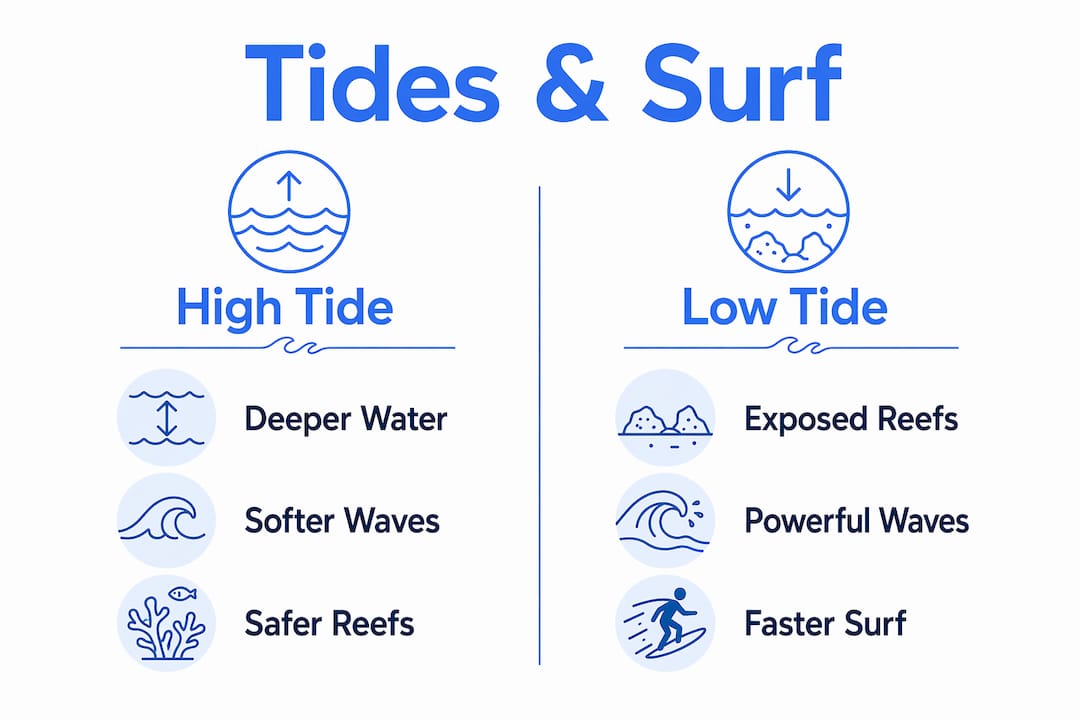
At beach breaks, low tide often makes waves too shallow and fast for most surfers to ride comfortably. The wave closes out quickly rather than offering a rideable face.
Mid-tide
Mid-tide on an incoming tide is the sweet spot for most beach breaks. The water depth over sandbars is balanced. Waves have enough push to break cleanly without becoming too fast or too mushy. Most experienced surfers plan their beach break sessions around this window.
Pro Tip: Check whether your local break is a beach, reef, or point break before reading a tide chart. The same tide level produces completely different results at each break type.
How do spring and neap tides shape your surf window?
Tidal cycles are driven by the gravitational pull of the moon and sun. The two main cycle types, spring tides and neap tides, create very different surfing conditions and session windows.
Spring tides occur around the full and new moon and produce the largest tidal ranges, meaning the highest highs and the lowest lows. The water moves faster between these extremes. That rapid movement shortens the window of ideal tide conditions at any given break. You might have 45 minutes of perfect mid-tide before the water drops too low or rises too high.
Neap tides happen roughly a week after spring tides, when the moon is at a quarter phase. The tidal range is smaller, water moves more slowly, and conditions stay consistent for longer. Neap tide weeks are often the most forgiving for planning surf sessions because the ideal tide window stretches out.
Spring tides also amplify currents, making conditions less predictable. They can expose new surf spots or uncover hazards that are normally submerged. Surfers need to adapt quickly during spring tide periods.
The Rule of Twelfths
The Rule of Twelfths is a simple method for estimating how fast the tide is rising or falling at any point in a six-hour tidal cycle. The tide does not move at a constant rate. It moves slowly at the start and end of the cycle and fastest in the middle.
In the 1st hour of the cycle, the tide changes by 1/12 of its total range.
In the 2nd hour, it changes by 2/12.
In the 3rd hour, it changes by 3/12.
In the 4th hour, it changes by 3/12.
In the 5th hour, it changes by 2/12.
In the 6th hour, it changes by 1/12.
This matters for surf planning because the fastest tidal movement, hours 3 and 4, is when conditions shift most quickly. If you paddle out at the start of hour 3 at a beach break, you may find the tide has moved significantly by the time you are warmed up.
Tidal cycle type | Tidal range | Water movement speed | Ideal surf window length |
Spring tide | Large | Fast | Short and sharp |
Neap tide | Small | Slow | Long and consistent |
How do tidal currents and underwater topography change waves?
Tides do not just change water depth. They move water horizontally and interact with the seafloor in ways that reshape every wave you ride.
Backwash and the beach step
High tide increases backwash because waves break on the steeper upper section of the beach face. The reflected energy surges back out to sea, colliding with incoming waves and creating chaotic, surging conditions. This is not just uncomfortable. It actively disrupts wave shape and makes paddling out harder.
The beach step is a submerged ledge formed by the backwash action of high-tide waves. Understanding the beach step at your local break is key for safe paddling and timing your pop-up. The step changes position depending on the tidal cycle phase, so what worked last Tuesday may not apply this Saturday.
“Local topography creates micro-climates at surf breaks that alter ideal tide timing in ways no tide chart can fully predict. Surfers who learn their break’s unique tidal reactions gain a real edge over those who rely on charts alone.”
Incoming versus outgoing tide
Tide direction has a subtle but real effect on wave energy. Incoming tides push water toward shore, adding energy to waves at beach breaks. Outgoing tides pull water away from shore, which can flatten wave energy and make the surf feel less lively. The difference is not dramatic, but over a two-hour session it is noticeable.
At point breaks and reef breaks, the direction of tidal flow can also affect the lateral current along the break. An incoming tide at a right-hand point break may strengthen the current running down the point, making it easier to stay in position after a ride.
Pro Tip: Pair an incoming tide with offshore winds for the best wave energy combination. Offshore winds hold the wave face open while the incoming tide adds push from below.
Incoming tide adds wave energy at beach breaks.
Outgoing tide can flatten and soften wave quality.
Backwash increases at high tide due to steeper beach slope contact.
Beach steps shift position with each tidal cycle.
Local topography determines how strongly each of these effects shows up at your specific break.
What are the best practices for using tides to plan surf sessions?
Reading a tide chart is a skill. Using it well requires combining that chart with swell data, wind direction, and direct observation of your local break.
Tide charts provide precise timing for high and low water, and combining them with wind and swell forecasts helps you identify the best windows in a given day. A tide chart alone tells you when the water will be at a certain level. It does not tell you whether the swell will be clean or the wind will be blowing onshore.
Surfers who combine tide knowledge with local topographical observation and wind direction consistently find better waves than those who rely on charts alone. Spend several sessions at the same break across different tide stages. Note what the wave does at each stage. That local knowledge becomes more valuable than any app.
Check the tide chart the night before and identify the mid-tide window on an incoming tide.
Cross-reference with a swell forecast to confirm wave height and period.
Check wind direction. Offshore winds are ideal. Onshore winds ruin wave shape regardless of tide.
Avoid reef breaks at extreme low tide unless you know the break well and the conditions are safe.
Arrive early during spring tide periods because the ideal window closes faster.
Pro Tip: Visit your local surf break at low tide when the water is out. You can see the sandbars, reef shelves, and channels that are invisible at high tide. That visual map will change how you read the break forever.
Safety is non-negotiable. Exposed reef at low tide is one of the most common causes of serious surf injuries. If you are not certain about the depth at a reef or rock break, surf it at a higher tide until you know the bottom well. The role of oceanography in surfing extends beyond tides, but tidal awareness is the foundation of safe session planning.
Key Takeaways
Tidal patterns determine wave quality, session timing, and safety at every surf break, making tide literacy a core skill for any surfer.
Point | Details |
Mid-tide on incoming tide | Most beach breaks perform best at this stage, balancing depth and wave energy. |
Spring vs. neap tides | Spring tides create shorter, sharper surf windows; neap tides offer longer, more consistent conditions. |
Reef break safety | Reef and point breaks require higher tide to cover hazardous seafloor features safely. |
Backwash and beach steps | High tide increases backwash and shifts beach step position, affecting paddling and wave shape. |
Combine charts with observation | Tide charts gain real value when paired with local break knowledge, swell data, and wind direction. |
What tides have actually taught me about surfing
Most surfers treat tide charts like a weather app. They glance at the number, decide it looks okay, and paddle out. That approach costs them good waves every single session.
The thing I have noticed over years of surfing and teaching at Praia Areia Branca is that the surfers who improve fastest are the ones who start treating the tide as a conversation partner. They show up at the same break across different tidal stages and actually watch what happens. They notice that the left-hander near the rocks goes flat at high tide but throws a clean barrel at mid-tide on the push. They figure out that the beach step at their local spot shifts about 10 meters down the beach during spring tide weeks.
The biggest misconception I see is that high tide is always safer and low tide is always better for waves. Neither is universally true. A beach break at high tide can be completely unrideable. A reef break at low tide can be genuinely dangerous. The correct answer always depends on the specific break, the swell direction, and the tidal range that week.
What changed my own surfing was learning to read the incoming tide as a source of energy, not just a water level. Pairing that incoming push with offshore winds is a combination that consistently produces the cleanest, most powerful waves. Standard tide charts do not tell you that. Local experience does.
If you want to accelerate that learning curve, surf with instructors who know the local breaks across all tide stages. That knowledge transfer is worth more than any app.
— Fernando
Surf smarter with Riparsurfschool at Praia Areia Branca
Riparsurfschool has been teaching surfers how to read the ocean at Praia Areia Branca since 2001. The instructors here know the local breaks across every tide stage, swell direction, and wind condition. That local knowledge is built into every lesson.

Whether you are booking a private surf lesson to work on tide-aware wave selection or joining a group surf lesson to learn alongside other surfers, the Riparsurfschool team applies real-time tidal knowledge to every session. Portugal’s Atlantic coast delivers consistent swell year-round, and the instructors here know exactly when to be in the water. Book your surf lessons and start surfing with the tide working for you, not against you.
FAQ
What is the best tide for surfing at a beach break?
Mid-tide on an incoming tide is best for most beach breaks. It balances water depth over sandbars, producing clean waves that are neither too fast nor too mushy.
Are reef breaks safer at high or low tide?
Reef breaks are safer at higher tide because the water covers dangerous seafloor features. Extreme low tide exposes rock and coral that can cause serious injury during wipeouts.
What is the difference between spring and neap tides for surfing?
Spring tides produce larger tidal ranges and faster water movement, creating shorter surf windows. Neap tides have smaller ranges and slower movement, giving surfers longer windows of consistent conditions.
Why does backwash increase at high tide?
High tide causes waves to break on the steeper upper beach face, reflecting energy back out to sea as backwash. This creates chaotic conditions and shifts the position of the submerged beach step.
How do I use a tide chart to plan a surf session?
Check the tide chart for mid-tide timing on an incoming tide, then cross-reference with a swell forecast and wind direction. Combining tide charts with local observation and wind data consistently produces better session timing than using charts alone.
Recommended
Comments