

The Role of Weather in Surfing: What You Need to Know

TL;DR:
Weather determines surf quality more than wave height or size. Wind direction, swell period, and climate cycles are the key factors for optimal conditions. Planning based on real-time weather windows results in better surf experiences than relying solely on destination reputation.
Weather is the single most powerful force shaping every surf session you will ever paddle into. The role of weather in surfing extends far beyond whether it rains on the beach. Wind direction, swell period, climate cycles, and daily thermal patterns collectively determine whether you ride clean, powerful waves or fight through choppy, disorganized mess. Understanding these forces is not optional for serious surfers. It is the difference between a session you remember and one you wish you had skipped.
How do wind patterns influence wave quality and surf conditions?
Wind is the most immediate weather factor affecting surf quality. The direction it blows relative to the shore determines whether waves are rideable or ruined before they even reach you.
Offshore wind blows from land toward the ocean. It holds wave faces open, creating clean, organized, and steep walls that are far easier to ride. Offshore wind under 10 knots produces the ideal conditions most surfers chase. That 10-knot threshold matters because beyond it, spray becomes a problem and paddling into waves gets harder.
Onshore wind blows from the ocean toward land. Even at moderate speeds of 8–10 knots, onshore wind collapses wave lips and creates surface chop that makes waves unpredictable and difficult to read. The wave face closes out faster, reducing your ride time and increasing wipeout risk.
Here is a quick breakdown of wind conditions and what they mean for your session:
Offshore, under 10 knots: Clean, glassy faces. Best conditions for all skill levels.
Offshore, 15–20 knots: Spray and difficult paddling, but waves stay organized.
Cross-shore: Mixed quality. Some breaks handle it better than others.
Onshore, 8–10 knots: Choppy surface, collapsing lips, degraded wave shape.
Onshore, 15+ knots: Messy, disorganized surf. Not recommended for beginners.
One factor most surfers overlook is the daily thermal cycle. Land heats faster than the ocean during the day. That temperature difference creates predictable wind shifts that favor offshore conditions in the early morning and onshore conditions by midday. This is the scientific reason dawn patrol consistently delivers cleaner surf than afternoon sessions.
Pro Tip: Check local headlands and cliffs near your target break. Geographic features can create wind shadows that shelter a specific break from regional onshore winds, giving you offshore-quality conditions even when the forecast looks unfavorable.
What does wave period reveal about swell power and surf quality?
Swell period is the number of seconds between each passing wave. It is a more reliable indicator of surf quality than wave height alone.
Short-period swells of 6–9 seconds are generated by nearby winds. They carry less energy, arrive in disorganized sets, and produce choppy, weak waves that break inconsistently. Long-period swells of 12–16 seconds originate from distant storms, sometimes thousands of miles away. They carry far more energy, travel in organized lines, and produce powerful, well-defined waves with steep, clean faces.
Swell type | Period | Wave character | Best for |
Local wind swell | 6–9 seconds | Weak, choppy, inconsistent | Beginners on forgiving boards |
Mid-range swell | 10–12 seconds | Moderate power, improving shape | Intermediate surfers |
Ground swell | 12–16 seconds | Powerful, clean, well-organized | Experienced surfers |
Long-period ground swell | 16+ seconds | Heavy, fast, demanding | Advanced and expert surfers |
Period also affects your board choice. A long-period swell breaks with more force and speed, so a shorter, more responsive board lets you react quickly. A short-period swell rewards volume and paddle power, making a longer board the smarter pick.
Period and wind direction are more critical than wave height when assessing surf quality. Two sessions with identical wave heights can feel completely different if one runs on a 7-second wind swell and the other on a 14-second ground swell. Combining period data with swell direction and tide timing gives you a far more accurate picture of what to expect at the water.
How do El Niño and La Niña affect regional surf conditions?
Large-scale climate cycles reshape surf seasons across entire ocean basins. The El Niño Southern Oscillation, known as ENSO, is the most significant of these cycles for surfers worldwide.
ENSO cycles occur roughly every five years and produce dramatically different surf outcomes depending on phase. El Niño brings warmer Pacific water temperatures and stronger, more frequent winter swells across the North Pacific. California and Hawaii typically see larger, more powerful surf during El Niño winters. Indonesia and Australia often experience reduced swell size and disrupted trade winds during the same period.
La Niña flips the script. It strengthens trade winds, cools equatorial Pacific waters, and generally produces smaller but cleaner, more consistent surf in regions like Indonesia, Fiji, and the South Pacific. For surfers who prioritize wave quality over raw size, La Niña seasons in these regions can be exceptional.
Key regional effects of ENSO cycles:
California: El Niño delivers bigger, more powerful winter swells. La Niña years tend toward smaller, cleaner surf.
Hawaii: El Niño amplifies North Shore swell frequency and size during winter months.
Indonesia: La Niña strengthens trade winds and improves wave consistency at breaks like Uluwatu and G-Land.
Australia: El Niño often brings drought conditions and reduced swell activity on the east coast.
The complication is that ENSO events show increased variability due to climate change. Historical patterns that surfers once relied on for trip planning are becoming less predictable. The 2015 “Godzilla El Niño” produced anomalous surf across multiple regions that defied standard forecasts. Climate scientists now advise surfers to treat ENSO forecasts as directional guidance rather than guaranteed outcomes.
The practical implication for surf travel planning is significant. Experienced travelers now follow real-time swell and weather windows rather than booking trips based solely on destination reputation or historical season data. A well-timed trip during a La Niña window to the Mentawai Islands will outperform a poorly timed El Niño trip to the same spot every time.
How can surfers read weather forecasts to plan better sessions?
Reading a surf forecast well requires a specific order of priority. Most surfers make the mistake of checking wave height first. Wave height is actually the least informative number on the forecast page.
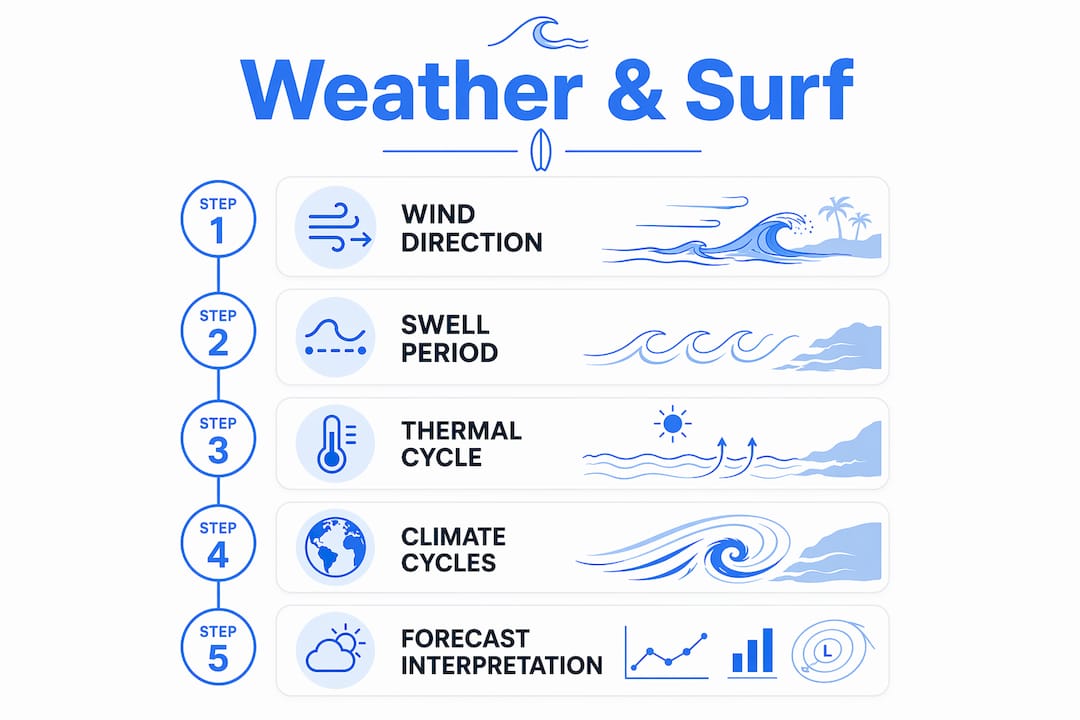
The correct sequence for reading surf conditions is:
Wind forecast first. Check direction and speed. Offshore under 10 knots is your green light. Onshore at any significant speed is a yellow or red flag depending on the break.
Swell period second. A 12-second or longer period signals organized, powerful surf. Anything under 9 seconds suggests weak, choppy conditions regardless of height.
Swell direction third. Match the swell direction to your break’s orientation. A south-facing break needs a south swell to work. A north swell hitting a south-facing beach produces flat, confused water.
Tide timing fourth. Most beach breaks perform best at mid tide. Reef breaks often need a specific tide window to avoid either closing out or going flat. Check local knowledge or a surf forecasting guide for your target spot.
Wave height last. Once the other factors check out, height tells you whether the session will be mellow or demanding.
Daily wind cycles give you a reliable planning tool even without a detailed forecast. The thermal pattern that creates offshore mornings and onshore afternoons is consistent across most coastal regions worldwide. If you can only surf once, surf at dawn.
Pro Tip: When regional wind forecasts show onshore conditions, search for breaks with natural wind protection before giving up on the day. A headland, cliff, or bay can flip a blown-out session into a clean one at a sheltered break just a few miles away.
For surf conditions in Portugal, the Atlantic swell window combined with the north wind patterns around Peniche and Ericeira creates some of the most consistent surf in Europe. Knowing which breaks favor north winds versus south winds at these spots is the kind of local knowledge that separates a great session from a wasted drive.
Key Takeaways
Wind direction, swell period, and climate cycles are the three weather variables that determine surf quality, safety, and the success of any surf trip.
Point | Details |
Offshore wind is essential | Offshore wind under 10 knots creates clean wave faces; onshore wind degrades quality at any significant speed. |
Swell period beats wave height | A 12–16 second swell delivers more power and organization than a taller 6–9 second wind swell. |
ENSO cycles reshape seasons | El Niño and La Niña shift swell frequency, size, and wind patterns across entire ocean basins every five years. |
Read forecasts in the right order | Check wind first, then period, direction, tide, and height last for accurate session planning. |
Dawn patrol wins consistently | Thermal land-sea cycles create offshore winds in the morning and onshore winds by midday, making early sessions reliably cleaner. |
Why I stopped trusting destination reputations and started chasing weather windows
After years of surfing and teaching at Praia Areia Branca near Peniche, I have watched countless surfers arrive with fixed plans and leave disappointed. They booked a week in Bali in july because a friend said it was perfect. They flew to Portugal in august expecting pumping Atlantic swells. Both trips can work. But both can also fail completely if the weather does not cooperate.
The shift that changed my surfing and my travel was simple. I stopped booking trips around destinations and started booking around weather windows. When a strong North Atlantic low-pressure system is tracking toward the Portuguese coast with a 14-second swell and north winds forecast, that is when I want to be at Supertubos or Ribeira d’Ilhas. Not because it is october. Because the conditions are right.
The same logic applies to wetsuit choice. Surfers routinely underpack for cold water because they trust the month rather than the actual sea surface temperature. NOAA sea surface temperature data by destination and month is freely available and takes five minutes to check. A 4/3mm wetsuit at 16°C water extends your session by an hour compared to a 3/2mm. That is not a minor comfort issue. It is a safety margin.
The other mistake I see constantly is over-relying on apps without understanding the underlying data. Surfline and Magicseaweed give you numbers. But a 6-foot forecast at 8 seconds is a completely different ocean than a 6-foot forecast at 15 seconds. Until you internalize that difference, the numbers are just noise. Learn to read the forecast the way I described above, and you will make better decisions than most surfers at any break in the world.
— Fernando
Learn to read surf conditions with Riparsurfschool

Riparsurfschool has been teaching surfers at Praia Areia Branca, near Peniche and Ericeira, since 2001. Every lesson includes real-time surf condition education. You learn to read wind, swell, and tide data before you ever paddle out. That knowledge stays with you long after the lesson ends. Whether you prefer a group surf lesson with other surfers or a private surf lesson focused entirely on your progression, Riparsurfschool’s certified local instructors bring the kind of location-specific weather knowledge that no app can replace. Check the Portugal surf season guide to find your ideal window, then book your surf lessons online and get in the water.
FAQ
What is the best wind direction for surfing?
Offshore wind is the best wind direction for surfing. It blows from land toward the ocean, holding wave faces open and creating clean, organized surf conditions.
How does swell period affect wave quality?
Longer swell periods of 12–16 seconds produce more powerful, well-organized waves from distant storms. Short periods of 6–9 seconds indicate weaker, choppier waves generated by nearby winds.
How do El Niño and La Niña affect surf conditions?
El Niño typically brings stronger, more frequent swells to the North Pacific, while La Niña produces smaller, cleaner waves with stronger trade winds in regions like Indonesia and the South Pacific.
Why is dawn patrol better for surfing?
Thermal land-sea cycles create offshore winds in the early morning before land heats up. By midday, the land warms faster than the ocean and reverses the wind to onshore, degrading wave quality.
Does wave height matter more than swell period?
Wave height is the least informative forecast number. Swell period and wind direction are more reliable indicators of actual surf quality, since a tall wave on a short period can be weaker and choppier than a smaller wave on a long period.
Recommended
Comments