

The Role of Oceanography in Surfing: A 2026 Guide
- Fernando Antunes

- Jun 23
- 9 min read

TL;DR:
Oceanography explains how wind, currents, and seafloor topography shape surf conditions and wave formation. It shows that ocean currents and tides significantly influence wave size, shape, and break locations, affecting surf quality and safety. Accurate forecasting incorporates wave-current interactions and tide data to help surfers choose optimal times and spots.
Oceanography is the science that determines whether you paddle out to perfect waves or flat, choppy disappointment. The role of oceanography in surfing covers everything from how storms generate swell thousands of kilometers away to how a reef or sandbar shapes that swell into a rideable wave. Wind, ocean currents, tides, and seafloor topography all interact to produce the surf conditions you experience at the beach. Research from institutions like the University of Rhode Island, Annual Reviews, and EGUsphere has sharpened our understanding of these interactions significantly in 2026. Knowing this science does not just satisfy curiosity. It makes you a smarter, safer surfer.
How does oceanography shape surf conditions and wave formation?
Oceanography explains surf by connecting wind energy to the waves you ride. Wind-forced wave growth produces a directional wave spectrum that travels as organized swell across ocean basins. Wave fields span from tiny capillary waves under 1 cm to gravity waves with wavelengths of 200–1,200 meters. That range matters because only the longer, more organized gravity waves carry the energy needed to produce surfable breaks.
Storm systems far out at sea generate swell that can propagate thousands of kilometers before reaching a coastline. As waves travel, shorter wind chop dissipates and longer period swell survives. By the time a North Atlantic storm swell reaches Portugal’s coast near Peniche, it has organized into clean, powerful lines. That is why surfers at spots like Supertubos can score world-class waves from storms that formed days earlier near Iceland.
Reading wave period and direction
Wave period is the time in seconds between two successive wave crests. A longer period means more energy per wave and a deeper water column affected by that energy. Wave buoys convert sea surface motion into energy spectra, separating swell from wind chop using 30-minute data segments processed through Fast Fourier Transform (FFT). Surf forecasting platforms like Surfline and Magicseaweed pull directly from this buoy data to show dominant period and direction.
Key factors to check in any surf forecast:
Swell period: 14 seconds or more signals powerful, organized swell. Under 8 seconds is usually wind chop.
Swell direction: The angle of arrival determines how a specific break responds. A beach facing northwest fires on northwest swell.
Swell height: Significant wave height from buoys is an average of the highest third of waves, not the maximum.
Wind direction: Offshore winds (blowing from land to sea) groom wave faces. Onshore winds create chop.
Pro Tip: When reading a forecast, prioritize period and direction over raw wave height. A 1.5-meter swell at 16 seconds will produce far better surf than a 2-meter swell at 7 seconds.
How do ocean currents and tides influence surf conditions?
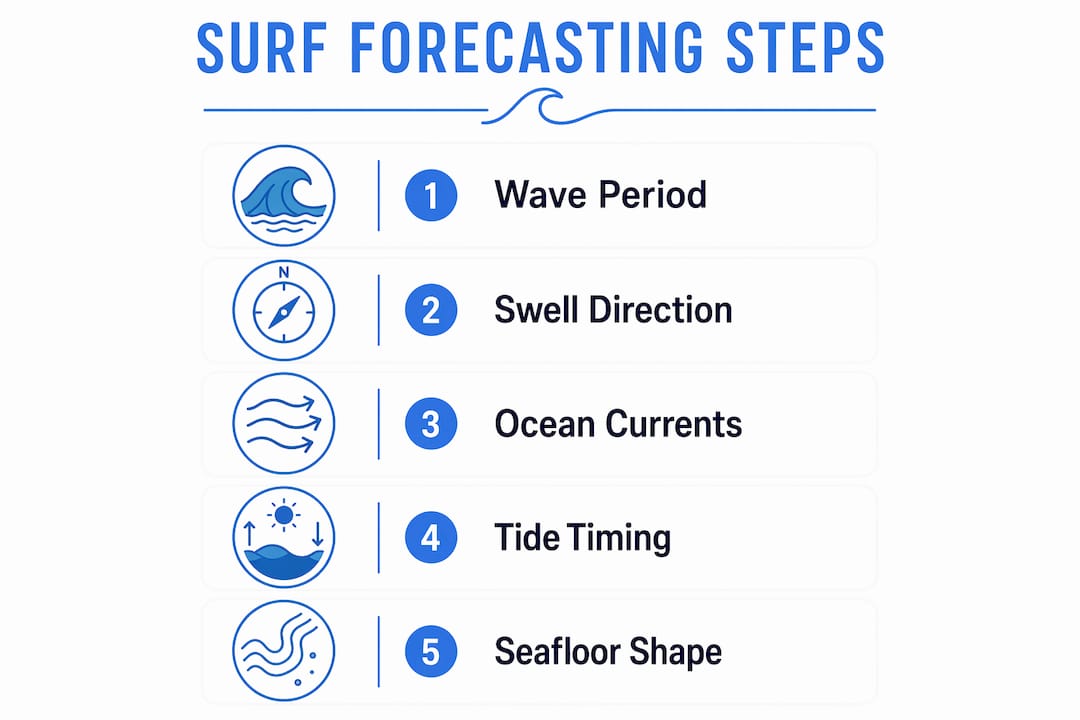
Ocean currents directly modify wave size and period, and the effect is larger than most surfers realize. Strong currents reduce significant wave heights by 0.4–2.2 meters and shorten dominant wave periods by 0.3–1.5 seconds. University of Rhode Island simulations published in 2026 show that wave forecasts improve measurably when wave-current coupling is included in the model. Ignoring currents produces real errors in predicted wave size and shape.
Currents also affect how wind transfers energy to waves. Wind stress depends on relative current speed and wave steepness, creating a nonlinear feedback loop. A current running against the swell direction steepens waves and can make them break earlier or more violently. A current running with the swell flattens them. Both scenarios change what you experience in the water, even when the buoy reading looks identical.
How tides reshape the surf break
Tides change water depth over a reef or sandbar, which directly controls where and how waves break. Tidal water-level variability alters beach face slope and surfzone morphodynamics, shifting the wave break zone shoreward or seaward with each tidal cycle. A reef break that fires perfectly at mid-tide may close out at high tide or expose dry rock at low tide.
Tidal effects on surf quality:
Low tide: Shallower water over reefs causes waves to break harder and faster. Barrels are more common but wipeouts are more dangerous.
Mid tide: Often the sweet spot for beach breaks, giving enough water depth for waves to build before breaking.
High tide: Deeper water can cause waves to crumble rather than pitch, reducing power and shape.
Upwelling events: Coastal upwelling from atmospheric systems can temporarily raise or lower sea level, modifying beach slope and break zone location.
Pro Tip: Check a local tide chart alongside your swell forecast. For reef breaks, arriving one hour before the optimal tide stage gives you time to assess conditions before committing to the water.
How does seafloor topography shape surf breaks?
The seafloor is the final filter that turns raw ocean swell into a specific wave shape. Wave refraction, reflection, and shoaling all occur as swell interacts with underwater features like reefs, canyons, and sandbars. The result is that two beaches receiving identical swell can produce completely different surf. Seafloor geometry is why certain spots are world-class and others are mediocre.
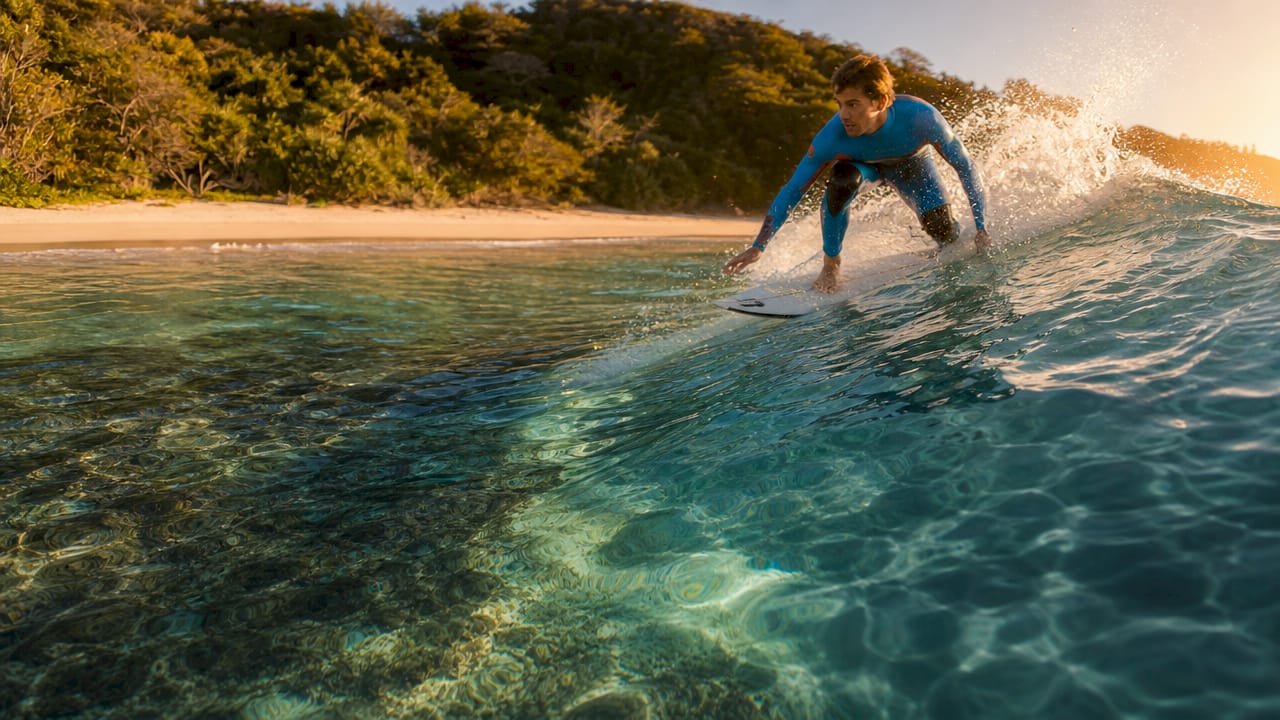
The Nazaré submarine canyon in Portugal is the clearest example of this principle at scale. Research published in 2026 shows the canyon edge focuses swell most powerfully for waves arriving from 275°–315°, with waves longer than 7 seconds mostly reflected along the canyon edge rather than simply channeled through it. The fine-scale geometry of the canyon’s edge over the final hundreds of meters near shore is what produces the wave focusing that creates record-breaking surf. A swell arriving from 260° produces a very different result at the same spot.
Reef, point, and beach breaks compared
Break type | Seafloor feature | Wave character | Tidal sensitivity |
Reef break | Coral or rock reef | Hollow, fast, consistent shape | High: depth over reef changes rapidly |
Point break | Rocky headland or submerged point | Long, peeling walls | Moderate: direction matters more than depth |
Beach break | Migrating sandbars | Variable, shifting peaks | Moderate: sandbars move with storms and tides |
Coral reefs add another layer of complexity. Reef crest roughness increases energy dissipation and shapes wave quality by modulating how the wave breaks and how much turbulence it generates. A reef with high surface complexity produces a different breaking pattern than a smooth rock shelf. Surfers reading a reef break need to account for tide, swell direction, and reef shape simultaneously.
Sandbars behave differently because they migrate. Radar measurements of surfzone dissipation show that reflection coefficients near 0.8 at surf frequencies influence wave shape and drive sandbar movement over time. A sandbar that produced perfect peaks last month may have shifted after a storm, changing the break entirely. Understanding beach orientation in surfing helps you predict which sandbars are likely to fire on a given swell direction.
Why does integrated forecasting matter beyond wave height?
Surf forecasting based only on wave height misses most of what determines actual surf quality. The interaction between wind, waves, and currents is nonlinear. Each variable modifies the others in ways that a single number cannot capture. A forecast showing 2-meter waves at a spot affected by a strong offshore current may actually deliver 1.6-meter waves with a shortened period. That difference changes the entire character of the session.
Wave-ocean coupled models address this gap by incorporating current fields into wave propagation calculations. The practical result is more accurate period forecasts, better predictions of wave shape, and improved safety assessments for big-wave spots. Forecasting accuracy improves when current influence on wave period is included, not just wave height. Period shapes how waves interact with local bathymetry, which determines whether a swell produces a quality break or a messy close-out.
Practical ways to read forecasts with more depth:
Check current data: Tidal current charts and regional oceanographic models show current direction and speed near your break.
Watch the period trend: A dropping period over a forecast window signals deteriorating swell quality even if height stays constant.
Factor in wind history: Swell generated by sustained, organized winds produces cleaner wave trains than swell from chaotic storm systems.
Use multiple models: Cross-referencing NOAA’s WAVEWATCH III output with local buoy data gives a more complete picture than any single forecast app.
Understanding surf forecasting for every surfer means treating the forecast as a starting point, not a final answer. The ocean always adds variables that models approximate but never fully capture.
Key takeaways
Oceanography determines surf quality by linking wind energy, swell propagation, ocean currents, tidal cycles, and seafloor topography into a single, interconnected system that every surfer benefits from understanding.
Point | Details |
Wave period beats wave height | A longer period signals organized, powerful swell; prioritize it over raw height in any forecast. |
Currents modify wave size and period | Strong currents can reduce wave height by up to 2.2 m and shorten periods by 1.5 seconds. |
Tides control where waves break | Water depth over reefs and sandbars shifts with each tidal cycle, changing the break zone entirely. |
Seafloor geometry is decisive | Canyon edges, reef shape, and sandbar position determine wave quality as much as swell size. |
Integrated forecasting is more accurate | Models that include wave-current coupling produce better period and height predictions than swell-only forecasts. |
What 20 years in the water taught me about ocean science
Most surfers check the wave height and stop there. That habit leaves a lot of good surf on the table. I have watched surfers drive past firing conditions because the forecast showed “only” 1.5 meters, not realizing the 16-second period meant those waves were stacking with serious power. The number on the screen is never the whole story.
The Nazaré canyon research genuinely surprised me. The idea that a narrow band of incoming swell directions, roughly 275°–315°, is what separates a historic big-wave day from a mediocre one at the same spot reframes how I think about coastal erosion and surf breaks. The ocean is not random. It has geometry, and that geometry rewards surfers who study it.
Ocean literacy also changes how you think about safety. Knowing that a strong current can shorten wave period by over a second helps you understand why a session that looked clean from the beach felt disorganized in the water. Tidal knowledge tells you when a reef will be dangerously shallow. These are not abstract science points. They are the difference between a great session and a bad injury.
My honest recommendation: spend 10 minutes with a tide chart and a buoy data page before every session. Not to predict the perfect wave, but to build the mental model of what the ocean is doing that day. Over time, that habit builds the kind of ocean reading ability that no amount of paddling alone can teach.
— Fernando
Surf smarter with Riparsurfschool in Portugal
Understanding currents, tides, and swell is exactly what Riparsurfschool instructors bring to every lesson at Praia Areia Branca, near Peniche and Ericeira. The team has been reading this stretch of Atlantic coastline since 2001, and that local knowledge shapes every session they run.

Whether you are a beginner learning to read the break for the first time or an intermediate surfer wanting to connect ocean science to your performance, Riparsurfschool tailors lessons to the conditions of the day. Book a private surf lesson to work one-on-one with an instructor who factors in tides, currents, and swell direction before you ever hit the water. Ready to commit to a full surf experience? Book your session online and let the Atlantic do the rest.
FAQ
What is the role of oceanography in surfing?
Oceanography explains how wind, ocean currents, tides, and seafloor topography combine to generate and shape surfable waves. Surfers who understand these processes can read forecasts more accurately and choose better surf times and locations.
How do ocean currents affect wave size?
Strong ocean currents can reduce significant wave heights by 0.4–2.2 meters and shorten dominant wave periods by 0.3–1.5 seconds. This means a forecast that ignores current data can significantly overestimate the actual wave size at a given break.
Why does wave period matter more than wave height?
Wave period determines how much energy a wave carries and how deeply it affects the water column. A long-period swell of 14 seconds or more produces powerful, organized waves even at moderate heights, while short-period wind chop at the same height delivers weak, choppy surf.
How do tides change surf conditions?
Tides alter water depth over reefs and sandbars, shifting where waves break and how they break. A reef break that produces hollow barrels at mid-tide may close out at high tide or become dangerously shallow at low tide.
Why does the Nazaré canyon produce such large waves?
The Nazaré submarine canyon focuses incoming swell through refraction and reflection along its edge, amplifying wave size for swells arriving from 275°–315°. The fine-scale geometry of the canyon’s edge near shore is the primary driver of wave focusing, not simple channeling through the canyon.
Recommended
Comments