

Surf stance explained: Master balance and boost your skills

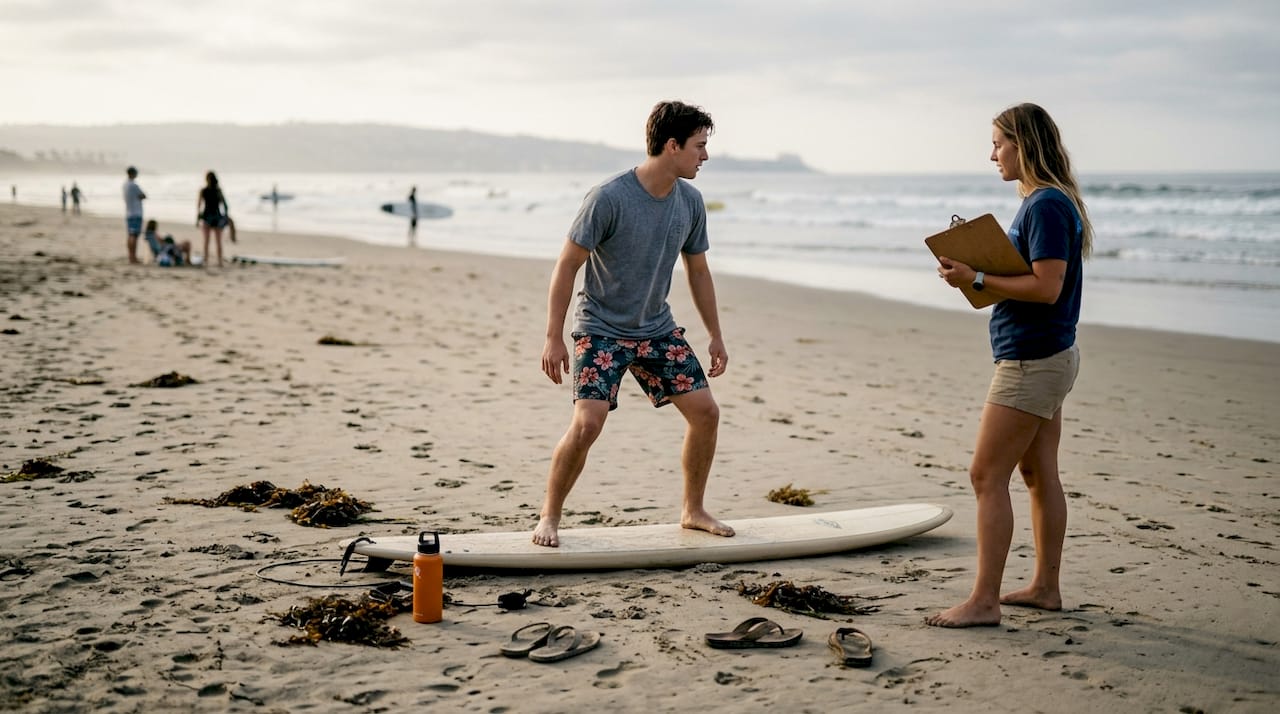
Most surfers think progression is about learning flashy tricks or charging bigger waves. The truth? Every wipeout, every wobble, every missed turn traces back to one thing: your stance. A surf stance is the body position and foot placement you adopt when standing on the surfboard to maintain balance, control speed, and perform maneuvers while riding a wave. Get it right and everything else clicks into place faster. Get it wrong and you’ll keep repeating the same frustrating mistakes no matter how many hours you log in the water. This guide breaks down exactly what surf stance is, how to build it correctly, and how to practice it so your progression accelerates.
Table of Contents
Key Takeaways
Point | Details |
Stance is foundational | A correct surf stance builds your balance, control, and confidence on the board. |
Master key mechanics | Proper foot placement, knee bend, and shoulder alignment let you ride waves smoothly and safely. |
Avoid beginner mistakes | Common errors like squatting, heavy front foot, or disco arms can slow your progress and should be corrected early. |
Practice drills matter | Pop-up routines and balance exercises off the water speed up stance mastery for quicker surf progression. |
Lessons accelerate learning | Hands-on guidance from surf instructors helps lock in good habits and advance your skill quickly. |
Defining surf stance: What it is and why it matters
Surf stance is not just about where you put your feet. It is the entire relationship between your body and the board, from your toes to your shoulders. Think of it as your home base on the wave. Every turn, every speed adjustment, every recovery from a bump starts from that position.
“A surf stance is the body position and foot placement a surfer adopts when standing on the surfboard to maintain balance, control speed, and perform maneuvers while riding a wave.”
When your stance is solid, the board responds to subtle shifts in weight and pressure. When it is off, even a gentle wave feels chaotic. That is why experienced surfers and coaches treat stance as the single most important skill to nail before anything else.
Here is what a correct surf stance controls:
Balance: Keeps your center of gravity stable over the board
Speed: Lets you shift weight to accelerate or slow down
Control: Enables precise turns and direction changes
Safety: Reduces the risk of falls and impact injuries
If you are just starting out, beginner surf lesson planning always puts stance at the top of the priority list, and for good reason. You cannot build a house on a shaky foundation.
Key mechanics of a great surf stance
Now that you understand its impact, let’s look step by step at the mechanics any surfer should master. The details matter more than most beginners expect.
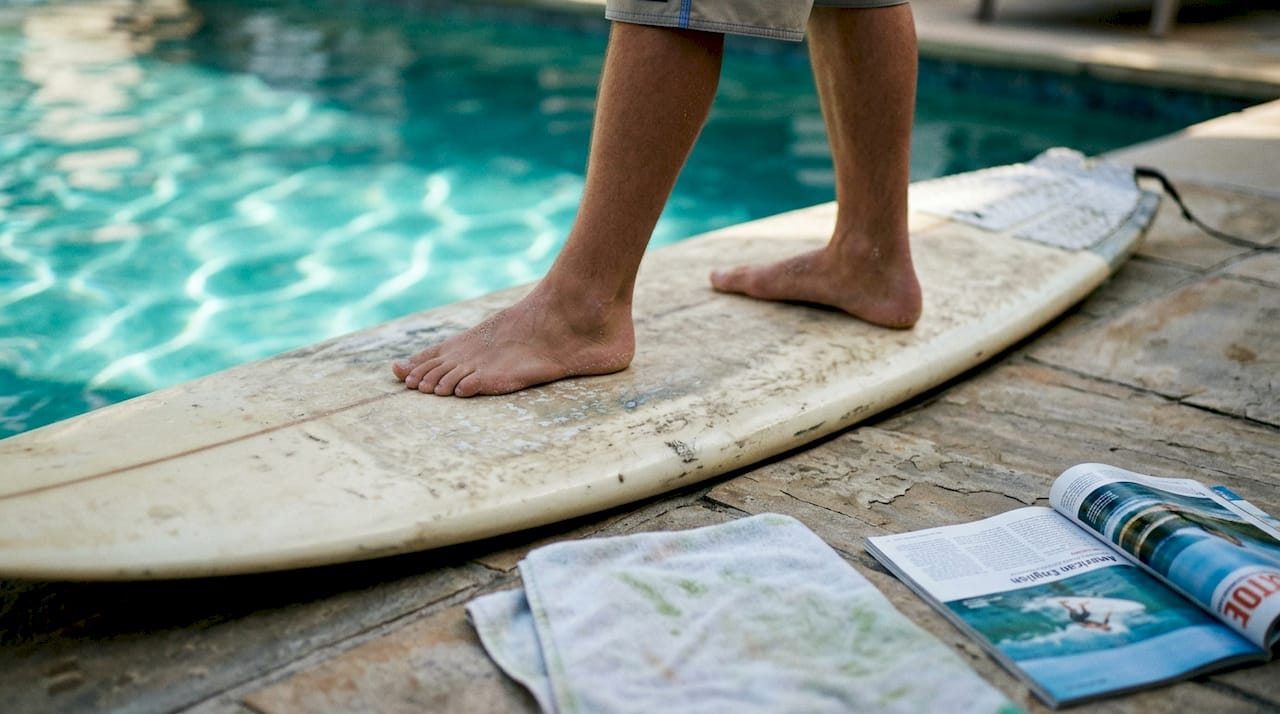
The key mechanics include feet shoulder-width apart, front foot near board center angled 45 degrees to the stringer (the central line running down the board), back foot near the tail at 90 degrees to the stringer, knees bent for absorption and power, shoulders aligned with the direction of travel, arms relaxed outside the rails, a low center of gravity, and weight centered or subtly shifted.
Body part | Correct position | Why it matters |
Front foot | 45° angle, near board center | Steers and guides direction |
Back foot | 90° angle, near tail | Controls speed and pivot |
Knees | Bent, soft | Absorbs bumps, generates power |
Shoulders | Aligned with travel direction | Drives turns and balance |
Arms | Relaxed, outside rails | Fine-tunes balance |
Hips | Low and centered | Lowers center of gravity |
A few key points to keep in mind:
Never lock your knees. Straight legs kill your ability to react.
Keep your gaze forward, not down at your feet.
Let your arms float naturally rather than pinning them to your sides.
Distribute weight evenly unless you are intentionally shifting for a maneuver.
Pro Tip: If you are unsure whether your stance is correct, ask a qualified instructor to watch your pop-up from the side. The surf instructor essentials that coaches focus on most include stance correction in the first session. A good coach with effective teaching qualities will spot a misaligned foot angle in seconds.
Common mistakes: How not to stand
Understanding the right stance helps, but avoiding easily made mistakes is just as vital. Here is what not to do.
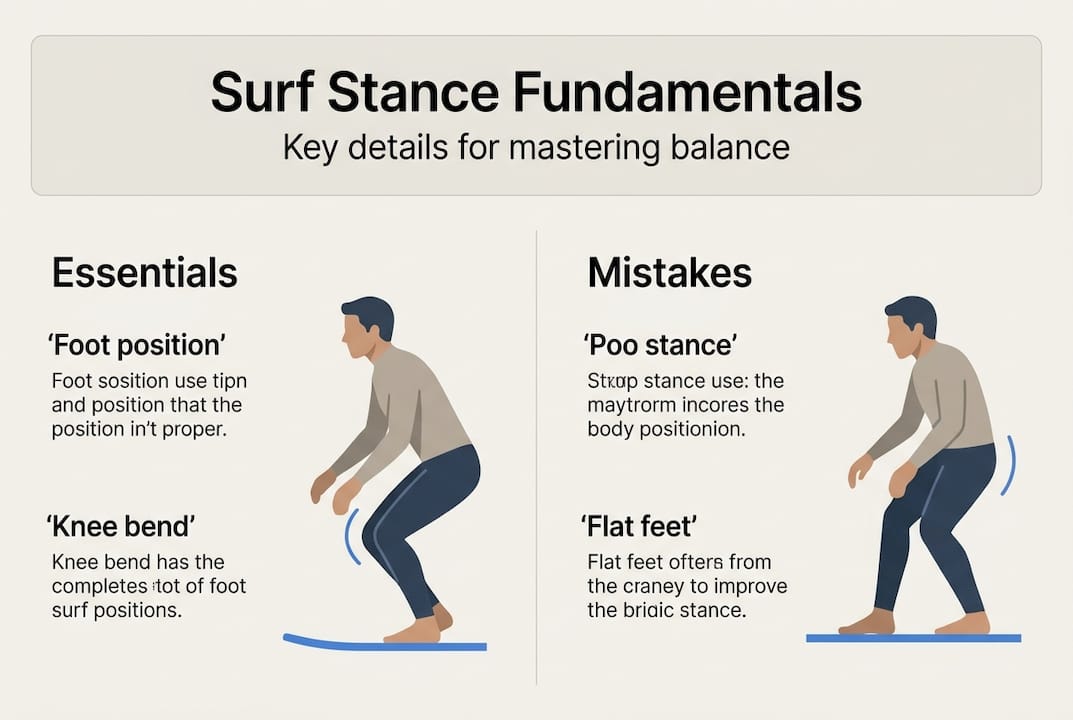
The most common stance errors for beginners and intermediates include poo stance (knees splayed out, squatting low like you are sitting on a toilet), heavy front foot, not bending knees at all, disco arms (flailing wildly for balance), looking down at the board, and keeping both feet parallel.
Mistake | What it looks like | Correct alternative |
Poo stance | Knees out, hips dropped too low | Knees bent forward, hips centered |
Heavy front foot | Nose diving, board slows | Weight centered, slight back pressure |
Parallel feet | No rotation, poor steering | Front foot 45°, back foot 90° |
Disco arms | Flailing, loss of control | Arms relaxed, slightly raised |
Looking down | Head drops, balance lost | Eyes forward on the wave |
Here is a simple numbered sequence to fix a bad habit mid-session:
Paddle back out and pause before your next wave.
Visualize the correct position: feet angled, knees soft, eyes forward.
On your next pop-up, focus on one correction only (for example, foot angle).
After the ride, mentally check whether you held it.
Repeat with the same focus for three to five waves before adding another correction.
Pro Tip: Instructors who fix surf mistakes often use video playback so you can see your own stance from outside. Watching yourself is ten times more effective than hearing a verbal description. If you are learning to surf and feel stuck, this single tool can break a plateau fast.
Training and drills: Practicing surf stance on land
Once you know the errors, effective practice begins on dry land. Here is how to build muscle memory for great stance.
The pop-up drill is the cornerstone of land training. Your pop-up should be completed in less than one second, moving from lying flat to standing in a single explosive motion. Slow pop-ups lead to missed waves and awkward landings.
Here is a step-by-step land pop-up routine:
Lie face down on your board (or a towel on the floor) in paddling position.
Place your hands flat under your shoulders, like the start of a push-up.
Push up explosively, bringing both feet under your hips in one movement.
Land with front foot at 45 degrees, back foot at 90 degrees.
Check your knee bend, shoulder alignment, and arm position.
Hold for three seconds, then reset and repeat ten times.
Beyond the pop-up, build the supporting strength and balance with these exercises:
Squats: Build the leg strength needed for sustained knee bend on the board
Russian twists: Develop the rotational core strength that powers turns
Balance board training: Simulates the instability of a moving surfboard
Single-leg stands: Improve proprioception (your body’s sense of position in space)
Yoga: Builds flexibility, body awareness, and breath control under pressure
If you want to take your balance training seriously, yoga for surf balance is one of the most underrated tools available to surfers at any level. Many of our students at Ripar Surf School notice a real difference in their stability after just a few sessions.
Why proper stance unlocks progression
With a training routine in place, let’s examine why stance is the key to unlocking surfing flow and skill advancement.
“Proper stance provides the foundation for balance and control, absorbs impacts like a vehicle’s suspension system, and enables dynamic movement. Poor stance, like the poo stance, actively limits progression.”
Think about a car’s suspension. When it works correctly, the car glides over bumps and corners smoothly. When it fails, every small imperfection in the road becomes a jarring jolt. Your bent knees and centered hips work exactly the same way on a wave.
Here is what proper stance makes possible as you progress:
Executing bottom turns and cutbacks with precision
Generating speed down the line without losing control
Absorbing chop and turbulence without falling
Setting up for aerial maneuvers safely
Reducing knee and ankle strain over long sessions
Every advanced skill in surfing is built on top of stance. Skipping this foundation does not save time. It costs time. Surfers who nail their stance early move through the learning curve noticeably faster, and you can see this pattern play out constantly in our surf school community at Praia Areia Branca.
Take your surf stance further with expert lessons
Knowledge and drills will take you a long way, but nothing replaces real-time feedback in the water from someone who has coached hundreds of surfers through exactly the same challenges you are facing.

At Ripar Surf School and Surfcamp Portugal, our certified local instructors have been helping surfers of all levels build solid foundations since 2001. Whether you are brand new or stuck at an intermediate plateau, our all levels group surf lessons are designed to give you personalized stance corrections in a relaxed, small-group setting on one of Portugal’s best beaches. Ready to commit to a full week of focused improvement? Our surfcamp in Portugal combines daily lessons, land training, and an incredible coastal environment to accelerate your progress. Book online and take the next step toward surfing with real confidence.
Frequently asked questions
What do you do with your feet in a surf stance?
Keep your feet shoulder-width apart, front foot angled about 45 degrees near board center and back foot perpendicular near the tail. This setup gives you both steering control and stability.
How quickly should I pop up into surf stance?
Your pop-up should take less than one second from lying flat to standing. A slow pop-up means you miss the wave’s momentum and land in an unbalanced position.
What mistakes should beginners avoid in their surf stance?
Avoid the poo stance and parallel feet, putting too much weight on your front foot, failing to bend your knees, and flailing your arms. Each of these errors directly limits your balance and control.
Why does stance matter for surf progression?
Proper stance builds balance, absorbs wave impacts, enables dynamic maneuvers, and protects your joints. Without it, every advanced skill becomes harder and riskier to learn.
Recommended
Comments