

Surf Progression Tips That Build Real Skill Fast
- Fernando Antunes

- Jun 25
- 8 min read
TL;DR:
Focusing on one skill theme per session accelerates surf progression by reinforcing automatic execution through repeated practice. Using video analysis and pairing consistent training with proper equipment choices significantly enhances learning speed and skill development. Regular land-based drills like surf-skate training enable high-volume repetitions that transfer directly to ocean surfing, boosting overall performance.
Surf progression tips are practical methods that move critical surfing skills from conscious effort to automatic execution. The fastest improvers combine focused session themes, smart equipment choices, video analysis, and consistent practice patterns. Tools like surf-skates, video coaching, and structured drills from schools like Riparsurfschool accelerate this process far beyond random time in the water. Whether you are working through your first green waves or pushing into intermediate territory, the strategies below give you a clear path forward.
1. How can focusing on one skill theme per session accelerate surf progression?
Single-theme sessions are the most underused method in intermediate surf progression. Stacking small improvements by choosing one focus, like angle takeoffs or bottom turn timing, beats random practice every time. When you chase multiple goals in one session, none of them get enough repetition to stick.
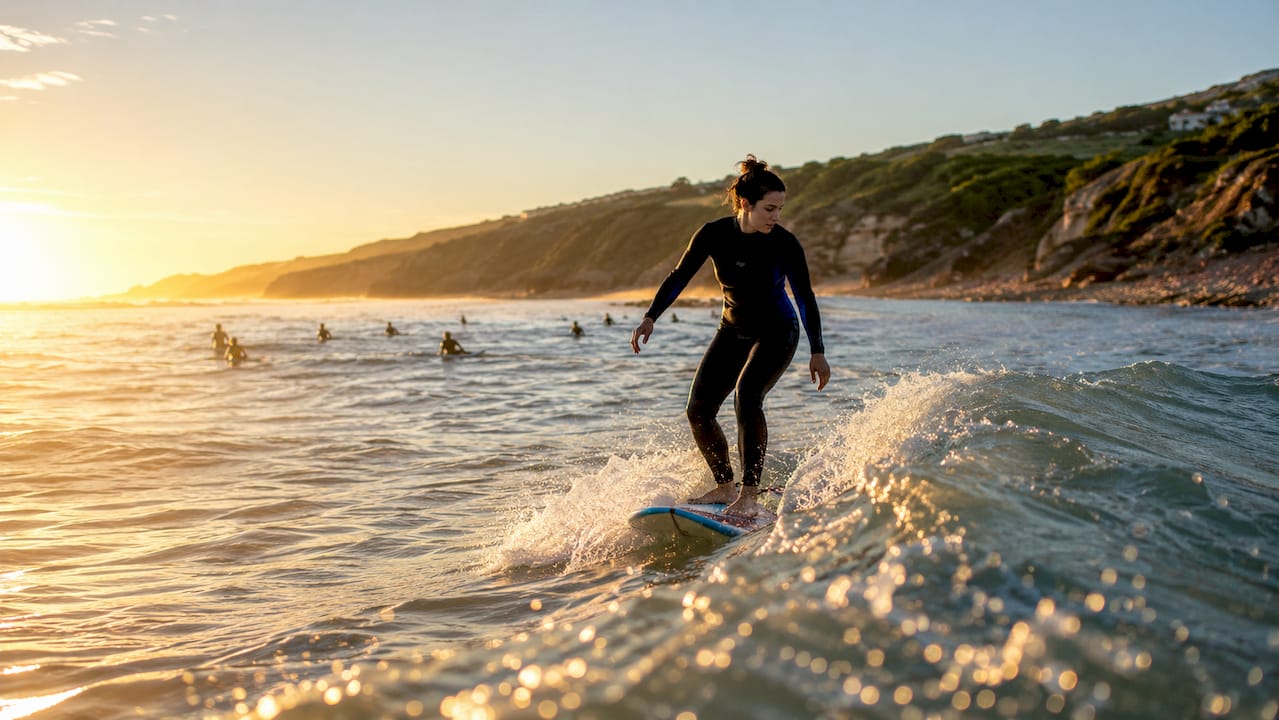
Pick one measurable theme before you paddle out. Good examples include: angling your takeoff toward the open wave face, compressing low through your bottom turn, or keeping your eyes looking down the line rather than at your feet. Write it on your wrist with a waterproof marker if you need a reminder.
After each wave, run a quick mental replay. Ask yourself whether the theme happened automatically or whether you had to think about it mid-ride. Skills become automatic only through repeated, conscious repetition followed by honest self-review. That internal check is your real progress meter.
Gradually expose yourself to slightly harder conditions as each theme becomes comfortable. Moving from waist-high beach breaks to slightly overhead surf before a skill is automatic increases your injury risk and slows learning. Build the habit in easy conditions first, then transfer it.
Pro Tip: Write your session theme on your forearm with a waterproof pen. Glancing at it between sets keeps your focus locked and stops you from drifting into “just surfing” mode.
2. What role does equipment selection play in surf progression?
The wrong board is the single most common reason intermediate surfers plateau. Dropping board volume too fast reduces your wave count, and fewer waves means fewer learning repetitions per session. Less volume means more paddling effort and missed waves, which kills momentum and confidence together.
The recommended approach is incremental volume reduction of 3–5 liters at a time. This keeps your wave catch rate high enough to practice the skills you are working on. A surfer who catches 15 waves per session learns faster than one who catches 5, regardless of how advanced the smaller board looks on the beach.
Match your board volume to your body weight and current skill level. A common starting point for intermediates is a volume multiplier of around 35–40 liters per kilogram of body weight, though this varies by wave type and fitness. The goal is a board that lets you practice technique, not one that forces you to fight for every wave.
Board stage | Volume approach | Best for |
Beginner | High volume, wide nose | Building pop-up and wave reading |
Early intermediate | Moderate volume reduction | Practicing turns on green waves |
Intermediate | 3–5 liter drops per step | Refining bottom turns and cutbacks |
Advanced | Low volume, performance shape | Speed generation and critical sections |
Pro Tip: Before downsizing, count how many waves you catch per session on your current board. If that number drops by more than a third on the new board, go back up in volume.
3. How does video analysis and feedback enhance intermediate surf progression?
Video is the fastest way to break a plateau because it shows what you cannot feel. Video reveals paddling timing and positioning patterns that are invisible from inside the wave. Most intermediate surfers are shocked by the gap between what they think they are doing and what the camera shows.
The most common issues video exposes include:
Paddling sprint timing. Starting your sprint too early burns energy before the wave arrives. Starting too late means the wave passes under you. Video shows exactly where your sprint begins relative to the wave peak.
Pop-up form. Many surfers push up with bent arms and a wide stance, which kills balance from the first second of the ride. Video makes this obvious in one frame.
Positioning at the peak. Sitting too far inside or outside the peak means you are always chasing waves rather than reading them. Camera angles from the beach show this clearly.
Eye direction. Surfers who look at their feet instead of down the line lose speed and direction. Video catches this habit instantly.
Use video as a regular part of your progression plan, not a one-time experiment. Video coaching works best as an ongoing feedback loop reviewed after every few sessions. One review session will not change your surfing. Monthly reviews tied to your session themes will.
Pro Tip: Film from the beach at a 45-degree angle to the break, not straight on. This angle shows both your positioning on the wave and your body mechanics at the same time.
4. Why is consistent, well-timed practice more effective than sporadic surfing?
Consistent sessions build muscle memory faster than any single long session. Surfing 2–3 sessions close together accelerates breakthroughs far more than isolated outings spread weeks apart. Your nervous system needs repeated, closely spaced signals to wire a new movement pattern.
The conditions you choose matter as much as the frequency. Smaller, cleaner, less crowded waves give you more focused practice time per session. Crowded lineups mean fewer waves and more waiting. Choppy, powerful surf forces survival mode rather than skill development.
Deliberate practice looks different from a fun session. A deliberate session has a theme, a target wave count, and a post-session review. A fun session is just surfing. Both have value, but only deliberate sessions drive consistent improvement. Mixing both across your week keeps motivation high without sacrificing progress.
Surfing multiple days in a row is one of the most effective ways to break through a skill barrier. The second and third days of a back-to-back run often produce the clearest improvements because your body is already warmed up and your nervous system is primed. A structured surf lesson workflow at the start of a multi-day block sets the right foundation for this kind of momentum.
5. How can land-based drills like surf-skate improve surfing technique?
Surf-skate training solves the biggest problem in surf skill development: you cannot get enough repetitions in the ocean. You can perform 50 cutback drills in 10 minutes on a surf-skate versus a handful of attempts across an entire surf session. That volume of repetition accelerates skill automation dramatically.
The movements that transfer best from surf-skate to ocean surfing include:
Bottom turn compression. Practice dropping low, loading your back foot, and driving off the bottom. The weight shift and timing are identical to the ocean version.
Cutback initiation. Work on rotating your shoulders first, then letting your hips and feet follow. This sequence is the same on a surf-skate as on a wave.
Pumping for speed. Surf-skate pumping trains the compression and extension rhythm that generates speed on a wave face. Compression and extension through the bottom turn are foundational to on-wave speed.
Switch stance training. If you want to ride backside with more confidence, surf-skate lets you practice the unfamiliar stance without the pressure of a moving wave.
The key is to transfer what you practice on land back to the water within the same week. The longer the gap between land drill and ocean session, the weaker the transfer. Treat surf-skate as a pre-session warm-up or a between-session skill reinforcement tool.
Key takeaways
Surf progression is fastest when you combine focused session themes, correct equipment, video feedback, and consistent practice rather than relying on time in the water alone.
Point | Details |
One theme per session | Pick a single measurable focus and repeat it across every wave in the session. |
Incremental board downsizing | Reduce volume by 3–5 liters at a time to keep wave count and learning reps high. |
Video as a feedback loop | Review footage regularly to catch timing and positioning errors you cannot feel. |
Consistent session spacing | Surfing 2–3 sessions close together builds muscle memory faster than isolated outings. |
Surf-skate for repetition | Use land-based drills to perform high-volume repetitions of turns and speed moves. |
What I have learned about breaking surf plateaus
The surfers I see improve fastest are not the ones who surf the most hours. They are the ones who surf with the clearest intention. A 90-minute session with one theme and a post-session mental review beats three hours of unfocused paddling every time.
The equipment mistake I see most often is surfers rushing to a smaller board because it looks better. I have watched capable intermediates lose half their wave count overnight by dropping 10 liters in one step. That loss of repetition stalls progress for months. Patience with board progression is not a weakness. It is the smarter path.
Video feedback changed how I think about coaching entirely. Surfers who watch themselves on camera for the first time almost always say the same thing: “I had no idea I was doing that.” The gap between felt experience and actual movement is real, and it is wide. Surf coaching in Portugal’s waves works so well partly because the consistent Atlantic swell gives you clean, repeatable conditions to film and review.
My honest advice is to slow down your progression goals and speed up your practice quality. Pick one thing, repeat it until it is automatic, then move to the next. That sequence builds real surfers.
— Fernando
Riparsurfschool’s structured lessons for faster surf progression
Riparsurfschool has been coaching surfers at Praia Areia Branca, near Peniche and Ericeira, since 2001. The school’s certified local instructors build sessions around exactly the kind of focused themes and video feedback this article describes.
Whether you are working on your first green waves or pushing into intermediate turns, Riparsurfschool matches lesson structure to your current skill level. The Atlantic swells at Areia Branca provide consistent, clean conditions ideal for deliberate practice. Book your surf lessons online and choose from private surf coaching or group sessions designed to keep your wave count high and your progress moving forward.
FAQ
What is the fastest way to improve surfing skills?
The fastest method is to pick one skill theme per session and repeat it deliberately across every wave. Focused repetition combined with post-session mental review builds automatic habits faster than unstructured surfing.
How often should intermediate surfers practice to see real progress?
Surfing 2–3 sessions close together in the same week produces faster breakthroughs than isolated outings. Closely spaced sessions build confidence and muscle memory more effectively than one long session per month.
When should I downsize my surfboard?
Downsize only when your wave catch rate stays consistent on the new board. Dropping volume by 3–5 liters at a time keeps your learning repetitions high and prevents the plateau that comes from fighting an undersized board.
Does surf-skate training actually help in the ocean?
Yes. Surf-skate allows you to repeat specific movements like cutbacks and bottom turns at high volume on land. The timing and weight shifts transfer directly to ocean surfing when you practice both within the same week.
How do I know if I am actually progressing in surfing?
The clearest sign of real progress is when skills like your pop-up, duck dive, or bottom turn happen without conscious thought. Automatic execution of core movements is the most reliable marker of genuine skill development.
Recommended
Comments