

Surf Levels Explained: A Beginner's Complete Guide
- Fernando Antunes

- Jun 14
- 8 min read
TL;DR:
Surf levels categorize surfing skills into four main stages—Beginner, Improver, Intermediate, and Advanced—that influence safety, performance, and progression. Recognizing your true level and surf conditions, such as swell period, wind, and tide, are essential for safe and effective practice. Progression depends on automatic movements, deliberate practice, and matching conditions to your ability rather than simply increasing surfing volume.
Surf levels explained refers to the standardized classification of surfing skills into four progressive stages that guide beginners and intermediates in understanding their abilities and choosing the right conditions. These stages are Beginner, Improver, Intermediate, and Advanced. Knowing which level you belong to is not just about ego. It directly affects your safety, your session quality, and how fast you improve. Official frameworks like the French Surfing Federation’s Passeport Surf have formalized these stages into 13 recognized levels, giving surfers a clear, lifelong progression record backed by national certification.
What are the four main surf levels?
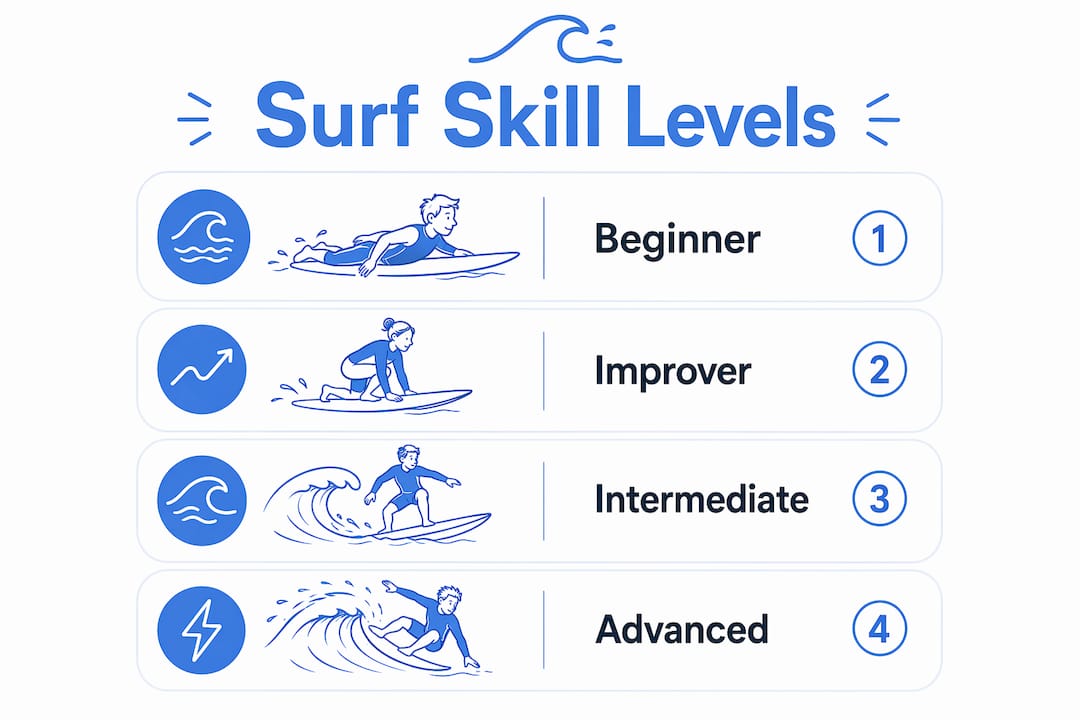
Standard surf level classifications break into four primary stages: Beginner, Improver, Intermediate, and Advanced. Each stage defines the skills you have, the waves you should ride, and how much supervision you need.
Level 1: beginner
Beginners focus on the basics of paddling, balance, and popping up on a board in white water. White water is the broken, foamy part of a wave after it has already crashed. It is forgiving, predictable, and the safest place to start. Beginners must always surf in supervised environments with a certified instructor nearby. The priority at this stage is building physical comfort in the ocean, not catching perfect waves.
Level 2: improver
Improvers have mastered the white water pop-up and are ready to catch unbroken waves. An unbroken wave is the green, open face of a wave before it breaks. Standing up consistently on these waves is the defining skill of this stage. Improvers still need guidance on wave selection and basic surf etiquette, but they can handle more dynamic conditions than pure beginners.
Level 3: intermediate
Intermediate surfers ride unbroken waves with control and begin executing basic maneuvers like bottom turns and cutbacks. Wave selection becomes a conscious skill at this stage. Intermediates also understand and follow surf priority rules, which govern who has the right of way on a wave. This level marks the transition from survival surfing to actual wave riding.
Level 4: advanced
Advanced surfers perform complex maneuvers, read conditions independently, and adapt to varied surf environments. They choose their own sessions without needing guidance on safety or wave suitability. The Passeport Surf framework recognizes this stage as full autonomy, where the surfer is responsible for their own decisions in the water.
Level | Key Skill | Ideal Environment | Supervision Needed |
Beginner | Pop-up in white water | Gentle beach break, white water | Always |
Improver | Catching unbroken waves | Small, clean beach break | Recommended |
Intermediate | Bottom turns, wave selection | Varied beach breaks | Optional |
Advanced | Complex maneuvers, full autonomy | Any surf environment | None |
Pro Tip: If you are unsure of your level, default one stage lower. Surfing conditions that are slightly too easy builds confidence faster than getting overwhelmed.
How do surf conditions affect which level should surf?
Surf conditions are not just about wave height. Swell period, wind, and tide are the three variables that determine whether a session is safe and fun or dangerous and frustrating for your skill level.
Swell period: the number that matters most
Swell period is the time in seconds between two consecutive waves. Waves with periods under 9 seconds are windswells, which are weak, choppy, and inconsistent. Waves with periods of 12 seconds or more are groundswells, which are powerful, organized, and steep. Beginners do best in windswell conditions because the waves are softer and less punishing. Intermediates can start working with groundswell, but they need to respect the added power.
Wind: offshore vs. onshore
Offshore wind blows from the land toward the ocean. It holds waves up longer, creating cleaner, more defined faces. Onshore wind blows from the ocean toward the land. It creates choppy, messy surfaces that make it harder to read waves and maintain balance. Beginners should always prioritize offshore or light wind conditions. Onshore surf is harder to read and physically more tiring, which compounds the challenges of learning.
Tide: every spot is different
Every surf spot has a preferred tide where wave quality peaks. Low tide can make waves hollow and fast, which is exciting for advanced surfers but dangerous for beginners. High tide often slows waves down and reduces their shape. Mid tide is typically the safest and most consistent window for beginners and improvers. Checking local tide charts before paddling out is a non-negotiable habit worth building early.
Condition | Beginner Ideal | Intermediate Ideal |
Swell period | Under 9 seconds (windswell) | 10–14 seconds (moderate groundswell) |
Wave height | 1–2 feet | 2–4 feet |
Wind | Offshore or calm | Offshore preferred |
Tide | Mid tide | Mid to low tide |
Pro Tip: Do not judge a session by wave height alone. A 3-foot wave with a 14-second period is far more powerful than a 4-foot wave at 7 seconds. Always check the period.
How do you assess and improve your surf level?
Recognizing your current level requires honest self-assessment. Most surfers overestimate their ability, which leads to sessions in conditions that are too challenging and slow down real progress.
The clearest marker of progression is not how many waves you catch. Real progress happens when movements become automatic rather than conscious. When you stop thinking about your pop-up and just do it, you have moved to the next stage. Coaching accelerates this transition significantly because an instructor can identify mechanical errors you cannot see yourself.
Here are the most effective steps for assessing and improving your surf level:
Video your sessions. Watching yourself surf reveals posture, foot placement, and timing errors that feel invisible in the water. Even a phone propped on a bag at the shoreline works.
Target one skill per session. Deliberate practice focused on specific mechanics outperforms random wave catching every time. Pick one thing, like your back foot position, and work only on that.
Learn surf etiquette early. Knowing priority rules, drop-in etiquette, and right-of-way is a safety skill, not just a social one. Intermediate surfers who ignore etiquette create dangerous situations for everyone.
Match conditions to your level. Surfing waves that are too big or too powerful does not build skill. It builds fear. Consistent practice in manageable conditions builds the muscle memory that transfers to bigger surf later.
Get structured coaching. A certified instructor compresses months of self-taught progress into a few focused sessions. Riparsurfschool’s surf progression guide breaks down exactly how this works in practice.
Understanding why consistent practice builds real skill is the foundation of every surfer’s progression. Volume without focus stalls development. Focus without volume limits exposure. The combination of both, in the right conditions, is what moves you from one level to the next.
Do surf forecast star ratings match your skill level?
Surf forecast star ratings are one of the most misunderstood tools in surfing. Star ratings reflect subjective wave quality, not objective safety or suitability for your level. A session rated 1 star by a forecast platform like Surfline might be a perfect beginner day. A 4-star day might be genuinely dangerous for anyone below intermediate level.
The core problem is that star ratings do not account for local bathymetry or individual ability. Bathymetry is the shape of the ocean floor, which determines how waves break. A reef break and a beach break can produce completely different waves from the same swell, but a star rating treats them identically. Beginners who rely only on stars often show up to sessions that look manageable on paper but are physically overwhelming in person.
The fix is simple. Read the raw data instead of the summary. Check swell period, wind direction, and tide window before you look at stars. A 4-foot wave can feel spectacular to beginners but tedious to pros, and the star rating will reflect the pro’s perspective, not yours.
Pro Tip: Use forecast platforms like Surfline or Windguru to check period and wind direction, not just the star summary. A 1-star day with offshore wind and a 10-second period is often better for learning than a 3-star day with onshore chop.
Key takeaways
Matching your surf level to the right conditions is the single most effective way to stay safe and progress faster.
Point | Details |
Four official levels exist | Beginner, Improver, Intermediate, and Advanced each require different skills and conditions. |
Swell period beats wave height | A longer period means more power; always check period before choosing your session. |
Star ratings are subjective | Low-rated forecast days are often ideal for beginners; read raw data, not just stars. |
Skill automation signals progress | When movements feel automatic rather than conscious, you have genuinely leveled up. |
Deliberate practice beats volume | Targeting one specific skill per session produces faster gains than catching random waves. |
What i’ve learned watching surfers progress over two decades
The surfers who improve fastest are rarely the ones who surf the most. They are the ones who surf smart. I have watched beginners spend three summers in the water and still struggle with their pop-up because they kept chasing bigger waves instead of fixing the basics in small surf.
The real breakthrough almost always comes from the same place: matching your session to your actual level, not your aspirational one. A beginner who spends six sessions in clean, waist-high white water with focused coaching will outpace someone who jumps straight to overhead surf and spends every session surviving instead of learning.
Plateaus are not a sign of failure. They are a sign that you have been practicing the wrong thing, or in the wrong conditions, for too long. The solution is almost always to step back one level, slow down, and automate the mechanics you thought you already had. Patience in surfing is not passive. It is the most aggressive thing you can do for your progression.
Respect the ocean, respect your level, and trust the process. The waves will still be there when you are ready for them.
— Fernando
Learn to surf at your level with Riparsurfschool
Riparsurfschool has been teaching surfers of all abilities at Praia Areia Branca, near Peniche and Ericeira, since 2001. The team of certified local instructors designs every session around your current skill level, whether you are paddling into white water for the first time or working on your bottom turn.

Group and private surf lessons are available for every stage, from complete beginner to intermediate surfer looking to break through a plateau. Structured coaching in Portugal’s world-class surf conditions is one of the fastest ways to move from one level to the next. You can also check out surf spots near Lisbon to plan your sessions around your ability. Book your lesson online and get matched with the right instructor, the right conditions, and the right level from day one.
FAQ
What are the four main surf skill levels?
The four main surfing skill levels are Beginner, Improver, Intermediate, and Advanced. Each stage defines the skills, wave conditions, and level of independence a surfer should have in the water.
What surf conditions are best for beginners?
Beginners do best in small, clean waves with a swell period under 9 seconds, offshore or calm wind, and mid-tide conditions. White water beach breaks are the safest and most forgiving environment for learning.
How do i know when i’ve moved to the next surf level?
The clearest sign is when your movements become automatic rather than conscious. When your pop-up or paddle technique no longer requires active thought, you have genuinely progressed to the next stage.
Are surf forecast star ratings reliable for beginners?
Star ratings reflect subjective wave quality from an experienced surfer’s perspective and do not account for your skill level or local conditions. Always check swell period, wind direction, and tide alongside any star rating.
How many surf levels does the passeport surf system have?
The Passeport Surf system from the French Surfing Federation includes 13 official levels recognized at national surf schools in France. It provides a structured, lifelong progression record that tracks both skill development and safety training.
Recommended
Comments