

What Is Pop Up Surfing: A Beginner's Guide

TL;DR:
Mastering the quick, explosive pop-up is essential for successful surfing and improves balance and maneuverability.
Practicing on land with drills like floor pop-ups and reverse movements develops muscle memory, leading to better technique in the water.
Proper timing, matching the style to your board, and consistent practice build confidence and set the foundation for advanced surfing skills.
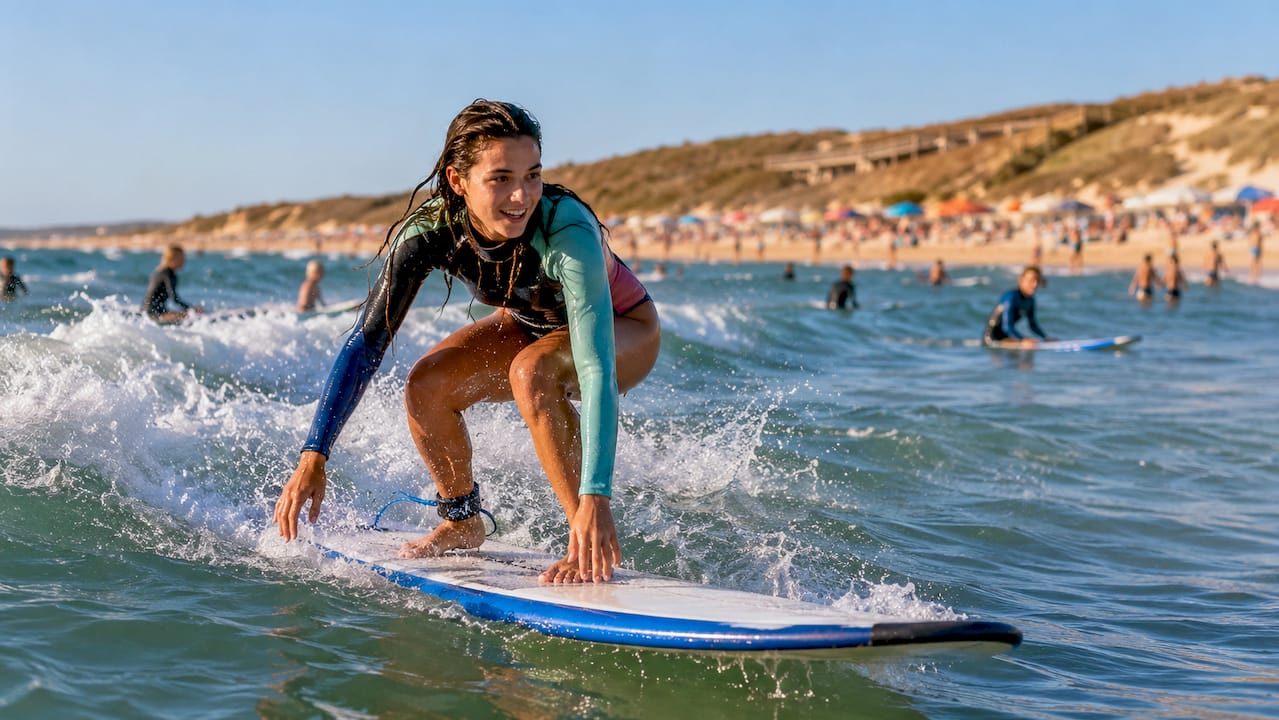
The pop-up in surfing is defined as the fast, explosive transition from lying flat on your board to standing upright in a balanced athletic stance as the wave carries you forward. This single movement separates surfers who catch waves from those who watch them pass. A clean pop-up affects your balance, your speed on the wave, and every maneuver you attempt after standing. Get it right and the rest of surfing opens up. Get it wrong and no amount of wave reading or paddle fitness will save the ride.
What is pop up surfing and how does the technique work?
The pop-up is a fast, controlled transition starting prone and ending standing with knees bent in a low, athletic stance. In the surf world, instructors also call it the “takeoff.” Both terms describe the same movement. Knowing the standard term helps when you read coaching guides or watch instructional videos from sources like OMBE or Surf Mastery.
The sequence breaks down into five clear steps:
Lie flat on the board. Your chest rests on the deck. Your hands press flat against the board near your lower chest, roughly at your ribs. Fingers point forward.
Push your chest up. Drive through your palms in one explosive push-up motion. Your hips lift off the board at the same time. This is not a slow yoga stretch. It is a burst.
Snap your back foot forward. Your back foot lands first, roughly centered between the tail and the midpoint of the board.
Plant your front foot between your hands. Your front foot lands sideways, shoulder-width apart from your back foot. Both feet point across the board, not toward the nose.
Land in your stance. Knees bent, weight centered, arms out wide for balance, eyes looking forward down the wave. Never look at your feet.
The pop-up should happen in one fluid motion lasting less than one second. Pausing between steps kills your board speed and throws off your balance. Think of it as a single “push, snap, land” action rather than three separate moves.
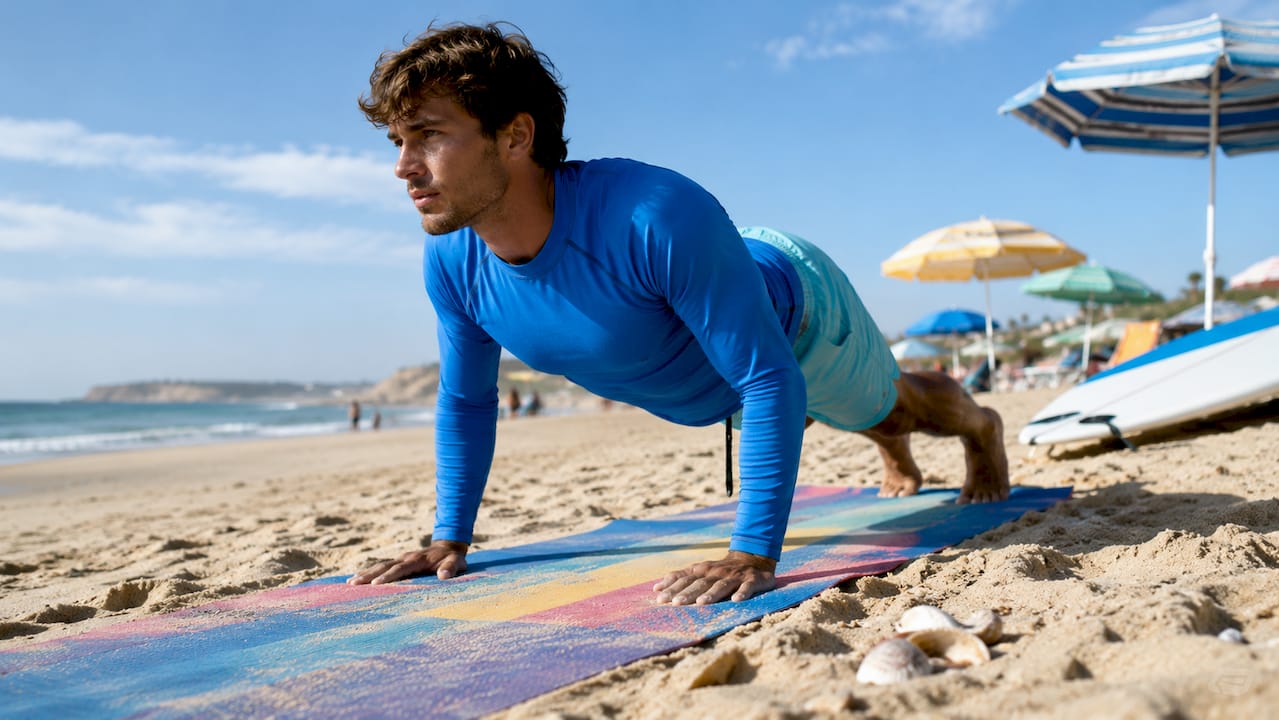
Pro Tip: Place a piece of tape on your yoga mat at home to mark where your feet should land. Drill the pop-up 20 times before breakfast. Your body will memorize the foot placement faster than any ocean session can teach it.
Why is timing the pop-up so critical?
Timing the pop-up correctly determines whether you catch the wave or miss it entirely. Popping up too early causes you to miss the wave or lose balance before the board gains speed. Popping up too late causes a nose dive, also called pearling, where the board’s nose digs into the water and launches you forward.
The correct moment to pop up is just after you feel the wave physically push your board. That push is your signal. Your board will accelerate under you. That acceleration is the wave doing the work. Your job is to stand up while that energy is moving through the board.
Common timing mistakes beginners make:
Standing before the push. You feel the wave approaching and panic-stand. The wave has not caught you yet, so you have no speed and fall sideways.
Waiting too long. You feel the push but hesitate. The nose drops, the board stalls, and you go over the front.
Rushing the paddle. You stop paddling one stroke too early. The wave passes under you and you never get the push at all.
Ignoring the angle. You paddle straight into the wave instead of at a slight angle. The board bobs rather than accelerates.
A practical drill for timing: practice on whitewater first. Broken waves push your board hard and give you a clear, unmistakable signal. Once you feel that push consistently in whitewater, move to unbroken waves where the signal is subtler.
Pro Tip: Count your paddle strokes out loud as the wave approaches. Most beginners need 3–5 strong strokes before the wave catches them. Counting keeps you from stopping too early and gives you a rhythm to build timing around.
How do different pop-up styles compare by board type?
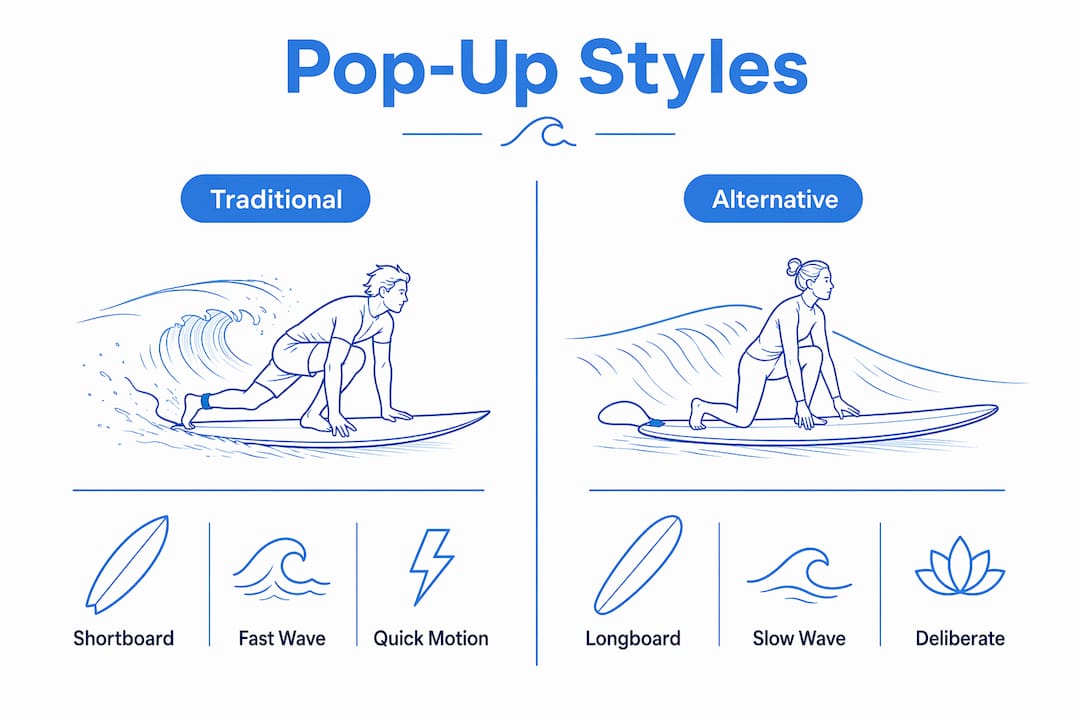
Choosing the right pop-up technique based on board type and wave speed optimizes stability and ride success. Three main styles exist: the standard pop-up, the longboard pop-up, and the chicken wing pop-up. Each suits a different setup.
Pop-Up Style | Best Board | Wave Type | Key Trait |
Standard pop-up | Shortboard | Fast, steep waves | Speed and precision required |
Longboard pop-up | Longboard or funboard | Slow, rolling waves | Stability over explosiveness |
Chicken wing pop-up | Any board | Beginner or small surf | Arms flare wide for balance |
The standard pop-up is what most surf coaches teach first. It works on shortboards and mid-length boards. It demands speed because shortboards lose momentum quickly. You have no margin for hesitation.
The longboard pop-up is slower and more deliberate. Longboard pop-ups provide control on slower waves where you have more time to find your feet. The board is wide and stable, so you can afford a half-second more to place your feet carefully. Many beginners actually learn faster on a longboard for this reason.
The chicken wing pop-up is not a technique coaches teach on purpose. It is what happens when a beginner flares their elbows out wide during the push-up phase. It slows the motion and looks awkward, but it does help some beginners feel stable early on. The goal is to phase it out as you build confidence.
How to practice and improve your pop-up on land and in water
The pop-up is a mechanical skill trainable on land using dry-land drills, independent of wave conditions. This is the most underused training tool beginners have. You do not need an ocean to build a better pop-up.
Here are the most effective practice methods:
Floor pop-ups on a yoga mat. Mark foot positions with tape. Lie flat, then explode up into your surf stance. Do 3 sets of 10 repetitions daily. Focus on landing both feet simultaneously rather than one at a time.
Reverse training (eccentric pop-up). Reverse eccentric training controls body-weight transfer smoothly from standing back down to the paddling position. Start standing in your surf stance, then slowly lower yourself back to the prone position. This builds the exact muscles used in the pop-up and trains your body to understand the movement in both directions.
Skateboard or balance board drills. Stand on a balance board in your surf stance for 5 minutes daily. This trains the knee bend and weight distribution you need after the pop-up lands.
Flexibility work. Hip flexor stretches and thoracic spine rotations directly improve how cleanly your hips rotate during the pop-up. Tight hips are one of the most common reasons beginners land with their feet in the wrong position.
Pro Tip: Film your land pop-ups with your phone. Most beginners are shocked to see how slowly they actually move. Watching the footage once is worth 50 repetitions of blind practice.
Consistent land practice builds muscle memory for the pop-up before you ever paddle out. When you get to the water, your body already knows the pattern. You only need to apply timing.
How does the pop-up differ from your surfing stance?
The pop-up and your surfing stance are two different things. Beginners often confuse them. The pop-up is the transition movement. Your stance is the position you hold after the pop-up lands.
A successful pop-up impacts overall surfing quality and mental preparedness beyond just getting you upright. The position you land in sets up every turn, trim, and maneuver that follows. A sloppy pop-up that lands you with your weight too far back or your feet misaligned will make the entire ride feel out of control, even if the wave is perfect.
Your surfing stance has two main variations: regular (left foot forward) and goofy (right foot forward). You discover your natural stance early in your beginner surf lessons. The pop-up always delivers you into that stance. If your pop-up is clean, you land centered, knees bent, and ready to respond to the wave. If the pop-up is rushed or hesitant, you land off-balance and spend the rest of the ride recovering.
A common misconception is that the pop-up only matters for beginners. Professional surfers at events like the WSL Championship Tour work on their pop-up mechanics constantly. The difference is that at an advanced level, the pop-up must be adapted to steep, fast waves where the window to stand is measured in fractions of a second. Mastering the basic pop-up now builds the foundation for that speed later.
Key takeaways
The pop-up is the single most trainable skill in beginner surfing, and mastering it on land before entering the water cuts your learning curve significantly.
Point | Details |
Define the pop-up correctly | The pop-up is the explosive transition from prone paddling to a standing surf stance in under one second. |
Timing is everything | Pop up the moment the wave pushes your board forward, not before and not after the nose starts to drop. |
Match technique to your board | Use a standard pop-up on shortboards and a slower, more deliberate style on longboards or funboards. |
Train on land first | Daily floor pop-ups and reverse eccentric drills build muscle memory without needing waves or ocean access. |
Pop-up sets up the whole ride | Where and how you land after the pop-up determines your balance, stance, and ability to make turns. |
What 20 years of teaching pop-ups has taught me
I have watched thousands of beginners attempt their first pop-up at Praia Areia Branca, and the pattern is always the same. The students who struggle are not the ones who lack fitness or coordination. They are the ones who think too much. They break the movement into steps in their head and execute it like a checklist. The result is a slow, segmented motion that kills board speed before they ever get to their feet.
The students who progress fastest treat the pop-up like a reflex, not a procedure. They drill it on land until it stops feeling like a decision and starts feeling like a reaction. That shift, from thinking to reacting, is the real breakthrough. It usually happens around day three of a surf camp, and when it clicks, you can see it on their faces before they even stand up.
The other thing I tell every beginner: do not judge your pop-up by whether you stand up. Judge it by where you land. A fast pop-up that puts you in a crooked, stiff-legged stance is worse than a slightly slower one that lands you centered and balanced. Quality of position beats speed of execution, at least in the first weeks. Speed comes naturally once the body knows where it is going.
Mastering the pop-up also does something no fitness drill can replicate. It builds confidence in a way that carries into every other part of your surfing. Once you know you can get to your feet reliably, you paddle harder, you commit to waves earlier, and you stop hesitating at the critical moment.
— Fernando
Learn the pop-up with expert coaching at Riparsurfschool
Riparsurfschool has been teaching the pop-up to beginners at Praia Areia Branca since 2001. Every lesson starts on land, where certified local instructors walk you through the exact mechanics before you ever touch the water. That structure is not an accident. It is the fastest way to build a clean, consistent pop-up.

Whether you prefer the focused attention of a private surf lesson or the energy of learning alongside others in a group surf lesson, Riparsurfschool builds your progression around your pace. Portugal’s Atlantic coast delivers consistent waves year-round, and the instructors here know every break. Book your surf lessons and get your pop-up dialed in with people who have done this for over two decades.
FAQ
What exactly is a pop-up in surfing?
The pop-up is the movement that takes you from lying flat on your surfboard to standing upright in your surf stance as the wave carries the board forward. It is the foundational skill every surfer must master before progressing to turns or maneuvers.
How long does it take to learn a clean pop-up?
Most beginners develop a functional pop-up within 2–5 days of consistent practice, especially when combining daily land drills with water sessions. The timeline shortens significantly with structured coaching from a certified surf instructor.
What is the most common pop-up mistake beginners make?
The most common mistake is breaking the pop-up into separate steps instead of executing it as one continuous motion. Wasted motion and hesitation cause momentum loss and instability that leads directly to wipeouts.
Does board size affect how you pop up?
Yes. Longboards and funboards allow a slower, more deliberate pop-up because they are stable and carry speed well on smaller waves. Shortboards require a faster, more explosive pop-up because they lose momentum quickly if you hesitate.
Can you practice the pop-up without going to the ocean?
Absolutely. Surf instructors recommend practicing pop-up movements on a yoga mat or floor to build muscle memory before hitting the water. Daily repetitions on land are one of the most effective ways to accelerate your progress.
Recommended
Comments