

Surf Fitness Exercises That Make You a Better Surfer

TL;DR:
Choosing surf-specific exercises enhances water performance by developing explosive pop-ups, paddle endurance, and injury prevention. Structuring training with mobility, strength, and balance work, such as front squats and TRX drills, improves functional movement patterns necessary for surfing. Consistent, movement-focused routines and shoulder stability work prevent injuries and elevate overall surf ability.
Choosing the right surf fitness exercises is where most surfers get it wrong. They hit the gym, build general strength, and wonder why their pop-up still feels sluggish or their shoulders ache after an hour in the water. The gap between gym fitness and surf performance is real, and it comes down to specificity. The exercises covered here are selected because they transfer directly to surfing mechanics: explosive pop-ups, paddle endurance, board control, and staying injury-free long enough to actually improve. This is the list Riparsurfschool instructors stand behind.
Table of Contents
Key Takeaways
Point | Details |
Specificity beats general fitness | Choose exercises that mirror surfing movements like pop-ups, paddling, and rotational turns. |
Balance training matters more than you think | TRX outperforms traditional balance training for surf-specific stability gains. |
Shoulder prehab is non-negotiable | Build rotator cuff endurance before problems start, not after your shoulder gives out. |
Structure your sessions like a surf session | Warm-up, mobility, strength circuit, and cool-down each serve a distinct purpose. |
Mobility unlocks power | Hip and thoracic mobility directly improve pop-up mechanics and bottom turn range. |
What makes a surf fitness exercise actually worth your time
Not every gym exercise belongs in a surfer’s program. Before you add anything to your surf fitness routines, it needs to clear a simple filter. Does it improve a movement pattern you actually use in the water?
The five physical qualities every surfer needs are: explosive power, rotational strength, balance and proprioception, shoulder endurance, and hip mobility. An exercise earns its place by developing at least one of these in a way that transfers to real surf conditions. A leg press builds quad strength. A front squat builds quad strength and trains the upright torso position you need in a bottom turn. Same muscle group, completely different functional value.
Here is what strong surf fitness tips all have in common when evaluating an exercise:
Functional transfer: Does the movement pattern show up in surfing?
Injury prevention value: Does it protect joints that take the most surf stress (shoulders, knees, lower back)?
Scalability: Can a beginner start it safely and an advanced surfer progress it over months?
Time efficiency: Does it train multiple qualities at once?
A structured surf session follows a clear workflow: warm-up (joint activation), mobility and stability work, strength and power circuit, then cool-down. Every exercise below fits somewhere in that sequence.
Pro Tip: Before building strength, lock down the movement pattern. Practicing a slow pop-up at 70% effort five times before your gym session costs you two minutes and pays off more than an extra set of squats.
1. Front squats
Front squats are the single best lower body exercise for surfers because they force an upright torso position. That posture directly mirrors the athletic stance you hold while riding a wave. Back squats are fine for general leg strength, but the forward barbell position in a back squat lets you compensate by leaning forward, which actually reinforces poor surf posture.
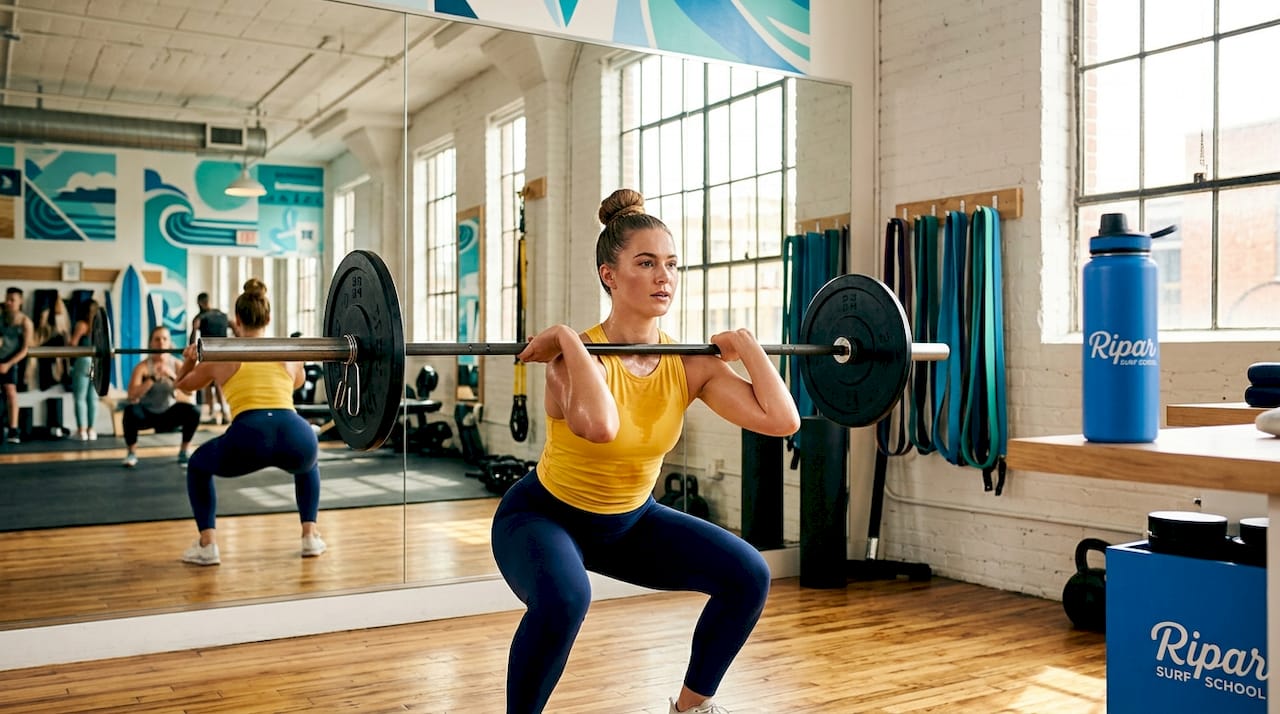
Box jumps and front squats form the backbone of advanced surf power training. For front squats, work in the 4x6 rep range with controlled descent. Feel the quad load at the bottom of the squat. That tension is exactly what fires during a fast pop-up.
2. Box jumps
Explosiveness is the quality that separates surfers who catch waves from surfers who watch them pass. Box jumps train the fast-twitch fibers responsible for a quick, clean pop-up. The movement develops hip extension power that translates directly to getting your feet under you fast when a wave lifts your board.
Use a box height that lets you land soft, with bent knees and controlled balance. Three sets of five reps is the standard starting point. Land quietly. Loud landings mean you are absorbing force with your joints instead of your muscles.
3. Medicine ball slams
Medicine ball slams are a total-body power drill that few surfers think to use. The overhead load and explosive downward drive train the same force chain you use when snapping off the top of a wave. They also condition the thoracic spine to rotate under load, which carries over to cutbacks and off-the-lip moves.
Three sets of eight reps is the typical prescription. The key is full extension overhead before the slam. Rushing the top position kills the power output and the surf-specific benefit.
4. Push-ups with T-rotation
This is the push-up upgrade every surfer needs. At the top of each push-up, you rotate one arm toward the ceiling and hold for a breath. That rotation trains the thoracic spine mobility and shoulder stability you need while paddling and during the pop-up. It also builds the kind of shoulder strength that resists injury over a long session.
Do three sets of eight to ten reps, alternating sides. If regular push-ups feel easy, elevate your feet. If the rotation is shaky, slow it down to three seconds per hold.
5. TRX suspension training
TRX is not just a gym trend. Research shows TRX significantly improves surfing-specific balance in elite surfers compared to traditional balance training, with statistically significant results across static, dynamic, and surfing-specific balance measures. The reason is simple: TRX forces your body to stabilize on an unstable surface, which is exactly what every wave demands.
Use TRX rows to build paddle-specific pulling strength. Use TRX single-leg squats to develop the unilateral leg stability that controls your board through turns. Even TRX planks challenge the core differently than a floor plank because the handles shift with every breath.
Exercise type | Traditional balance training | TRX suspension training |
Stability challenge | Static, predictable surface | Dynamic, constantly shifting load |
Surf transfer | Moderate | High |
Core demand | Low to moderate | High throughout movement |
Injury prevention benefit | Limited | Trains stabilizers proactively |
6. Single-leg deadlifts
Proprioception is the nervous system’s ability to know where your body is in space. Surfers with strong proprioception recover from wobbly moments on the board rather than falling off. Single-leg deadlifts are the most direct way to train this quality under load.
Stand on one leg, hinge at the hip, and lower a light dumbbell toward the floor while the free leg extends behind you. Keep the spine neutral. Three sets of eight per leg, moving slowly. The wobble you feel during the movement is the goal. Your stabilizing muscles are learning to fire correctly.
Pro Tip: Do single-leg deadlifts barefoot or in minimal shoes. Removing the thick sole forces the small muscles in your foot and ankle to work, which is exactly how you feel the board underfoot.
7. Bird-dog
The bird-dog looks easy. It is not. Extending the opposite arm and leg from a tabletop position while keeping your lower back completely still trains anti-rotation core stability. That quality is what keeps your torso controlled during powerful turns and prevents lower back strain during long paddle sessions.
Move slowly through each rep. Pause for two seconds at full extension. Three sets of ten on each side. If your lower back arches or your hips rotate, the weight is too heavy or your mobility is limiting the movement. Scale back and focus on form.
8. Pallof press
The Pallof press is a cable or band exercise where you press a handle straight out from your chest and resist the band’s pull trying to rotate you. That anti-rotation demand is one of the most functional movements in surf fitness training because the ocean constantly tries to pull your body off its axis.
Stand side-on to a cable machine or anchor point with a band. Press out, hold for two seconds, return. Three sets of ten on each side. The exercise looks small. The demand on your obliques and deep core tells a different story.
9. Band external rotation and scapular control work
Shoulder injuries are the most common serious injury in surfing, and most are preventable. External-rotation band work done two to three times per week at 15 to 20 reps builds the rotator cuff endurance that protects you during thousands of paddle strokes.
Add scapular retractions and face pulls to balance the forward-pulling posture that paddling creates. This is not glamorous work. But progressive shoulder conditioning during off-season training prevents the shoulder load spikes that lead to tears and months out of the water.
Pro Tip: Stretch your internal rotators daily. Tight internal rotators are the root cause of most paddling shoulder pain. Cross-body arm stretches held for 30 to 45 seconds per side address this directly.
10. Hip 90/90 switches
Tight hips kill surf performance. A restricted hip joint limits how deep you can crouch, how far you can rotate through a turn, and how cleanly your pop-up foot placement lands. Hip 90/90 switches move both hips through their full internal and external rotation range, which is exactly what surfing demands from both legs simultaneously.
Sit on the floor with both legs bent at 90 degrees. Rotate both hips in one direction, pause, then switch. Move slowly through the range. Do two to three sets of ten switches before every session and again at night if your hips feel tight.
11. The surf RAMP warm-up flow
The Surf RAMP protocol is a readiness sequence covering shoulder prep, thoracic rotation, hip mobility, and slow pop-up practice at 70% effort before any hard training or surfing. The reason it matters: most surfers skip warm-up entirely or do a few arm circles and call it done.
The RAMP works because it activates neuromuscular patterns specific to surfing before asking the body to perform explosively. The slow pop-ups at reduced effort are particularly valuable. Neuromuscular pattern training like this combined with strength work builds functional pop-up power that raw muscle size alone cannot deliver. Foot sequencing, hand placement, hip drive. These details only improve when you practice them deliberately.
A practical surf fitness training workflow
Knowing the exercises is one thing. Knowing how to organize them is what produces results. A recommended weekly structure runs two to three sessions lasting roughly 45 minutes each.
Session phase | Duration | Exercises |
Joint warm-up | 5 minutes | Leg swings, arm circles, thread-the-needle |
Mobility and stability | 10 minutes | Hip 90/90, bird-dog, Pallof press |
Strength and power circuit | 20 minutes | Front squats, box jumps, TRX rows, medicine ball slams |
Cool-down | 10 minutes | Shoulder stretches, hip flexor holds, breathing |
Two strength sessions per week plus one mobility-focused session hits all the fitness components without overloading recovery. Add the Surf RAMP on every day you surf. That combination delivers consistent progress without burning you out.
My honest take on surf fitness and where surfers go wrong
I have watched surfers put in serious gym time and still struggle with the same technical failures in the water. The pattern is almost always the same. They trained muscle groups, not movements.
Building a strong squat is great. But if you never practice a pop-up on land with deliberate foot placement and hip drive, the strength never transfers. Strength without movement pattern practice leaves surfers physically capable but neurologically unprepared for what a wave actually demands.
The other thing I see constantly is shoulder neglect until something hurts. Paddling is repetitive loading under fatigue. The rotator cuff is not built to handle that volume without preparation. I think the 15 minutes a week of band work and scapular exercises is the single highest-return investment in a surfer’s long-term health. Most people only discover this after their first shoulder injury.
What changed performance for the surfers I have worked with most was adding unstable balance training to their programs. TRX and single-leg stability work transformed their board control in ways that flat-ground exercises never did. When your stabilizers learn to fire under shifting load, small corrections on the board become automatic.
Consistency beats intensity every time. Three moderate sessions a week for three months beats two brutal weeks followed by exhaustion. Your body adapts to patterns, not peaks.
— Fernando
Train smarter, then surf better with Riparsurfschool
If these exercises are giving you ideas, imagine having certified instructors put the whole program into practice with you at the beach.

Riparsurfschool has been developing surfers of all levels since 2001 at Praia Areia Branca, near Peniche and Ericeira. Whether you want a private surf lesson tailored to your current fitness and skill level or a group surf camp combining waves, coaching, and yoga sessions for mobility and recovery, the structure is already there for you. The yoga program at Riparsurfschool integrates directly with surf training, covering the hip mobility and shoulder recovery work that makes these exercises even more effective. Ready to put it all together in the water? Book your surf lessons and arrive knowing your body is prepared.
FAQ
What are the best exercises for surf fitness?
Front squats, TRX rows, box jumps, single-leg deadlifts, and band external rotation work cover the key qualities surfers need: power, balance, shoulder endurance, and injury prevention.
How often should surfers do fitness training?
Two to three structured sessions per week covering strength, mobility, and stability work is enough to see clear progress without compromising recovery or time in the water.
Can I do surf fitness exercises at home?
Yes. Many indoor surf fitness exercises require no equipment at all. Bird-dog, push-up to T-rotation, hip 90/90 switches, and resistance band shoulder work all translate perfectly to a home routine.
Why is balance training so important for surfers?
Research shows TRX suspension training produces significantly better surfing-specific balance than traditional training because it replicates the unstable, shifting demands of an actual wave.
How do I prevent shoulder injuries from surfing?
Band external rotation work done two to three times per week at 15 to 20 reps builds the rotator cuff endurance that protects you from the repetitive load of paddling.
Recommended
Comments