

How to Stand Up Surfing: a Beginner's Guide

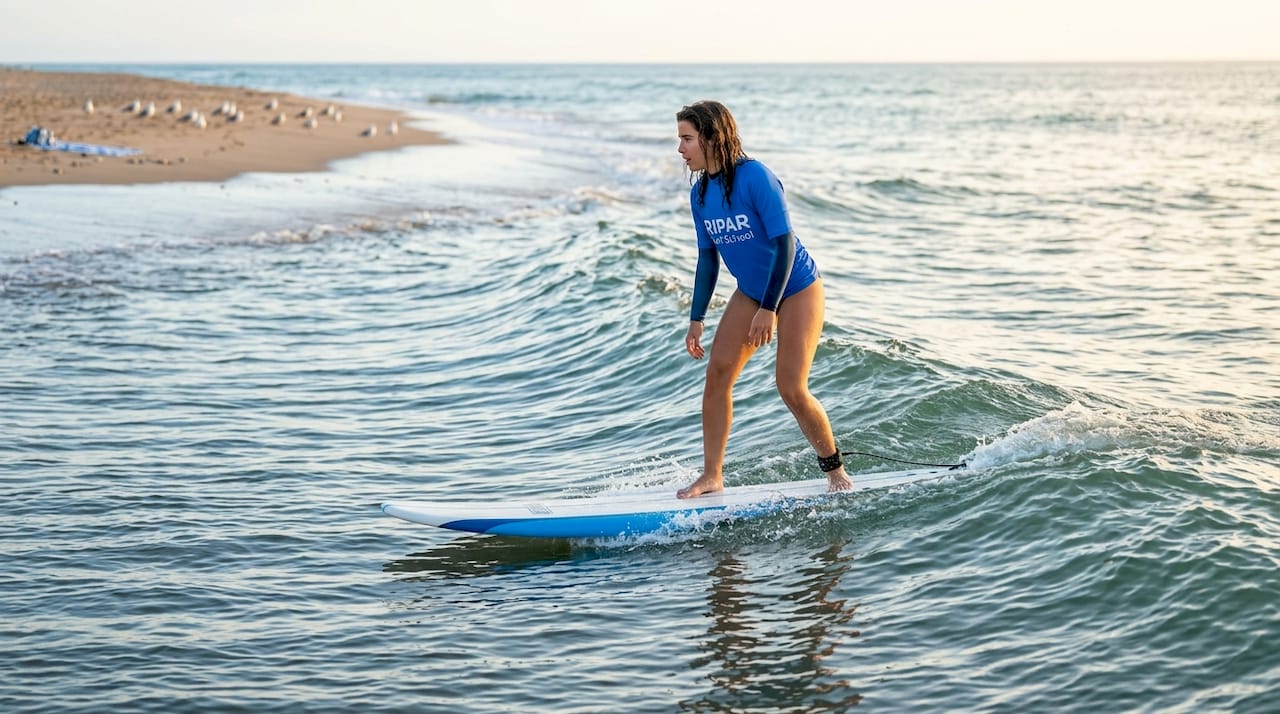
TL;DR:
Learning to stand up on a surfboard is the main challenge for beginners, requiring proper technique and practice. Using a long, stable board and practicing the explosive pop-up on land help build muscle memory essential for water success. Maintaining the correct stance with knees bent, eyes forward, and balanced feet increases stability and reduces falls.
There’s a moment every beginner surfer knows well. You’re lying on your board, the wave lifts you, and your body scrambles to stand up — only to find yourself underwater a second later. Learning how to stand up surfing is the single biggest hurdle between paddling around and actually riding waves. This guide breaks down exactly what you need to know: the right gear, the pop-up technique, proper stance, and how to fix the mistakes that keep most beginners falling flat.
Table of Contents
Key takeaways
Point | Details |
Board size matters | Beginners should use longer, wider boards for stability and better balance when learning to stand. |
The pop-up is everything | Mastering this explosive one-second movement is the foundation of all stand-up surfing technique. |
Stance controls balance | Knees bent, weight centered, and eyes forward are the three non-negotiables of a solid surfboard standing position. |
Land practice pays off | Drilling your pop-up on a yoga mat builds muscle memory that transfers directly to water performance. |
Common mistakes are fixable | Slow pop-ups, locked knees, and looking down are the top three errors beginners make, and all three have straightforward corrections. |
Gear and conditions for beginners
Before you even think about standing up, you need the right board under you. Beginner surfers need boards that are 2 to 3 feet taller than their own height, chosen for their buoyancy and stability rather than performance. A longboard or a foam “softop” in the 8 to 10 foot range gives you a wide, forgiving platform to practice your pop-up without the board squirting out from under you on every attempt.
Here’s what your beginner setup should include:
Surfboard: A longboard or foam top, minimum 8 feet, wide nose and thick rails
Leash: Matches your board length to keep the board close if you fall
Wetsuit: Suited to the water temperature of your location
Surf wax or traction pad: Applied to the deck so your feet actually grip the board
Where you practice matters just as much as what you ride. Look for beaches with small, consistent waves between 1 and 3 feet and a sandy bottom. Sandy bottoms are forgiving when you wipe out, and gentle waves give you enough push to stand without overwhelming you before you’ve got the technique down.
Feature | Beginner setup | Advanced setup |
Board length | 8 to 10 feet | 5’6" to 7’ |
Board width | 22" to 24" | 18" to 20" |
Volume | High (60L and above) | Lower (30 to 50L) |
Wave size | 1 to 3 feet | 4 feet and above |
Bottom type | Sandy | Rocky or reef acceptable |
Pro Tip: Wax the entire top of your board when you’re a beginner, not just the foot zones. Your hands, knees, and feet all need grip during the pop-up.
Mastering the pop-up
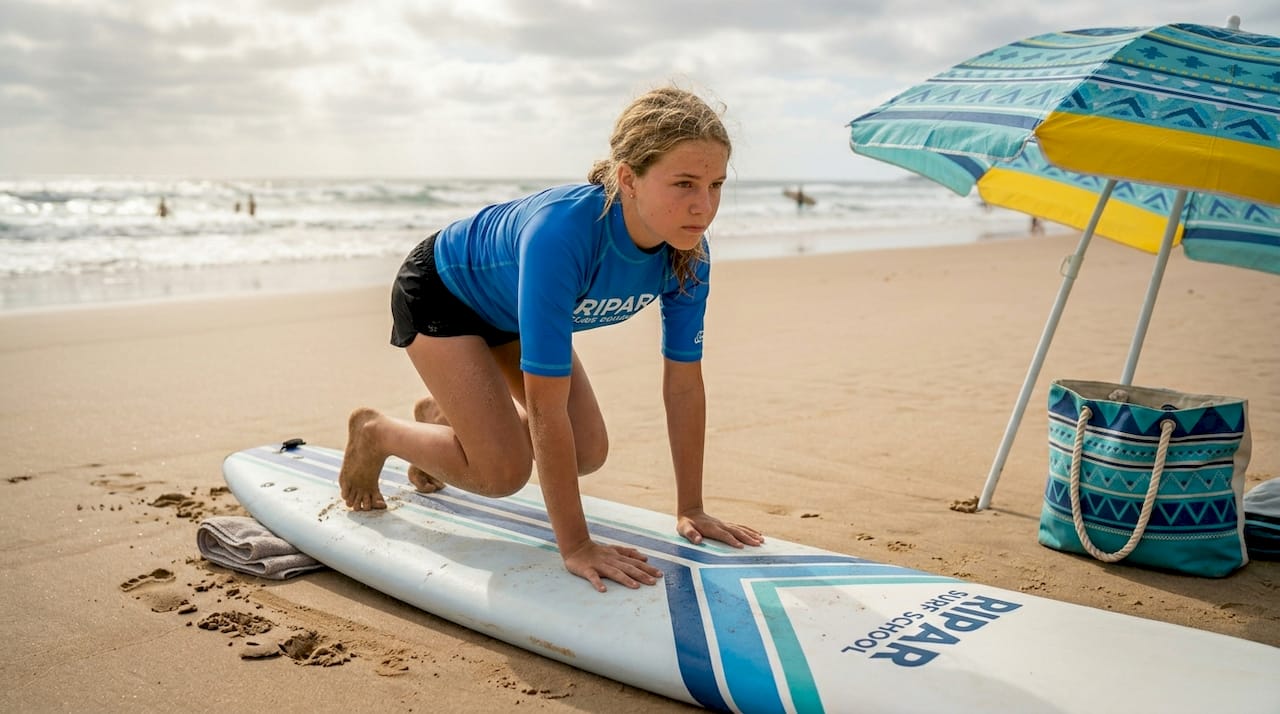
What is pop-up in surfing? It’s the explosive movement that takes you from lying flat on the board to standing upright in under a second. The pop-up takes just over a second to execute, which means there’s no room for hesitation or a slow, cautious climb. You either commit to it or you fall.
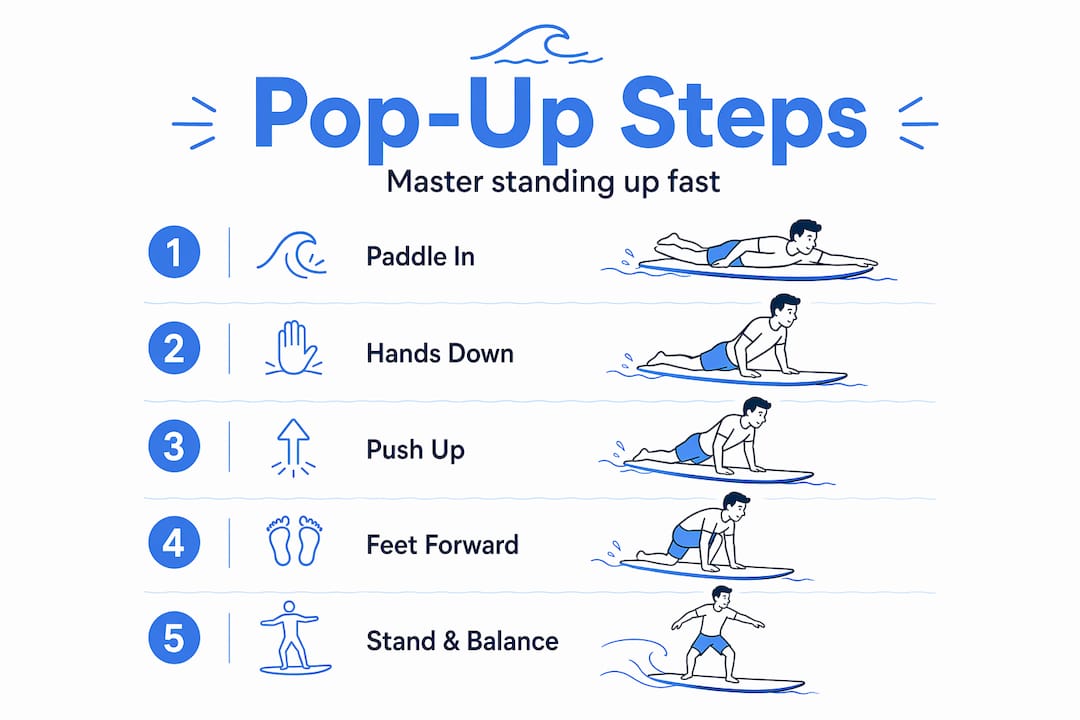
Here is the complete pop-up sequence, step by step:
Lie flat on the board. Your chest should be lifted slightly, abs engaged, and your toes resting on the tail. Position your body so the board’s nose sits about 2 to 3 inches above the water.
Place your hands flat under your shoulders. Hands positioned under your shoulders with elbows close to your ribs give you the most power for the push-up motion.
Paddle hard to match wave speed. You need to be moving at the wave’s pace before you even think about standing up. Three to five strong strokes is usually enough on a beginner wave.
Feel the wave lift the tail. This is your trigger. When the board begins to angle downward with the wave pushing it, that’s your moment.
Execute the push-up explosively. Press your palms into the board and push your entire upper body up in one fluid motion. No hesitation.
Bring your front foot between your hands. Your front foot lands roughly where your hands were, pointing at a slight angle across the board.
Place your back foot over the fins. Your back foot goes near the tail, perpendicular to the stringer. This is your brake and your steering control.
Rise to standing with knees bent. Both feet land simultaneously, or as close to it as possible. Your knees absorb the movement of the wave from the start.
Pro Tip: Practice this pop-up on land using a yoga mat before you ever hit the water. Ten minutes of dryland drills each day will build the muscle memory you need to make the movement automatic under pressure.
The biggest mistake at this stage is treating the pop-up like a slow, careful stand. You’re not getting up from a chair. Think of it as one explosive movement, not three separate ones.
Surfboard standing position and balance
Once you’re on your feet, the work isn’t over. The surfboard standing position you hold in those first seconds determines whether you ride the wave or fall off it.
Your feet should be roughly shoulder-width apart. The front foot angles forward at about 45 degrees, and the back foot sits nearly perpendicular across the board above the fin cluster. This gives you a stable platform that works with the board’s natural flex and response.
Here’s what the right stance looks like in practice:
Do this:
Keep your knees slightly bent at all times to lower your center of gravity and absorb wave energy
Keep your head up and your eyes looking toward the beach or the direction you’re traveling
Spread your arms out naturally at your sides for balance, like a tightrope walker
Engage your core. Your torso does a surprising amount of the stability work
Avoid this:
Standing straight-legged. Locked knees are the fastest route to a wipeout
Looking down at your feet. Your head weight throws off your balance when you look down
Leaning too far back. This stalls the board and kills your momentum
Crossing your feet or placing them too close together
Correct position | Error signal |
Knees bent, weight even | Board wobbles side to side |
Eyes forward, chin up | Head drops, body follows |
Core tight, arms out | Arms pinned to body, upper body rigid |
Front foot angled 45 degrees | Both feet pointing straight forward |
Weight centered over fins area | Nose pearling into the water |
Pro Tip: If you keep falling to one side, check your foot placement first before changing anything else. Ninety percent of balance problems come from feet that are too close together or placed too far forward on the board.
Troubleshooting common mistakes
Even when you know the theory, the water has a way of exposing every flaw. Common mistakes beginners make include locking the knees on landing, looking straight down at the board, and popping up too slowly after the wave has already caught them. All three are fixable with specific corrections.
Here’s a breakdown of the most frequent problems and what actually fixes them:
Slow pop-up: You’re thinking too much. Drill the movement on land until it’s automatic, then trust your body in the water.
Looking down at your feet: Your eyes control your body. Practice keeping your gaze at the horizon during every land drill.
Popping up too early: You haven’t matched wave speed yet. Focus on paddling harder before committing to the stand.
Popping up too late: Timing the pop-up correctly means moving the moment the wave lifts the tail. If you wait for the full drop, you’ve already missed it.
Landing with feet too close together: This is usually nerves. Consciously jump your feet wider than feels comfortable during drills.
Pearling (nose dives into water): You’re positioned too far forward on the board. Slide your body back a few inches before paddling.
Building confidence is as much a part of learning to stand up as the physical technique. Start on the smallest waves you can find. Ride the white water first. There’s zero shame in it. White water is predictable, it pushes consistently, and it lets you practice the pop-up without worrying about timing the wave catch.
Safety reminder: Always wear your leash. A leash matching your board length keeps your board from becoming a hazard to yourself and other surfers when you wipe out. Never surf without one, especially as a beginner.
My honest take on learning to stand up
I’ve been teaching beginners to surf at Riparsurfschool since the early days of the school, and the one thing I’ll tell you is this: the pop-up is deceptive. It looks easy when you watch someone who’s been surfing for years. It feels impossible when you’re the one lying on the board and the wave is coming.
What I’ve seen over and over again is that the students who progress fastest are not the most athletic. They’re the ones willing to fall down 50 times without taking it personally. The pop-up is a learned reflex, not a natural talent. Every surfer you’ve ever admired had to drill that same clumsy movement on a yoga mat before it looked effortless in the water.
The fear is real too. I won’t tell you it isn’t. Wipeouts feel chaotic, especially early on. But what I’ve learned from years of watching beginners transform into surfers is that fear shrinks fast once you get your first real ride. That moment when the board starts moving with the wave and you actually stand up, even for three seconds, it changes the whole experience. You stop being afraid and start being hooked.
My advice: don’t rush the process. Practice your pop-up more on land than you think is necessary. Surf small waves longer than your ego wants to. And find an instructor who will correct your stance in real time rather than just cheering you on from the shore.
— Fernando
Learn to stand up with Riparsurfschool

If you want to move from falling to riding faster than going it alone, Riparsurfschool has been doing exactly that since 2001 on the shores of Praia Areia Branca near Peniche. The certified local instructors work with beginners every day, correcting pop-ups, fixing stance, and teaching you how to read waves in real time. Whether you prefer one-on-one coaching with a private surf lesson or the social energy of a group surf lesson, there’s an option built around where you are right now. Ready to get on your feet? Book your surf lesson and start learning on one of Portugal’s best beginner breaks.
FAQ
What is a pop-up in surfing?
The pop-up is the explosive movement that takes a surfer from lying prone on the board to standing upright in under two seconds. It requires coordinated arm push, foot placement, and balance all in one fluid motion.
How long does it take to learn to stand up surfing?
Most beginners can get to their feet on small waves within one to three lessons with proper instruction. Consistent practice of the pop-up on land and in white water speeds up the process significantly.
What is the correct surfboard standing position for beginners?
Feet should be shoulder-width apart, front foot angled at roughly 45 degrees near the center of the board, and back foot positioned above the fins. Knees stay bent and eyes stay forward at all times.
Why do I keep falling when I try to stand up on a surfboard?
The most common causes are a slow or hesitant pop-up, locked knees on landing, and looking down at the board instead of forward. Drilling the pop-up on land and focusing on explosive movement corrects most of these issues.
Do I really need a leash as a beginner?
Yes, without exception. A leash keeps your board attached to your ankle when you fall, preventing the board from hitting other surfers and letting you recover quickly without swimming after it each time.
Recommended
Comments