

What Is a Surfari? the Traveler's Real Answer


TL;DR:
A surfari is an expedition where surfers actively seek ideal wave conditions by relocating based on forecasts, not a fixed beach vacation. It can also describe hybrid trips combining surfing with wildlife safaris, especially in South Africa, offering diverse adventure experiences. To ensure a genuine surfari, travelers should ask operators about their flexibility in changing locations according to surf conditions and avoid fixed itineraries marketed as surfaris.
If you’ve been searching for what is a surfari and walking away more confused than before, you’re not alone. The term gets tossed around loosely in travel brochures, surf camp websites, and social media posts, often meaning something slightly different each time. At its core, a surfari is an expedition where surfers travel in search of ideal wave conditions, much like hunters tracking game across open terrain. But the word has evolved. Today it can also describe a hybrid adventure that blends surfing with African wildlife experiences. This article untangles both meanings so you know exactly what you’re signing up for.
Table of Contents
Key takeaways
Point | Details |
Surfari definition | A surfari is a journey or expedition in search of ideal surf conditions, not just a fixed beach vacation. |
Two distinct types | Surfaris can mean condition-hunting surf travel or a hybrid surf-and-wildlife safari trip, especially in South Africa. |
Not all surfaris are equal | Some operators use the term loosely; always confirm whether the itinerary actually moves based on surf forecasts. |
Planning matters | Ask specific questions about wave-hunting flexibility, wildlife activity scheduling, and what happens on flat days. |
Portugal as a base | Portugal’s Atlantic coastline offers consistent swells and multiple surf breaks, making it an ideal surfari starting point. |
What is a surfari? The definition and origins explained
The word itself is a portmanteau. Surfari blends “surf” and “safari”, where safari traces its roots through Swahili back to the Arabic word safar, meaning journey or travel. That linguistic heritage matters, because a safari was never just about the animals. It was about the act of traveling, of going out in search of something. Surfari borrows that same spirit and applies it to wave hunting.
Wiktionary defines surfari as a noun meaning “a hunt for good surfing conditions,” with the surfers on such a hunt called “surfaris” themselves. Oxford takes it a step further. The Oxford definition of surfari describes it as “a journey made by surfers in search of good conditions for surfing, or to visit several beaches suitable for surfing.” That phrase “visit several beaches” is the key detail most people miss.
Here is what separates a surfari from a standard surf trip:
A surf trip might mean flying to Bali and surfing the same break every morning for two weeks.
A surfari involves actively moving. You read the forecast, you assess the swell direction, and you relocate to where the waves are best.
The traveler becomes a participant in the hunt, not just a passenger at a fixed resort.
The journey and expedition ethos from traditional African safaris transfers directly into how surfers plan and execute these trips.
The surfari mindset is fundamentally different from the “book a resort and show up” approach. It rewards preparation, flexibility, and a willingness to adapt.
How surfari trips actually work in practice
Understanding the surfari definition is one thing. Seeing how it plays out on the ground is another. In practice, a surfari trip is built around surf forecasting, not a rigid calendar. Operators and experienced surfers use apps and meteorological data to monitor incoming swells, and then the itinerary adjusts accordingly.
Here is a realistic breakdown of how a well-run surfari unfolds:
Pre-trip scouting. Before departure, guides assess the seasonal swell patterns for the region. They know which spots fire in which wind directions and at what tidal stages.
Flexible home base or mobile camp. Some surfaris operate from a central lodge and day-trip to multiple breaks. Others involve van-based or boat-based travel, sleeping in different locations as the waves demand.
Daily forecast checks. Every morning, the guide reviews the overnight data. The group heads to the spot that matches the current swell size, wind, and tide.
Backup plans. Good operators always have multiple spots mapped for different conditions. If the primary spot closes out, there’s a secondary and a tertiary option ready.
Cultural integration. Evenings are often spent in local towns, eating at family-run restaurants, and connecting with local surf communities rather than retreating to resort bubbles.
A common misconception about surfaris is that they are simply a fancier name for any group surf vacation. They’re not. The defining feature is active condition-hunting. Without that, you have a surf trip, not a surfari.
Pro Tip: Before booking anything labeled a surfari, ask the operator directly: “What happens if the surf is flat at our primary location? Do we relocate?” If they hesitate or say the itinerary is fixed regardless of conditions, you’re looking at a surf trip with a marketing label, not a true surfari.

The hybrid surfari adventure: surfing meets wildlife
Here is where the surfari definition expands into something genuinely exciting for adventure travelers who don’t necessarily identify as hardcore surfers. Over the last decade, a new category of surfari travel has grown significantly, particularly centered on South Africa. These trips combine quality surf sessions at world-class breaks with full game reserve wildlife experiences.
A hybrid surfari in South Africa might look like this:
Part of the trip | What you’re doing |
Morning surf session | Riding waves at breaks like Jeffreys Bay or Cape St. Francis |
Afternoon game drive | Tracking lions, elephants, and rhinos in a private reserve |
Evening | Sundowner drinks with ocean or bushveld views |
Full day options | Whale watching, Great White shark cage diving, cultural township tours |
South Africa is uniquely positioned for this kind of combination travel because world-class surf and major wildlife reserves exist within a few hours of each other along the Eastern Cape coastline. Jeffreys Bay, known globally as one of the longest and most consistent right-hand point breaks on the planet, sits close to safari destinations like Addo Elephant National Park.
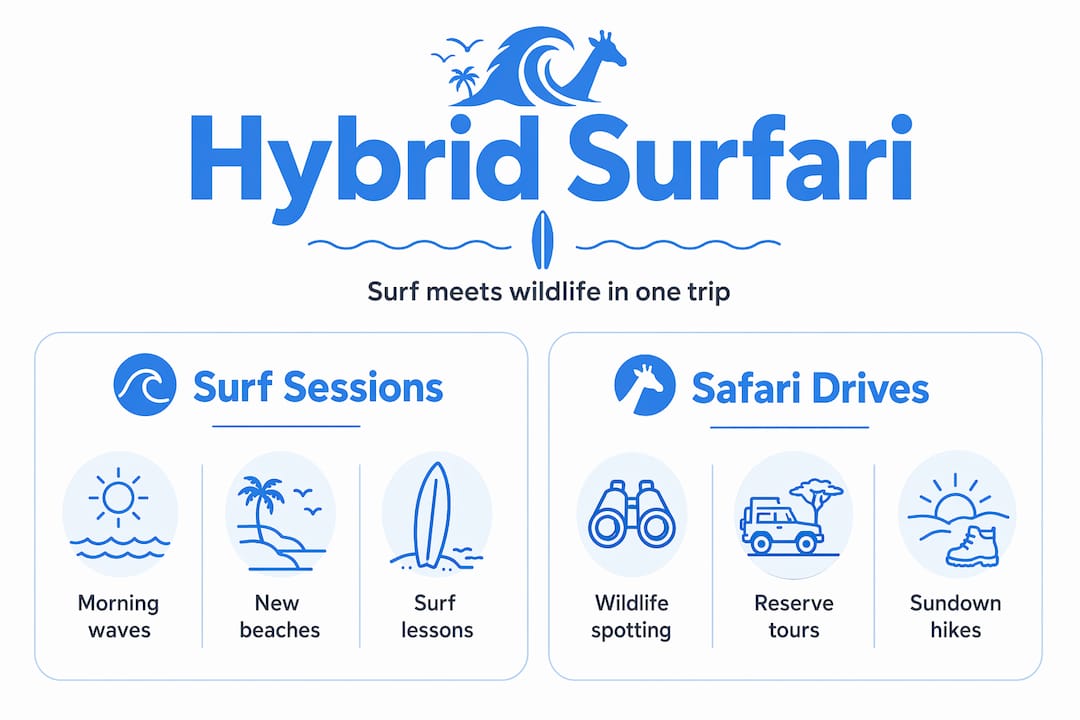
The hybrid surfari trip offers the chance to spot lions, elephants, and rhinos in African reserves while spending mornings in the water chasing excellent waves. For non-surfers traveling with surfing partners, this format solves a real problem. Everyone gets something extraordinary.
That said, there are real scheduling tensions to manage. Balancing surf times with wildlife drives takes deliberate planning, because the best surf windows and the best game viewing windows often overlap in the early morning. If your operator doesn’t coordinate this carefully, you’ll end up compromising both experiences rather than maximizing either.
Planning your surfari: questions to ask before you book
Good surfari trip planning starts with knowing the right questions, not just the destinations. Whether you’re chasing Atlantic swells in Europe or planning a bush-and-beach combination in South Africa, the preparation process is similar.
Questions to ask any surfari operator:
Does the itinerary relocate based on surf forecasts, or is every location pre-fixed from day one?
How many surf hours per day are guaranteed, and what happens on flat days?
If it’s a hybrid trip, how are mornings allocated between surf sessions and wildlife drives?
What’s the group size? Smaller groups allow faster, more flexible decision-making when conditions shift.
What level of experience do participants need? Some surfaris target experienced surfers only, while others welcome beginners with instruction built in.
Packing and preparation specifics:
Pack for two very different environments if you’re doing a hybrid surfari. Wetsuits and surf hardware on one side, neutral-colored, lightweight clothing suitable for game reserves on the other. Bright colors can disturb wildlife, and saltwater-soaked neoprene doesn’t work well in an open-air game vehicle.
Pro Tip: If you’re new to surfing and want to join a surfari, look for operators who include surf instruction as part of the package rather than assuming prior ability. Learning in a structured way during a multi-spot trip dramatically increases how much you get out of each session at different breaks.
Learning the fundamentals before embarking on a multi-spot trip also matters. Understanding how to read a break, how rips work, and how to position yourself on a board will make every new spot feel less chaotic. Surf lessons Portugal at an established school before your trip is one of the most practical investments you can make.
Understanding what a surf lodge experience actually involves also helps you evaluate surfari accommodations more critically when you’re comparing options and reading between the marketing lines.
My take on how the surfari label is being misused
I’ve spent years watching the surf travel industry and, more directly, working with the kinds of travelers who show up at the Portuguese coast wanting more than just a week on the same beach. Here’s what I’ve noticed: the word surfari has become a marketing shortcut.
Operators slap it onto fixed-location group surf trips because it sounds exciting and adventurous. But when you press them for details, there’s no real wave-hunting happening. The itinerary is identical whether the surf is pumping or flat. That dilutes the entire concept.
The real value of a surfari, in my experience, is the unpredictability. The best surf days I’ve been part of happened because someone made a call at 6am to change the plan and drive an hour in a different direction. That spontaneous decision-making is what separates a genuine surfari from a packaged surf holiday.
Where travelers go wrong is expecting the word surfari to guarantee adventure automatically. It doesn’t. The guarantee comes from the operator’s commitment to actually chasing conditions. Scrutinize the surfari marketing you encounter and ask for specifics. A confident operator with real surfari spirit will welcome those questions. One who stumbles over them is telling you something important.
My advice: find people who love the hunt as much as you do and let that shared obsession drive the itinerary.
— Fernando
Experience surfari-style surf travel with Riparsurfschool

If the surfari spirit resonates with you and you want to build that foundation before or during your Atlantic surf travel, Riparsurfschool at Praia Areia Branca offers exactly the kind of environment where genuine surf exploration starts. Located between Peniche and Ericeira, two of Europe’s most consistent and celebrated surf zones, the school runs group surf lessons and private surf instruction for all levels. Certified local instructors who know the coastline intimately can introduce you to multiple breaks and help you read conditions the way a real surfari demands. Browse the surf camp options and book your sessions online to start planning an Atlantic surf experience that goes well beyond the basics.
FAQ
What does surfari mean exactly?
A surfari is defined as a hunt or journey in search of good surfing conditions, blending the words “surf” and “safari.” The Oxford Dictionary expands this to include traveling between multiple surf-suitable beaches.
How is a surfari different from a regular surf trip?
A regular surf trip typically involves staying in one location and surfing the same break repeatedly. A true surfari involves actively relocating based on surf forecasts to find the best conditions available.
What is a hybrid surfari?
A hybrid surfari combines surf sessions at quality breaks with traditional safari wildlife viewing, most commonly in South Africa. Travelers surf world-class waves in the morning and may track elephants or lions in a nearby game reserve in the afternoon.
What should I ask before booking a surfari?
Ask whether the itinerary actually relocates based on real-time surf conditions or whether locations are fixed in advance regardless of forecasts. This single question will tell you whether you’re booking a genuine surfari or just a surf trip with an adventurous label.
Do I need to be an experienced surfer to do a surfari?
Not necessarily. Some surfaris cater specifically to beginners and include instruction, while others target experienced surfers only. Check the skill level requirements before booking, and consider taking lessons beforehand to maximize what you get from each new break.
Recommended
Comments