

Coastal Erosion Surfing: What Every Surfer Must Know
- Fernando Antunes

- Jun 6
- 9 min read

TL;DR:
Coastal erosion significantly alters surf breaks by shifting sandbars and changing wave quality, impacting surfers worldwide. Human structures like seawalls and jetties often exacerbate erosion, reducing surfable areas and increasing hazards. Climate change accelerates shoreline retreat, threatening iconic breaks and emphasizing the need for surfers’ advocacy in coastal management.
Coastal erosion surfing is the practice of surfing at breaks where wave form and sand-bottom geometry shift continuously due to net sediment loss along the shoreline. This is not a niche concern for scientists. It directly affects every surfer who has paddled out to a favorite break and found the waves unrecognizable compared to last season. Geoscience Australia defines coastal erosion as the net removal of sediments or bedrock from the shoreline, and that removal changes wave quality in ways that range from subtle to dramatic. Understanding how erosion works, what it does to surf breaks, and how human interventions complicate the picture gives you a real edge, both in the water and as a steward of the coasts you love.
What is coastal erosion surfing and why it changes your waves
Coastal erosion is the process by which wave action, currents, storms, and human activity strip sediment from a shoreline faster than natural processes can replace it. For surfers, the consequence is direct. Surf breaks depend on nearshore sediment profiles, and when sandbars shift position relative to tide and swell angle, the location and quality of breaking waves changes even when swell size stays constant.
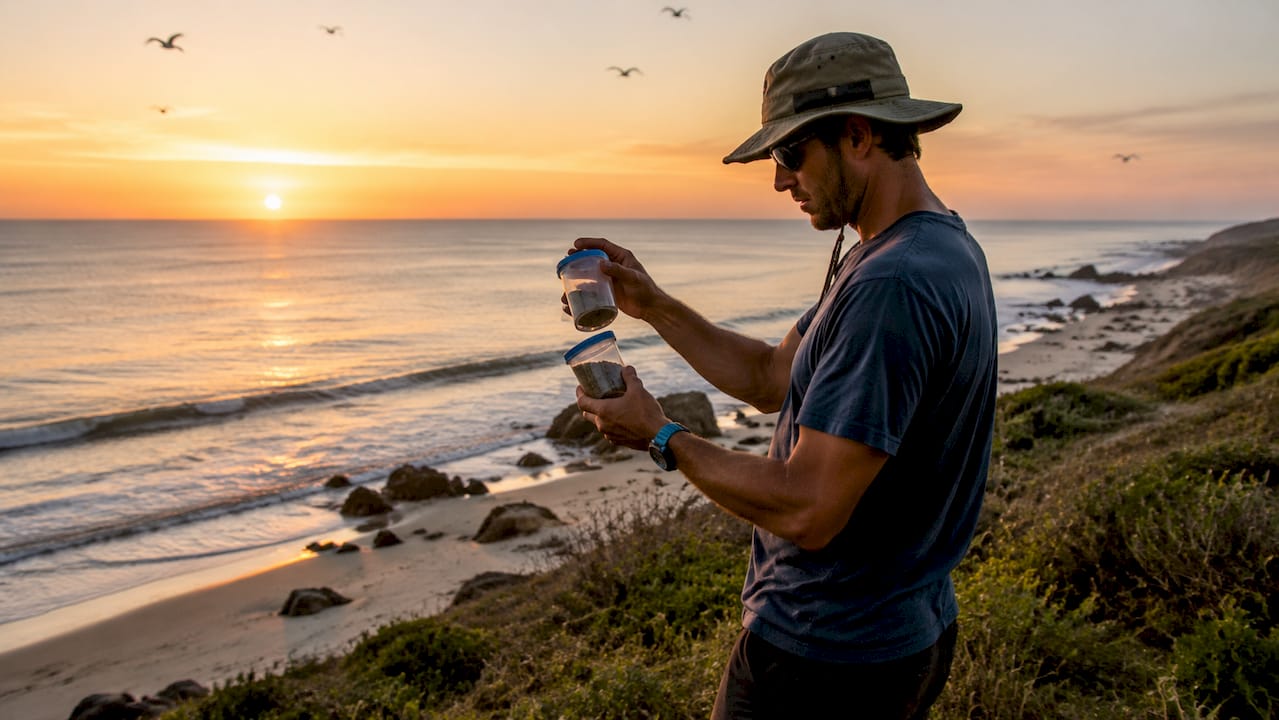
The primary drivers of sediment loss are wave energy and longshore currents. Waves arriving at an angle to the beach push sand along the coast in a process called longshore drift. When that sand leaves the system faster than it arrives, the beach narrows and the underwater profile flattens. Flatter profiles produce slower, mushier waves. Steeper profiles, by contrast, concentrate wave energy and produce the hollow, punchy breaks that surfers seek.
Tidal range also plays a role. On beaches with large tidal swings, the same sandbar can produce excellent waves at mid-tide and close-out sets at high tide. Erosion shifts those bars seaward or eliminates them entirely, compressing the window of surfable conditions.
Storm swells carry sand offshore, creating what researchers call an “erosive” beach profile
Calmer conditions allow sand to settle back over weeks to months in a process called accretion
Sediment grain size determines how quickly a beach recovers: coarser sand settles faster than fine sand
Tidal effects amplify or dampen the impact of bar position on wave shape
Pro Tip: After a major storm, track the sandbar recovery at your local break over the following four to six weeks. Experienced surfers who monitor bar position often score the best sessions during the rebuilding phase, when bars are steep and waves are hollow before the profile flattens again.
How does coastal erosion affect surfers at real breaks
The impact of coastal erosion on surf breaks is not theoretical. At Santa Cruz, California, cliffs erode 6 to 12 inches yearly, adding rocky debris to the surf zone and altering the sand interactions that shape iconic waves. Surfers at breaks like Pleasure Point report changes in wave shape and new underwater hazards that were not present a decade ago.
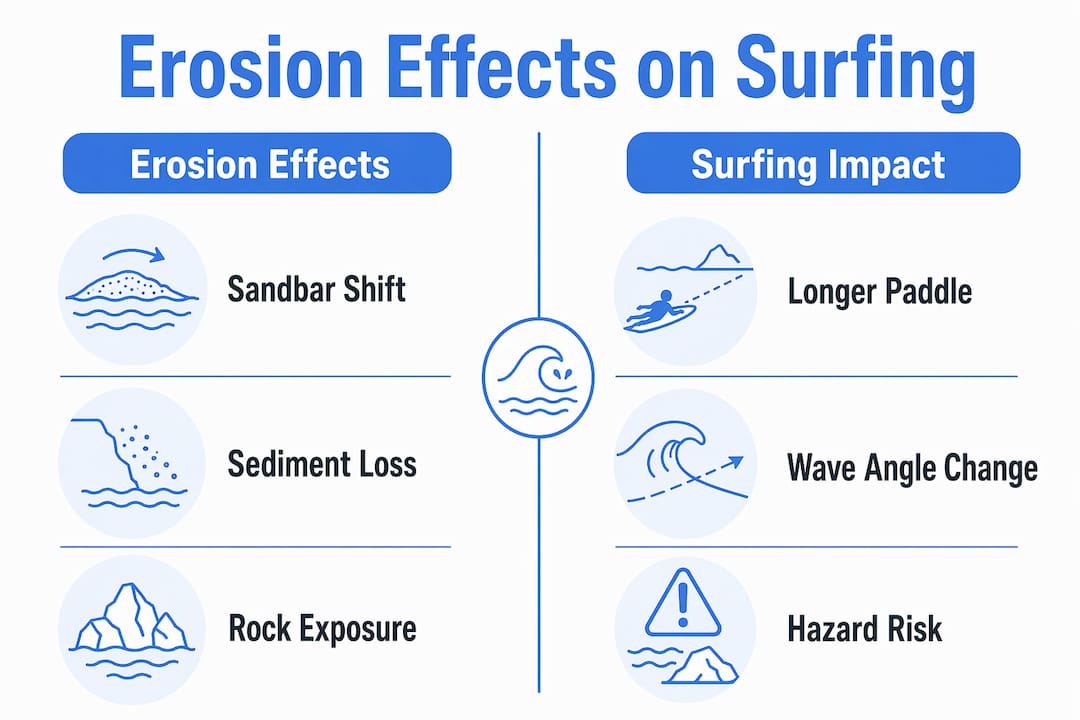
Sand depletion shifts the break point of waves. When a sandbar moves seaward due to erosion, waves that once broke close to shore now break further out, requiring longer paddle-outs and producing different ride lengths. When bars disappear entirely, waves break directly onto rock or reef, increasing injury risk and reducing surfability for all but expert surfers.
The table below summarizes the most common erosion-driven changes to surf conditions and their practical effects on surfing.
Erosion effect | Impact on surfing |
Sandbar migration seaward | Longer paddle-out, altered wave angle |
Sand depletion over reef | Shallower water, higher injury risk |
Cliff debris in surf zone | New underwater obstacles, changed wave shape |
Flattened beach profile | Slower, mushier waves with less power |
Narrowed beach width | Reduced safe landing zone for wipeouts |
Surf conditions fluctuate with sediment suspension and bar reconstruction timelines, meaning surfers often experience weeks of poor waves during the recovery phase after a major erosion event. This is not random bad luck. It is a predictable consequence of sediment dynamics that experienced surfers learn to read.
Pro Tip: If you are surfing near eroded coasts, always walk the beach at low tide before paddling out. Exposed rock shelves and debris fields that are invisible at high tide become obvious at low water, giving you a clear picture of what lies beneath the break.
Natural erosion vs. engineered interventions: what surfers need to know
Hard coastal structures are built to protect property, but their effects on sediment transport and surf quality are often severe and long-lasting. Seawalls, jetties, and groynes interrupt the natural flow of sand along the coast. Hard structures like seawalls can accelerate erosion on the downdrift side of a barrier by blocking the sediment supply that would otherwise replenish that stretch of beach.
The case of Puerto Escondido in Mexico illustrates this clearly. A jetty built near the famous Zicatela break disrupted sand transport, reducing the effective break range from roughly 50 yards to roughly 20 yards over several decades. A world-class wave was narrowed by engineering designed to serve a different purpose entirely. The surfers who depended on that break had no seat at the planning table.
Intervention type | Intended purpose | Effect on surf breaks |
Seawall | Protect shoreline property | Reflects wave energy, accelerates downdrift erosion |
Jetty | Stabilize harbor entrance | Traps sand, reduces break range and wave quality |
Groyne | Retain sand on updrift beach | Starves downdrift beaches of sediment |
Artificial reef | Enhance wave shape and reduce erosion | Can improve surf quality if well-designed |
Beach nourishment | Restore sand volume | Temporary fix; can alter sandbar geometry |
Artificial reefs represent a more nuanced option. When designed with surf quality in mind, they can concentrate wave energy and produce consistent breaks while also reducing erosion by dissipating wave energy before it reaches the shoreline. The Narrowneck artificial reef in Queensland, Australia, is one of the most studied examples, though results have been mixed in terms of wave quality versus erosion control. The lesson is that coastal engineering and surf amenity are not automatically in conflict, but they require deliberate coordination to align.
Poorly sited hard structures are the single largest human cause of localized surf break degradation
Beach nourishment projects can temporarily restore sand volume but often alter sandbar geometry in ways that change wave character
Surfer advocacy groups like Save The Waves Coalition have successfully influenced coastal planning decisions in multiple countries
Nature-based solutions such as dune restoration and wetland preservation are increasingly favored over hard engineering for their lower long-term costs and better ecological outcomes
Future outlook: sea level rise, climate change, and surf zone management
Climate change is not a distant threat to surf breaks. Under high emissions scenarios, sea level rise is projected to cause extensive coastal erosion and significant land loss by 2150, putting roughly half a million people at risk worldwide and threatening the coastal habitats that underpin surf ecosystems. For surfers, this means that breaks which exist today may be fundamentally altered or lost within a generation.
Shoreline retreat accelerates as sea levels rise because higher baseline water levels allow waves to reach further inland and attack previously stable dune systems. Dunes are the natural buffer between the ocean and the land. When they erode, the beach narrows, the underwater profile changes, and the surf break moves or disappears. Coastal erosion research increasingly points to dune restoration as one of the most cost-effective responses available to coastal communities.
Community responses are gaining momentum across surfing regions. Dune planting programs in Portugal, Ireland, and New Zealand have demonstrated measurable reductions in shoreline retreat rates. Managed retreat, where infrastructure is relocated away from eroding coastlines rather than defended in place, is gaining acceptance in planning circles as a long-term strategy. Surfers have a direct stake in these decisions and an increasingly recognized voice in shaping them.
Emerging monitoring tools are changing how surf zones are managed. LiDAR surveys, drone-based photogrammetry, and citizen science programs that engage local surfers in regular beach profiling are producing higher-resolution data on sediment dynamics than was possible a decade ago. Tracking sandbar position and morphology is now recognized as a practical tool for forecasting surf conditions after storms, not just for scientific research.
Dune restoration reduces shoreline retreat and preserves the sediment supply that feeds sandbars
Managed retreat protects long-term surf amenity by removing hard structures that accelerate erosion
Surfer-led monitoring programs generate data that improves both coastal management and surf forecasting
Sustainable surf tourism models that limit coastal development pressure are gaining traction as a conservation strategy
Key takeaways
Coastal erosion is the defining environmental challenge for surf breaks worldwide, and surfers who understand sediment dynamics are better equipped to adapt, advocate, and protect the waves they depend on.
Point | Details |
Erosion changes wave quality directly | Sandbar migration and sand loss alter where and how waves break, independent of swell size. |
Storms cause rapid erosion with slow recovery | Beach profiles can take weeks to months to rebuild after major swells, producing poor surf conditions. |
Hard structures often worsen erosion | Seawalls and jetties disrupt sediment flow and can degrade surf breaks downdrift of the structure. |
Sea level rise threatens iconic breaks | Projections show significant land loss and shoreline retreat by 2150 under high emissions scenarios. |
Surfers are effective coastal advocates | Local surf knowledge and citizen monitoring programs contribute meaningfully to coastal management decisions. |
Why surfers belong at the coastal management table
I have been watching the beach at Praia Areia Branca for over two decades, and the changes are not subtle anymore. Sandbars that used to hold their shape through winter now shift after every significant swell. The left-hand break that was reliable in October has moved 30 meters seaward in the past five years. These are not abstract statistics. They are the difference between a session worth waking up at 5 a.m. for and a paddle-out that ends in frustration.
What I find consistently undervalued in coastal management discussions is the depth of observational knowledge that regular surfers carry. A surfer who has been riding the same break for ten years has a mental archive of sandbar positions, seasonal patterns, and storm recovery timelines that no satellite survey can replicate. That knowledge is genuinely useful to coastal engineers and planners, but it rarely gets into the room where decisions are made.
The uncomfortable truth is that most coastal defense projects are designed without any input from the surf community, and the results reflect that gap. The Puerto Escondido jetty story is not an anomaly. It is a pattern. Hard structures get approved because the people who benefit from them, property owners and port authorities, are organized and present in planning processes. Surfers, as a group, are not.
Organizations like Save The Waves Coalition and Surfrider Foundation have started to change this, and their track record shows that surf community advocacy works when it is sustained and specific. The nature-friendly surf habits that protect eroding coasts start with individual behavior, but they scale through collective action. Every surfer who shows up to a coastal planning meeting, joins a beach monitoring program, or supports dune restoration work is doing something that matters beyond their own sessions.
— Fernando
Surf Portugal’s best breaks with Riparsurfschool

Portugal’s Atlantic coastline near Peniche and Ericeira is one of Europe’s most dynamic surf environments, shaped by exactly the sediment processes this article describes. At Riparsurfschool, based at Praia Areia Branca since 2001, certified local instructors teach you to read shifting sandbars and adapt your surfing to breaks that change with every season. Whether you are a complete beginner or an intermediate surfer looking to sharpen your technique on real Atlantic waves, the team adjusts every lesson to the conditions on the day. Book your surf lessons now and experience Portugal’s coast with instructors who know every sandbar shift by heart. Group sessions and private surf lessons are available year-round.
FAQ
What is coastal erosion surfing?
Coastal erosion surfing refers to surfing at breaks where wave shape and quality change because the shoreline is losing sediment and the nearshore sand-bottom geometry is shifting. Geoscience Australia defines coastal erosion as the net removal of sediments or bedrock from the shoreline, which directly alters wave-breaking patterns.
How does coastal erosion affect surfers practically?
Erosion moves or eliminates sandbars, shifts break points seaward, exposes reef and rock, and introduces debris into the surf zone. Surfers experience this as changed wave shape, longer paddle-outs, reduced surfable windows, and increased underwater hazards.
What causes coastal erosion at surf breaks?
The primary causes are wave action, longshore currents, storm swells, and human structures like seawalls and jetties. Storms strip sand offshore rapidly, while hard structures block the natural sediment flow that would otherwise replenish eroded beaches.
Can coastal erosion be reversed or managed?
Natural accretion restores some sand after storms, but the recovery timeline ranges from weeks to months. Longer-term management strategies include dune restoration, beach nourishment, artificial reefs, and managed retreat, each with different trade-offs for surf quality and coastal protection.
Will climate change make coastal erosion worse for surfers?
Sea level rise under high emissions scenarios is projected to cause extensive shoreline retreat and land loss by 2150, threatening surf breaks worldwide. Higher baseline water levels allow waves to attack dune systems that currently buffer beaches, accelerating the erosion that changes surf conditions.
Recommended
Comments