

7 Must-Know Surfer Habits for Skills and Safety

TL;DR:
Progress in surfing depends on consistent habits like pre-surf routines, land pop-up practice, and respectful etiquette. Building mental and physical discipline enhances safety, confidence, and enjoyment in every session. Ripar Surf School provides structured coaching to help beginners develop these essential habits for long-term progress.
Most beginner and intermediate surfers plateau or risk injury not because they lack enthusiasm or the right board, but because they skip the small, repeatable habits that experienced surfers treat as non-negotiable. Progress in surfing is rarely about one magic session or a sudden breakthrough. It builds quietly, session by session, through consistent routines, smart preparation, and a respectful approach to the ocean and the people in it. This article walks you through seven habits that cover everything from your morning warm-up to your mindset in the water, so you can surf better, safer, and with a lot more fun.
Table of Contents
Key Takeaways
Point | Details |
Pre-surf routines matter | A structured routine boosts safety and sets you up for better sessions. |
Practice off the water | Land-based pop-up drills build fast reactions and reduce missed waves. |
Surf etiquette is essential | Knowing and following lineup rules keeps everyone safer and happier. |
Communication prevents incidents | Speaking up and controlling your board protects you and those around you. |
Master your mindset | A calm, focused mind improves both your performance and your learning. |
Habit 1: Consistent pre-surf routine
Every great session starts before you even touch the water. A repeatable pre-surf routine is the single most powerful habit you can build as a beginner, because it removes guesswork and puts your body and mind in the right state to learn fast.
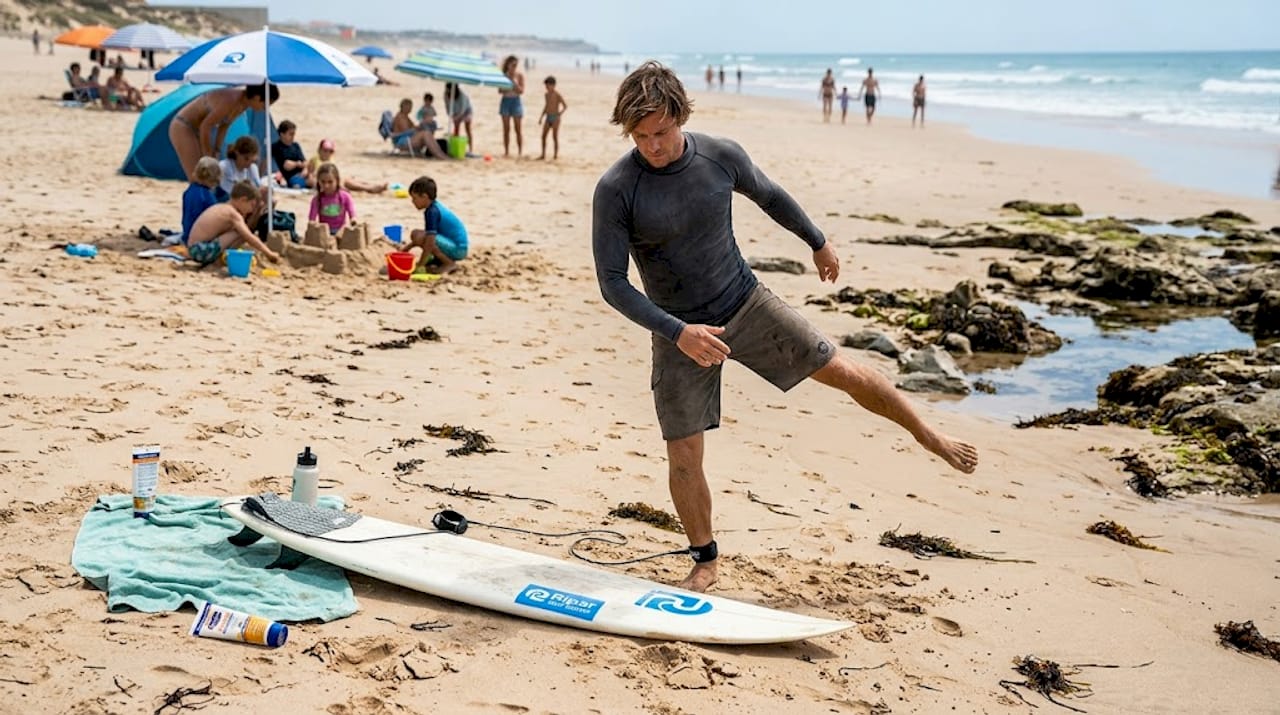
A solid pre-surf routine follows a clear sequence: first check ocean conditions and hazards, then warm up the joints you use most (shoulders, hips, and ankles), add a brief mental regulation step, and finish with at least one pop-up rehearsal on dry land. Skipping any of these steps raises your injury risk and makes your session harder to control.
Here is how to structure it:
Check conditions and hazards. Scan for rip currents, rocks, other surfers, and the direction the waves are breaking. The importance of conditions checks cannot be overstated for safety, especially on unfamiliar beaches.
Joint warm-up. Rotate your shoulders 10 times each direction, open your hips with a deep lunge, and circle your ankles. Spend at least five minutes here.
Mental regulation. Take three to five slow breaths, visualize yourself paddling into a wave and popping up cleanly, and set a simple intention for the session.
Pop-up rehearsal. Lie flat on the sand, do two to three clean pop-ups, and check your foot placement before you paddle out. This step is covered in more detail in the next section, and it is directly supported by beginner lesson routines used by experienced instructors.
“A repeatable pre-surf routine that checks conditions, warms up joints used in paddling and pop-up, and includes a mental regulation step is one of the most underused tools for consistent surf progression.” Surfhungry.com
Surfers who skip the warm-up often pull muscles in their shoulders or lower back within the first 20 minutes. Beyond injury, cold muscles react slower, which means slower pop-ups and missed waves. Make sure you also understand the surf session safety protocols in place at any beach or surf school you visit, because conditions rules vary by location.
Pro Tip: Practice your pop-up on sand or at home before every session. Even two repetitions on the beach will fire up your muscle memory and make your first wave cleaner.
Habit 2: Practicing pop-up mechanics beyond the water
Once your pre-surf routine is solid, it is time to go deep on the pop-up itself. This is where many beginners stall, thinking that more time in the water is the only way to improve. It is not. In fact, rehearsing pop-up timing in calm, controlled conditions on land is one of the best ways to eliminate hesitation and build automatic movement patterns.
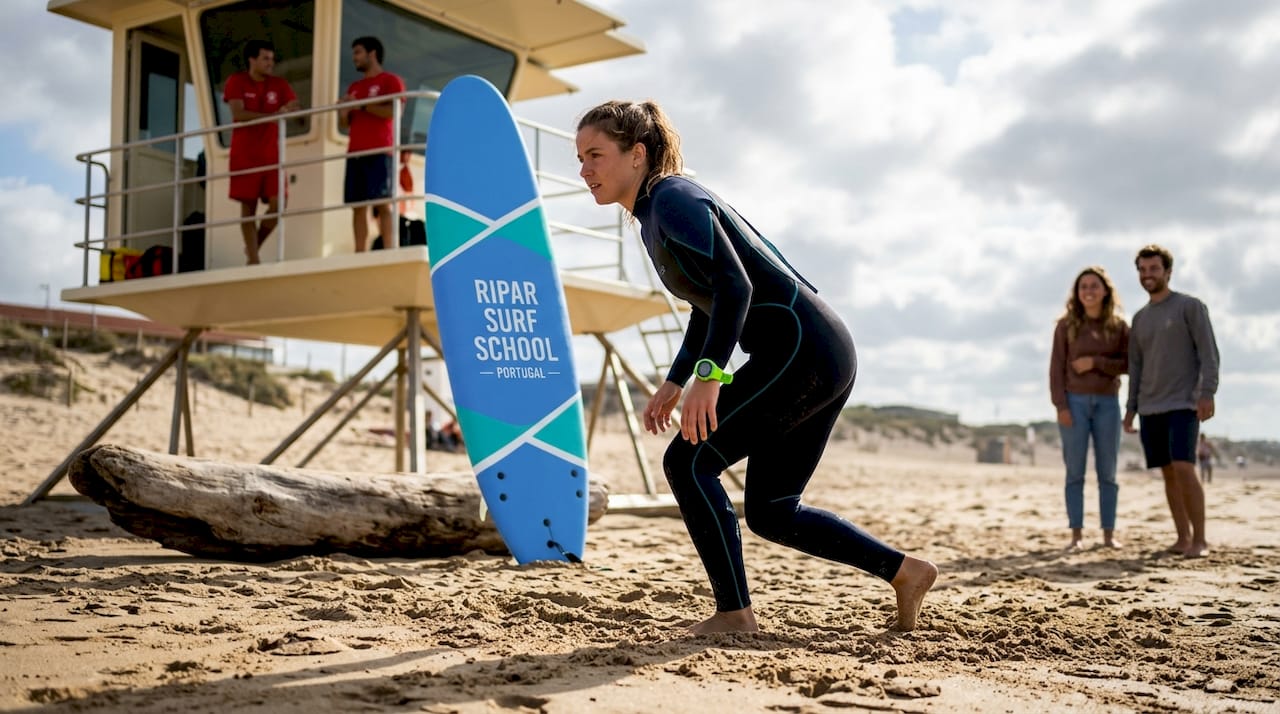
Hesitation at the moment of takeoff is the number one cause of missed waves, not lack of strength. When you practice on land, you train your brain to commit without overthinking. That commitment transfers directly to the water.
Where you can train your pop-up off the water:
On the beach. Sand gives you immediate feedback on foot placement and posture.
On a yoga mat at home. Great for daily repetitions before and after work.
On a smooth garage or living room floor. Lets you focus on hand placement and speed.
In a gym or surf training class. Adds resistance and variety to the movement.
Think about it this way: a guitarist does not only practice when performing on stage. They repeat chord transitions at home until they become automatic. The same logic applies to your pop-up. When a wave picks you up, you have less than one second to act. That decision needs to already be made in your muscles.
Pro Tip: Record your pop-up on your phone from the side. Watch it back and look for two things: slow hand placement and a delayed back foot. These are the most common issues that a live mirror or camera will reveal instantly.
Building your pop-up confidence off the water also supports the mindset preparation tips you will use before each session. Knowing you have drilled the movement reduces anxiety and makes you more relaxed in the lineup.
Habit 3: Surf etiquette and pacing
Now that you have built your personal routine and pop-up mechanics, it is time to focus on the social side of surfing. Etiquette is not just politeness. It is a practical safety system that keeps everyone in the water injury-free, and it is the fastest way to earn respect in any lineup.
The core rule in surf etiquette is wave priority: the surfer closest to the peak of the wave has the right of way. Everyone else must yield. When that rule breaks down, collisions and conflicts happen quickly.
Key etiquette principles every surfer should know:
Right of way. The surfer nearest the peak always has priority. Learn to read where the peak is forming before you paddle.
No snaking. Paddling around another surfer repeatedly to get in front of them is disrespectful and dangerous.
No dropping in. Never take off on a wave that another surfer is already riding.
Communicate. Call out “left!” or “right!” when you take off so nearby surfers know your direction.
Board control. Keep your board close and never let it fly toward other swimmers or surfers.
Here is a quick comparison of what poor etiquette versus good etiquette looks like in practice:
Situation | Poor etiquette | Good etiquette |
Wave approaching | Paddle for any open wave | Check who is closest to peak first |
Another surfer on your wave | Drop in anyway | Pull back and wait for the next one |
Paddling out through lineup | Paddle straight through | Paddle around the breaking zone |
Board slips from hands | Let it go freely | Use leash, grab rail when possible |
Unfamiliar spot | Jump in anywhere | Observe lineup order for 5 minutes first |
Learning how to behave in surf lineups is one of the best things you can do for your overall progress. Surfers who respect the lineup get more waves, receive more help from locals, and enjoy every session more. These community and etiquette habits also matter especially in group retreats or surf camps, where you are sharing waves with others all week.
Habit 4: Communication and board control in the lineup
Etiquette sets the framework, but day-to-day communication and board control are what make that framework work in real time. These two skills are especially important in surf schools and group sessions where multiple beginners are sharing a stretch of beach.
Clear communication prevents accidents. These are the most useful verbal and visual cues to know:
“Left!” or “Right!” Called out at takeoff to signal your direction to anyone nearby.
Hand raise. Raising your arm after a wipeout signals to others that you are okay and aware of your surroundings.
Pointing to a wave. A simple hand gesture toward an incoming set lets paddling partners know you have seen it.
Eye contact. Before paddling for a wave in a crowded lineup, make eye contact with the surfers around you to confirm no one else is committing.
Board control matters just as much. An uncontrolled board becomes a projectile in the surf, and it is one of the leading causes of cuts and bruises in beginner lineups.
Poor board control | Risk level | Better alternative |
Ditching board to dive under wave | High, board hits others | Turn turtle (hold rails, flip board over) |
Carrying board across body on beach | Medium, fin can cut someone | Carry under arm, fins pointing back |
Standing in shallow water letting go | High, board hits swimmers | Hold leash and rail at all times |
Long board flying after wipeout | High, leash failure risk | Check leash condition before each session |
Being solid at both communication and board control makes you a trusted, safe partner in a group surf lesson environment. It also makes every session more enjoyable because people around you feel safe and relaxed. If you are ready to practice these skills in a structured setting, you can book surf lessons and develop them under direct instructor guidance.
Habit 5: Mental regulation for better sessions
Physical skills get most of the attention in surf education, but mental habits are just as decisive for how a session goes. Nerves, overexcitement, and distraction are all forms of energy that, when left unmanaged, lead to rushed decisions, wipeouts, and frustration.
The good news is that mental regulation is a learnable, practicable skill, not something you either have or you do not. You do not need years of meditation. You need a few short habits before each session.
Effective pre-surf mental habits include:
Box breathing. Inhale for 4 counts, hold for 4, exhale for 4, hold for 4. Two rounds of this before paddling out calm the nervous system noticeably.
Visualization. Close your eyes and picture yourself paddling into a wave, feeling the board lift, and standing up with your arms out for balance. Athletes across sports use this to prime their motor patterns.
A simple mantra. One short phrase like “smooth and steady” or “one wave at a time” stops overthinking and brings focus back to the present.
Shoreline observation. Spend two to three minutes watching the ocean before entering. Notice set intervals, where waves peak, and where other surfers are positioned. This turns observation into calm, informed action.
Pro Tip: If something feels off when you get to the shoreline, do not just paddle out and hope for the best. Stop. Take three slow, deep breaths while watching the water. That 60-second reset lowers cortisol, which is the stress hormone that makes your movements tense and reactive instead of fluid.
Strong mental preparation is something the best mindset for surf sessions articles keep coming back to, and for good reason. The surfers who progress fastest are not always the most athletic. They are usually the most composed, the most present, and the most willing to stay calm when things do not go as planned.
Perspective: What most beginners miss about surfer habits
After working with surfers of all levels at Praia Areia Branca, we have seen the same pattern play out again and again. Beginners arrive fired up, make fast initial progress, and then hit a plateau. When you dig into why, it almost never comes down to board choice or lack of waves. It comes down to skipped habits.
People get excited about trying new maneuvers before they have made the basics automatic. They rush past their warm-up. They paddle out before checking conditions. They skip the pop-up drills because they feel repetitive. And then they wonder why their sessions feel inconsistent.
The uncomfortable truth is that the boring, repeatable steps are the ones that separate surfers who make steady progress from those who stay stuck. Consistency is the most underrated skill in surfing. It is also what our instructors reinforce every single day, because they have seen what happens when it is present and when it is absent.
“The students who go from beginner to confident intermediate surfer in the shortest time are always the ones who take the routine seriously. They warm up, they practice on land, they respect the lineup, and they stay calm when things go wrong. Talent matters less than you think.”
Our most experienced instructors point out that consistency in surf lessons is not about doing the same thing forever. It is about building a reliable foundation you can always return to, even when conditions are tricky or motivation dips. If you commit to these five habits for your next ten sessions, you will notice a measurable difference. Not because anything dramatic happened, but because you built something real.
Surf smarter with Ripar Surf School
These habits are much easier to build when you have experienced coaches watching your technique, correcting your timing, and keeping your sessions structured and safe. At Ripar Surf School, based in the small beach village of Praia Areia Branca near Peniche and Ericeira, Portugal, that is exactly what we offer.

Whether you are working on your pop-up mechanics, learning lineup etiquette for the first time, or simply wanting more consistent and enjoyable sessions, our certified local instructors are ready to help. We offer private surf lessons for focused one-on-one coaching and group surf lessons for a more social and community-driven experience. Both options are designed to reinforce the kind of habits you just read about. You can check availability and book surf lessons directly on our site and get started on real, lasting progress.
Frequently asked questions
Why is a pre-surf routine so important for beginners?
A consistent pre-surf routine minimizes injury risk and primes your body and mind for a successful session by covering conditions, joint warm-up, and mental focus before you ever enter the water.
What is the right of way in surfing?
The surfer closest to the peak has priority, and others must yield rather than drop in on that wave. Breaking this rule is the most common cause of collisions in beginner and intermediate lineups.
How can I improve my pop-up speed outside the water?
Rehearse your pop-up on land repeatedly to build quick, automatic movements, because hesitation at takeoff is the most common reason beginners miss waves, not lack of strength or fitness.
Does mental preparation really impact surfing performance?
Yes, brief mental regulation steps like box breathing, visualization, and observation at the shoreline reduce stress and lead to more focused, fluid, and enjoyable sessions in the water.
Recommended
Comments