

Why surfboard shape matters: your guide to better surfing
- Fernando Antunes

- May 16
- 9 min read
TL;DR:
Understanding surfboard volume, shape, and fin flex enables surfers to optimize performance in different waves and skill levels. Tailoring board design—such as rocker, tail shape, and volume distribution—improves paddling, turning, and stability, making riding waves more effective and enjoyable. Choosing the right surfboard through expert guidance accelerates progression and enhances overall surfing experience.
Walk into any surf shop and you’ll feel it instantly — racks of boards that all look vaguely similar but ride completely differently. Most beginners assume those differences are cosmetic. They’re not. Why surfboard shape matters comes down to physics, feel, and the specific demands of the wave beneath your feet. The curve of the tail, the thickness of the rails, the overall length and volume: each element changes how the board paddles, catches waves, and responds when you’re on your feet. Understanding these design choices doesn’t just make you a smarter shopper. It makes you a better surfer.
Table of Contents
Key Takeaways
Point | Details |
Surfboard volume | Volume determines flotation and paddling ease; beginners need higher volume for stability. |
Rocker impact | Rocker controls speed and turning; match rocker curve to your local wave conditions. |
Tail shape role | Tail shapes affect how the board pivots during turns, influencing control and release. |
Fin flex effect | Fins flex significantly during turns, altering control and performance dynamically. |
Choose wisely | Select board shape based on your skill level, waves, and combined design features for best results. |
How volume influences float and paddling ease
Before you think about rocker or tail shape, volume is the number that shapes your entire experience on the water. As Surfer Magazine explains, “volume” is the amount of foam in a surfboard measured in liters, and it’s used as a barometer for how easily a board will float and behave in the water. A board with 50 liters floats you higher and paddles faster than one with 32 liters. Simple as that.
Why does that matter in practice? Higher volume means more surface area pushing against the water, which translates to:
Easier paddling because the board sits higher and moves through the water with less effort
Earlier wave entry since you catch the wave before it steepens and becomes harder to match in speed
More stability underfoot, which gives beginners time to find their footing and balance
Forgiveness on missed turns, because the board keeps gliding rather than stalling instantly
Lower volume boards sit deeper in the water. Advanced surfers love this because it creates a more connected, responsive feel. Every weight shift registers immediately. But for anyone still building their pop-up or working on reading waves, that sensitivity becomes a liability.
Volume distribution across the board matters too. A board with volume concentrated in the center paddles well but turns slowly. Boards with volume spread toward the nose and tail tend to be faster through the water but less maneuverable in tight situations. Exploring surfboard types and volume in more detail will help you connect these numbers to real-world board categories.
Pro Tip: A common starting formula for beginners is to multiply your body weight in kilograms by 0.6 to get a rough target volume in liters. A 70 kg surfer would aim for around 42 liters. Use it as a starting point, not a rule.
With volume understood, let’s explore how the board’s curvature shapes your ride.
Rocker: the curve that controls speed and maneuverability
Hold a surfboard at eye level from the side and you’ll notice it isn’t flat. It bows upward slightly from nose to tail. That curve is called the rocker, and it’s one of the most consequential decisions a shaper makes. According to Degree 33’s rocker guide, flatter rocker increases glide and faster paddling because it increases surface area in contact with the water, while more rocker reduces glide and increases resistance.
Here’s how to think about rocker practically:
Flat rocker boards feel like they’re on rails in small, slow waves. They generate speed naturally because more of the hull is touching water at any given moment.
Moderate rocker boards are the versatile middle ground, handling a wide range of conditions without excelling wildly at either end.
High rocker boards shine on steep, hollow waves where you need to match the wave’s sharp angle during takeoff. They turn tightly and absorb critical sections well.
Nose rocker specifically prevents the tip from catching water on steep drops, which surfers call “pearling” (the board nosediving).
Tail rocker controls how the back of the board releases from the water during turns, influencing how snappy or smooth your pivots feel.
“A board with too much rocker in small, weak surf will feel sluggish and frustrating to paddle. The same rocker in overhead beach break suddenly feels right.”
Matching rocker to wave steepness is often the single most impactful design decision for how a board performs on a given day. Many intermediate surfers obsess over tail shape or fin setup while using a board whose rocker is completely mismatched to their home break.
Next, we’ll examine how tail shape further tunes your board’s turning performance.
Tail shape: tuning your back-foot turns and release behavior
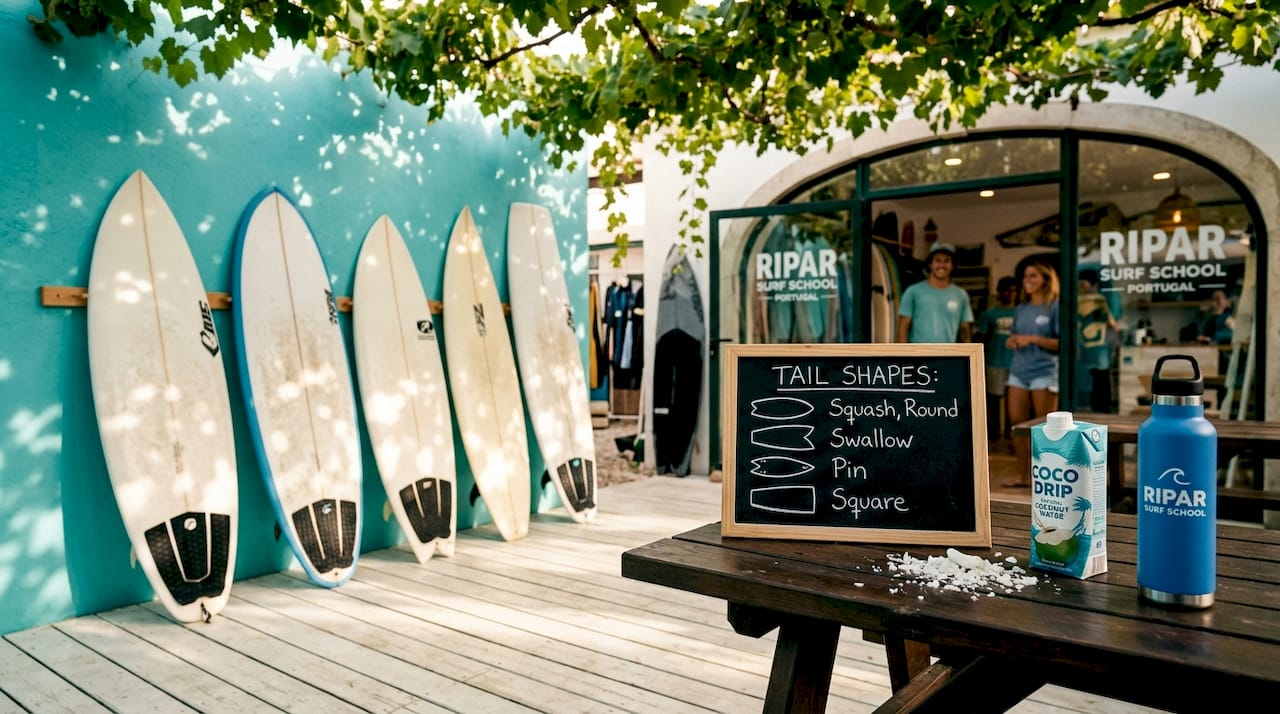
The tail is where the board leaves the wave. Its shape controls exactly how that release happens. As Flux Surf explains, tail shape mainly affects what happens on “the yaw axis” when you load your back foot in a turn — the release behavior and how quickly the board swings around from the back-foot-loaded position.
Here’s a quick comparison of the most common tail shapes:
Tail shape | Best for | Feel | Wave type |
Squash | Versatile surfing | Quick release, snappy turns | Beach break, varied |
Round | Powerful surf | Smooth arcs, more hold | Overhead+ waves |
Pin | Big, powerful waves | Maximum hold, flowing turns | Heavy surf |
Swallow | Down-the-line speed | Projection + release combo | Smaller, faster waves |
Square | Aggressive surfing | Sharp pivot, lively response | Punchy beach break |
A few things worth knowing about how surfboard tail shapes actually perform beyond the catalog descriptions:
Tail width is often more influential than tail shape itself. A wider tail of any shape will release earlier and feel looser than a narrow version of the same shape.
Squash tails are the most forgiving all-around choice for intermediate surfers because they balance release and hold across different wave sizes.
Pin tails require commitment. They hold in powerful surf beautifully, but in small, weak waves they feel sluggish and unresponsive.
Pro Tip: If you’re unsure which tail to choose, pick the squash. It forgives hesitation better than any other shape and still rewards aggression when you’re ready to push harder.
Beyond tail shape, fins also play a crucial role, as we’ll see next.
Fin flex and its subtle impact on your board’s feel
Most surfers treat fins as fixed, rigid structures. They’re not. Research from Kevin Okun at Science of Surfing found that fin flex loads correlate with about 70 pounds of force per fin during turns and flex increases from 2 to 3 percent while paddling to about 8 to 9 percent during bottom turns. That’s a meaningful change in the fin’s actual geometry while you’re surfing.
What does that mean in practice?
Stiffer fins return energy immediately, giving a snappier feel at the cost of some forgiveness. Good for powerful turns on clean waves.
Flexible fins absorb and then release energy through the turn, creating a “whip” sensation that many longboarders and progressive shortboarders love.
Material matters. Fiberglass fins flex differently than carbon or plastic, and each has a different load and release profile.
Too much flex reduces control at high speeds because the fin geometry deviates too far from its design shape under load.
“The board you feel while paddling out is not the same board you’re riding during a hard bottom turn. Fins are changing shape in real time.”
Understanding fin flex and surfboard feel matters most for surfers refining their technique. For beginners, standard fiberglass fins are fine. But as your surfing develops, fin selection becomes a real performance variable worth experimenting with.
Having covered key shape elements, let’s now compare how various surfboard designs suit your progression and conditions.
Choosing the right surfboard shape for your skills and waves
All these elements — volume, rocker, tail shape, fin flex — combine differently depending on the type of board. Selecting the right shape depends on your abilities and wave conditions; beginner boards are longer, wider, and higher volume for stability, while advanced boards prioritize responsiveness and control.
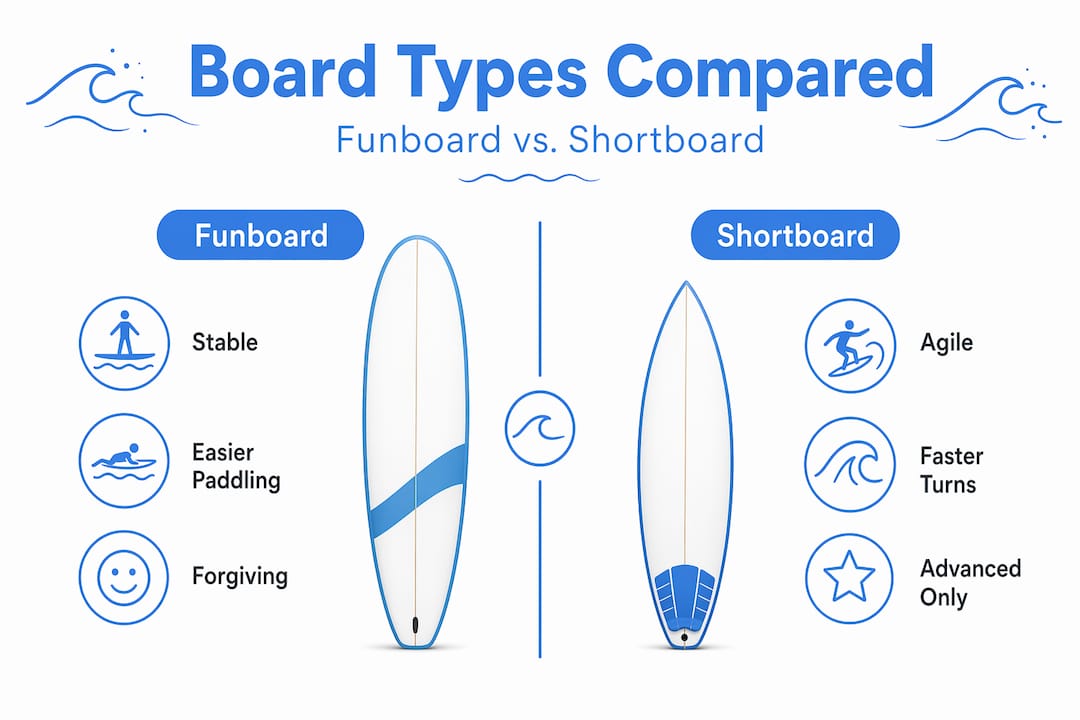
Here’s how the main board categories compare:
Board type | Length | Volume | Rocker | Best for |
Longboard | 9 ft+ | High (60+ L) | Flat | Beginners, small waves |
Funboard / mid-length | 7 to 8.5 ft | Medium (45 to 60 L) | Moderate | Intermediates, varied surf |
Shortboard | 5.5 to 7 ft | Low (25 to 40 L) | Higher | Advanced, powerful waves |
A few guidelines that aren’t always obvious:
Small, weak waves reward wider shapes because width generates surface area that compensates for the wave’s lack of power. Many experienced surfers ride oversized boards in small surf on purpose.
Big, powerful waves demand narrower boards with more rocker to handle the steepness without spinning out or catching the rail.
Funboards are underrated. Many intermediate surfers rush to shortboards before their technique is ready. A mid-length builds skills faster because it allows more waves per session.
Beginner surf lessons almost always start on longboards or foam boards because the high volume and stability give new surfers the physical margin to practice pop-ups and balance without fighting the board.
Pro Tip: The best board for your progression isn’t always the coolest looking one. It’s the one that lets you catch the most waves and practice the most turns in your typical conditions.
Why common beliefs about board shape often miss the bigger picture
Here’s what two decades of watching surfers choose boards has made clear: people overestimate the power of any single design element. They fixate on tail shape, or they chase volume numbers, or they copy what their favorite pro rides. Then they wonder why the magic didn’t transfer.
The reality is that shape isn’t one single magic lever. As Flux Surf’s Scott Turner points out, tail shape interacts with rocker, width, and rails, so performance differences from tail shapes alone are often smaller than surfers assume. A round tail on a wide board with flat rocker behaves very differently than the same round tail on a narrow board with high rocker. You can’t isolate variables in surfboard design the way you can in a lab.
The most common mistake we see? Riders blaming their board for problems that live in their technique. If your turns feel stiff, it might not be your tail shape. It might be your back foot placement or your timing. If your paddling is slow, it might not be lack of volume. It might be your arm entry or body position.
That said, equipment genuinely matters. But it matters most when your fundamentals are solid enough to feel the differences. A beginner on a pin tail versus a squash tail will notice almost nothing. A surfer with three years of experience will feel the difference immediately.
The most useful thing you can do is talk to a shaper or an experienced instructor, ride as many different boards as possible, and pay attention to overall feel rather than specs. Understanding the surfboard shape interplay between all these elements is a skill that takes time, and it grows every time you paddle out on something new.
Discover the right surfboard shape with Ripar Surf School
At Ripar Surf School, based at Praia Areia Branca near Peniche and Ericeira, our certified instructors have been matching surfers to the right boards since 2001. We know exactly which shapes work in Portugal’s varied coastal conditions, from small, fun beach break to the heavier swells that roll through in autumn.

Whether you’re paddling for the first time or looking to break through a performance plateau, our instructors will assess your level and put you on the right equipment from session one. Choose from group surf lessons for a social, energetic experience or private surf lessons for focused, one-on-one coaching tailored entirely to your progression. Ready to find the board and the wave that fits you? Book your lesson online and we’ll take care of the rest.
Frequently asked questions
What is surfboard volume and why does it matter?
Surfboard volume measures the board’s foam in liters and directly affects how well it floats and how easy it is to paddle, making it essential for matching your skill level and wave conditions. As Surfer Magazine notes, volume acts as a barometer for how a board will float and behave in the water.
How does rocker influence my surfing?
Rocker is the curve of the surfboard from nose to tail and affects paddling speed, wave fit, and turning ability. According to Degree 33’s guide, flatter rocker increases surface contact for better glide, while more rocker allows sharper turns in steep waves.
What tail shape is best for beginners?
Squash tails are generally the best starting point because they balance release and control across a variety of conditions, though tail width and overall board volume matter just as much. Flux Surf describes squash tails as versatile but most effective when waves have a defined pocket.
Do fins really affect how my board feels when surfing?
Yes, significantly. Research shows that fin flex increases from 2 to 3 percent during paddling to around 8 to 9 percent during bottom turns under loads of about 70 pounds per fin, changing the fin’s shape and altering board responsiveness in real time.
How should I choose the right surfboard shape for my waves?
Match your board to your skill level and your home break: beginners need volume and stability, intermediate surfers benefit from versatile mid-lengths, and advanced surfers choose shapes tuned to wave size and power. TheSurfStar’s guide confirms that shape selection should always account for both ability and conditions together.
Recommended
Comments