

Surf lesson workflow guide for beginners

TL;DR:
Most beginners experience frustration or injury when they start surfing without a structured workflow and proper safety checks.
A clear, repeatable process—including gear preparation, land warm-ups, and safety flag awareness—significantly improves skill development and safety.
Adhering to a standardized surf lesson routine ensures faster progress, reduces risks, and provides a confident, enjoyable experience in Portugal’s Atlantic waves.
Stepping into the ocean for the first time without a clear surf lesson workflow is how most beginners end up frustrated, exhausted, or worse, hurt. Portugal’s Atlantic coast is powerful and generous at the same time, but that generosity disappears fast when you skip the fundamentals. A structured surf instruction process is not just a convenience. It is the single biggest factor that separates a breakthrough session from one where you spend more time underwater than on the board. This guide walks you through every stage, from gear checks to getting on your first wave, so you arrive prepared and leave stoked.
Table of Contents
Key Takeaways
Point | Details |
Proper equipment | Using a leash at least as long as your surfboard greatly reduces injury risk during wipeouts. |
Pre-surf routine | Scanning hazards, warming up, and rehearsing pop-ups prior to surfing improves safety and skill. |
Beach safety | Surf lessons in Portugal follow Blue Flag beach standards with lifeguards and flag systems. |
Workflow consistency | A structured lesson workflow ensures safer, more productive sessions and builds surfer confidence. |
Booking options | Ripar Surf School offers convenient online bookings for group and private lessons and surf camps. |
What you need before starting your surf lesson
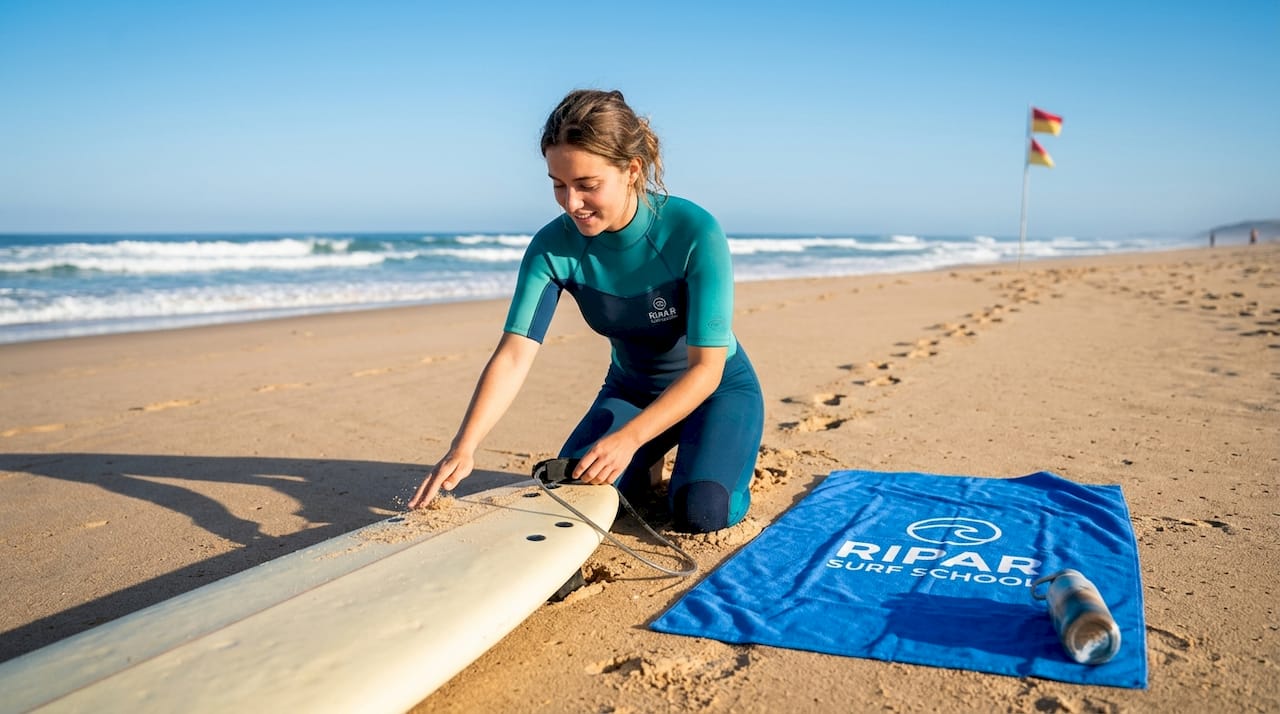
Before your feet touch the sand, your gear and your knowledge base need to be in order. Surf lesson planning starts on shore, not in the water.
The leash is your most underrated piece of safety gear. Most beginners treat it as an afterthought. It is not. Surf leashes should be at least as long as the surfboard to reduce injury risks during wipeouts. A shorter leash yanks the board back toward your body. A correctly sized one lets the board travel away from you on a fall, which is exactly what you want.
Here is a quick-reference table for leash sizing by board type:
Board length | Recommended leash length |
7 ft funboard | 7 ft leash |
8 ft mini mal | 8 ft leash |
9 ft longboard | 9 to 9.5 ft leash |
6 ft shortboard | 6 to 6.5 ft leash |
Beyond the leash, your wetsuit thickness matters more than most first-timers realize. Portugal’s Atlantic water temperature ranges from about 14°C (57°F) in winter to 20°C (68°F) in summer, so a 3/2mm wetsuit is standard for warmer months and a 4/3mm for cooler ones. Proper fit means no water flushing through constantly, which drains your body heat and your energy.
Before every session, check these essentials:
Leash condition (no cracks, secure ankle attachment)
Fin placement (fins locked in, no wobble)
Wax coverage on the deck (enough grip to stand on)
Wetsuit integrity (no torn seams)
Local flag status at the beach
That last point is critical. Portugal’s Blue Flag beaches enforce lifeguards and safety flags during the season, and understanding what each flag means is part of your beach safety workflow. A red flag means no swimming or surfing. A yellow flag means caution. Green means go. Ignoring these is not brave; it is reckless.
Pro Tip: Build surfer safety habits into your gear check before every session, not just your first one. Experienced surfers do this automatically. You should too, from day one.
Reviewing the surf camp safety rules at your camp also gives you a clear picture of what your instructors expect before entering the water. Knowing the rules in advance removes hesitation when conditions change quickly.
Now that you know what you need, let’s move on to the step-by-step surf lesson workflow.
Step-by-step surf lesson workflow for safety and learning
A good surf instructor workflow is not improvised. It follows a repeatable sequence that reduces risk and accelerates learning. Here is the structure we use at Ripar Surf School, built from over two decades of teaching on Portugal’s Atlantic coast.
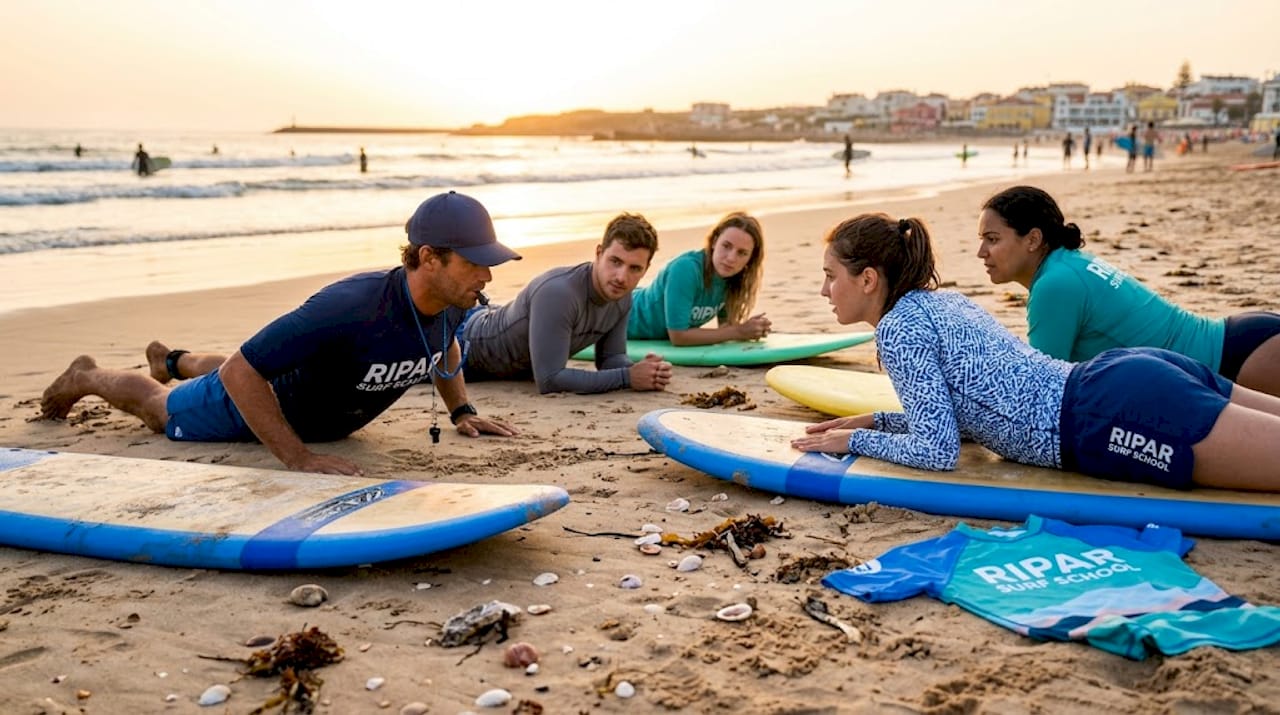
Step 1: Observe conditions for 60 seconds Stand at the water’s edge. Watch the wave sets. Identify where waves are breaking, how strong the rip currents look, and where other surfers are positioned. This is not optional. A pre-surf routine that includes hazard scanning, warm-up, pop-up rehearsal, and a conditions check is timed precisely to prepare you mentally and physically.
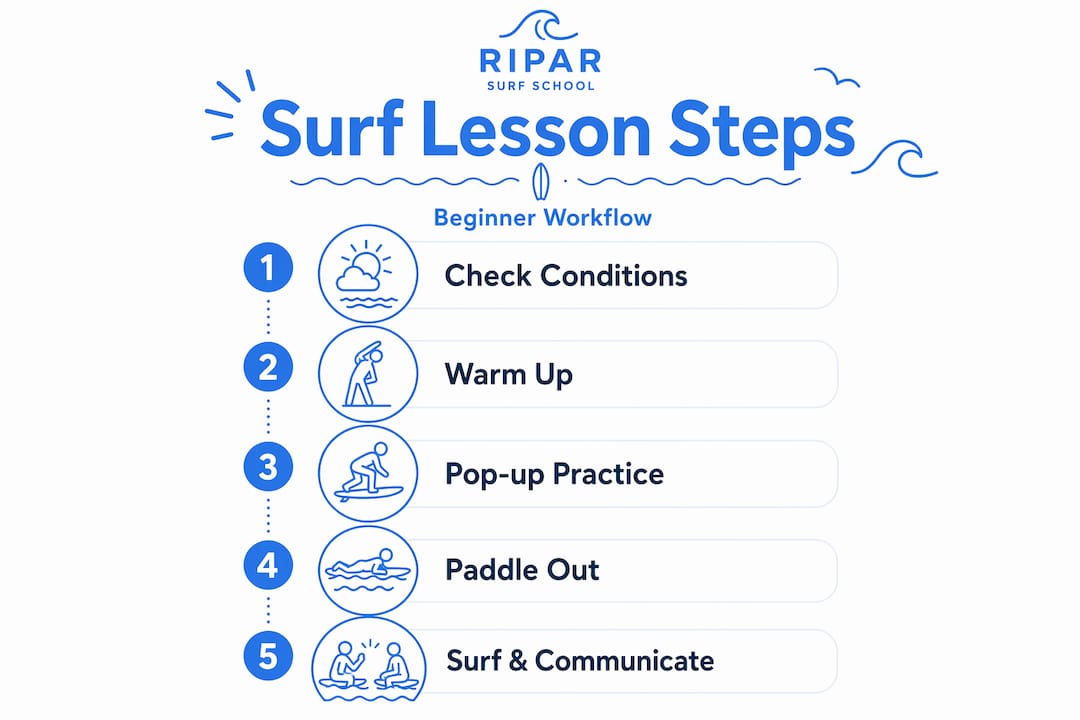
Step 2: Warm up on land Your shoulders, hips, and thoracic spine take the most strain during surfing. Spend 8 to 10 minutes warming these areas up specifically. Arm circles, hip rotations, and cat-cow stretches are not just yoga clichés. They directly improve how well your pop-up feels in the water. Check out specific surf warm-up routines that target these exact muscles.
Step 3: Practice your pop-up on the sand Place your board on flat ground and rehearse the pop-up motion 10 to 15 times. This builds muscle memory so your body does the movement automatically when a wave hits. Most beginners rush this step. The ones who don’t catch waves faster.
Step 4: Final safety check before paddling out Confirm the following before you enter:
Flag color at the lifeguard post (green or yellow only)
Your leash is checked and properly fitted to your ankle
Entry point is clear of rocks, swimmers, and other surfers
You have agreed on a take-off zone with your instructor
Step 5: Paddle and communicate Stay within eyeline of your instructor at all times. Use the agreed hand signals for “I’m okay,” “I need help,” and “I’m coming in.” Communication is part of the surf safety workflow, not an add-on.
Here is a timed breakdown of an effective 90-minute beginner lesson:
Phase | Duration | Activity |
Conditions scan | 5 minutes | Observe waves, flags, currents |
Land warm-up | 10 minutes | Shoulders, hips, breathing |
Pop-up practice | 10 minutes | Board on sand, repetitions |
Instructor briefing | 10 minutes | Rules, signals, plan |
In-water session | 50 minutes | Paddling, wave catching, standing |
Cool-down debrief | 5 minutes | Feedback and next steps |
Pro Tip: Ask your surf instructor to demonstrate the pop-up from behind the board so you see the foot placement clearly. Watching from the front gives you a mirrored view that confuses muscle memory.
With the steps understood, next we’ll cover common mistakes to avoid and troubleshooting tips.
Common mistakes in surf lesson workflows and how to avoid them
Even with a solid plan, certain errors consistently slow down progress or create safety problems. Knowing them in advance puts you ahead.
Ignoring the safety flags. This one has real consequences. Failure to follow lifeguard flag signals can put you directly in hazardous conditions. Waves do not care about your enthusiasm. When a flag changes, get out of the water and ask why before going back in.
Using a leash that’s too short or damaged. Improper leash length and ignoring safety flags are among the most common causes of injuries during surf lessons. Check the leash before every session, not just your first one.
Skipping the warm-up because you feel fine. Cold muscles tear. A five-minute warm-up feels unnecessary until you pull a shoulder paddling for a set wave and your session ends on the beach.
Tuning out your instructor mid-session. Fatigue, excitement, and sensory overload from the ocean all compete for your attention. The common patterns instructors notice in struggling beginners almost always include one thing: they stopped listening and started guessing.
“The best surfers in the world still have coaches. Beginners who think they can figure it out alone just take three times as long to get there.”
Common mistakes to watch for:
Dropping to one knee instead of popping up with both feet simultaneously
Looking down at the board instead of at the horizon when standing
Paddling too slowly before the wave hits, losing momentum
Positioning yourself too far forward on the board, causing nosedives
Not communicating with nearby surfers about right-of-way rules
Pro Tip: Record yourself on video from shore during one session. What feels like a clean pop-up often looks completely different on screen. One viewing session will show you more than an hour of self-analysis.
After understanding pitfalls, let’s explore the expected results from following a proper surf lesson workflow.
Expected results and benefits of a structured surf lesson workflow
Stick to the workflow consistently and the results become predictable in the best way.
Reduced injury risk. Injury prevention and performance improve significantly with proper equipment checks and pre-surf routines. This is not soft advice. Surfing generates real physical forces on your body. Managing those forces starts before you paddle.
Faster wave-catching. Pop-up rehearsal on land builds the exact muscle memory you need in the water. Beginners who practice 10 to 15 dry reps before each session consistently stand up sooner than those who skip it.
More confidence in the water. Confidence is not just mental. It is physical. When your body knows the routine, your brain stops worrying about the basics and can focus on reading waves. That is when surfing becomes genuinely fun rather than a survival exercise.
Better use of your lesson time. A structured surfing class organization means every minute has a purpose. You spend less time confused and more time doing the things that build skill. On a week-long surf camp in Portugal, that difference compounds into a huge amount of extra water time.
Here is what consistent workflow adherence looks like across a five-day beginner camp:
Day | Primary focus | Expected milestone |
Day 1 | Safety, gear, paddle technique | First unassisted paddle |
Day 2 | Pop-up mechanics | First stand on a whitewater wave |
Day 3 | Wave timing and foot placement | Consistent pop-ups |
Day 4 | Direction control | Slight turns on the wave face |
Day 5 | Open-face waves (gentle) | Full ride on a green wave |
The benefits of surf warm-ups extend beyond injury prevention too. Surfers who warm up properly report noticeably less muscle soreness the following day, which matters a lot when you are training five days in a row.
Now that you know the benefits, here is a unique perspective on structured surf lesson workflows from our surf camp experience.
Why standardizing surf lesson workflows is crucial for surf camps in Portugal
Here is something most surf camps do not talk about openly: the biggest variable in a guest’s experience is not the waves or the weather. It is the consistency of the instruction process itself.
We have watched guests arrive with identical ability levels have completely different outcomes based solely on whether their lessons followed a clear sequence or were improvised based on what felt right that day. The gap in progress was not small. It was the difference between standing on a green wave by day three versus still struggling with whitewater by day five.
Many surf injuries stem from overlooked equipment safety, and the enforcing of leash checks before every session is one of the simplest and most effective things a camp can do. It sounds basic. But when you are managing 20 guests of varying ability levels across a morning session, “basic” is exactly what keeps everyone safe.
Portugal’s Blue Flag beaches require lifeguard presence during the season, and a well-run surf camp builds this into the workflow rather than treating it as background scenery. Our instructors check in with lifeguards at the start of each session at Praia Areia Branca. That five-minute conversation often reveals local knowledge about shifting rips or unusually strong currents that no weather app will tell you.
The role of your surf instructor is not just to demonstrate technique. It is to run the workflow so you do not have to think about it. The best sessions happen when the student’s only job is to surf. The qualities that make surf instructors effective are almost entirely about their ability to maintain that structure without making it feel rigid.
Standardization also protects against the single most dangerous thing in surf instruction: overconfidence. When a guest has one great session and wants to jump straight to bigger waves the next morning, a workflow-based approach creates a natural checkpoint. Has the skill actually been consolidated? Are the conditions appropriate? These are not bureaucratic questions. They are the difference between a memorable progression and a preventable accident.
Book your structured surf lesson and camp experience with Ripar Surf School
If this guide has shown you anything, it’s that a great surf experience is not left to chance. It’s built on a repeatable, safety-first process that your instructors run every single day.

At Ripar Surf School, based in the village of Praia Areia Branca near Peniche, we have been running exactly this kind of structured surf instruction since 2001. You can book surf lessons online for private or group surf lessons that fit your level, your schedule, and your goals. If you want more than a day trip, our surf camp bookings include accommodation, meals, and daily lessons across multiple days, all following the workflow this guide describes. Our instructors are local, certified, and genuinely invested in your progress. Come learn where the Atlantic does the heavy lifting.
Frequently asked questions
What is the ideal leash length for beginner surfers?
Your leash should be at least as long as your surfboard to prevent the board from snapping back and causing blunt-force injury during wipeouts. Match leash length to board length exactly.
How do surf camps in Portugal ensure beach safety?
Reputable camps operate on Blue Flag certified beaches that require lifeguards and a flag communication system throughout the season, giving both instructors and guests a reliable safety baseline.
What should beginners do before paddling out in a surf lesson?
Follow a pre-surf routine that includes scanning for hazards, warming up key muscle groups, rehearsing the pop-up on land, and checking wave conditions and safety flags before entering the water.
Why is a structured surf lesson workflow important?
It reduces injury risk, builds skills in a logical sequence, and gives both students and instructors a shared framework so nothing critical gets skipped under pressure or excitement.
Can I book private and group surf lessons at Ripar Surf School?
Yes, Ripar Surf School offers both formats through easy online booking, with flexible packages that work for solo travelers, couples, and groups of all experience levels.
Recommended
Comments