

Surfing Terminology for Families: Your Holiday Guide

TL;DR:
Learning basic surf terminology before arriving helps families follow instructions, stay safe, and enjoy their surfing experience. Familiarity with gear terms, surf slang, action words, and etiquette fosters confidence and seamless communication in the water. Practicing vocabulary through fun, everyday activities enhances participation and respect within the surf culture, enriching family surf holidays.
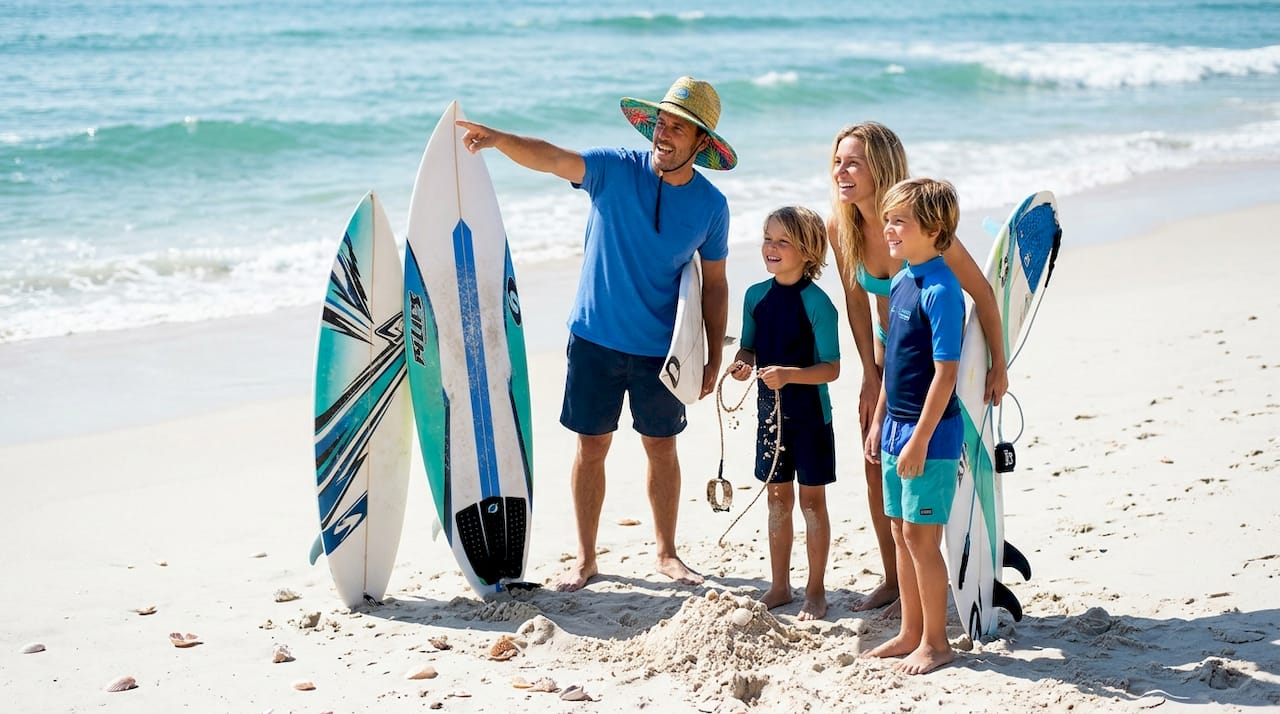
You’re standing on a beach in Portugal, your kids are buzzing with excitement, and the surf instructor says, “We’ll paddle out past the impact zone and wait for a clean set.” Half your family nods along. The other half looks at you. Knowing basic surfing terminology for families before you arrive turns those blank looks into confident smiles. It also keeps everyone safer, makes lessons more productive, and honestly, it’s half the fun of the surf holiday experience.
Table of Contents
Key takeaways
Point | Details |
Learn gear terms first | Knowing board parts and wetsuit basics helps kids follow instructor directions immediately. |
Surf slang sets the vibe | Words like “stoked” and “grom” are part of surf culture; understanding them builds confidence on the beach. |
Action words support lessons | Terms like “pop up,” “paddle,” and “wipe out” make surf lessons click faster for kids and parents. |
Practice together, not alone | Families who learn surf vocabulary together reinforce it through shared experiences and games. |
Respect is the real language | Understanding etiquette terms like “priority” and “lineup” keeps everyone safe and welcome in the water. |
Surfing terminology for families: the gear basics
Before anyone catches a wave, your family needs to speak the language of the equipment. Surfboard parts have specific names developed over decades of surf culture, and knowing them helps kids respond to instructions without hesitation.
Here are the core gear terms to learn together:
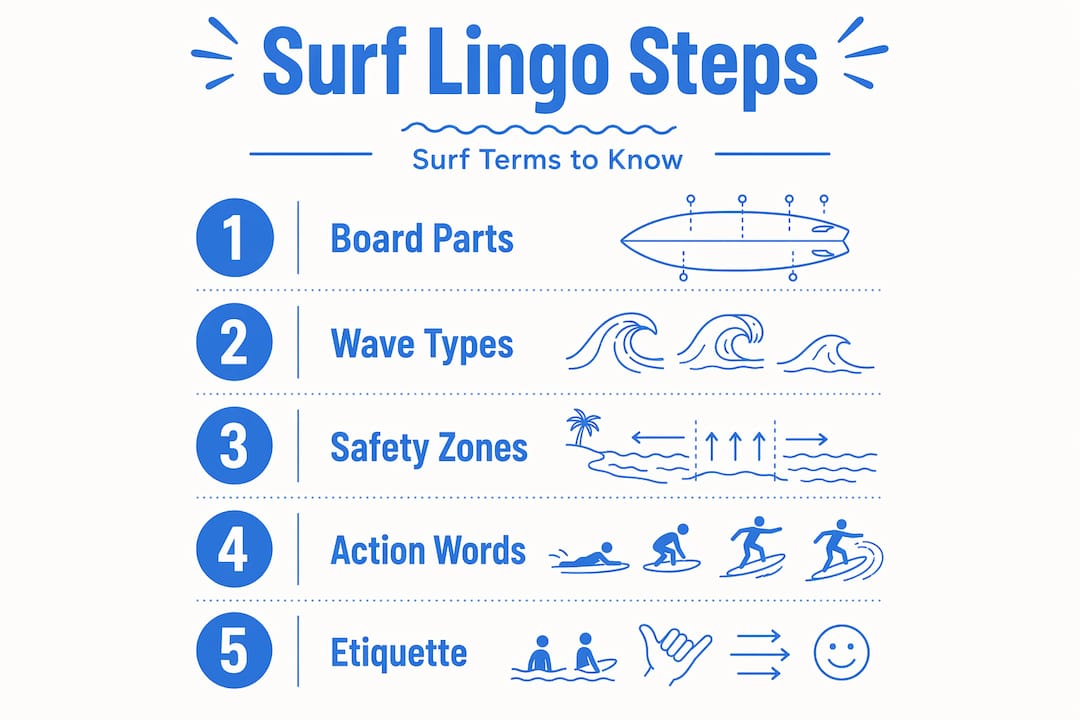
Deck: The top surface of the surfboard where the surfer stands. Think of it as the “floor” of the board.
Nose: The front tip of the board. Longer noses are common on beginner boards called longboards.
Tail: The back end of the board. Different tail shapes affect how the board turns.
Fins: The plastic or fiberglass blades on the underside of the tail. They act like a rudder, keeping the board tracking straight.
Leash: The cord connecting the surfer’s ankle to the board. It stops the board from washing away after a wipe out.
Soft board (foamie): A beginner board made with a foam deck. Safer for kids and slower, more forgiving on small waves.
Wetsuit: The rubbery suit that keeps surfers warm in cool water. In Portugal, you’ll likely wear one even in summer.
Ocean conditions have their own vocabulary too. Wave and wind terms like beach break, barrel, offshore, and glassy are the ones instructors use constantly. A beach break is a wave that breaks over a sandy bottom, which is ideal for beginners. A barrel or tube is when the wave curves over and creates a hollow tunnel. Most families will watch those from the shore.
Offshore wind blows from land toward the ocean, which creates clean, well-shaped waves. Onshore wind does the opposite and makes conditions choppy. When conditions are glassy, the ocean surface is smooth and perfect. Sets are groups of waves that arrive together, and the lull is the calm period between sets.
Pro Tip: Before your first lesson, spend five minutes on the beach with your kids naming what you see. Point to the nose and tail of boards on the sand, watch for fins, and try to spot a set rolling in. This turns vocabulary into a real game.
Surf slang and culture your family will hear at the beach
Surf culture has its own social language, and hearing it without context can feel like arriving at a party where everyone has an inside joke. Here is the family surfing terms cheat sheet for the beach community.
Surfers use a range of nicknames and labels:
Grom (or grommet): A young surfer, usually under 18. Often used affectionately by instructors and older surfers. Your kids will almost certainly get called this, and it’s a compliment.
Local: A surfer who regularly surfs a particular spot and knows it well. Locals have unspoken priority in many lineups.
Kook: A beginner who ignores surf etiquette, sometimes used as a put-down. No one wants this label. Teach your kids that the best way to avoid it is to watch, wait, and be patient.
Charger: Someone who goes for big, heavy waves without hesitation. Usually said with admiration.
Soul surfer: A surfer who surfs purely for love of the ocean, not competition or social status.
Then there’s the emotional vocabulary. Surf slang captures attitude and vibe in ways that standard English doesn’t. Stoked means thrilled and excited. Epic means the conditions or the session were outstanding. Gnarly means something was intense, impressive, or borderline scary. Rad is short for radical and means impressive. Shredding means surfing with skill and aggression.
One gesture stands apart from words entirely. The shaka sign is made by extending your thumb and little finger while curling your middle three fingers. It originated in Hawaii and represents the aloha spirit: love, respect, and community. Surfers flash it to say thanks, to acknowledge a good wave, or just to say hello. Teach your kids the shaka on day one. It works in any language and gets a smile every time.
“Cowabunga!” is not just a cartoon phrase. It became a genuine surf exclamation rooted in 1940s children’s TV and has been part of surf vocabulary ever since. It means pure joy and stoke. Let your kids shout it after their first successful ride.
If your child gets called a kook or feels teased by a label, preparing them to stay humble and keep improving is the real lesson. Surf culture respects effort and patience far more than it respects bravado.
Action words and technique terms for surf lessons
This is the vocabulary your family will use most during actual lessons. When an instructor calls out a command, your child needs to know what to do immediately. Water situations move fast.
Here are the key surfing vocabulary terms for kids and parents, in the order they typically appear in a lesson:
Paddle: The arm movement used to propel the board through water. You lie on your stomach and alternate arm strokes. Paddling is the foundational skill that determines everything else.
Pop up: The motion of jumping from lying flat to standing on the board in one smooth movement. This is the single most practiced skill in beginner lessons.
Take off: The moment you catch the wave and begin to ride. Timing the take off correctly is what separates a successful ride from a missed wave.
Ride: Simply surfing across the face of the wave after a successful take off.
Wipe out: Falling off the board, which happens constantly and is completely normal. Wipe outs are not failures. They’re part of learning.
Carve: A sharp, fluid turn on the wave face. More advanced but kids love knowing the word.
Stall: Deliberately slowing the board to let the wave catch up or to position inside a barrel. Something to aspire to.
Safety terms matter just as much as technique words. The lineup is the area where surfers wait for waves beyond where they break. Priority goes to the surfer closest to the peak or the one already riding. Dropping in on someone who has priority is the most common etiquette violation and causes most conflicts in the water.
The impact zone is the area where waves break with the most force. Staying out of the impact zone when you are not surfing protects you from getting hit by boards and held underwater by whitewater.
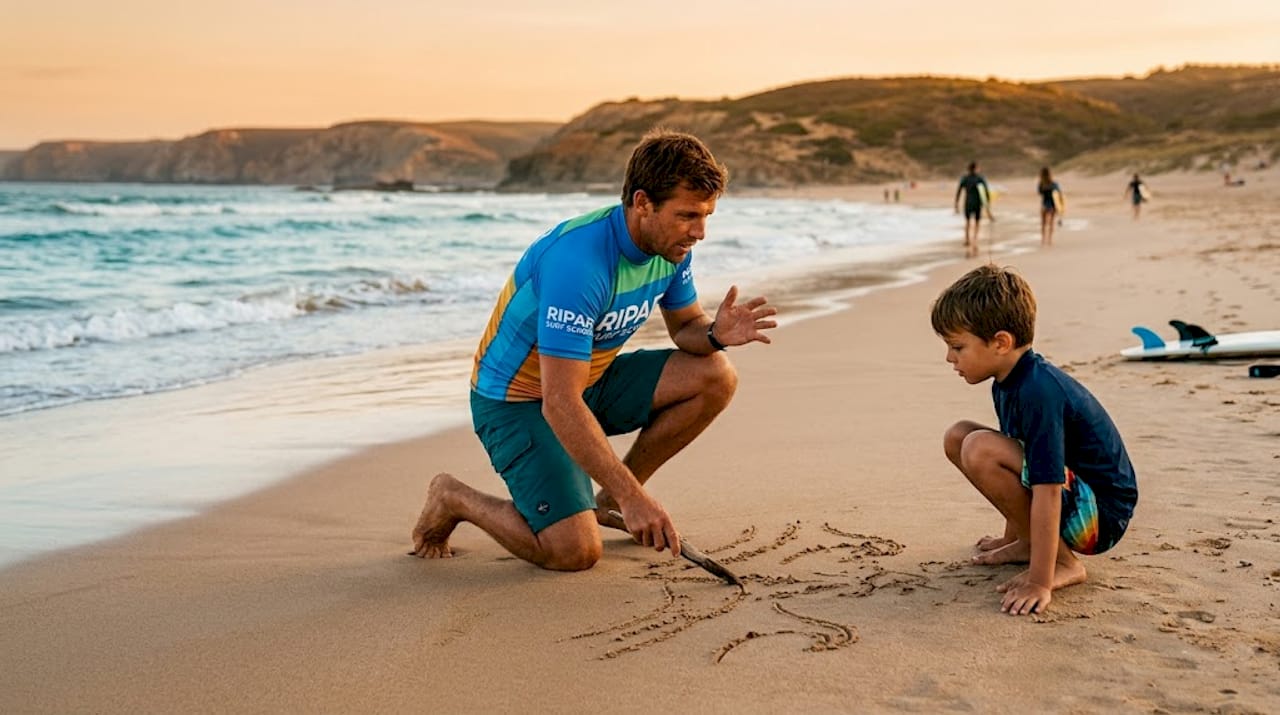
Pro Tip: After each lesson, ask your kids to narrate their best wave back to you using the correct terms. “I paddled, popped up, took off, and then wiped out on the shoulder.” This reinforces vocabulary and builds memory of what went well.
How families can practice surf lingo together
Learning surf lingo for families works best when it becomes part of the holiday routine rather than a homework exercise. You do not need flashcards. You need context and repetition in a fun environment.
A few approaches that work well:
Wave-watching sessions: Sit on the beach before or after lessons and narrate what you see together. Name the sets, the lull, the offshore wind, the groms in the lineup. Ten minutes of this each day builds vocabulary faster than any reading.
Daily surf word challenge: Pick one new term each morning at breakfast. Use it correctly in conversation at least three times during the day. Whoever uses it most naturally wins.
Shaka scorecard: Every time a family member correctly uses a surf term in context while in the water or on the beach, they earn a shaka from the group. Kids especially love this.
Ask your instructor: Surf schools integrate terminology into lessons naturally. Encourage your kids to ask instructors what words mean when they hear new ones. Instructors love curious students.
Parents play a big role here too. When you model respectful surf etiquette and use terms correctly, your kids follow. Point out priority situations from the shore. Comment on good and bad positioning in a neutral, educational way. And always lead with respect for the ocean and the local surf community.
Families traveling to surf destinations like Portugal’s Atlantic coast often find the local surf culture welcoming when they arrive with curiosity and humility rather than entitlement. Knowing the language is one of the most genuine signals of respect you can show.
My honest take on surf lingo and family surf trips
Over many years of watching families arrive at the beach, I’ve noticed a clear pattern. The families who have the best time are almost never the ones with the most athletic kids. They’re the ones who arrive curious about the culture, willing to look a little lost at first, and genuinely interested in learning.
I’ve seen parents who spend five minutes before a lesson learning three surf terms completely change the dynamic of their child’s first lesson. The instructor doesn’t have to stop and translate. The kid doesn’t freeze when they hear “pop up.” Everyone moves faster and enjoys it more.
What I find genuinely underrated is how surf vocabulary gives kids a sense of belonging. When a grom successfully calls out “gnarly set!” at the right moment, they feel like they’re part of something real. Not just a tourist watching. An actual participant in surf culture.
My advice to every family planning a surf holiday: don’t wait until you’re in the water to start learning. Do 15 minutes of beginner surfing words with your kids the week before you leave. Watch a surf clip together and try to name what you see. And when your child wipes out and laughs and shouts “cowabunga,” you’ll understand exactly why this culture is worth learning.
— Fernando
Start your family surf experience in Portugal
Riparsurfschool has been teaching families to surf at Praia Areia Branca since 2001, and terminology is always part of the lesson. Instructors explain every term in plain, kid-friendly language so that even first-timers understand what’s happening and why.
Whether you prefer a group surf lesson where kids learn alongside other groms or a more focused private session, every class is designed to build confidence in the water and in the language of surfing. The small-village setting means no crowds, no rush, and real connection with local surf culture. Book your family lessons online and arrive ready to speak the language.
FAQ
What does “grom” mean in surfing?
A grom, or grommet, is a young surfer typically under 18. The term is usually used affectionately within surf communities to describe young, enthusiastic beginners or talented junior surfers.
What is the shaka sign and why do surfers use it?
The shaka is a hand gesture made by extending the thumb and little finger, originating in Hawaii. Surfers use it to express goodwill, acknowledge a good ride, or simply greet one another in the lineup.
What does “wipe out” mean in surf lingo for families?
A wipe out is when a surfer falls off their board during a ride, which is completely normal and happens at every skill level. Beginners should expect plenty of wipe outs and treat them as part of the learning process.
What is the impact zone in surfing?
The impact zone is the area of water where waves break with the most force. Families should know to keep beginners and non-surfers clear of this zone to avoid injury from breaking waves or loose surfboards.
Why is surfing vocabulary for kids worth learning before a trip?
Surf schools integrate terminology into lessons, and kids who already know basic terms respond to instructions faster and feel more confident during their first sessions. It also helps families engage respectfully with the local surf community from day one.
Recommended
Comments