

What Portugal's Surf Camp Cancellation Rules Mean for You
- Fernando Antunes

- 11 minutes ago
- 7 min read

Most surf camps in Portugal give you a free cancellation window several weeks before arrival, a partial refund tier inside that, and zero refund inside about two weeks, though exact cutoffs vary by operator. Deposits, often a portion of the total, are usually non-refundable once paid, and admin fees apply if you cancel rather than reschedule. To cancel with Ripar Surf School, send written notice to the email listed in its Booking Terms, including your booking reference and dates, and keep the confirmation reply as proof.
Free cancellation: typically several weeks before arrival
Partial refund: usually the mid-to-late cancellation window
No refund: inside about two weeks, or per the specific policy you booked under
Pro Tip: Screenshot your booking confirmation and cancellation email the moment you send them. If a dispute arises weeks later, having a timestamp beats a memory.
Key Takeaways
Surf camp cancellation policies in Portugal typically hinge on how many days before arrival you cancel, with penalties escalating sharply inside 30 days and no-shows almost always forfeiting the full payment.
Point | Details |
Cancel early | Notice given 30 to 60+ days out usually qualifies for a full or near-full refund. |
Deposits rarely refund | Deposits (often 20 to 30 percent) are typically non-refundable once paid. |
No-shows lose everything | Missing arrival without notice almost always forfeits the entire payment. |
Get it in writing | Email your cancellation request with your booking reference and keep the confirmation. |
Ripar offers clear terms | Ripar Surf School’s Booking Terms spell out deposit rules and rescheduling options upfront. |
Table of Contents
How does canceling affect refunds for lessons and rental gear?
Surf camp packages bundle several things you’re actually paying for separately: accommodation, lessons, and equipment rental. When you cancel, each piece can behave differently. A camp with unused equipment rental, for instance, often refunds that portion more readily than the lesson slot, because a board sitting in the rack costs the operator nothing extra, while a canceled lesson usually means an instructor was blocked out for you and possibly turned away another guest.
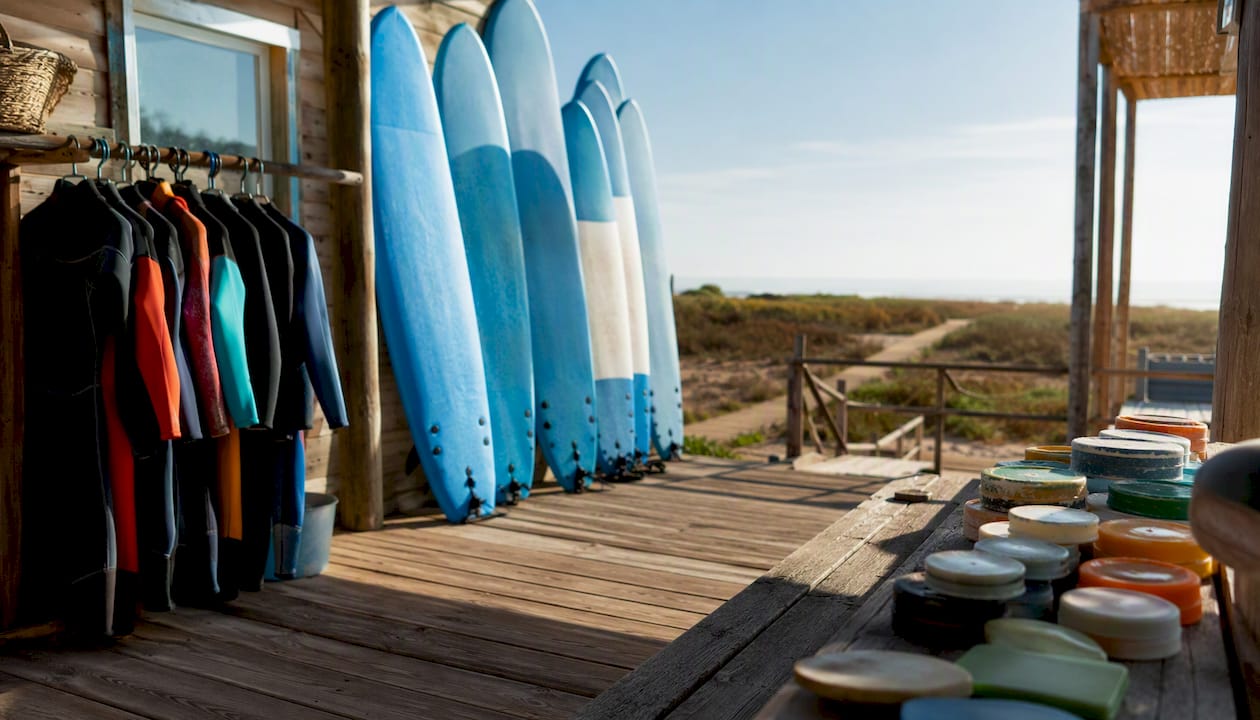
This is why reading the fine print on bundled bookings matters more than most travelers assume. Gota Dagua Surf Camp’s terms, used here purely as an industry example, apply tiered refund percentages to the whole package rather than itemizing lessons and gear separately, meaning a late cancellation can forfeit money tied to equipment you never picked up.
Some operators split it differently. If you booked a standalone group surf lesson or beginner lesson rather than a full camp week, the cancellation math is usually simpler and the notice period shorter, since there’s no accommodation or multi-day gear allocation involved. If you’re unsure whether your booking is a bundle or a standalone lesson, that distinction is the first thing to check before you assume a refund percentage applies uniformly across everything you paid for.
Do high season and low season have different cancellation rules?
Yes, and the gap can be significant. Peak season in Portugal, roughly June through September, means surf camps operate near full capacity, so a cancellation inside the notice window often leaves a bed and an instructor slot empty with little chance of rebooking on short notice. That’s the core reason high season policies tend to enforce stricter, shorter free cancellation windows and steeper penalty tiers as the trip date approaches.
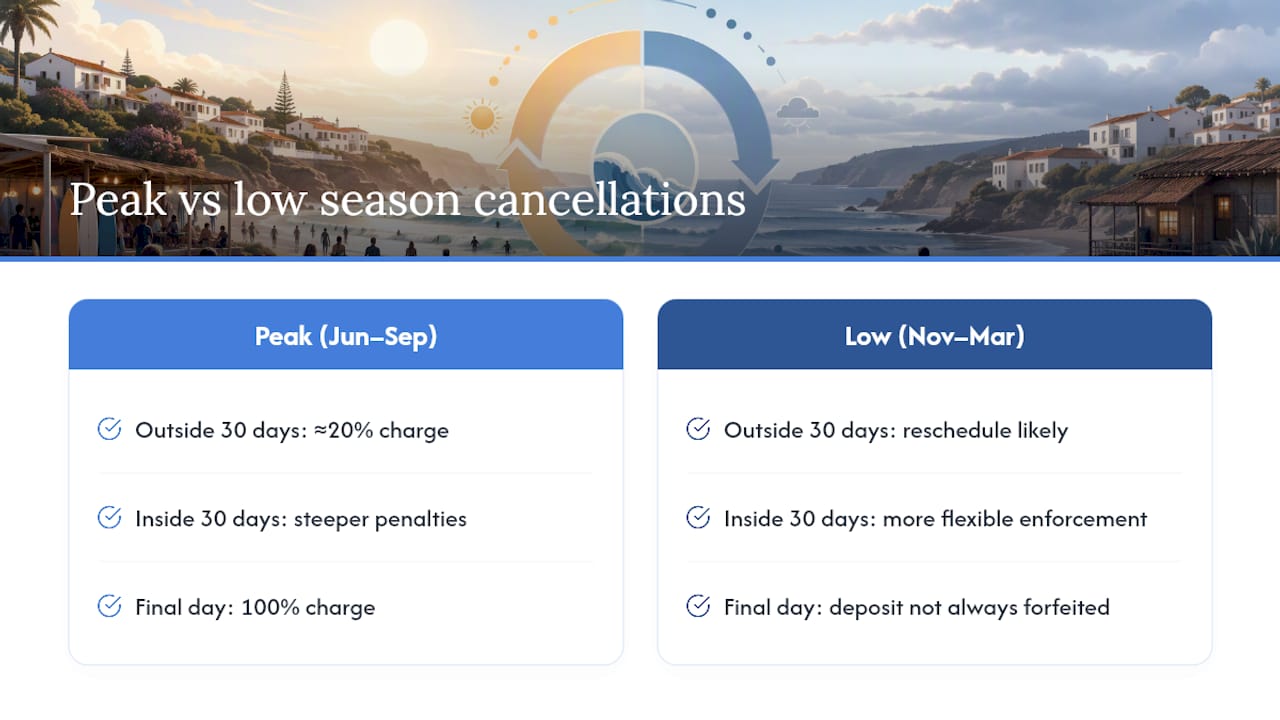
Low season (November through March in most of Portugal) works differently. Demand is lower, occupancy is more flexible, and operators are generally more willing to offer a reschedule instead of forfeiting your deposit outright, since filling that slot with another guest is less likely anyway.
Wave Culture Tenerife’s terms, cited here as an industry comparison rather than a Portugal-specific rule, illustrate this pattern well: cancellation charges scale from around 20% outside 30 days up to 100% inside the final day, with steeper enforcement typically tied to peak periods. The practical takeaway for anyone booking in Portugal: if you’re booking July or August, lock in your dates only when you’re confident, and consider travel insurance more seriously than you would for a quiet October week. Flexibility costs the operator more when demand is high, and policies reflect that.
What happens if you no-show or cancel at the last minute?
A no-show is treated worse than a late cancellation almost everywhere, and Portugal’s surf camps are no exception. Canceling 10 days out at least gives an operator a slim chance to fill your spot or offer it to someone on a waitlist. A no-show gives them nothing, and most policies respond accordingly with full forfeiture of everything paid, no credit, and no rescheduling option.
Menehune Surf School’s cancellation policy, used here as an out-of-market comparison, requires notice a full week before arrival for any refund or penalty-free rebooking, and imposes no refunds at all inside 72 hours. That 72-hour cutoff shows up across the surf travel industry generally, not just at one operator, because instructors and equipment get scheduled tightly in the final days before a group arrives.
Flagler Surf School’s policy takes a slightly softer approach, offering credit rather than a straight loss for cancellations made 14 to 29 days out, while still charging a flat fee even at the generous end of the window. The pattern across nearly every camp is consistent: the closer you get to arrival, the less negotiable the outcome becomes, and a no-show almost always forfeits the full amount with no exceptions for a missed flight or a bad weather forecast you should have checked earlier.
Have COVID-19 rules changed surf camp cancellation terms?
The pandemic pushed most surf camps to build in more flexibility than they had before 2020, and a good chunk of that flexibility has stuck around even as formal health restrictions have lifted. Operators learned that rigid no-refund policies during a border closure or quarantine order generated disputes they couldn’t win, so many rewrote their terms to include illness-related rescheduling clauses that didn’t exist previously.
What that looks like in practice today: a documented positive test or a government travel restriction is now more likely to get you a credit or a date change instead of an outright forfeiture, even inside a normally non-refundable window, though this depends entirely on the individual camp’s current policy rather than any blanket Portuguese law. Portugal has no COVID-specific cancellation mandate for private tourism bookings at this point, so the protection you get is whatever the operator chooses to write into its terms, not a legal guarantee.
This is exactly why reading a camp’s actual policy document matters more than assuming pandemic-era flexibility is now industry standard. Some operators kept illness clauses permanently; others quietly reverted to pre-2020 rigidity once demand recovered. If flexibility around sudden illness matters to you, confirm it’s explicitly stated before you book, and treat travel insurance as the more reliable safety net regardless of what any operator currently promises.
Why cancellation terms exist: the operator’s side
Running a surf camp means booking instructors, beds, and boards months out based on who’s confirmed. A cancellation 45 days before arrival is manageable; one made five days out usually isn’t, because that slot can’t be resold in time. Clear terms aren’t about punishing guests. They’re what let us keep instructor pay and equipment availability steady for everyone else on the schedule. Since 2001, transparent policies (posted plainly in our Booking Terms, run by certified local instructors) have kept disputes rare and refunds predictable.
Book with clarity: Ripar’s flexible booking terms
Unlike camps that bury cancellation rules in vague language, Ripar keeps its terms visible and specific from the moment you book, so you know your refund tier before you ever need it. If your plans change, Ripar’s Booking Terms outline exact deposit amounts, admin fees, and rescheduling windows for both camp packages and standalone lessons, meaning you’re never guessing which portion of your payment is recoverable.

If you need to cancel or change dates, email the contact address listed on the Booking Terms page with your booking reference, original dates, and requested change, and keep the reply as your proof of notice. For readers weighing whether to insure their trip, travel insurance with cancellation coverage is worth the modest cost, especially for peak season bookings where refund tiers tighten fast. Portuguese consumer protections still apply to your purchase regardless of insurance, but insurance covers the gaps a standard policy won’t, like illness or a canceled flight.
Ready to lock in dates or check availability? Book your surf camp directly, or start with online booking to see current openings before rates or availability shift.
Where to verify your rights and check the fine print
Direção-Geral do Consumidor (Portugal’s consumer authority)
Frequently Asked Questions
What is a typical surf camp cancellation policy in Portugal?
Most policies offer free cancellation 30 to 60 days before arrival, partial refunds in a middle window, and no refund inside about two weeks of arrival. Deposits are usually non-refundable regardless of timing.
How do I cancel a surf camp reservation?
Send written cancellation notice to the operator’s listed contact, referencing your booking number and original dates, then keep the confirmation reply as proof the request was received.
Can I get a refund if I get sick before my surf camp?
Some operators added illness-related flexibility after the pandemic, but it’s not guaranteed by Portuguese law for private bookings. Check the specific policy, and carry travel insurance for cases the operator’s terms don’t cover.
Does the cancellation policy differ for lessons versus full camp packages?
Yes. Standalone lessons, like a private surf lesson or group lesson, usually have simpler, shorter notice requirements than bundled multi-day camp packages that include accommodation and gear.
What happens if I just don’t show up?
A no-show almost always forfeits the entire payment with no credit or rescheduling offered, since the operator has no chance to resell your spot on the spot.
Who do I contact in Portugal if I think a surf camp treated my cancellation unfairly?
The Direção-Geral do Consumidor handles Portuguese consumer complaints, including disputes tied to package travel bookings that include accommodation and activities.
This article is general information, not a substitute for advice from a qualified lawyer. Consult a qualified legal professional about your own circumstances before acting on anything here.
Sources
How Jet Ski Rental Check-In Works for Tourists
Recommended
Comments