

What Is Pocket in Surfing? A Guide for Learners
- Fernando Antunes

- 4 hours ago
- 8 min read
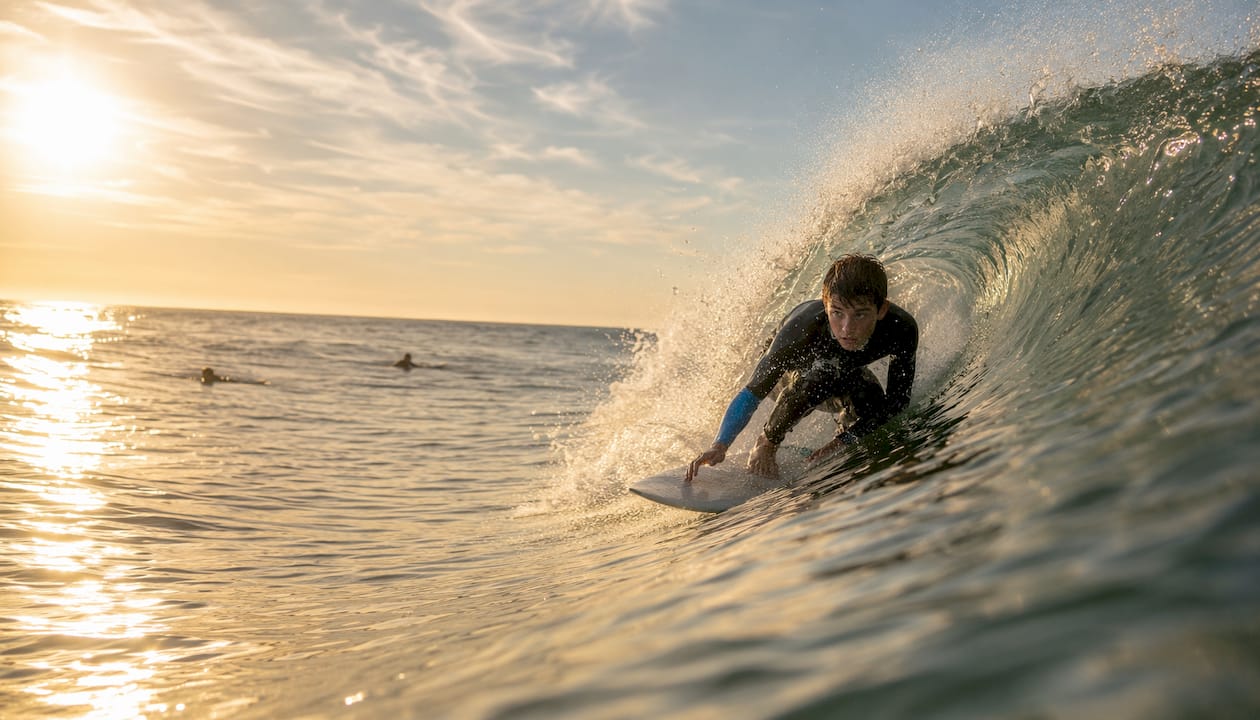
The pocket is the most powerful section of the wave, sitting directly in front of the breaking lip or curl. Position yourself there and the wave does the work: it pushes your board, loads your fins, and gives you the platform to turn. Fernando at Riparsurfschool puts it simply to every new student: on your next wave, aim your takeoff toward the steepest part of the face, not the flat shoulder, and you will feel the difference immediately.
Table of Contents
What does the pocket mean in surfing?
The pocket is the energy zone directly ahead of the breaking foam, where the wave face is steepest and most vertical. Think of it as the engine room of the wave. Everything useful happens there: speed, power, and the wall you need for turns.
Two analogies help learners lock this in:
The engine room: the pocket is where the wave’s energy concentrates, just like an engine converts fuel into motion. Ride away from it and you lose that energy fast.
Musical “in the pocket”: jazz and funk musicians use this phrase to describe perfect rhythmic timing. Surfing the pocket is the same idea: you are syncing with the wave’s rhythm, not fighting it. The musical metaphor helps learners understand that this is about flow and timing, not brute force.
The pocket’s exact position shifts depending on the break:
Beach breaks: the pocket tends to be short and peaky, moving fast as the wave pitches
Point breaks: the pocket can run longer down the line, giving you more time to work it
Reef breaks: often form consistent vertical walls, creating a defined, predictable pocket
Understanding how wave type affects the pocket helps you adapt your angle and timing at each spot.
Why surfing in the pocket makes you better
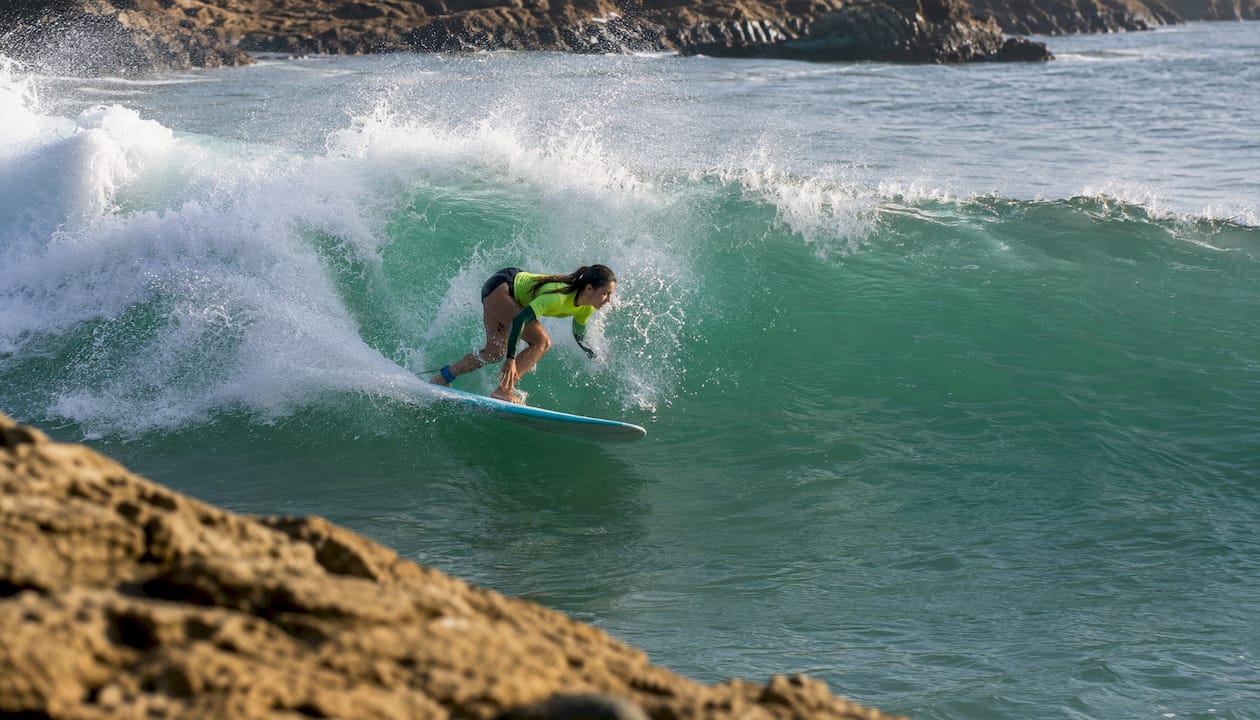
Staying in the steepest, most powerful face is not just about looking good. It changes what you can actually do on a wave.
Key benefits:
Speed generation: the steep face accelerates your board without any pumping effort
Vertical wall for turns: bottom turns, cutbacks, and re-entries all need a wall to push against
Speed recharge: returning to the pocket after a maneuver refuels your momentum
Access to powerful sections: snaps, re-entries, and aerials all require the pocket’s energy
Maneuvers that depend directly on pocket positioning include the bottom turn (which sets up every other move), the cutback (which brings you back to the pocket after drifting toward the shoulder), and the re-entry (which uses the lip itself as a launch point). Ride the shoulder instead and those moves become flat and weak.
One safety note: steeper waves mean more power, and the pocket in a heavy wave can be unforgiving. Beginners should build pocket awareness on smaller, slower waves before committing to powerful sections.
How to tell if you are actually in the pocket
Visual and sensory cues give you real-time feedback while you ride.
Visual cues:
The breaking lip is just behind your back shoulder, not far behind you
The wave face in front of you looks steep and glassy
Whitewater is forming close to your tail, not 10 feet back
Sensory cues:
You feel a lifting or pushing sensation under your back foot
The board feels lively and responsive, not sluggish
Speed builds without extra effort
If the wave no longer lifts or pushes behind your back foot, you have drifted onto the shoulder or flats. That sluggish feeling is the clearest signal you have lost the pocket.
Quick self-check while riding: (1) Is the lip breaking just behind me? (2) Do I feel pressure under my back foot? (3) Is the face steep in front of me? (4) Am I generating speed without pumping? If you answer no to any of these, shift your weight forward and angle back toward the curl.
How to get into the pocket and stay there
This is a sequence, not a single move. Work through it in order.
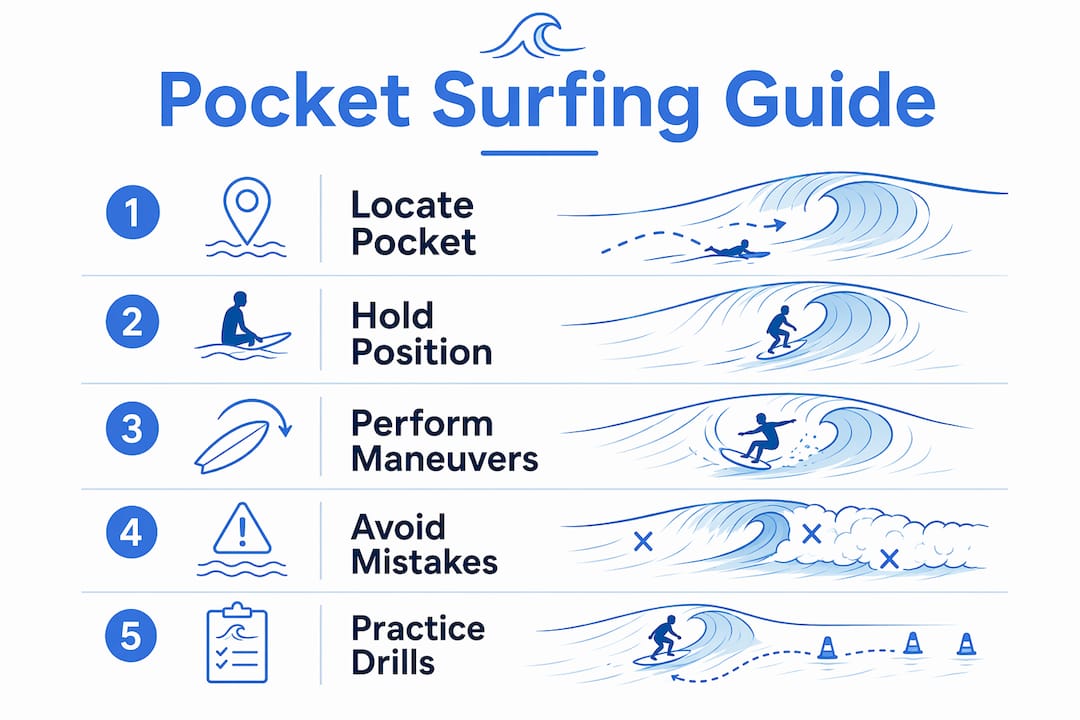
Pre-takeoff positioning: sit just inside the peak, not on the shoulder. Watch where the lip will throw and aim your paddle slightly toward the open face, angled down the line.
Angled takeoff: instead of popping up and going straight, angle your board at roughly 45 degrees toward the open face as you stand. This puts you on the face immediately rather than in the whitewater.
Bottom turn: drive off your back foot, compress through the bottom, and aim your line back up toward the steepest section. The bottom turn is your entry ticket to the pocket.
Trim and pump: once on the face, use small compress-and-extend movements through your knees to maintain speed. Shift rail pressure to stay on the steepest part as the wave moves.
Reconnect after turns: after a cutback or snap, your goal is always to return to the pocket. Plan the return before you execute the turn.
Coaching cues that work: “Look where you want to go,” “compress then explode,” and “back foot pressure” are the three Fernando returns to most often with students.
Pro Tip: After your bottom turn, pick a spot on the lip and ride toward it. Surfers who look at the shoulder drift to the shoulder. Your eyes lead your body, every time.
Common mistakes that push you off the pocket
Mistake | What it looks like | Quick fix |
Straight-line takeoff | Riding directly toward shore, no angle | Angle your board 45° at pop-up |
Drifting to the shoulder | Board feels slow, wave peeling behind you | Shift weight to back foot, look toward curl |
The “death turn” | Aggressive snap causes speed loss or wipeout | Use smooth rail pressure, not a pivot |
Leaning forward | Nose dips, board stalls | Keep weight centered to back foot |
Late takeoff | Dropping into the steepest section unprepared | Paddle earlier, read the peak before it throws |
The “death turn” is worth calling out specifically: trying to snap too hard in the pocket without enough speed causes the board to stall or spin out. Keep the board pointed down the line and use subtle body adjustments before committing to radical turns.
When a wave is closing out fast or the lip is throwing over you, exit the ride. Straighten out toward the channel or dive off the back of the wave. The pocket rewards timing, not stubbornness.
Drills to practice finding the pocket
Build these progressions over several sessions, starting in small, manageable surf.
Sit and watch the lip drill: before paddling for anything, spend 10 minutes watching where the lip breaks on each wave. Identify the peak and the pocket’s travel direction. Do this every session.
Angled small-wave takeoff drill: on waist-high waves, practice popping up with your board already angled. Count how many takeoffs land you on the face versus in the whitewater.
Bottom-turn target drill: pick a spot on the upper third of the wave face as your target after each bottom turn. Ride toward it. Repeat on every wave.
Pump-to-reconnect drill: after a bottom turn, pump twice and check whether you are still on the steepest section. If not, adjust your rail pressure and try again next wave.
Shoulder-check habit: glance back over your shoulder once per ride to see where the lip is breaking relative to your position. This spatial awareness habit is one of the fastest ways to self-correct in real time.
Progression note: once these feel consistent in small surf, move to faster, more powerful waves. Set a measurable goal each session, such as landing three clean bottom-turn targets per hour in the water.
What Fernando tells students about the pocket
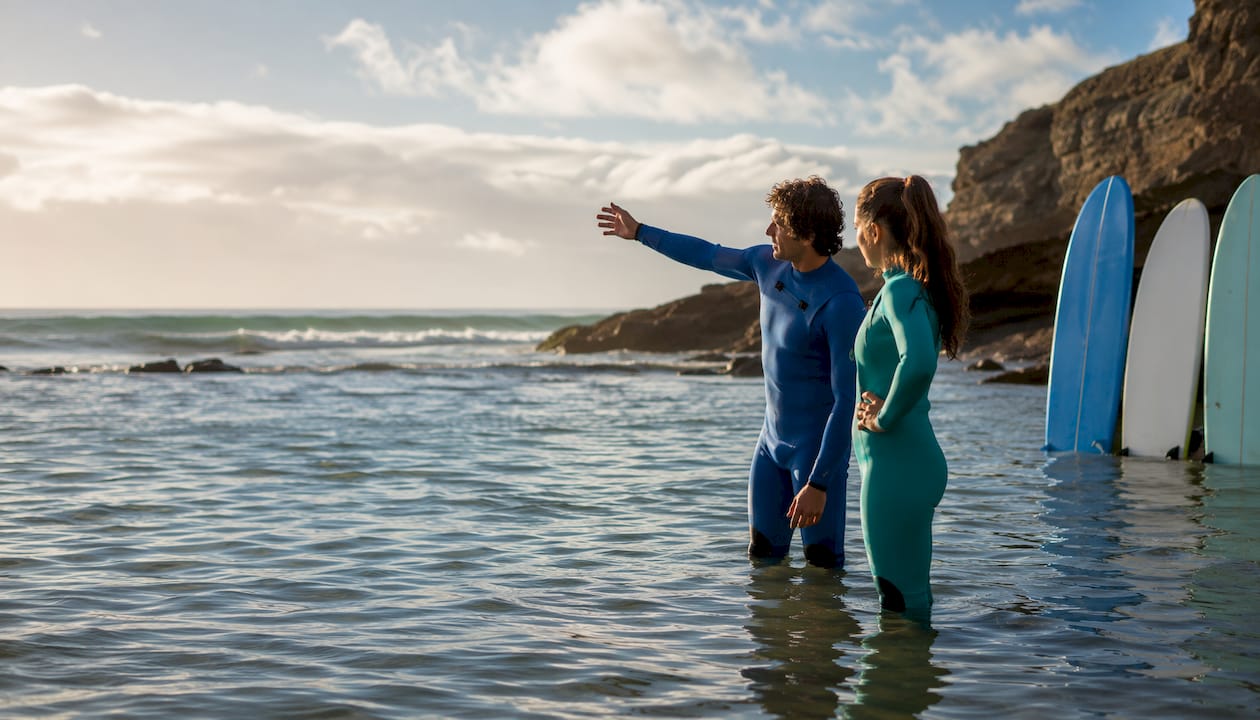
At Riparsurfschool, pocket positioning is introduced in the first intermediate lesson, not saved for advanced surfers. Here is what the coaching actually sounds like:
“Paddle for the steepest part, not the easiest part.” Most beginners naturally aim for the shoulder because it feels safer. The pocket feels intimidating at first.
“If your board feels dead, look behind you.” That one cue fixes 80% of shoulder-drift problems on the spot.
“The wave is doing the work. Your job is to stay where the work is happening.”
Instructor-led drill (suitable for a supervised lesson): paddle for three consecutive waves with the sole goal of keeping the breaking lip within arm’s reach behind your back shoulder for the entire ride. No turns, no tricks. Just positioning. This drill, done under coaching supervision, builds the spatial awareness that makes every other technique click faster.
Safety milestone: Fernando steps in when a student is consistently taking off too late or angling into the lip rather than along the face. Those are the two moments where the pocket becomes dangerous rather than productive. Beginner-to-intermediate milestone: you are ready to add turns when you can hold pocket position for at least half a ride on three waves in a row.
Key Takeaways
Staying in the pocket is the single skill that separates flat, slow rides from fast, powerful surfing with real maneuver options.
Point | Details |
Pocket definition | The steepest section just ahead of the breaking lip, where wave energy concentrates. |
Main benefit | Generates speed and provides a vertical wall for turns without extra effort. |
Primary sensory cue | Lifting pressure under your back foot signals you are in the pocket. |
Top drill to try next session | Angled takeoff drill: pop up with your board at 45° and count how many rides land you on the face. |
Riparsurfschool coaching | Fernando’s lessons at Ripar Surf School introduce pocket positioning early, with real-time cues and supervised drills to accelerate progress. |
The pocket is harder to find than it looks, and that is fine
Most surfers spend their first year riding the shoulder and wondering why their surfing feels flat. The pocket looks obvious from the beach and genuinely confusing from the water. That gap is normal.
What I have seen coaching students at Praia Areia Branca is that the shift usually happens in one session, not over months. A student paddles for the steepest part instead of the safest part, feels the board come alive under their back foot, and something clicks. The wave stops feeling like something to survive and starts feeling like something to use.
The conventional advice is to “stay near the curl.” That is true but incomplete. The real skill is learning to read where the curl will be in two seconds, not where it is right now. That is the timing piece, the rhythm piece, the musical “in the pocket” idea made physical. Once you feel it once, you will recognize it every time.
Expect a few sessions of frustration before that moment arrives. Film one ride per session and watch where you are on the face. The gap between where you think you are and where you actually are is usually the whole lesson.
Coached pocket sessions at Riparsurfschool
Real-time feedback from an instructor cuts the learning curve on pocket positioning faster than solo practice alone.

At Riparsurfschool, private surf lessons are built around exactly this kind of technical correction: an instructor in the water with you, calling out cues in real time, and surf video analysis after the session so you can see your positioning on the face. A typical pocket-focused lesson includes:
Real-time positioning cues from the instructor while you ride
Guided angled-takeoff and bottom-turn drills on appropriate waves
Post-session video review to identify exactly where you left the pocket
Ripar Surf School operates at Praia Areia Branca, near Peniche, one of Europe’s most consistent surf destinations. Book a lesson and get the feedback that turns a concept into a felt skill.
Useful sources and further reading
Glossary of Surfing, Wikipedia: a broad reference for surf terminology including the pocket, curl, and other wave-part definitions.
Pocket Meaning in Surfing, PlayTerms: a concise technical definition of the pocket and its role in speed generation and high-performance surfing.
What Is the Pocket in Surfing, The Wipeout Weekly: covers sensory cues, common mistakes, and the musical timing analogy in practical detail.
Parts of a Surf Wave, The Beginner Surfer: explains how pocket behavior differs across beach, point, and reef breaks with beginner-friendly language.
Surf Terminology for Beginners, Riparsurfschool: a practical glossary from Ripar Surf School covering the pocket and related wave terms for learners starting out.
Recommended
Comments