

Thruster vs. Quad: Which Fin Setup Should You Ride?
- Fernando Antunes

- 1 hour ago
- 11 min read
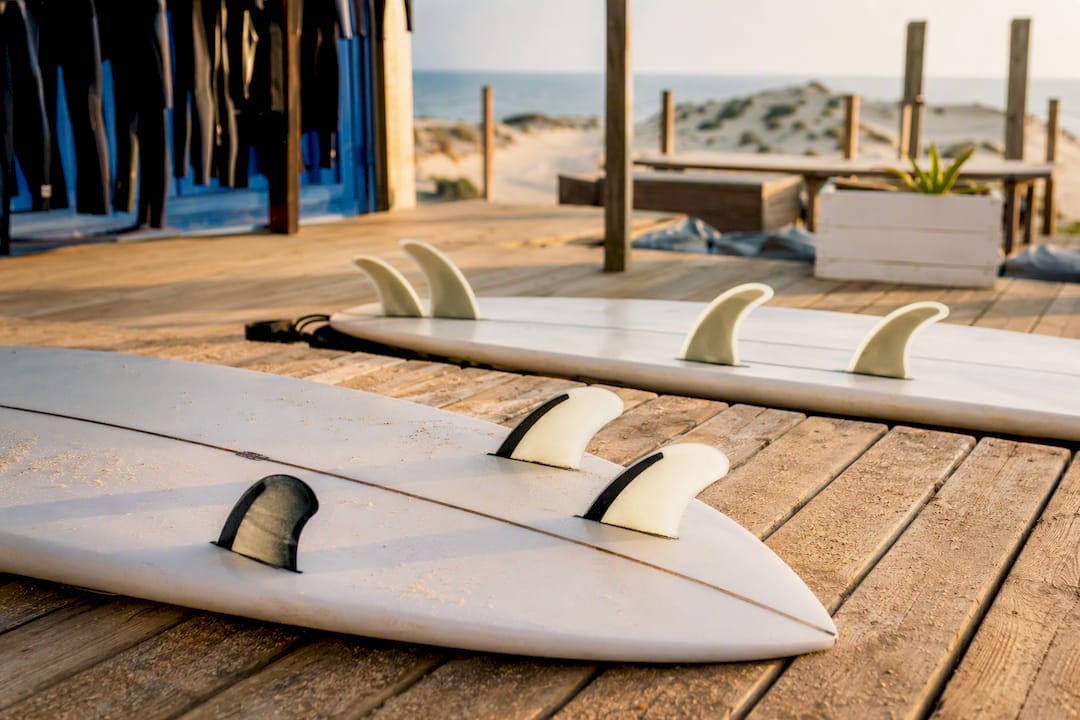
Choose a thruster when you need predictable pivot and hold; choose a quad when you want free speed and down-the-line drive. That’s the whole decision, stripped to its core.
A small, mushy beachbreak with soft, crumbling walls rewards the extra glide of a quad. A punchy, hollow point break where you need to snap off the bottom and redirect hard rewards the control a thruster gives you in the pocket. Most surfers end up needing both setups at different points in a session, not just one forever.
Thruster: best for vertical surfing, tight pockets, and boards where predictability matters more than raw speed
Quad: best for weak or fast, open-faced waves where acceleration and rail-to-rail drive matter more than pivot
Undecided? Rent both across a few sessions before committing to one setup on your own board
The rest of this guide breaks down the mechanics, the wave-by-wave calls, sizing by weight, and the mistakes that trip up surfers switching between the two for the first time.
Key Takeaways
Thrusters win on control and pivot, quads win on speed and drive, and fin template can shift either outcome more than the setup name suggests.
Point | Details |
Match setup to wave shape | Ride thrusters in hollow, pocket-heavy waves and quads in fast or weak, open-faced conditions. |
Size fins to your weight first | Start with the weight-based range, then adjust for wave power and board type. |
Template can override setup type | A raked, large quad fin can feel more stable than a small, upright thruster fin. |
Change one variable at a time | Swap setup or fin size separately so you know what actually caused the difference in feel. |
Test both under instruction | Riparsurfschool’s group and private lessons let you compare thruster and quad setups on real waves with guidance. |
Table of Contents
Thruster vs. Quad: Speed, Pivot, Hold, and Feel
The difference comes down to where the water goes. A thruster routes flow through three fins arranged in a triangle, with the center fin acting as a rudder that stabilizes the tail and resists rail-to-rail rotation. A quad drops that center fin entirely and adds a second pair of fins further back near the rail, so water releases off the tail with less resistance and the board holds speed longer down the line.
That center fin is the whole story. SurfScience notes that the thruster’s third fin gives the tail a stable pivot point, which is why the setup feels so locked in through vertical snaps and tight arcs. It’s also why a thruster costs you a bit of speed. The center fin creates drag every time water passes over it, and that drag is the trade you make for control.
Quads remove that trade. One Revolver Surfboards explains that pulling the center fin cuts centerline drag and increases projection, which is why quads feel noticeably faster once you’re established on a wave face. The catch is that quads can feel looser and less predictable when you try to pivot hard off the tail, since there’s no rudder fin anchoring that rotation.
Three variables change how dramatic that difference feels in practice:
Fin size and rake. Larger, more raked fins add hold and stability to either setup; smaller, more upright fins add looseness and quickness.
Fin placement. Moving side fins forward opens up pivot and rotation; moving them back (or setting them wider) adds drive and hold through turns.
Fin foil and template. A flexible tip releases more easily out of turns, while a stiffer template holds a line longer under load.
A raked quad fin with a big base can feel almost as drivey and stable as a thruster, and a tiny, upright thruster fin can feel loose and skatey. Experts at The Inertia frame this correctly: treat the thruster as your control and pivot tool, and the quad as your speed and rail-to-rail tool, but never assume setup type alone tells you how a board will actually ride.
Pro Tip: If you’re testing a new board, paddle out on the thruster first. It’s more forgiving while you’re still reading how the fins interact with the rocker and rail shape, and it gives you a baseline to compare the quad against later that session.
The practical result shows up in specific maneuvers. Snaps and vertical redirections favor the thruster’s rudder effect. Long, drawn-out carves and rail-to-rail pumping favor the quad’s lower drag. A big, arcing bottom turn into a fast section is where quads genuinely shine, because you carry more speed into the turn than a thruster would let you keep.
When to Ride a Thruster vs. a Quad by Wave and Board
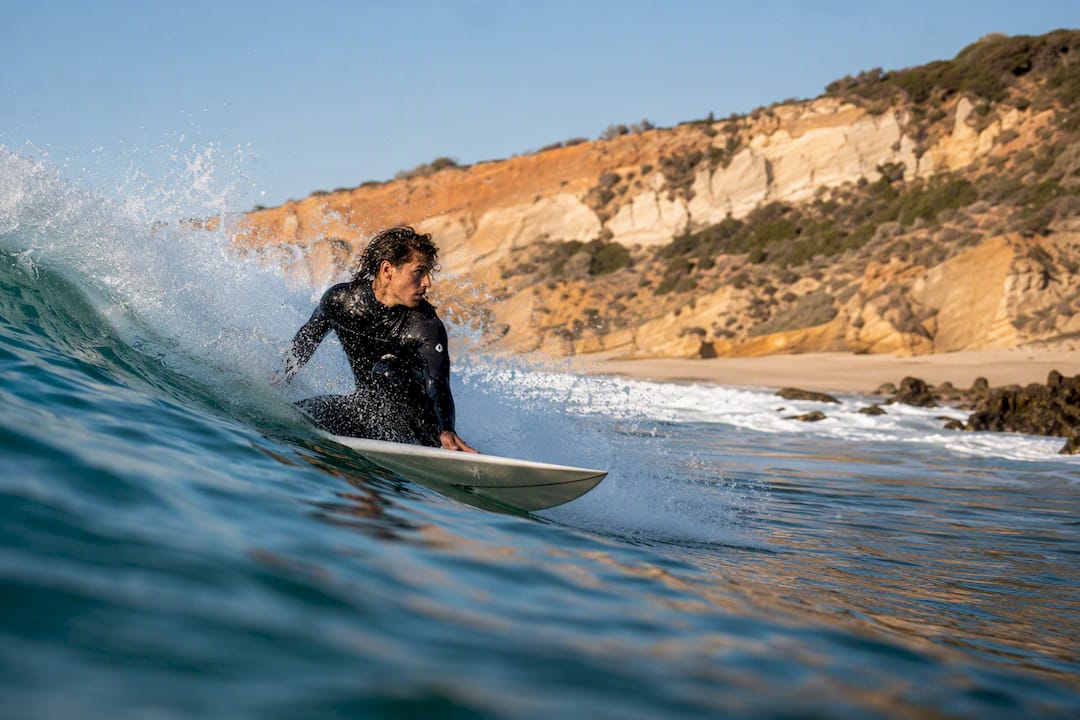
Wave shape decides more than personal preference ever will. A thruster earns its reputation on waves with a defined, steep pocket, the kind of wave where you need to slow down, set your rail, and snap back up. Beachbreaks with punchy, hollow sections, point breaks with a tight pocket, and any wave demanding vertical surfing all favor the three-fin setup. Guns for bigger waves also lean thruster almost universally, since hold and predictable release matter more than extra speed when you’re dropping into serious size.
Quads take over where speed is the scarce resource. Fast, open-faced points where the wave is racing away from you, barreling waves where you need every ounce of acceleration to make the section, and small, mushy beachbreaks where there simply isn’t enough push in the wave all reward the quad’s lower drag.
Board shape reinforces this pattern rather than fighting it:
Fish and retro shapes almost always run quads. Their wide tails and flatter rocker already generate speed; a quad setup lets that speed carry through turns instead of getting choked by a center fin.
Standard shortboards split the difference and often come rigged as five-fin boards so you can run either.
Step-ups and guns favor thrusters almost every time, because hold and control matter more than glide once the wave has real size and consequence.
Skill level changes the calculus, too. Beginners should stick with a thruster while they’re learning to read waves and control speed, since the setup’s predictability forgives sloppy weight distribution. Intermediates benefit from deliberately trying a quad on a small, weak day, because it teaches rail engagement and pumping in a way a draggy thruster never will. Advanced surfers should be swapping setups based on the forecast, not habit, running quads on fast or weak days and thrusters whenever the wave gets hollow or steep.
Fin Sizing and Setup: A Practical, Weight-Based Guide
Fin size should start with your body weight, then get adjusted for wave power and board type. Sizing guides consistently recommend using weight as the first filter before fine-tuning for conditions, and manufacturers typically list side fin height in inches as the easiest starting measurement.
Rider Weight | Fin Size | Notes |
light weight | XS (small) | Smaller fins keep light riders from over-gripping the wave face |
medium-light weight | S | Standard for lighter intermediate surfers on typical shortboards |
medium weight | M | The most common size range for average-weight adult surfers |
medium-heavy weight | L | Larger base and height needed to generate enough drive |
heavy weight | XL (large) | Prevents fins from flexing out and losing hold under heavier riders |
Height isn’t the only variable. Base width adds drive and hold low in the turn, while total surface area (height plus base combined) determines overall grip. Two fins with the same height but different base widths will feel noticeably different: the wider base holds a line longer but turns more slowly.
Rake and cant give you finer control once size is dialed in. More raked fins (angled back toward the tail) add speed and a looser, more drawn-out turning arc. More upright fins with less rake add quickness and pivot at some cost to top speed. Increasing cant, the angle of the fin relative to the stringer, tends to loosen up rotation; reducing it adds stability.
If you’re riding a five-fin convertible board, switching between setups is straightforward. The forward side fins usually stay in place; you simply add or remove the center fin and, for a true quad, swap in the rear fin boxes if your board has them. Always check that fin boxes are clean and tabs aren’t cracked before pushing a fin home.
Troubleshooting a setup that feels wrong usually points to one of three issues. Tail sliding out under turns often means fins are too small or too upright for your weight. A board that feels stiff and won’t pivot usually has fins set too far back or with too much base. A board that feels slow and draggy on weak days is telling you it’s time to try the quad.
A Quick Checklist Before You Rent or Buy Fins
Ask what fin height and template come standard on the rental board. Cheap rental fins are often undersized or badly foiled, which throws off everything above.
Tell the shop or instructor your weight and riding style honestly. A conservative fin recommendation for a heavier or more aggressive surfer will feel sluggish and unresponsive.
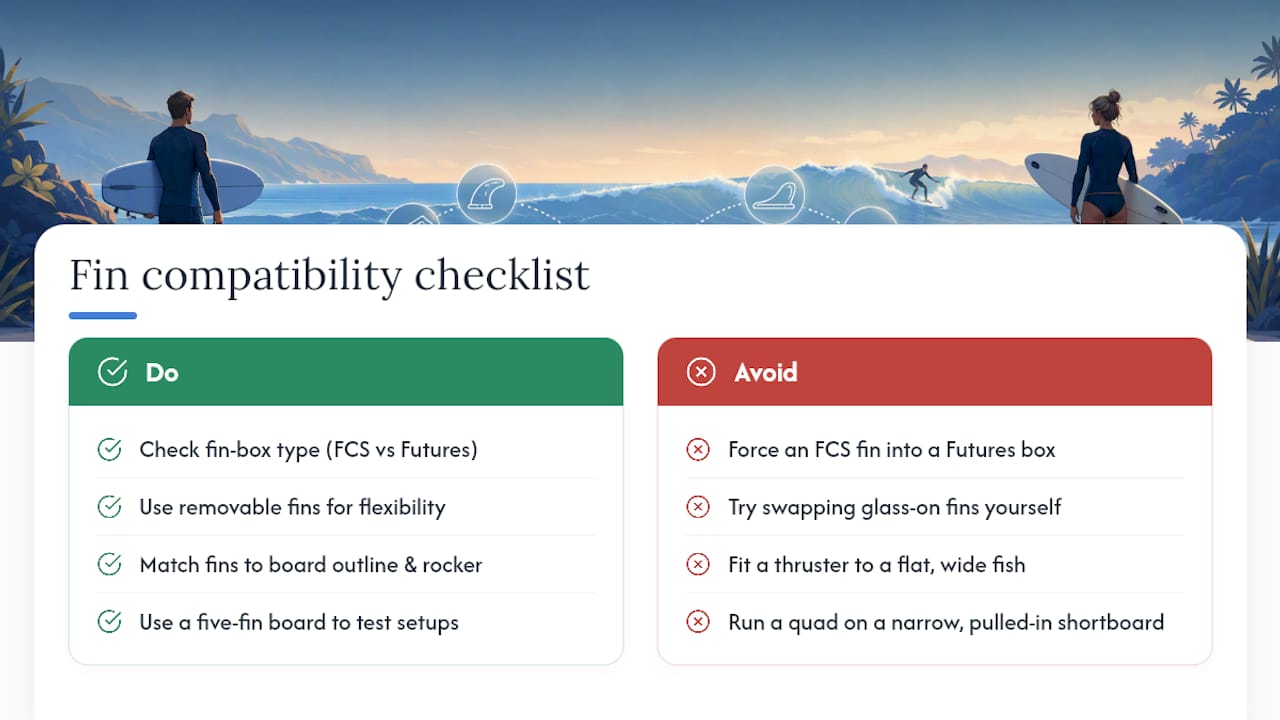
Confirm the fin box type (FCS, Futures, or glass-on) matches what you’re being handed, since a mismatched box means the fins won’t seat properly.
Ask about the swap policy if you want to try both setups during a rental period.
Check for damage before paddling out. Cracked tabs, worn threads, or a mismatched five-fin combo (one quad fin swapped for a thruster fin, for instance) will make the board behave unpredictably.
For lessons specifically, expect a conservative thruster setup by default. It’s the right call for learning, not a limitation.
Instructor Perspective: How We Choose Setups in Lessons
We default new students to a thruster because the center fin gives them a stable reference point while they’re still learning weight distribution. Once someone is pumping down the line comfortably, we’ll switch them to a quad mid-camp just to feel the difference in speed. That contrast teaches more in one session than any explanation does.
If you want to feel that contrast yourself under supervision, Riparsurfschool’s rental and lesson programs are built around exactly that kind of guided experimentation.
The History Behind Thruster and Quad Setups
The thruster wasn’t the original fin setup, and it’s worth knowing that before assuming it’s the “default” for some deep technical reason. Surfboards ran single fins through the 1970s, giving stability but limited maneuverability. Twin-fin setups followed, adding looseness and speed but sacrificing control in bigger or steeper surf.
Simon Anderson introduced the three-fin thruster in 1981, riding it to a win at Bells Beach that changed competitive surfing almost overnight. The setup solved the twin-fin’s control problem by adding a center fin that gave surfers a stable pivot point, and within a few years it became the standard configuration on shortboards worldwide. That dominance held for roughly two decades.
Quads have an older lineage than most surfers realize. Four-fin configurations existed in experimental form before the thruster, but they didn’t gain real traction until shapers like Rusty Preisendorfer and later Richard “Tudor” Kondracki refined the concept in the 1990s and 2000s. The setup found its niche in fish and speed-oriented shapes, where surfers wanted twin-fin speed with more hold than a two-fin setup could offer. Glenn Winton’s history with the concept also helped push quads back into mainstream shortboarding.
Neither setup replaced the other. They settled into complementary roles, which is exactly why the “which one is better” question misses the point.
Fin Material and Shape: The Variable Everyone Underrates
Setup type gets all the attention, but fin material and template arguably matter just as much. Fiberglass fins flex more, which softens the pop out of turns and forgives a slightly aggressive stance. Carbon fins hold their shape under load, which means faster response but less forgiveness if your weight is out of position.
Foil shape changes how each setup breathes. A flat-foil fin on the inside face and curved on the outside generates lift efficiently, useful on a quad where you want easy speed generation. A fully symmetrical foil, common on thruster center fins, prioritizes even performance in both directions since that fin has to work equally well on either rail.
Template shape can genuinely invert what you’d expect from a setup. A quad running large, heavily raked fins can feel more stable and drivey than a thruster running small, upright fins, because template characteristics often outweigh the simple count of fins on the board. That’s a point worth repeating any time someone gives blanket advice about “quads are always looser” or “thrusters are always more stable.” Neither claim holds up once fin template enters the equation.
Base width and tip design finish the picture. A wider base low on the fin adds hold and drive through the bottom of a turn. A narrower, more tapered tip releases more easily at the top of a maneuver, which is why many performance thrusters pair a wide base with a pulled-in tip.
Compatibility: Matching Fins to Your Board and Fin Boxes
Not every board accepts every fin setup, and this trips up more surfers than you’d expect. Fin box type is the first checkpoint. FCS and Futures boxes dominate the market and accept a huge range of removable fins, but the boxes themselves aren’t interchangeable, an FCS fin won’t seat in a Futures box, and vice versa.
Glass-on fins, still common on some guns and longboards, are permanent. You can’t switch a glass-on thruster to a quad without a shaper cutting new boxes into the tail, which is a real repair job, not a swap.
Board outline and rocker matter just as much as the box type. A flat, wide-tailed fish is shaped to run a quad well, its outline already generates speed, so the fin setup complements the shape instead of fighting it. Forcing a thruster onto that same fish tends to choke the speed the outline is designed to produce. The reverse holds for a pulled-in, narrow-tailed performance shortboard: it’s built around a thruster’s pivot, and running a quad on it can feel skatey and hard to control through vertical sections.
Five-fin boards solve most of this by giving you both box configurations on one board, which is why they’ve become the standard for surfers who want to experiment without owning two boards. If you’re testing setups for the first time, a five-fin board removes the compatibility question entirely. You’re only deciding on fins, not fighting the board’s fundamental design against a fin count it wasn’t shaped for.
Common Mistakes When Switching Between Setups
The biggest mistake is expecting an identical ride. Surfers switch from thruster to quad expecting the same turning behavior with a speed bonus, then get frustrated when the board feels loose and skips through turns instead of holding a rail. The fix is adjusting your stance slightly forward and trusting the extra speed to carry you through turns you’d normally generate with a hard pivot.
The second mistake runs the other direction: dropping onto a thruster after weeks on a quad and over-pivoting, throwing the tail around too aggressively because muscle memory expects a looser response. Give yourself a wave or two to recalibrate before judging the setup.
A third mistake is changing setup and fin size at the same time. If you swap from a thruster to a quad and also drop to smaller fins because you assume quads “should” run small, you can’t isolate which change caused the different feel. Change one variable, ride it for a session, then change the other.
The last mistake is mismatched fins on a five-fin conversion, running one worn or wrong-sized fin because it was the only spare in the bag. Fin template inconsistencies throw off the balance you’re trying to test, and you’ll draw the wrong conclusion about the setup itself when the real problem was a mismatched fin.
Author Note
I’ve watched hundreds of students discover their fin preference by simply trying both. That’s still the fastest way to learn what actually works for you.
— Fernando
Test Both Setups With Riparsurfschool Before You Commit
Riparsurfschool gives you a way to feel the thruster-versus-quad difference firsthand instead of guessing from a blog post, on real waves, with someone who can adjust your stance and fin choice in real time.

A group surf lesson is the affordable way to get a feel for a standard thruster setup and build the wave-reading skills that make any fin configuration work better. If you want focused, one-on-one attention while comparing setups back to back, a private surf lesson lets your instructor tailor the session around exactly what you’re trying to learn. Planning a longer trip and want multiple sessions across different conditions to test both setups properly? A surf camp package gives you the repeated water time that a single lesson can’t. And if you’re mapping out the rest of your trip while you’re at it, this guide to planning a beach holiday covers the logistics worth sorting out in advance.
Ready to feel the difference between a thruster and a quad on your own board? Book your session online and tell us your weight, experience level, and the conditions you’re chasing, we’ll set you up with the right fins from the first paddle out.
Sources
Recommended
Comments