

Best Time to Surf Peniche: A Month-by-Month Guide

Beginners get the best conditions from June through August, when the surf sits small and the water runs warm. The best overall window is September through November, when swells turn consistent and crowds thin out. For advanced surfers chasing big, hollow waves, October through March delivers the goods, but at a cost: cold water, thick wetsuits, and serious hazard at breaks like Supertubos.
Beginners: June–August, mellow rollers, warmest water of the year
Intermediates: September–November, reliable swell without winter’s chaos
Advanced surfers: October–March, the biggest and gnarliest barrels on the peninsula
Pick your month, then check the local forecast the morning you plan to paddle out. Conditions shift break to break, and Peniche rewards anyone willing to look at the map before picking a spot.
Key Takeaways
The right time to surf Peniche depends entirely on skill level: summer for beginners, September through November for the best all-around conditions, and October through March for the biggest, most demanding waves.
Point | Details |
Beginners go in summer | June through August offers the smallest, most forgiving waves and the warmest water of the year. |
Best overall window | September through November combines consistent swell, warm water, and the Rip Curl Pro Peniche. |
Winter is expert-only | December through February brings the largest groundswells, often 5 to 10 feet at exposed breaks like Supertubos. |
Check wind and tide daily | Local forecasts update every six hours, so recheck swell, wind, and tide the morning of your session. |
Book instruction locally | Riparsurfschool offers certified local instructors and camp packages near Praia Areia Branca matched to your season and skill level. |
Table of Contents
When to Go to Peniche for Surf: A Seasonal Breakdown
Peniche sits on a peninsula, which means it almost always has a wave working somewhere, whatever the wind is doing. That geography gives the town 30-plus breaks within a 20-minute drive, and it’s the real reason locals say Peniche surfs year-round rather than seasonally.
Summer (June–August) brings the mellowest surf of the year, with rollers generally in the 1 to 3 foot range and water hovering around 17 to 19°C, making it one of the best beach breaks for UK travellers in July to explore. It’s also the busiest stretch on the beaches, largely because it overlaps with Portugal’s general tourist season, not just surf traffic.
Autumn (September–November) is where most seasoned visitors point first. Swells firm up, the water is still warm enough for a 3/2mm wetsuit, and this window lines up with the Rip Curl Pro Peniche, the WSL event held at Supertubos.
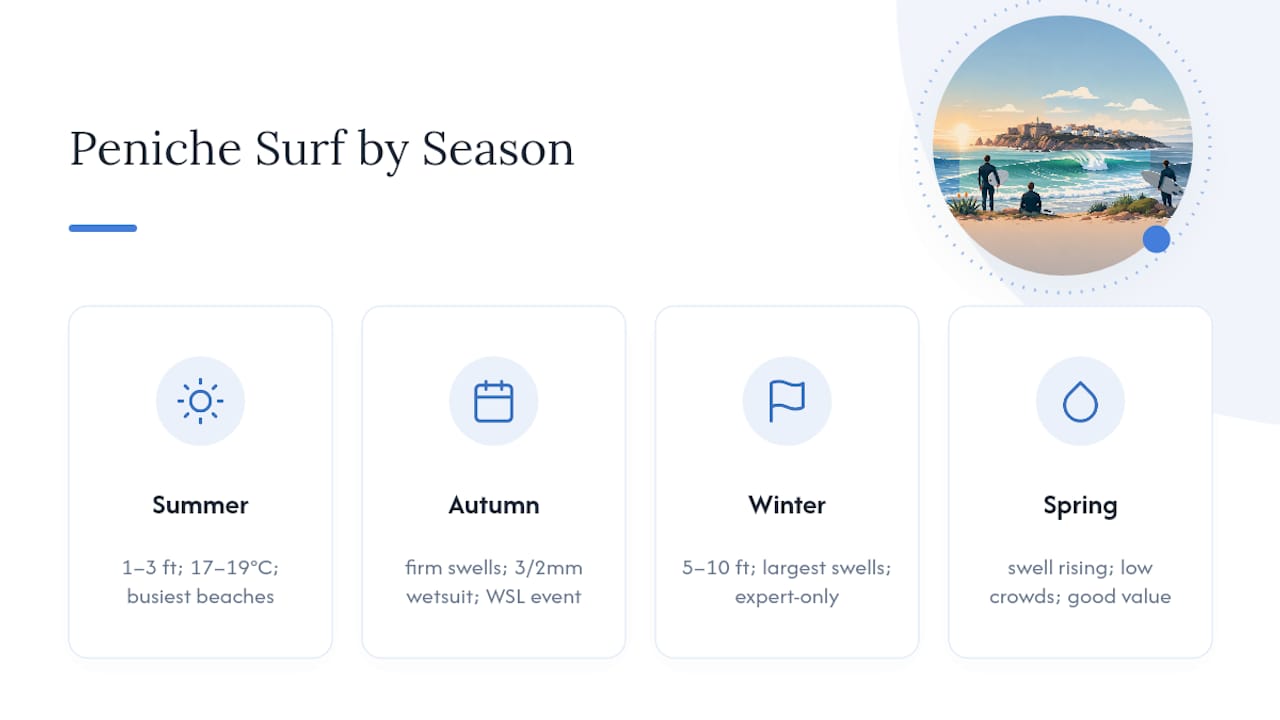
Winter (December–February) produces the year’s largest groundswells, often topping 5 to 10 feet at exposed breaks. This is Supertubos territory for people who know what they’re doing, not a season to learn on.
Spring (March–May) is the sleeper pick. Swell quality climbs steadily, crowds stay low, and the value for intermediate surfers looking to progress without a summer scrum is hard to beat.
What Does Each Month Actually Look Like in Peniche?
Zooming into individual months tells you more than a seasonal label ever will, since Peniche’s swell window moves fast.
January — Big, powerful swell, water around 14 to 15°C, thick wetsuit required, advanced surfers only at exposed spots.
February — Similar to January, occasional cleaner windows between storm systems.
March — Swell starts organizing, water still cool, good for intermediates chasing bigger waves without full winter chaos.
April — Steadier conditions, fewer people in the water, solid intermediate month.
May — Warming water, dependable swell, one of the best all-around value months.
June — Small, friendly waves begin, water comfortable, beginner season opens.
July — Typically the year’s lowest average swell, warmest water, busiest beaches, prime beginner month.
August — Same beginner-friendly pattern as July, peak crowd levels at Baleal in particular.
September — Swell starts picking back up, water still warm, fewer tourists, arguably the best single month to visit.
October — Consistent, powerful swell arrives, Rip Curl Pro window often falls here, Supertubos firing.
November — Swell stays strong, water cooling, still excellent for confident intermediates and above.
December — Winter swells ramp up, water drops toward 15°C, expert territory returns.
The September–October stretch pairs 3 to 8 foot swells with 16 to 18°C water, which explains why it gets flagged as the sweet spot across nearly every local guide.
Which Peniche Break Fits Your Skill Level?
Matching the season to a month is only half the job. The other half is picking the right beach once you’re standing on the sand, because Peniche’s spots don’t all work the same way on the same day.
Supertubos — Hollow, powerful barrels, advanced surfers only, working best October through March.
Baleal / Cantinho da Baía — Sandy bottom, forgiving whitewater, the default beginner zone.
Lagide — Punchy peak, good for intermediates ready to move past whitewater.
Molhe Leste — Sheltered by the harbor wall, a solid intermediate option when the main coast is too big.
Almagreira — Consistent beach break, another strong intermediate pick outside peak crowds.
Peniche’s peninsula shape means north winds clean up south-facing beaches while the reverse happens with south winds, so if your morning spot looks blown out, driving ten minutes to the other side of the point often fixes it entirely.
Pro Tip: Supertubos runs as a shorebreak with heavy, fast takeoffs. If you’re not confidently reading a barreling wave from the peak, watch a session from the beach before you paddle out. It humbles plenty of intermediate surfers who assumed it would surf like a normal beach break.
How Do You Read a Peniche Surf Forecast?
Three numbers matter more than any others: swell height, swell period, and wind direction. Height tells you size, period tells you power (a 14 second period packs far more punch than a 14 second period’s smaller cousin at 8 seconds), and wind direction tells you whether a spot will be clean or torn apart.
Check swell height and period together, not separately, since a small swell with a long period can outsurf a bigger one with a short period.
Confirm wind is blowing offshore or cross offshore for the spot you’re considering.
Cross-reference tide, since many Peniche breaks favor a specific tide phase, mid to high for beginner-friendly beach breaks, lower tide for exposing reef and sandbar peaks like Supertubos.
Recheck the forecast the morning of your session and again a few hours before paddling out, since conditions can shift meaningfully within a single tide cycle.
Local forecast maps update every six hours, and live wind reports refresh hourly, which is frequent enough to catch a wind switch before it ruins your session.
A forecast with a wind layer lets you spot exactly where offshore conditions will show up on the peninsula that day, often the difference between a clean session and a wasted morning.
For a deeper walkthrough of how swell, period, wind, and tide interact along the Portuguese coast, this breakdown of good surf conditions is worth bookmarking before your trip.
When Should You Book Lessons and Camps?
Book summer lessons and camps six to eight weeks ahead, since July and August fill up with school groups fast. The Rip Curl Pro week in October or November brings its own crowd, tighter parking near Supertubos, and packed viewing areas, so book lodging even earlier if you want to watch the event.
Traveling during the WSL window? Expect road closures near the contest zone and plan alternate breaks for your own sessions.
Want fewer people in the water without sacrificing quality? Aim for May, June, or September.
Session timing matters too: early mornings beat midday almost everywhere in Peniche during peak months.
Why Local Instruction Matters in Peniche
Riparsurfschool has run surf lessons and surf camps from Praia Areia Branca, near Peniche and Ericeira, since 2001. That’s more than two decades of watching how each season actually surfs here, not just reading a forecast from a screen.
Certified local instructors who know which break suits the day’s swell and wind, not a generic script.
A small beach-village base rather than a crowded resort strip, with equipment, a deck area, and showers on site.
Flexible lodging and surf camp options for travelers who want structure built around the season they’re visiting.
That local knowledge is the piece a forecast app can’t replace: knowing which side of the peninsula will be clean at 8 a.m. on a Tuesday in October.
A Local’s Honest Read on Timing Your Trip
If you’re new to surfing, don’t let anyone talk you into a winter trip for the “real” Peniche experience. Go in summer, learn on forgiving waves, and come back in September or October once you can read a lineup. Whatever month you choose, respect the pecking order in the water, wait your turn, and don’t paddle straight for Supertubos on your third lesson.
— Fernando
Plan Your Peniche Trip With Local Instruction
Riparsurfschool turns this seasonal guide into an actual trip. Instead of guessing which break matches the swell on your arrival day, you get certified local instructors who already know where the wind is offshore that morning.

Beginners heading over in summer can book a beginner surf lesson or join a full surf camp package with lodging included at Praia Areia Branca. Surfers wanting more one-on-one attention, especially outside the busiest weeks, can arrange a private surf lesson built around that day’s forecast.
Pro Tip: If your trip lands in July, August, or the WSL event window, book your dates at least six weeks out. Those weeks fill first, every year.
Ready to lock in dates? Book online and match your lesson or camp to the season that fits your level.
Forecast Tools and Guides Worth Bookmarking
Surf-forecast for swell, wind, and tide data
Surfing in Peniche: Complete Guide (Suay Hype) for spot-by-spot detail
Riparsurfschool’s Peniche guide for local planning notes
Sources
Recommended
Comments