

Surfing Traditions Explained: The Culture, Rules, and Spirit


TL;DR:
Surfing traditions are built on unwritten principles that ensure safety, respect, and community sharing in the ocean.
Understanding and living by lineup etiquette, local customs, and regional differences foster inclusion, trust, and lasting connections among surfers.
Most people assume surfing is about two things: finding the right wave and knowing how to ride it. That assumption leaves out the most important part. Surfing has a living culture built on unwritten lineup etiquette that functions like a shared code of conduct, covering everything from who rides which wave to how you treat the people around you. These traditions shape your safety, your fun, and whether you’re welcomed or shut out. This guide breaks down where those traditions come from, how they work globally and locally, and how you can learn to live by them.
Table of Contents
Key Takeaways
Point | Details |
Tradition shapes behavior | Surfing traditions set clear expectations for safety and respect in every lineup. |
Local customs vary | Knowing local etiquette, especially at famous spots, helps avoid conflict and earns you respect. |
Observe before you act | Watching local surfers and learning from instructors prevents mistakes and speeds up acceptance. |
Traditions build community | True surfing spirit comes from shared culture, not just catching waves. |
Instructors make it easier | Taking lessons is the fastest way to learn essential etiquette and enjoy surf travel safely. |
What are surfing traditions?
Surfing traditions aren’t rules printed on a sign at the beach. They’re passed down through watching, doing, and sometimes learning the hard way. At their core, they represent a collective agreement among surfers that makes sharing the ocean fair, safe, and genuinely enjoyable for everyone in the water.
The most powerful of these traditions live in the lineup, which is the zone just beyond the breaking waves where surfers wait for their turn. Think of it as an informal queue that runs on respect and awareness rather than numbers. According to lineup etiquette standards, the key principles involve respecting right of way, never dropping in on a wave another surfer is already riding, and honoring the hierarchy that develops naturally among regulars, elders, and locals.
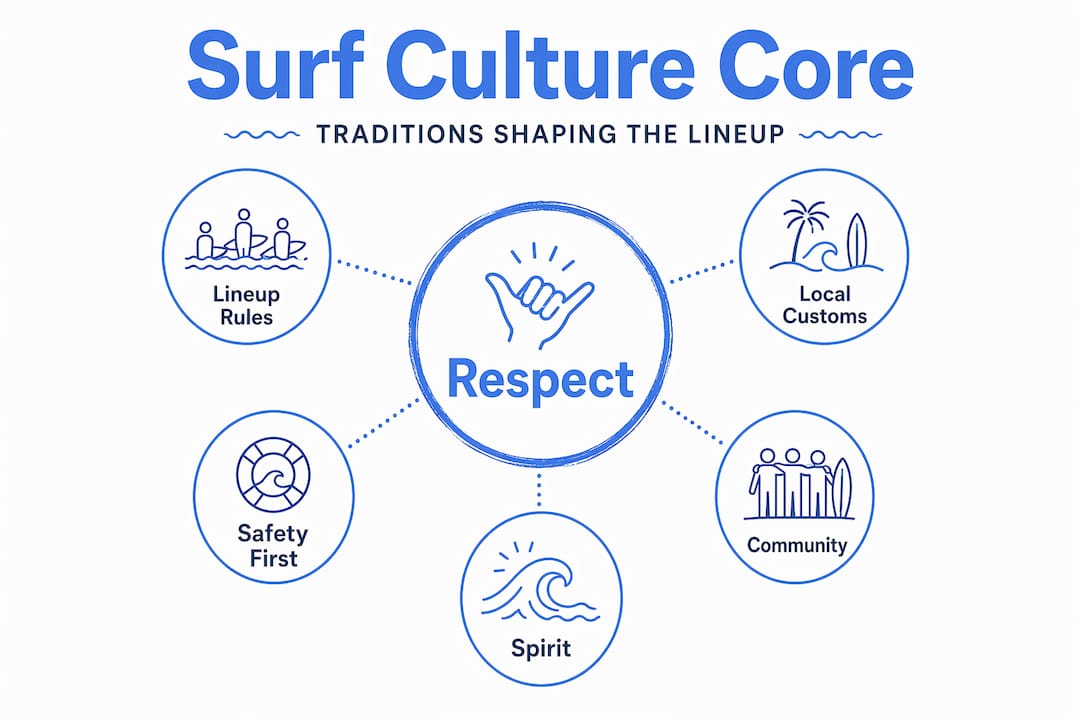
These principles connect directly to the broader concept of surf culture and community, which extends far beyond the water. Surf traditions influence how people greet each other, how they talk about waves, what they value in a session, and how they treat the ocean itself. They’re the backbone of a global tribe with millions of members.
Here’s what surfing traditions typically cover:
Right of way: The surfer closest to the breaking part of the wave has priority
No dropping in: Never paddle for or ride a wave that someone else is already on
No snaking: Don’t paddle around another surfer repeatedly to steal position
Lineup order: Wait your turn; don’t rush to the front just because you arrived
Respect for locals and elders: Experienced surfers and regulars earn priority through time and knowledge
Ocean stewardship: Leave the beach cleaner than you found it; protect the environment
“The lineup is its own world. When you paddle out, you’re not just entering the ocean. You’re entering a social space with its own norms, hierarchy, and expectations. Learn them, and you belong. Ignore them, and you’re out.”
Understanding these traditions before you paddle out is one of the essential surfer habits that separates a frustrating session from a genuinely great one.
Lineup etiquette: The foundation of surf culture
The lineup is where theory meets practice. You can read about surf etiquette for hours, but the real test comes when a perfect wave rolls in and three surfers all want it. Knowing the rules in that moment makes every difference.
Here’s how standard lineup etiquette typically unfolds in a session:
Observe before paddling out. Spend five to ten minutes watching from the beach. Identify where the peak is, who the regulars are, and how busy the lineup feels.
Paddle out without disrupting. Choose your entry point carefully and avoid paddling through the path of surfers actively riding waves.
Sit at the back of the lineup. Don’t immediately position yourself at the peak. Let your place in the queue build naturally.
Read who has priority. The person deepest (closest to the breaking point) or who has been waiting longest generally has the right to the wave.
Catch your wave and paddle back. After a ride, return to the lineup without rushing to cut back in at the front.
Communicate. A simple nod, eye contact, or verbal “go for it” goes a long way in preventing misunderstandings.
Pro Tip: If you’re visiting a new break, introduce yourself to a local surfer or your instructor before paddling out. A friendly exchange on the beach can open doors in the water that would otherwise stay closed.
The table below lays out the contrast between etiquette that builds trust and behavior that breaks it:
Situation | Respectful behavior | Disrespectful behavior |
Paddling for a wave | Check for others with priority first | Paddle without looking, drop in on someone |
Returning after a ride | Paddle around the break | Cut through the impact zone in others’ paths |
Waiting in the lineup | Hold your position, wait your turn | Repeatedly paddle to the peak (snaking) |
Crowded sessions | Share waves, let sets pass | Catch every single wave, hog the peak |
Communication | Eye contact, nod, simple words | Ignoring others, aggressive gestures |
Behavior with locals | Defer initially, show respect | Act entitled, ignore established order |
Good surfer safety habits are built right into this etiquette. When surfers follow priority rules, collisions drop significantly. When people communicate, dangerous situations become preventable. Etiquette isn’t just politeness; it’s a functional safety system.
The best great surf instructors always teach lineup behavior alongside physical technique because you can’t separate the two. Knowing how to pop up on a board is useless if you’re constantly creating conflict in the water.
Regional differences: How local traditions shape the lineup
Core etiquette may be universal, but how it’s expressed varies dramatically from one beach to the next. What’s acceptable at a beginner-friendly beach in Portugal might be completely inappropriate at a powerful reef break in Indonesia or a legendary Hawaiian point break.
Hawaiʻi sits at the spiritual heart of surfing history. The sport traces its roots to ancient Polynesian culture, and local surf culture in Hawaii reflects that depth. The concept of aloha, which means love, respect, and mutual care, runs through every aspect of Hawaiian surfing. At famous spots like Pipeline on Oahu’s North Shore, the hierarchy is intensely local. Visiting surfers are expected to observe, wait, and earn their place gradually. Lineup hierarchy differences exist even within the global surf code, with certain breaks explicitly reserving peak priority for locals, elders, and lifeguards.
At the same time, Hawaiian culture often offers genuine warmth to visitors who show respect. The cultural experiences in Hawaii that leave the deepest impression are the ones shaped by mutual regard, not entitlement.
Here’s how core rules compare globally versus locally:
Rule | Global standard | Local variation (example) |
Right of way | Closest to the peak has priority | In Hawaii, locals and elders override visitor priority at many breaks |
Dropping in | Never acceptable | At beginner breaks, instructors may guide exceptions with communication |
Wave sharing | One surfer per wave | Some longboard communities allow tandem riding or cooperative wave sharing |
Lineup position | First come, first priority | Regulars at some spots hold unofficial permanent positions in the peak |
Communication style | Nonverbal nods are enough | Some breaks have very vocal cultures where talking through waves is normal |
Pro Tip: Before paddling out at any new spot, spend time observing and ask your local guide or instructor about unwritten local rules. What’s rude at one beach might be standard practice at another, and assuming you know is one of the fastest ways to create conflict.
Even in Portugal, where the surf culture is known for being open and welcoming, different spots along the coast carry their own personalities. The approach that works at a mellow beach break near Ericeira won’t necessarily fly at a heavier reef break closer to Peniche. Adapting to that local character is part of sustainable surf habits that keep communities thriving over the long term.
The key lesson: traditions are living, not fixed. They evolve with geography, wave type, community history, and even the time of year. Showing up with humility and curiosity is always the right opening move.
Learning and respecting traditions as a visitor or new surfer
Knowing the rules and actually living by them are two different skills. For visitors and newer surfers, the challenge isn’t just learning the theory but putting it into practice in real time, in the water, when adrenaline is high and instinct takes over.
In places like Hawaii, visitor expectations are clear: respect elders and locals, wait your turn without complaint, and absolutely never drop in. These aren’t suggestions at serious breaks. They’re the price of admission to a great session.
Here’s a practical step-by-step approach for any visitor entering a new surf community:
Arrive early and watch. The first 20 minutes on the beach tell you almost everything about how a lineup runs.
Introduce yourself. A simple, friendly greeting to a local surfer signals good faith.
Start conservatively. Take smaller, less contested waves at first. Show that you’re not there to dominate.
Thank people. When someone lets you have a wave or warns you about a hazard, acknowledge it.
Defer to experience. If an elder or local is going for the same wave, pull back. You’ll earn more respect by stepping aside than by fighting for it.
Ask your instructor. If you’re with a surf school, lean on your guide’s knowledge constantly.
Mistakes that visitors commonly make include:
Cutting the line by paddling straight to the peak without waiting
Ignoring the pecking order because they’re on holiday and think the rules don’t apply
Assuming silence means approval when local surfers are actually frustrated
Treating the break like a theme park rather than someone else’s home
Overestimating their skill level and paddling out at breaks beyond their ability
The role of learning from your surf instructor is enormous here. A skilled local instructor doesn’t just teach you to stand on a board. They translate the cultural context of each break, tell you who the regulars are, and coach you through the social dynamics of the water before you ever paddle out.
Instructors with the qualities of excellent teaching understand that surf education is as much about culture as it is about physical skill. The best sessions happen when a student arrives in the water already aware of the invisible rules that govern it.
A deeper look: Why surfing traditions matter more than you think
Here’s an uncomfortable truth that most “surf etiquette guides” skip over: the majority of visitors treat these traditions as a checklist to pass rather than a culture to enter. They read the rules, feel prepared, then paddle out and still manage to irritate everyone in the lineup. The information wasn’t the problem. The mindset was.
Surf etiquette isn’t a bureaucratic set of regulations. As surf safety research shows, it encodes real safety and social coordination, making split-second decisions in the water faster and less likely to end in conflict or injury. When everyone understands the system, the lineup practically runs itself. When one person ignores it, the whole dynamic breaks down.
Think of the lineup less like a competitive arena and more like a shared resource. The ocean belongs to everyone who respects it. Traditions are the operating system that makes shared access possible without constant fighting. They’re not about keeping people out; they’re about keeping the experience worth having for everyone involved.
We’ve seen this firsthand at Praia Areia Branca. Surfers who arrive with genuine curiosity about the local culture, who ask questions, watch carefully, and treat the community as something worth joining, leave with experiences that go well beyond waves. They make friends. They get invited back. They find a place in a community that spans generations and continents.
The surfers who treat etiquette as a box to check are the ones who finish their trip feeling like they missed something. Because they did. The connection to surf lifestyle and community that makes surfing so powerful doesn’t come from catching the most waves. It comes from earning your place within something larger than yourself.
If you want surfing to change your life, which it genuinely can, start by taking the traditions seriously. Not as rules to memorize but as values to internalize. That shift in approach is the difference between a surf trip and a surf experience.
Ready to experience surfing traditions firsthand?
Understanding surf culture is one thing. Living it is something else entirely, and that’s where real learning happens. At Ripar Surf School and Surfcamp Portugal, our local certified instructors teach you the traditions, the lineup dynamics, and the cultural context of each break from day one, not as an afterthought.

Whether you’re just starting out or looking to go deeper into surf culture, we have options built for genuine immersion. Book surf lessons with instructors who grew up surfing these waters, or go all-in with a private surf lesson tailored entirely to your goals and learning pace. If you want the full community experience, our book surf camp packages place you inside the daily rhythm of a real surf village, where traditions are lived, not just explained. Come find out what it feels like to belong in the lineup.
Frequently asked questions
What is the most important surfing tradition for beginners?
The top priority for any newcomer is respecting the lineup by learning who has right of way and never dropping in on a wave another surfer is already riding. This single habit prevents most conflicts and signals genuine respect.
How do surfing traditions differ around the world?
Core etiquette remains consistent globally, but each region adds its own customs. Regional lineup differences mean that places like Hawaiʻi may reserve peak priority for locals and elders in ways that wouldn’t apply at a beginner-friendly beach break elsewhere.
What happens if you break surf etiquette?
Ignoring traditions typically leads to tension in the water, verbal warnings from locals, and potentially being asked to leave the break entirely. In ancient Hawaiian surf culture, lineup violations were treated with serious consequences, and modern surf communities still take these breaches seriously.
Can surf instructors help you understand local traditions?
Absolutely. Local instructors are among the best resources for learning the unwritten rules specific to each break, and their guidance before you paddle out can prevent misunderstandings and open doors within the community.
Are there surfing traditions unique to certain famous spots?
Yes. Breaks like Pipeline on Oahu’s North Shore have codes shaped by decades of local surfer history and the specific geography of the wave, making them unlike any other spot in the world.
Recommended
Comments