

How to surf green waves: a step-by-step guide

TL;DR:
Catching green waves represents a major milestone that transforms surfing from beginner practice into real skill. Success requires precise positioning, timing, paddling, and a psychological awareness of ocean behavior, especially along Portugal’s consistent coastlines. Learning through observation, expert coaching, and respecting surf etiquette accelerates progress and ensures safety.
You paddle hard, feel the wave beneath you, pop up with confidence—and then watch it roll past without you, again. Catching green waves is the single biggest milestone for most surfers moving past the whitewater stage, yet it trips up even people who’ve been in the water for weeks. This guide breaks down exactly why that happens and what to do about it, with Portugal’s coastline as your classroom—one of the best places on earth to finally crack the code on unbroken waves.
Table of Contents
Key Takeaways
Point | Details |
Understand green waves | Green waves are unbroken and require timing, positioning, and technique to catch successfully. |
Choose the right location | Portugal’s coastline offers accessible green wave spots for both beginners and intermediates. |
Follow proven steps | Observation, positioning, and timing are more critical than power paddling for catching green waves. |
Avoid common mistakes | Don’t over-paddle, respect etiquette, and be aware of safety issues like reefs and tides. |
Invest in ongoing learning | Guided lessons and camps in Portugal help accelerate your green wave surfing skills. |
What are green waves and why do they matter?
Now that you know catching green waves is a game-changer, let’s clarify what they actually are and why they’re important for your surfing journey.
A green wave is simply an unbroken wave. Before it topples into the foamy whitewater you practiced on as a beginner, it rises up as a clean, moving wall of water. That wall is where real surfing happens. To ride it, you need precise positioning, timing, and paddling working together at exactly the right moment. Miss any one of those three, and the wave either passes under you or drives your nose straight into the sand.
The difference between green waves and whitewater matters more than most beginners expect. Whitewater is already broken—it pushes you forward with forgiving, relentless energy. A green wave is steeper, faster, and more selective. It only rewards surfers who are in the right spot at the right time. That sounds intimidating, but it’s also what makes finally riding one so satisfying.
Here’s a quick comparison to put things in perspective:
Feature | Whitewater | Green wave |
Wave state | Already broken | Unbroken, rising wall |
Paddle requirement | Minimal effort needed | Strong, well-timed paddling |
Steepness | Gentle, flat push | Steeper, faster drop |
Room for error | Very forgiving | Narrow timing window |
Skill level | Complete beginner | Beginner to intermediate |
Reward | Basic pop-up practice | Real surfing begins here |
If you’re ready to make that jump, check out this beginner’s surf guide for Portugal to understand the full learning curve. Here’s a quick list of what changes the moment you start riding green waves:
You travel further down the line instead of just straight to shore
Wave selection becomes a skill, not a guessing game
Your pop-up needs to be faster and more committed
You start reading the ocean rather than reacting to it
The satisfaction level goes up by a factor of ten
That emotional shift is real. Ask anyone who caught their first clean green wave—it’s the moment they stopped feeling like someone in the ocean and started feeling like a surfer.
Where to catch green waves in Portugal
With an understanding of green waves, the next step is knowing where to find them—especially if you want a memorable surf experience along Portugal’s coast.
Portugal has one of the most consistent surf coastlines in Europe. For green waves specifically, the spots near Peniche and Ericeira are hard to beat. Beginner green waves at Foz do Lizandro are sandy, mellow, and typically 1 to 3 feet, making them perfect for first attempts. Baleal and Cantinho da Baía offer similarly gentle conditions with a sheltered bay setup that keeps things manageable. For intermediates, Ribeira d’Ilhas delivers powerful 1.5 to 2.5 meter rights over a reef, while Amado in the Algarve is a forgiving beach break with consistent swell. September through April is the golden window for northwest swells across all these spots.
Spot | Location | Ideal level | Best season | Wave type |
Foz do Lizandro | Near Ericeira | Beginner | Sep to Apr | Sandy beach, mellow |
Baleal/Cantinho da Baía | Peniche area | Beginner | Year-round | Protected bay, gentle |
Praia Areia Branca | Near Peniche | Beginner/Intermediate | Sep to Apr | Beach break, consistent |
Ribeira d’Ilhas | Ericeira | Intermediate | Sep to Mar | Reef, long rights |
Amado | Algarve | Intermediate | Oct to Mar | Beach break, forgiving |
When choosing a spot, pay attention to three things: crowd density, tide behavior, and wave type. A quiet beach with smaller green waves will teach you far more than a crowded reef break where anxiety takes over. Portugal’s surf vacation planning gets much easier when you match your skill level to the right spot from day one.
A few quick pointers for surf travel planning in Portugal:
Book accommodation close to your chosen break to maximize water time
Check surf forecasts for swell direction, not just wave height
Arrive at the beach early—lineups fill up quickly at popular spots
Ask locally about any current or tide warnings before paddling out
Rent a bigger board than you think you need for your first green wave sessions
Pro Tip: Booking a surf camp gives you immediate access to local instructors who know which break is working on any given day—that knowledge alone can save you hours of frustration. Portugal’s Ericeira and Peniche regions offer ideal progression spots during surf vacations, and structured camps consistently produce faster results than solo practice.
How to catch green waves: step-by-step technique
After choosing the right location, success depends on your technique, so let’s break down the process in a simple, step-by-step way.
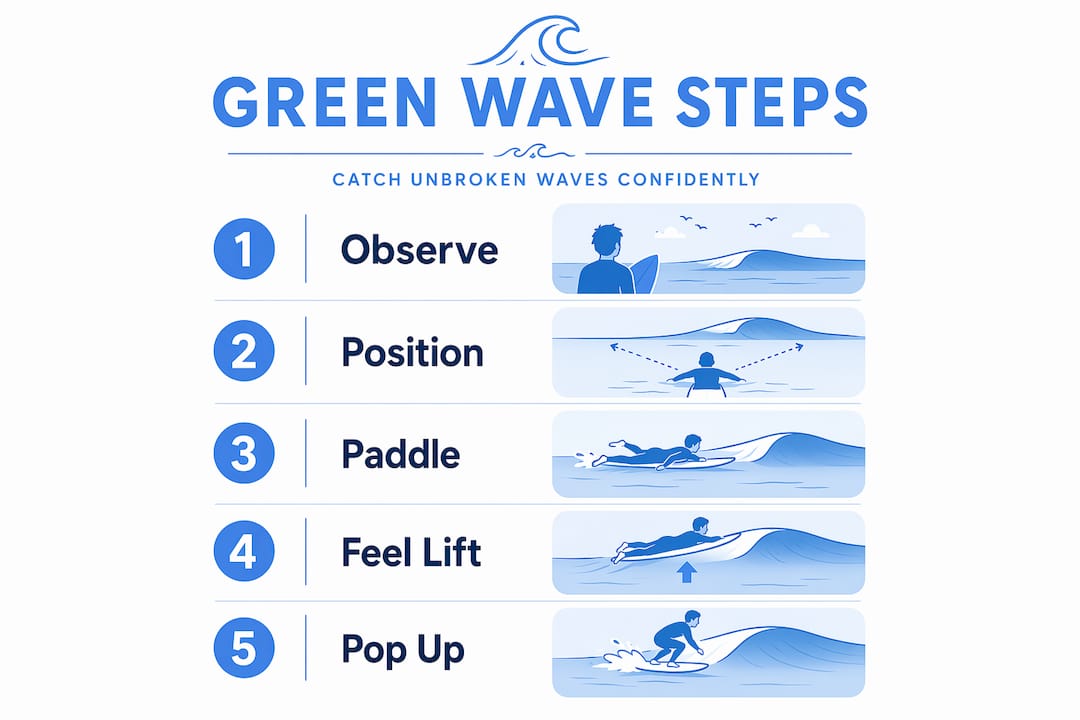
The core elements are observation, patience, positioning, timing, and paddling. Most beginners rush straight to the paddling part and skip everything that comes before it. That’s why they miss wave after wave.
Here’s the exact sequence to follow:
Sit and watch for at least 10 minutes before paddling out. Look at where waves break, how sets arrive, and where experienced surfers position themselves.
Paddle to the lineup using a channel—a section where waves aren’t breaking—to conserve energy for when it counts.
Position yourself at the peak, the highest point of the wave just before it pitches. Sit slightly outside the main break zone.
Choose your wave early. As a set approaches, identify your wave and start turning your board toward shore before the wave reaches you.
Begin paddling firmly and early—3 to 4 strokes before the wave arrives. Keep your strokes long, deep, and even.
Feel the lift. As the wave’s energy picks up your board, your speed will suddenly match the wave’s speed. This is your signal to pop up.
Commit and pop up. One smooth, explosive movement. Hesitation at this point kills the ride.
Look down the line, not at your feet, and let the wave carry you.
Prioritize observation and patience over aggressive paddling and copy experienced surfers’ positioning—this is the single most repeated piece of advice from experienced coaches, and it works.
There are actually two schools of thought on paddling: the patient approach (conserve energy, wait for the perfect moment) versus the high-energy approach (paddle hard and often to create your own momentum). Both have merit. On smaller, slower waves, patience pays off. On steeper, faster green waves, you need to generate speed quickly or the wave will outrun you. The consensus? Positioning and timing decide the outcome. Paddling just seals the deal.
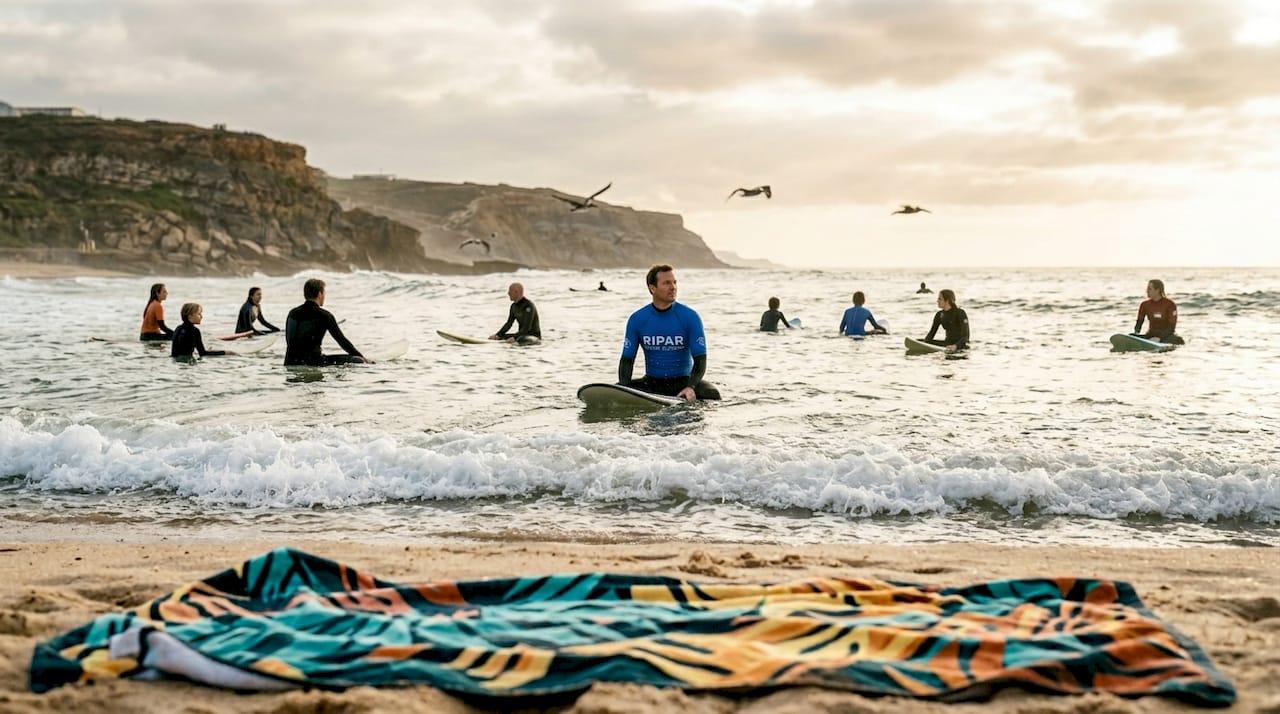
Pro Tip: Learn to “feel the lift.” It’s the subtle sensation of the wave’s energy beginning to move your board faster than your strokes alone can. When you feel that surge, stop paddling and pop up immediately. Practicing this awareness through surf lesson planning with a coach dramatically shortens the learning curve.
Watching more experienced surfers in the lineup is genuinely one of the fastest ways to improve. You’ll notice they barely seem to paddle—because they’re already where the wave wants them. Copy that, not their style.
Common mistakes, safety, and etiquette for green waves
Knowing what not to do and how to stay safe is just as important as good technique—here are the most common mistakes and how to avoid them as you tackle green waves.
Most beginners struggle with the same handful of errors. Recognizing them in real time is half the battle:
Over-paddling too early: You burn out before the wave arrives and either miss it or pearl (nose-dive)
Poor positioning: Being too far inside means waves break on you; too far outside and they pass under you
Not committing to the pop-up: Half-hearted attempts cause late takeoffs and wipeouts
Paddling straight to the peak through breaking waves: Use channels or turtle rolls to get out efficiently
Ignoring the tide: What’s a fun 2-foot wave at high tide can become a dangerous shore break at low tide
Safety on Portugal’s reefs and beaches deserves real respect. Paddle out via channels, use turtle rolls through breaking waves, avoid over-paddling, wait for the lift, and always watch shallow sections at low tide on reef breaks. Read Portugal’s surf conditions before paddling out—rip currents and swell size can change quickly, especially around Peniche and Ericeira.
“The ocean doesn’t care how much you want to surf. Respect the conditions, respect the lineup, and the sessions will take care of themselves.” This attitude is shared by most experienced surfers and coaches along Portugal’s coast.
Etiquette is not optional in Portugal’s popular lineups. Localism exists and it’s taken seriously, especially at world-class spots like Ribeira d’Ilhas and Supertubos. Follow these basics every time:
The surfer closest to the peak has priority—never drop in on them
Don’t paddle straight through the lineup; go around it
Apologize when you make a mistake and mean it
Wait your turn, even if the wait feels long
Never ditch your board toward other surfers
Respect earns respect. Locals are often far more welcoming when they see you following the rules from the start.
Measuring progress and next steps: how to keep improving
With mistakes and safety covered, let’s look at how you can set practical goals and create a roadmap for ongoing improvement, wherever you surf in Portugal.
Progress in surfing is rarely linear. You’ll have sessions where everything clicks, followed by days where nothing works. That’s completely normal. Setting clear, simple milestones keeps you motivated without setting unrealistic expectations:
Milestone 1: Catch your first green wave without pearling
Milestone 2: Pop up cleanly and ride to shore on a green wave, three times in one session
Milestone 3: Choose your wave intentionally, not just react to whatever shows up
Milestone 4: Ride consistently down the line rather than straight to shore
Milestone 5: Start thinking about your first bottom turn or direction change
Don’t judge a session by wave count alone. Some of your biggest learning moments will happen while sitting in the lineup watching others. Observation is practice too.
Structured lessons and camps dramatically speed up the process. Rather than repeating the same mistakes session after session, a good coach corrects your positioning before the wave even arrives. Portugal’s progression spots in Ericeira and Peniche are perfectly suited for this kind of focused improvement, especially during the September to April season when conditions are most consistent.
On your next Portugal surf holiday, commit to at least a few guided sessions alongside your free surfing time. The combination of coached feedback and unstructured practice is what produces real breakthroughs. Find out how to get the most out of every session by maximizing your surf camp stay with practical tips built around Portugal’s specific breaks and conditions.
Why most green wave advice misses the real difference-maker
Having covered all the steps and safety tips, let’s dig deeper—what actually creates those “aha” moments in a surfer’s progression?
Here’s an honest opinion from years of coaching at Praia Areia Branca: the vast majority of green wave guides focus almost entirely on the physical mechanics. Paddle harder. Pop up faster. Position yourself at the peak. All of that is useful, but it misses the thing that actually separates surfers who progress quickly from those who stay stuck.
The real difference-maker is psychological awareness combined with genuine humility. Most surfers trying to catch green waves are too focused on performing the steps to actually feel what the ocean is doing. They’re running through a checklist in their heads while the wave does something unexpected, and they freeze or react too late.
Watching locals and your surf instructor essentials at work teaches you things no article ever fully captures. You start to see the micro-adjustments—the tiny shift in weight, the half-stroke pulled at the last second, the patience of someone who knows the wave will come to them rather than chasing it. That’s the hidden curriculum of surfing. It’s transmitted through observation, not instruction manuals.
The challenge we’d put to you: spend the first 15 minutes of your next session doing nothing but watching. Don’t paddle for waves. Just observe. Where do experienced surfers sit? How early do they start paddling? What do they do when they let a wave pass? You’ll learn more in that 15 minutes than in an hour of frustrated attempts.
Slow down, observe, and adapt. That’s the advice most surf guides won’t give you because it doesn’t feel actionable enough. But in our experience, it’s exactly what unlocks the next level.
Learn faster with expert instruction in Portugal
Ready to stop guessing and start actually catching green waves with confidence? There’s no better shortcut than having an experienced local coach watch your session and fix what’s holding you back in real time.
At Ripar Surf School and Surfcamp Portugal, we’ve been coaching surfers of all levels since 2001 at Praia Areia Branca, right in the heart of some of Europe’s best surf territory. Our certified instructors know these waves the way you know your home street. Whether you’re chasing your first green wave or refining your takeoffs, our small group lessons and full surf camp packages are built around real progression. Book surf lessons directly or explore surf lodging in Portugal to make your next surf holiday a complete experience from the water to the dinner table.
Frequently asked questions
What is the minimum skill level for surfing green waves?
You should be able to paddle confidently, pop up on whitewater, and control your board before attempting green waves, since green waves require precise positioning and timing that demand a stronger base than whitewater riding.
Which surf spots in Portugal are best for green wave beginners?
Foz do Lizandro and Baleal/Cantinho da Baía are ideal starting points, with sandy, mellow 1 to 3 foot green waves that give beginners a forgiving environment to practice positioning and timing.
How do I avoid nose-diving or “pearling” on green waves?
Sit further back on your board, ease off the paddle intensity as the wave arrives, and wait for the wave’s lift before committing to your pop-up rather than forcing it too early.
When is the best time of year for green waves in Portugal?
September through April is consistently the best window, with regular NW swells delivering clean, well-formed green waves at both beginner and intermediate spots along the Peniche and Ericeira coastlines.
Do I need to worry about localism and etiquette in Portugal?
Yes, particularly at well-known breaks—always respect priority rules, never drop in, and follow basic lineup etiquette to keep the session safe and enjoyable for everyone in the water.
Recommended
Comments