

Types of surf warm-ups: boost performance and prevent injuries
- Fernando Antunes

- May 12
- 10 min read
TL;DR:
A proper surf warm-up should take 10 to 20 minutes, focusing on dynamic movements that mimic surfing demands. Static stretching is ineffective pre-surf and may reduce muscle power, making activation and mobility drills essential. Incorporating targeted exercises enhances performance, reduces injury risk, and prepares surfers on any skill level for optimal water performance.
Warming up before surfing isn’t just about touching your toes and jogging to the water. The choices you make in those first 10 to 20 minutes on the beach directly affect how well you perform, how quickly you progress, and whether you walk away injury-free. Most beginner and intermediate surfers either skip the warm-up entirely, default to holding static stretches that actually reduce muscle responsiveness, or rush through something generic that misses the muscles surfing actually demands. In this guide, you’ll get clear criteria for what a surf warm-up must do, a full breakdown of the main types, a side-by-side comparison, and practical advice for picking the right one every time.
Table of Contents
Key Takeaways
Point | Details |
Dynamic movement is best | Moving warm-ups activate your surf muscles better than static stretching. |
Tailor to your body | Select and adapt routines based on experience, comfort level, and any pain signals. |
Aim for 5–20 minutes | A quality surf warm-up lasts between five and twenty minutes depending on your goals. |
Mimic real surf actions | Include paddling, pop-up, and core activation moves to prime your nervous system. |
Ask instructors for tips | Surf school pros can show you the safest, most effective pre-surf routines. |
What makes an effective surf warm-up?
With the challenge of making your pre-surf warm-up count set out, let’s clarify what really matters when you choose how to prep your body.
Not all warm-ups are created equal, and surfing places very specific demands on your joints, muscles, and nervous system. A generic gym warm-up won’t cut it on the beach. You need something that matches what you’re actually about to do in the water.
The four must-have criteria for any surf warm-up:
Raises your heart rate and core temperature so muscles become more pliable and reactive
Mobilizes surf-specific joints including shoulders, hips, thoracic spine (mid-back), and ankles
Activates the right muscle groups especially the rotator cuff, core, glutes, and upper back
Takes 10 to 20 minutes and fits realistically into your beach routine
The biggest mistake most new surfers make is relying on static stretching, which means holding a position for 20 to 30 seconds without movement. Research from the fitness world consistently shows that static stretching before activity may reduce the muscle’s ability to fire powerfully. That’s the opposite of what you want before paddling out into waves that demand explosive power.
Dynamic warm-ups, which involve controlled moving stretches, light cardio, and activation drills, prepare your body’s neuromuscular system (the connection between your brain and muscles) for the real demands ahead. When you incorporate these into your essential surfer habits, you’ll notice the difference in your first paddle and your first pop-up.
“Skipping a meaningful warm-up increases injury risk; focus on raising blood flow and targeting shoulders, back, and core.”
Pro Tip: Think of your warm-up as a conversation with your body. You’re telling your muscles what’s coming so they don’t get surprised. A 15-minute dynamic routine can dramatically lower your injury risk while improving your first-wave performance.
Building your warm-up on these criteria will make every other decision easier. Once you understand why a warm-up needs to work this way, choosing the right type becomes straightforward. Combining your warm-up principles with solid surf fitness foundations creates a reliable foundation for long-term progress.
Core types of surf warm-up routines
Now that you know what a great surf warm-up should do, let’s break down the main types you’ll see at surf schools or before a solo session.
There are four main categories of surf warm-up routines. Most effective pre-surf routines combine two or three of these, but understanding each one helps you know what to prioritize depending on your situation.
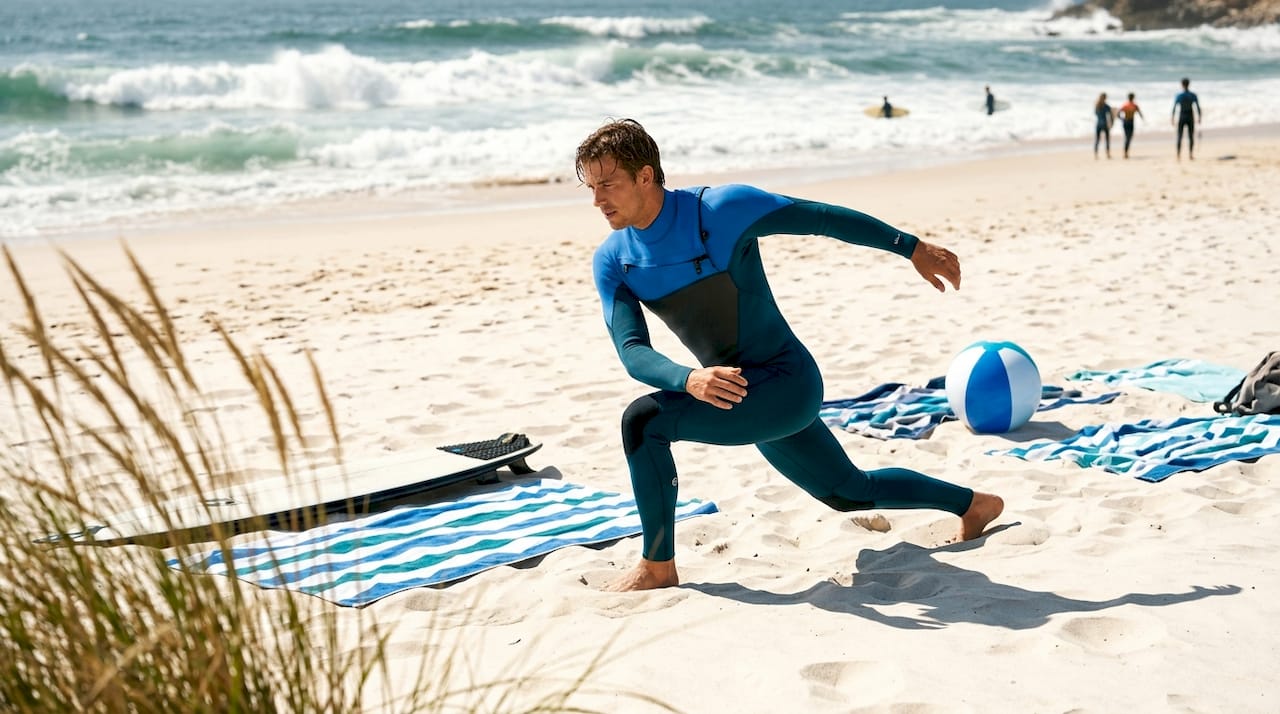
1. Dynamic stretching and cardio This is the foundation. It includes arm circles, shoulder rolls, torso rotations, leg swings, jumping jacks, and light jogging. The goal is to raise your core body temperature and get blood moving into the muscles you’ll rely on most. A well-known approach to surf warm-up routines keeps this phase short, around 2 to 3 minutes, but makes it count with movements that directly mirror surfing motions.
2. Surf-specific activation This is where most surfers miss out. Activation means waking up the specific muscles that control paddling, popping up, and balance. Examples include scapular push-ups (small movements that engage the shoulder blade stabilizers), mini band walks for glute activation, and slow-motion paddling simulations lying on a board or the ground. These exercises are short but powerful. They tell your rotator cuff, core, and hip stabilizers to get ready.
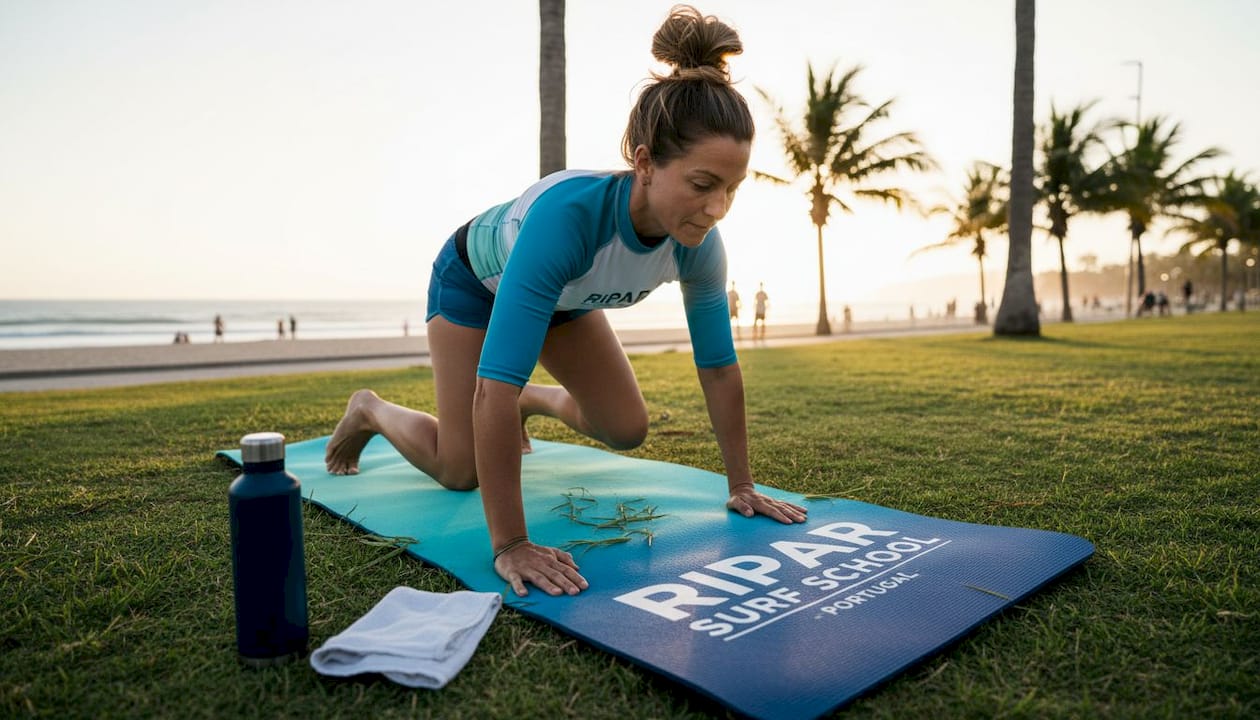
3. Targeted mobility work Mobility is not the same as flexibility. Mobility means moving a joint through its full range under control. Surfers especially need hip and shoulder mobility. The 90/90 hip switch, where you sit on the floor and rotate both hips through 90-degree angles, is a favorite among coaches. Controlled shoulder circles and chest-opening movements help the paddle stroke feel smooth and powerful right from the start.
4. Pattern practice and technique priming This is often overlooked but hugely valuable for beginners and intermediate surfers. Slow pop-up practice on the beach, where you rehearse the exact movement of jumping from prone to standing on your board, wires the motor pattern (the brain-to-muscle movement memory) before you hit the water. This also creates mental focus and helps you stay present. As highlighted in surf coaching benefits, technique priming before a lesson significantly increases the speed of skill development.
Here’s a simple timing example that works for most sessions:
Phase | Type | Duration |
Phase 1 | Dynamic stretching and light cardio | 2 to 3 minutes |
Phase 2 | Surf-specific muscle activation | 2 to 3 minutes |
Phase 3 | Core and balance exercises | 2 minutes |
Phase 4 | Targeted hip and shoulder mobility | 2 to 3 minutes |
Total | 8 to 11 minutes |
Dynamic warm-up and activation should dominate your pre-surf routine. Movements need to mimic the demands of surfing, not just loosen you up generically.
Pro Tip: If a specific exercise causes pain or sharp discomfort, don’t push through it. Drop the range of motion, slow down the speed, or swap it for an easier variation. A good warm-up never hurts.
Side-by-side comparison: which surf warm-up types fit your session?
Knowing the types is just step one. Let’s see how they actually compare so you can quickly spot which fits your next surf.
The table below gives you a fast reference to match your situation to the right approach.
Warm-up type | Duration | Key muscles targeted | Best use case | Main limitation |
Dynamic stretching and cardio | 2 to 5 min | Full body, heart rate | Any session, all levels | Incomplete without activation |
Surf-specific activation | 2 to 4 min | Shoulders, core, glutes | Lessons, post-rest days | Needs prior warm-up first |
Targeted mobility | 3 to 5 min | Hips, shoulders, spine | Stiffness, injury recovery | Slower, needs more time |
Pattern practice | 2 to 4 min | Neuromuscular system | Before lessons or coaching | Less physical warm-up value |
Static stretching only | 5 to 10 min | Passive flexibility | Post-session cool-down | Not recommended pre-surf |
A few important takeaways from this comparison:
Short dynamic routines work for virtually every surfer, at every level, before every session. They are fast, effective, and lower injury risk across the board.
Mobility and activation focus is the right choice if you have a history of shoulder injuries, recurring hip stiffness, or you’ve had a long travel day before reaching the beach.
Pattern practice gives you a mental and physical edge before structured lessons or coaching sessions because it primes your brain for learning.
Static stretching alone is not a warm-up. It belongs at the end of your session when your muscles are already warm and you want to improve long-term flexibility.
Research in sports science supports 5 to 10 minute warm-ups before balance and flexibility-dependent activities, which maps directly to beginner and intermediate surf protocols. Even the most time-pressed surfer can fit in five minutes that genuinely prepare their body.
If you want to add even more depth to your mobility and recovery work, exploring surf yoga stretches is a natural next step that complements all four warm-up types.
How to choose and adapt your surf warm-up
With the options side-by-side, let’s close with how to make the best and safest choice for your unique body and surf plans.
Choosing the right warm-up isn’t complicated, but it does require a moment of honest self-assessment. Follow these steps before you commit to a routine:
Assess your goal. Are you trying to perform your best in a free surf? Reduce injury risk during a lesson? Return to surfing after a break or minor injury? Your goal changes your priorities. Performance-focused warm-ups lean heavier on activation and pattern practice. Recovery-focused warm-ups prioritize gentle mobility work first.
Check your session length and intensity. A short 45-minute beginner lesson calls for an 8 to 12 minute warm-up covering all four phases briefly. A full morning free surf in bigger conditions deserves up to 20 minutes, especially targeting the shoulders and lower back.
Consider your experience level. Beginner surfers benefit enormously from including pattern practice because they’re still building muscle memory. Intermediate surfers can lean into activation and mobility more, since their patterns are more established.
Identify any physical limitations. Have you felt tightness in your hip flexors? Shoulder clicking? Lower back stiffness? These are signals to shift your warm-up emphasis toward targeted mobility for those specific areas before doing anything explosive.
Choose and commit. For most people, the answer is a short dynamic plus activation combo. Start with 2 to 3 minutes of arm circles, leg swings, and light jogging. Move into scapular push-ups and slow paddling simulations. Finish with 2 minutes of hip mobility. That’s it. Simple, effective, done.
If you feel pain during shoulder warm-ups, choose lighter variations, reduce range of motion, or slow the speed rather than skipping or pushing through the discomfort.
When in doubt, ask your instructor. Good coaches know exactly which warm-up adjustments work for different body types, injuries, and skill levels. Reading about surf instructor tips shows just how much quality teaching includes personalized pre-water prep, not just wave coaching.
Pro Tip: Keep a simple warm-up checklist on your phone. Before every session, run through it: heart rate up, shoulders activated, hips mobile, pop-up practiced. Consistency with a simple routine beats a perfect routine done occasionally.
A surf coach’s take: why most warm-ups miss the mark
Now that you know your options and how to adapt them, here’s what most surfers and schools still get wrong, and how to do better.
After years of coaching on the beach at Praia Areia Branca, one pattern shows up constantly. Surfers spend 20 minutes waxing their boards, chatting with friends, and watching the waves, and then do a quick 60-second stretch before paddling out. That’s not a warm-up. That’s a habit that quietly increases injury risk and slows progress.
The three most common warm-up mistakes we see are doing only static stretches, rushing through movements without control, and completely skipping core activation. When you skip that activation phase, your spine and shoulders enter the water unsupported. The first paddle of the session becomes the warm-up, and that’s when most muscle strains happen.
Here’s something coaches rarely say out loud: mental prep matters just as much as physical prep. When you add 2 minutes of slow, deliberate pop-up practice to your warm-up, you’re not just loosening your legs. You’re resetting your focus, building confidence, and telling your nervous system exactly what movement pattern it’s about to perform. We’ve seen complete beginners improve their pop-up consistency noticeably in a single lesson, just from adding a 5-minute pre-water drill combining pop-up practice and paddling simulation.
Surf camps and schools that build warm-up routines into every lesson, rather than leaving it up to each student, consistently produce better outcomes. Students paddle harder in their first session, fall less awkwardly, and report less muscle soreness the next day. The warm-up isn’t a formality. It’s the first part of the lesson.
Our advice: treat your warm-up as non-negotiable. Watch how the best instructors at your beach warm up and prep their students. There’s always something to learn from watching experienced people move well. Knowing what to look for starts with identifying great instructors who integrate these fundamentals naturally.
Ready to surf smarter? Prep with expert lessons and routines
With your warm-up knowledge dialed in, the best way to put it all together is through great instruction and a supportive community.
At Ripar Surf School in Praia Areia Branca, every lesson starts with a structured, coach-led warm-up that targets exactly the muscles you’ll need in the water. You’re not left guessing what to do on the beach.

Our certified instructors integrate pre-surf routines directly into group and private lessons, adapting movements to each student’s fitness level, physical history, and session goals. Whether you’re stepping on a board for the first time or sharpening your technique as an intermediate surfer, that guided warm-up makes a real difference in how your session feels and how fast you progress. Ready to experience it firsthand? Book your surf session today, join a group lesson for a social and energizing experience, or reserve surf lessons to lock in your spot at one of Portugal’s best surf locations.
Frequently asked questions
How long should a surf warm-up last for best results?
Most surf-ready sources recommend 5 to 10 minutes for general prep, but up to 15 to 20 minutes is preferred for optimal injury prevention, especially before challenging surf conditions.
Can I just do static stretching as my surf warm-up?
No. Static stretching alone is not enough and may actually reduce muscle power output before surfing; dynamic movements and activation drills are far more effective as pre-surf prep.
What are essential surf-specific warm-up exercises?
The most effective options include arm circles, leg swings, torso rotations, pop-up drills, and scapular push-ups, with top surf warm-up routines combining dynamic stretching, surf-specific movement, and technique practice.
What should I do if my shoulder or hip hurts during warm-up?
Reduce the range of motion, slow down, and switch to a lighter variation of the movement. As surf fitness guidance makes clear, forcing painful movements makes injuries worse, not better.
Is there a quick surf warm-up option for busy days?
Yes. A focused 5-minute dynamic routine targeting shoulders, core, and hips is an effective and widely used approach for fast readiness before shorter sessions.
Recommended
Comments