

Surf Photography Explained: Techniques, Gear, and Vision
- Fernando Antunes

- Apr 22
- 8 min read
TL;DR:
Surf photography combines technical skill, ocean knowledge, and cultural storytelling.
Both shore and in-water methods require specific gear, skills, and safety precautions.
Success relies on understanding the ocean, building trust with surfers, and capturing authentic moments.
Surf photography is one of those creative disciplines that looks deceptively simple from the beach. You see a photographer snap a wave, and the thought crosses your mind: how hard can it be? Extremely hard, as it turns out. Surf photography is the specialized practice of capturing surfers riding waves, emphasizing ocean dynamics, athletic performance, and culture. It demands technical mastery, deep ocean knowledge, and a real artistic eye. This guide breaks down everything from core techniques and essential gear to the safety skills and cultural depth that separate a snapshot from a genuinely powerful surf image.
Table of Contents
Key Takeaways
Point | Details |
True surf photography | It’s about capturing action, culture, and the ocean’s energy, not just snapping athletes. |
Shore vs. water technique | Shooting from the water gives dynamic, intimate images—but requires advanced skills and safety. |
Gear matters | Using waterproof housings, proper lenses, and fast settings is critical for quality outcomes. |
Skill and safety | Reading waves and strong swimming skills are as vital as camera knowledge for in-water shooting. |
Rich history | Pioneers like Gurrey, Blake, Ball, and Grannis shaped how surf culture is shared today. |
What defines surf photography?
Surf photography is not simply sports photography with a saltwater backdrop. It sits at the intersection of several demanding disciplines: action photography, landscape, portraiture, and documentary storytelling. To capture a truly great surf image, you need to understand the athlete, the wave, and the moment where both collide with maximum energy.
“Surf photography blends technical precision with athleticism and ocean knowledge.”
What makes it unique compared to, say, basketball or track photography? The environment itself is a moving, unpredictable subject. A basketball court stays still. The ocean does not. Light bounces differently off water. Spray creates blur. Timing a breaking wave on top of a surfer’s aerial maneuver requires anticipation you simply cannot fake.
Surf photography also carries a powerful documentary and cultural role. Since its earliest days, surf images have shaped how the world perceives surfing as a lifestyle. A single photograph can communicate freedom, danger, joy, and community in one frame. That is a storytelling responsibility that pure action photographers rarely face.
Here is what surf photography truly encompasses:
The surfer: Athletic form, style, raw emotion
The wave: Size, shape, power, spray, color
The ocean environment: Light, weather, horizon, crowds
Surf culture: The lineup, the beach scene, the community
The story: What this moment means beyond the sport
Exploring the history of surf photography shows just how deeply embedded these images are in the culture. Early photographers were not hired professionals. They were surfers themselves, obsessed with documenting a lifestyle the outside world did not yet understand. That passion is still the driving force today. Browse our surf photo gallery and you will immediately sense how much emotion lives inside a single well-timed frame.
Core techniques and essential gear
The two main approaches to surf photography are shore-based shooting and in-water shooting. Each has its own demands, risks, and rewards.
Shore vs. in-water shooting: a quick comparison
Feature | Shore-based | In-water |
Lens type | Telephoto (70-400mm) | Wide-angle (15-35mm) |
Perspective | Compressed, distant | Dynamic, close-up |
Gear needed | Tripod, long lens | Housing, fins, wetsuit |
Risk level | Low to moderate | High |
Best for | Barrels, full-wave shots | Portraits, spray, tubes |
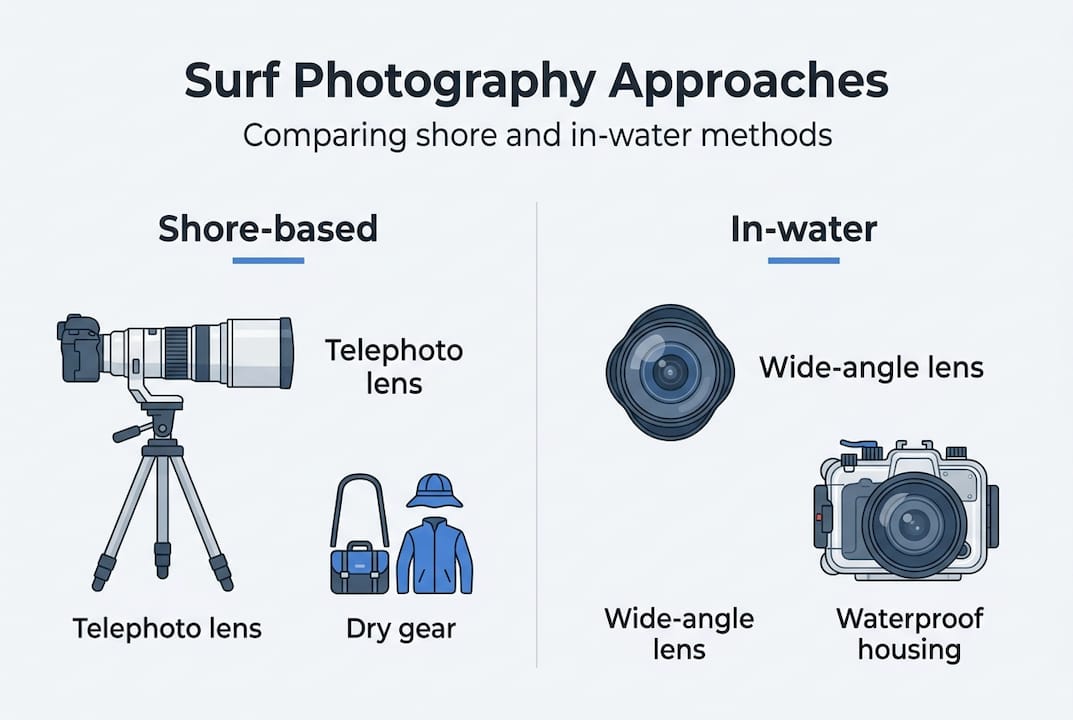
Shore-based shooting uses telephoto lenses for compressed perspectives, while in-water shooting requires waterproof housings, wide-angle lenses, swim fins, and wetsuits for dynamic close-ups.
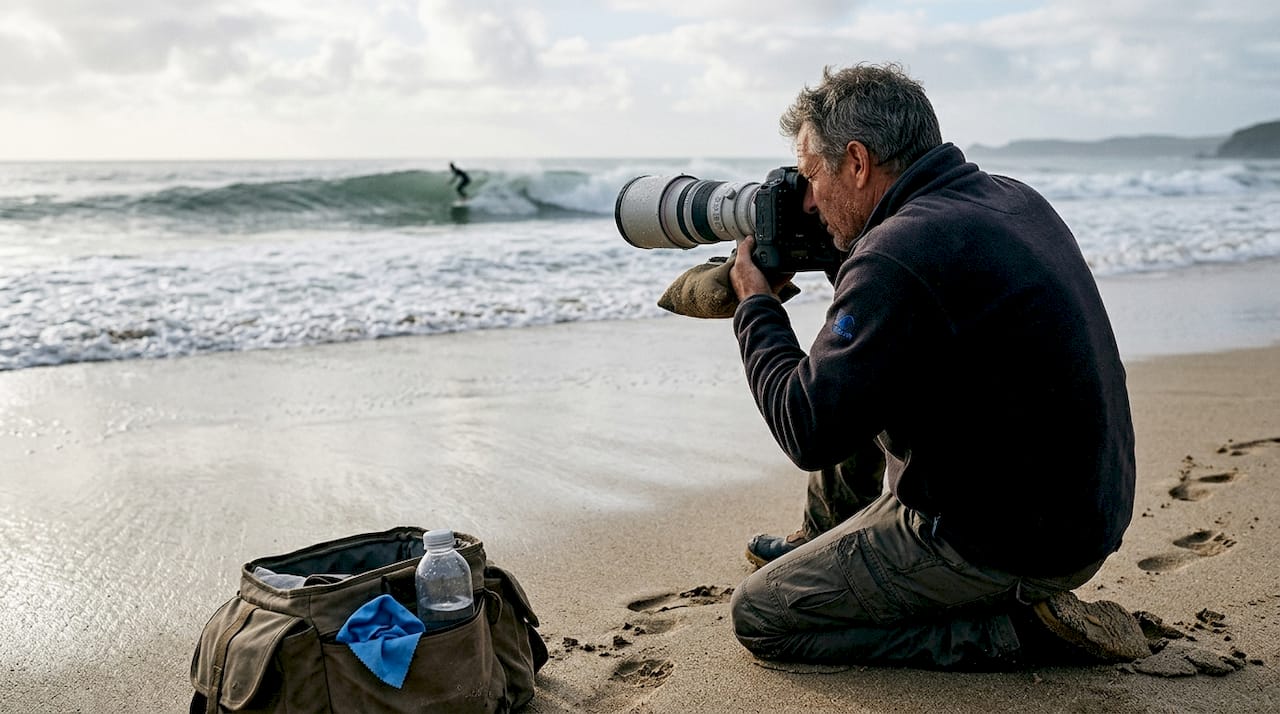
For beginners, shore shooting is the natural starting point. A 200mm to 400mm telephoto lens gives you reach without entering the water. In-water work is a different world entirely. You are swimming in active surf, holding a camera inside a waterproof housing, and trying to position yourself at exactly the right angle while waves detonate around you.
Here are the four foundational steps to nailing your camera settings for surf:
Set your shutter speed high. Fast shutter speed (1/1000s+) combined with burst mode is essential for freezing action cleanly.
Use continuous autofocus. Surfers move fast. Locking focus and holding it as they ride is non-negotiable.
Expose for the highlights. Ocean and white water blow out easily. Protect those bright areas first.
Shoot in RAW format. Post-processing latitude saves shots that would otherwise be lost.
Pro Tip: Rinse your housing and all metal components in fresh water immediately after every session. Salt crystals are invisible but destructive. A five-minute rinse routine after every shoot will extend your gear’s life by years. Check our surf action photos to see what the right gear and settings produce at world-class surf spots.
You can find even more practical beginner surf photography tips that cover everything from reading conditions to handling spray on your lens mid-session.
Advanced skills and safety essentials
Once you have the technical basics down, surf photography becomes a game of awareness. The photographers whose work consistently stands out are not necessarily the ones with the most expensive gear. They are the ones who understand the ocean at a deep level.
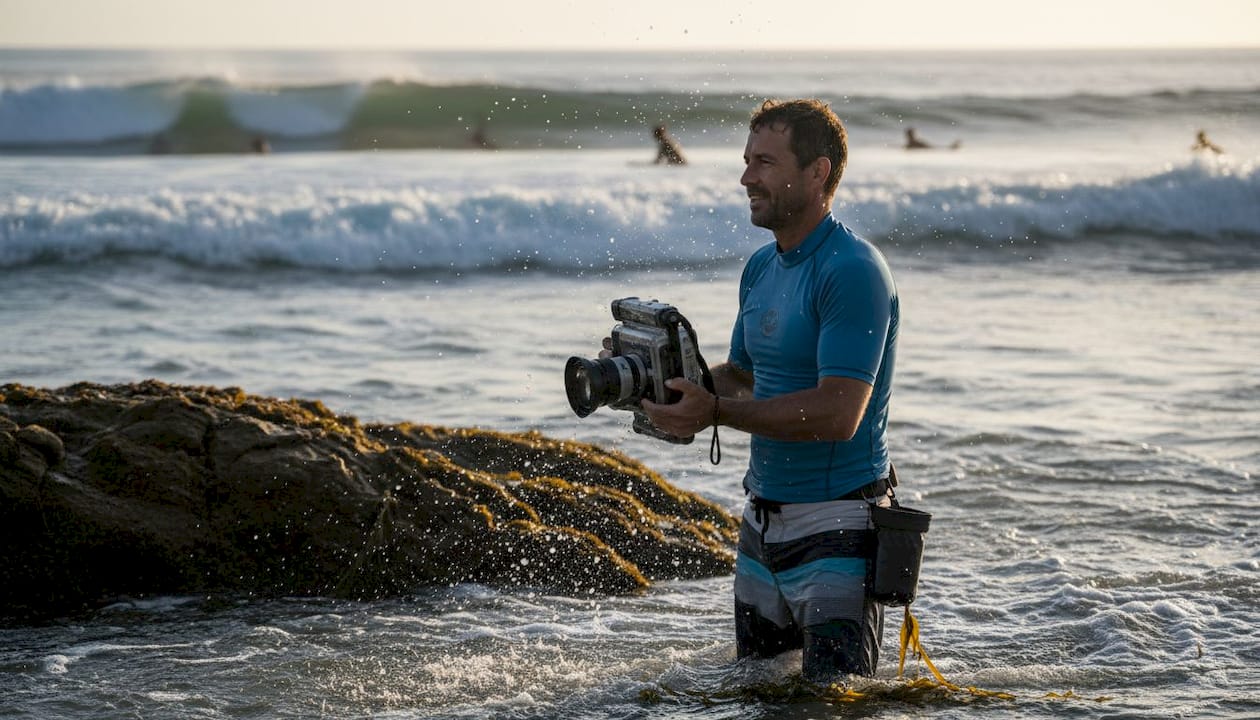
Reading the ocean means tracking swells, tides, and wind before you ever pick up a camera. An offshore wind creates clean, groomed waves that photograph beautifully. An onshore wind creates messy, choppy surf where great images are rare. Timing your sessions around tides can mean the difference between a photogenic sandbar reef and a closeout shore break.
Anticipating surfer maneuvers is equally critical. Knowing that a bottom turn almost always leads to either a cutback or a tube attempt lets you pre-frame your shot rather than react to it. Reaction-based photography misses the peak moment every single time. Anticipate maneuvers, read wave sets, and position based on break type. Golden hour lighting is preferred by professionals for its warm tones and long shadows.
Key safety considerations every surf photographer must respect:
Know your swimming ability honestly before entering any break
Study the specific break: reef, beach, point, and where rips form
Never shoot alone in the water at powerful or remote spots
Wear fins. Without them, positioning yourself correctly in the impact zone is nearly impossible
Know the local rules and surf etiquette so you are never in a surfer’s way
Big wave photography can be life-threatening for in-water shooters, and professionals who work at spots like Nazaré or Jaws train for years before attempting those lineups. For more context on how professionals handle extreme conditions, this deep dive on surviving big waves is eye-opening.
Pro Tip: Spend at least a full session just watching a new break without your camera. Map where the sets peak, where surfers kick out, and where the rips flow. That mental map will directly shape every positioning decision you make with a camera in hand. If you want to sharpen your ocean reading skills with experienced instructors, surf lesson booking at a quality surf school gives you a structured and safe starting point.
Surf photography’s evolution and cultural impact
The story of surf photography is inseparable from the story of surfing itself. From the very first wave captured on film to today’s ultra-high-speed digital bursts, the camera has shaped how surfing spread across the globe.
Key pioneers and their contributions:
Photographer | Era | Contribution |
A.R. Gurrey Jr. | Early 1900s | First documented surf images in Hawaii |
Tom Blake | 1920s-1940s | Waterproof camera housings, action shots |
Doc Ball | 1930s-1940s | Candid surf culture documentation |
LeRoy Grannis | 1960s-1970s | Magazine surf imagery, global reach |
Surf photography was pioneered by A.R. Gurrey Jr., advanced by Tom Blake and Doc Ball, and revolutionized by LeRoy Grannis, whose images defined the golden era of surf culture.
Early innovators overcame tech limits via custom housings, influencing modern techniques and popularizing surf culture globally.
What is remarkable is how much these images did without social media or digital distribution. A single published photograph in a surf magazine during the 1960s could inspire thousands of young people around the world to pick up a board. The cultural power was enormous. You can explore the fascinating story of history of Doc Ball to understand how one man’s camera changed what surfers believed was possible.
Today, the pipeline from ocean to audience is instant. A surf photo taken at Praia Areia Branca this morning can reach a global audience within hours. That speed has amplified surf photography’s cultural influence far beyond what Gurrey or Grannis could have imagined. The global community built around surf imagery reflects exactly the kind of surf camp culture that draws people to places like Portugal year after year.
A fresh perspective: What most miss about surf photography
Here is something you rarely read in photography tutorials: the actual shooting takes up maybe half your time. The other half is waiting, watching, and building relationships.
The photographers whose galleries consistently blow people away are not the ones sprinting to the beach with the most expensive housing. They are the ones sitting in the lineup talking with surfers, understanding who rides what kind of wave and why, and earning enough trust that athletes perform naturally in front of their lens. That social intelligence is not teachable in a camera manual.
Reading the ocean and respecting surf etiquette sets the best photographers apart from the rest in ways that no amount of gear ever will. When you understand where not to be, you automatically know where the shot is. And when surfers trust you, they stop performing for the camera and start surfing freely, which is exactly when the magic happens.
Surf photography is deeply community-oriented. The best images come from people who are genuinely part of the culture, not observers standing outside of it.
Bring your surf stories to life
Everything you have read here becomes real the moment you put yourself in the water or on the beach with a camera and the right coaching around you. Portugal’s Atlantic coast, where Ripar Surf School has been operating since 2001, is one of the most photogenic and wave-consistent destinations in Europe.

Browse our surf photo gallery to see what genuine surf imagery from Praia Areia Branca looks like at its best. When you are ready to experience those waves yourself, book surf lessons with our certified local instructors or go deeper with a full book a surf camp package. The best surf photo you will ever take might just be of yourself riding your first real wave.
Frequently asked questions
What camera gear is best for surf photography beginners?
Start with a DSLR or mirrorless camera paired with a telephoto lens of at least 200mm. For in-water work, add a waterproof housing and swim fins. Shore-based shooting with telephoto lenses in the 70-400mm range is the ideal entry point before attempting water housing photography.
How do you stay safe while shooting surf photography?
Study the break before entering, check tide and weather conditions, and always swim within your honest ability level. Safety is paramount in water and strong swimming skills are a genuine requirement, not a suggestion.
What are the most common mistakes in surf photography?
Shooting too far from the action, failing to anticipate maneuvers, ignoring light direction, and skipping equipment protection are the most frequent errors. Anticipating maneuvers and preferring golden hour lighting are two habits that separate average from excellent surf shots.
Who are the most influential surf photographers in history?
The field’s most important pioneers are A.R. Gurrey Jr., Tom Blake, Doc Ball, and LeRoy Grannis. Pioneered in the early 1900s by Gurrey and advanced by each successive generation, their collective work built the visual language of surf culture that still dominates imagery today.
Recommended
Comments