

How surf camp reviews guide your Portugal surf choices

TL;DR:
Genuine reviews reveal surf camp coaching quality, group size, and handling of bad weather.
Assess review reliability by checking review volume, recentness, detail, and cross-platform consistency.
Look for detailed stories about flexibility, instructor communication, and community atmosphere to make an informed choice.
Booking a surf camp in Portugal should feel exciting, but for most first-timers, it quickly turns into a scroll-fest of conflicting reviews, vague star ratings, and camps that all claim to be the friendliest on the coast. Which ones do you actually trust? The truth is, reviews contain far more useful information than most travelers ever extract from them. When you know what to look for, a well-written review can tell you about coaching quality, group dynamics, and how a camp handles a bad swell day. This article gives you a practical, evidence-based approach to reading surf camp reviews so your Portugal trip starts with the right choice.
Table of Contents
Key Takeaways
Point | Details |
Fraud detection matters | Trust surf camp reviews more when platforms actively remove fake or AI reviews. |
Review details reveal quality | Look for specifics on coaching, group splitting, and camp adaptability in real reviews. |
Cross-platform checking | Checking reviews on more than one site gives a fuller and fairer view of surf camps. |
Apply a benchmark approach | Use repeat signals and transparent reporting for confident surf camp choices. |
Why surf camp reviews matter for Portugal trips
Portugal is not a one-size-fits-all surf destination. The country offers everything from gentle, beginner-friendly beach breaks to powerful reef waves that challenge experienced surfers. Spots near Peniche and Ericeira regularly host World Surf League competitions, meaning the ocean can change dramatically depending on the season and swell direction. Choosing the wrong camp for your skill level does not just waste money. It can knock your confidence or leave you bored in flat water.
This is where peer reviews become genuinely important. Unlike glossy brochures or curated Instagram feeds, real traveler reviews reflect what actually happened during a stay. For beginners and intermediates especially, those accounts carry weight. You are not just picking a hotel room. You are choosing coaches, surf spots, travel companions, and a learning environment that will shape how quickly you progress.
Here is what reviews typically reveal that marketing copy never will:
Whether instructors adapt lessons to each student’s level
How camps handle poor surf conditions (do they find alternatives or cancel?)
The real size of lesson groups and how that affects learning
The community atmosphere in surf camps and how welcoming it feels day to day
Hidden costs or logistics not mentioned on the booking page
The platforms hosting those reviews have also gotten more serious about accuracy. Tripadvisor fraud detection now combines automation, human oversight, and community input to moderate reviews and remove fraudulent ones, making the ecosystem far more trustworthy than it was five years ago.
“Reviews are not just opinions. They are a crowd-sourced quality control system, and for surf camps in particular, they reveal details that no sales page would ever volunteer.”
Still, even on well-moderated platforms, you need a filter. Not every five-star review reflects a universal experience. Patterns matter more than any single rating. Read ten reviews and look for the same instructor’s name praised repeatedly, or the same logistical frustration mentioned across multiple stays. That repetition is signal. A single glowing or furious review is just noise.
Using a guide to booking a surf camp alongside review research makes the process even more focused, giving you a structure to evaluate what you find.
With the importance clearly set, let’s look at how to assess the reliability of those reviews.
How to assess surf camp review reliability
Not every review is created equal, and that is true even on platforms with serious moderation. In 2024, fraudulent reviews removed by Tripadvisor totaled 2.7 million, with 214,000 of those flagged specifically as AI-generated. That tells you two things: moderation has improved significantly, and fake reviews are still being attempted at scale.
So how do you sharpen your own filter? Start with this numbered checklist before trusting any surf camp’s review profile:
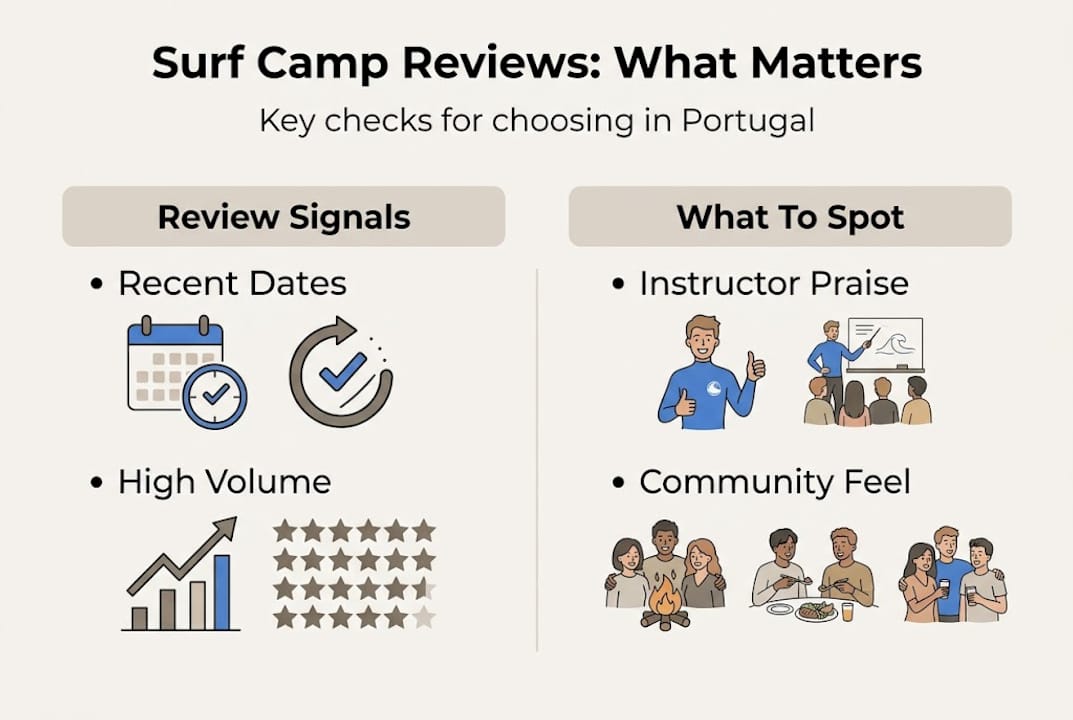
Check the review count. A camp with 12 reviews over five years is harder to evaluate than one with 200 reviews. Volume adds statistical weight.
Look at the spread of dates. Fresh reviews matter. A camp that earned strong reviews in 2019 but has been quiet since 2023 may have changed ownership or quality.
Read the one and three-star reviews first. Negative reviews that mention specific names, dates, and situations are usually genuine. Vague complaints without details are harder to verify.
Compare across platforms. Check Google, Tripadvisor, and any surf-specific booking platforms. Consistent praise across all three is a strong signal.
Look for verified bookings. Some platforms flag reviews from confirmed guests, which adds another layer of credibility.
Here is a quick comparison of what strong versus weak review profiles look like:
Signal | Strong profile | Weak profile |
Review volume | 100 or more | Fewer than 20 |
Date range | Active in the last 12 months | Last review over a year old |
Response to negatives | Thoughtful, specific replies | No replies or defensive tone |
Detail level | Names instructors, describes waves | Generic praise only |
Cross-platform match | Consistent across Google and Tripadvisor | Wildly different ratings per platform |
Knowing what signs of great surf instructors look like in writing helps you spot those signals in reviews even faster.
Pro Tip: Consistent positive patterns across a large review set are often more reliable than a handful of perfect five-star scores. A camp averaging 4.3 stars across 180 reviews with regular, detailed feedback is usually a safer bet than a camp with six fives and nothing else.
Your complete booking guide can help you layer this review intelligence into a structured decision process.
Now that you know how to spot reliable reviews, let’s dig into the details these reviews can reveal about what matters most at surf camps.
What to look for in detailed surf camp reviews
Once you are confident a review is genuine, the next step is knowing which details inside it actually matter. Most beginner surfers focus on the overall vibe and skip the specifics. That is where they lose the most useful information.
The most revealing surf camp reviews mention things like:
Group-to-instructor ratios. Reviews that say “we were only six students per instructor” or “the group was too large to get any real feedback” tell you exactly what the learning experience will feel like.
Adaptability to conditions. Strong camps get praised for finding alternate beaches or adjusting the day’s plan when the local swell is messy or too powerful. A surf camp review example found that edge-case trust signals include camps that shuttle guests to alternate spots and maintain proper group coaching attention even when conditions change.
How instructors communicate. Reviews that describe instructors breaking down technique simply, giving individual feedback, or checking in after sessions reveal a camp focused on genuine learning.
Lesson pacing and flexibility. Guests who mention being moved to a harder break once they progressed, or being held back to build fundamentals, are describing a camp that pays attention to how surf coaching works in practice.
Here is a signal table to help you categorize review phrases quickly:
Review phrase | What it signals |
“Instructor watched every wave and gave feedback” | High coaching attention, small group likely |
“We went to a different beach when conditions were rough” | Flexible, guest-focused operation |
“Felt lost in the crowd” | Large group ratio, limited instruction |
“Same break every day regardless of swell” | Rigid program, low adaptability |
“Great vibes but didn’t learn much” | Social-first, coaching-second culture |
Pro Tip: Look specifically for camps praised for splitting groups by skill level. A beginner should never be riding the same wave as an intermediate in the same session. If reviews mention this separation, it is a strong quality marker.
The community in surf camps matters too. Reviews that describe easy friendships, shared meals, and evening sessions in local spots suggest an environment where the social side of the trip matches the learning side.

Beware of reviews that say nothing specific about coaching or logistics. Generic praise like “amazing experience, would go back” tells you someone had a good time, but not why, and not whether their experience would match yours.
Understanding the review details sets you up to make use of that insight. Here’s how to use this knowledge to confidently choose your Portugal surf camp.
Putting it into practice: Using reviews to choose your surf camp
You now have the tools. Here is the step-by-step process for using everything above to pick the right camp.
Build a shortlist of three to five camps. Use Portugal-specific surf directories, Google Maps, and recommendations from surf communities online. Aim for camps near the breaks that match your level.
Run each camp through the review reliability checklist from the section above. Eliminate any camp with thin review coverage, no recent feedback, or major inconsistencies across platforms.
Read at least fifteen reviews per camp, focusing on detailed ones. Use the signal table to flag positive and negative patterns. Note anything that appears in three or more reviews, because repetition is the strongest signal of all.
Contact your top two camps directly. Ask specific questions: What is your average group size? What happens if the surf is unsuitable for my level? This step confirms whether the camp’s communication matches the responsiveness praised in its reviews.
Make your final choice using both data and feel. If the reviews are strong, the review platform transparency checks out, and the camp responds quickly and helpfully to your direct questions, you have found a strong match.
The benchmark mindset means using consistent reviews and cross-checking platforms to minimize bias, rather than picking a winner based on one extraordinary account.
Exploring surf retreat benefits can also help you clarify what kind of experience you are actually looking for before you even open a review platform. Knowing your own priorities makes filtering reviews much faster.
Pro Tip: Write down three things that matter most to you in a surf camp experience before reading any reviews. Use those as your personal filter. It prevents you from getting swayed by reviews that rave about things you do not actually care about.
The complete Portugal booking guide is a natural next resource once your shortlist is ready.
Let’s tie it all together with a perspective on what even experienced travelers often overlook about surf camp reviews.
The real value of surf camp reviews: Beyond the star ratings
Most travelers glance at the average score, check whether it clears four stars, and move on. That approach misses almost everything useful. The real intelligence in a surf camp review is buried in the second paragraph, where the writer stops summarizing and starts telling a story.
When someone writes, “on the third day the swell was huge, so they loaded us into a van and took us to a sheltered bay I’d never heard of,” that is a review worth ten five-star ratings. It tells you the camp has options, local knowledge, and the judgment to use both. That is exactly the kind of flexibility that separates an average surf holiday from an exceptional one.
After reading thousands of reviews across surf destinations, the pattern is clear: the community benefits of surf retreats that guests value most are rarely the ones advertised on the booking page. They emerge from coaches who remember your name, dinners that turn into impromptu surf theory sessions, and camps flexible enough to put the guest’s progression above the day’s original plan. Seek those stories in reviews, not just the scores.
Ready to surf? Next steps for your Portugal adventure
You’ve done the homework. You know how to filter reviews, spot the signals that matter, and cross-check camps before committing. Now it’s time to put that research to work and actually get in the water.

At Ripar Surf School and Surfcamp Portugal, we have been welcoming beginner and intermediate surfers to Praia Areia Branca since 2001. Our small, community-focused setup near Peniche and Ericeira is exactly the kind of camp that earns the detailed, story-driven reviews described in this article. Ready to take the next step? Book your surf camp online and secure your spot, or explore our group surf lessons if you want to start with a flexible, no-commitment session first.
Frequently asked questions
How do I know if a surf camp review is fake or genuine?
Look for consistent themes across multiple reviews, cross-check platforms like Google and Tripadvisor, and use sites with active fraud detection. Tripadvisor alone removed 2.7 million fraudulent reviews in 2024, making it one of the more reliable places to start.
What details in surf camp reviews should I pay most attention to?
Focus on comments about coaching quality, group size, and how camps handle difficult conditions. Reviews that mention coaching delivery and group splits as positive highlights are among the most trustworthy quality signals available.
Is it better to read recent or older surf camp reviews?
Prioritize reviews from the last twelve months for the most current picture, but also scan older feedback to identify long-term consistency in guest satisfaction and coaching quality.
Should I use only one platform to check surf camp reviews?
No. Cross-checking across Tripadvisor, Google, and surf-specific booking sites gives you a far more balanced and accurate view of each camp’s real strengths and weaknesses.
Recommended
Comments