

Surf instructor levels explained: Choose the right coach in Portugal

TL;DR:
Certified surf instructors in Portugal ensure safety, effective coaching, and legal compliance during lessons.
Instructor levels range from beginner whitewater coaches to advanced performance coaches, each with specific skills.
Qualities like teaching passion and communication often matter more than certification levels for a transformational lesson.
Not all surf instructors are the same. This might seem obvious, but hundreds of surf holidaymakers book lessons in Portugal every year without asking a single question about their instructor’s qualifications. They assume that anyone standing on a beach with a board knows how to teach. The reality is that instructor certification levels directly shape how safe your session will be, how quickly you progress, and whether you go home wanting more waves or wondering what went wrong. Understanding the difference before you book could genuinely change your experience.
Table of Contents
Why surf instructor levels matter for your Portugal surf holiday
Understanding surf instructor levels: The certification ladder explained
How to spot a top surf instructor: Credentials and qualities to look for
The truth about surf instructor levels: What most guides don’t tell you
Ready to book your lesson? Find certified, passionate surf instructors in Portugal
Key Takeaways
Point | Details |
Certification matters | Choosing an instructor with proper ISA or FPS credentials ensures safe and effective learning. |
Level impacts coaching | Higher instructor levels offer advanced feedback and faster progress, especially for experienced surfers. |
Personality counts | Great surf lessons depend as much on your instructor’s teaching style as their certification. |
Ask before booking | Always ask about your instructor’s level and background to find the best match for your goals. |
Why surf instructor levels matter for your Portugal surf holiday
Portugal is one of Europe’s premier surf destinations, drawing everyone from nervous first-timers to experienced wave hunters looking to challenge themselves at world-class breaks near Peniche and Ericeira. With that demand comes a wide range of surf schools, and not all of them apply the same standard of instruction. Safety is the first concern. Certified instructors are trained in water safety, rescue protocols, and managing groups in unpredictable ocean conditions. An uncertified “instructor” might know how to surf well, but that doesn’t mean they know how to keep you safe in the water.
Beyond safety, the quality of feedback you receive depends heavily on your instructor’s training level. A higher-certified coach has studied human movement, wave reading, and coaching methodology. They can spot a flawed pop-up technique in seconds and correct it before it becomes a bad habit. ISA or FPS certified instructors, and schools affiliated with AESP/FPS/IPDJ, offer advanced coaching that directly accelerates your progress and keeps your lessons compliant with Portuguese regulations.
Portugal’s surf industry is regulated. Reputable schools work within frameworks set by organizations like the Instituto Português do Desporto e Juventude (IPDJ), meaning your instructor should carry recognized certification. When you read about surf instructor essentials for a Portugal trip, credentials always appear at the top of the list. If you’re new to all of this, the Portugal beginner’s surf guide is a solid starting point for understanding the full picture.
“Choose a certified instructor not just for legal compliance, but because proper training turns a fun activity into a genuinely transformative experience.”
Pro Tip: Always ask for proof of certification before booking. Any reputable instructor will show you their credentials without hesitation. If they hesitate, look elsewhere.
Key reasons why instructor levels matter:
Safety: Certified instructors know how to handle rip currents, wipeouts, and emergency situations.
Progression: Structured coaching frameworks mean faster, cleaner skill development.
Compliance: Lessons at regulated schools protect you legally and financially.
Insurance: Many travel insurance policies favor activities run by certified professionals.
Understanding surf instructor levels: The certification ladder explained
The surf coaching certification world has its own hierarchy, and once you understand it, choosing the right instructor becomes much simpler. The International Surfing Association (ISA) sets the global standard, and most European countries, including Portugal, align with ISA frameworks or have national equivalents like the Portuguese Surfing Federation (FPS).
Here’s the step-by-step pathway from entry-level to advanced instructor:
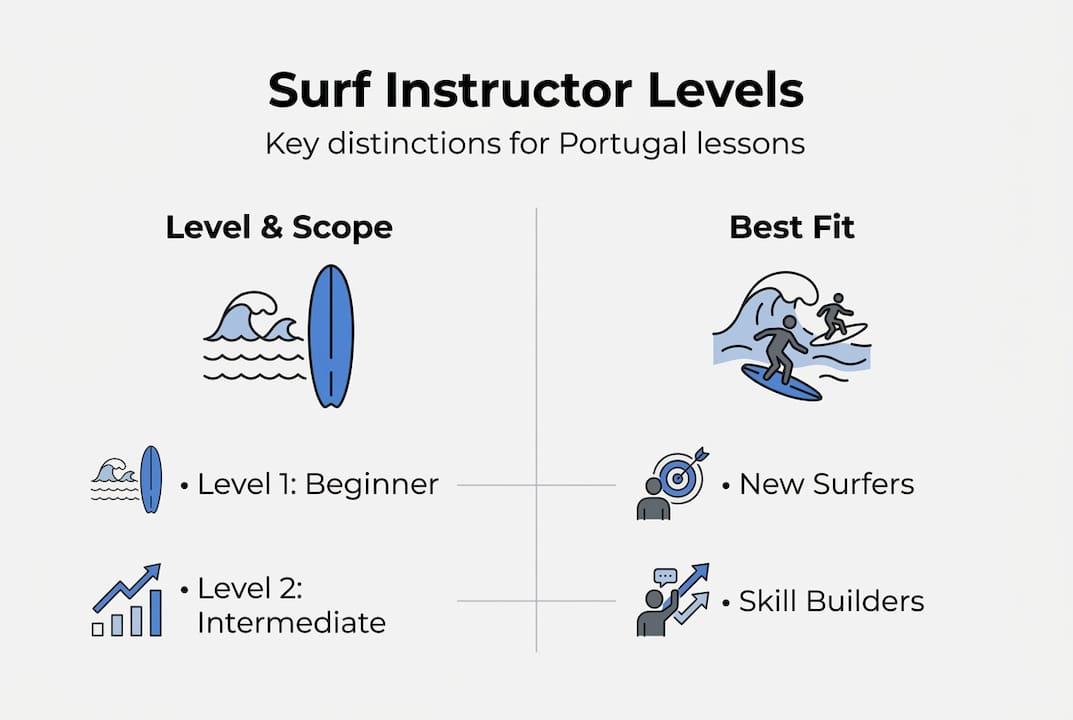
ISA Level 1: Entry-level certification. These instructors are qualified to teach beginners in the whitewater zone. They cover the fundamentals: paddling, safety awareness, reading simple shore break, and the pop-up technique.
ISA Level 2 / FPS Grade III: Intermediate and advanced coaching. These instructors work with surfers outside the whitewater, coaching backline positioning, wave selection, turning, and speed generation. They require real experience, not just a certificate.
Progression / Specialist Awards: Surf Coach Progression Award programs build on Level 1 to coach improvers and intermediates outside the whitewash. Requirements include at least one year of teaching experience, head-high wave competency, lifeguard qualifications, and safeguarding training.
Advanced Coaching Credentials: Some instructors pursue performance coaching, working with competitive surfers or developing specialty skills like aerial surfing and tube riding.
Understanding surf instructor certification types gives you a clearer picture of what each level actually qualifies an instructor to do, and knowing signs of great instructors helps you go beyond the paperwork.
Certification comparison table
Certification level | Teaching scope | Prerequisites | Best suited for |
ISA Level 1 | Whitewater, beginners | Basic swim/surf competency | First-timers, complete beginners |
ISA Level 2 / FPS Grade III | Intermediate to advanced | Level 1 + experience + lifeguard | Improvers, intermediate surfers |
Progression Award | Intermediates, out-back coaching | 1 year exp, head-high waves, safeguarding | Confident beginners, intermediates |
Performance Coach | Competitive and advanced technique | Multiple years + sport science background | Experienced, competitive surfers |
One important statistic worth knowing: most national surf coaching bodies require instructors to recertify or complete continuing professional development every two to three years, which means a quality instructor’s knowledge stays current with evolving safety and coaching standards.
How to spot a top surf instructor: Credentials and qualities to look for
A certificate on paper tells you what an instructor is qualified to do. It doesn’t tell you how well they actually do it. The best surf instructors combine verified credentials with genuine teaching talent, and you can assess both before your first session.
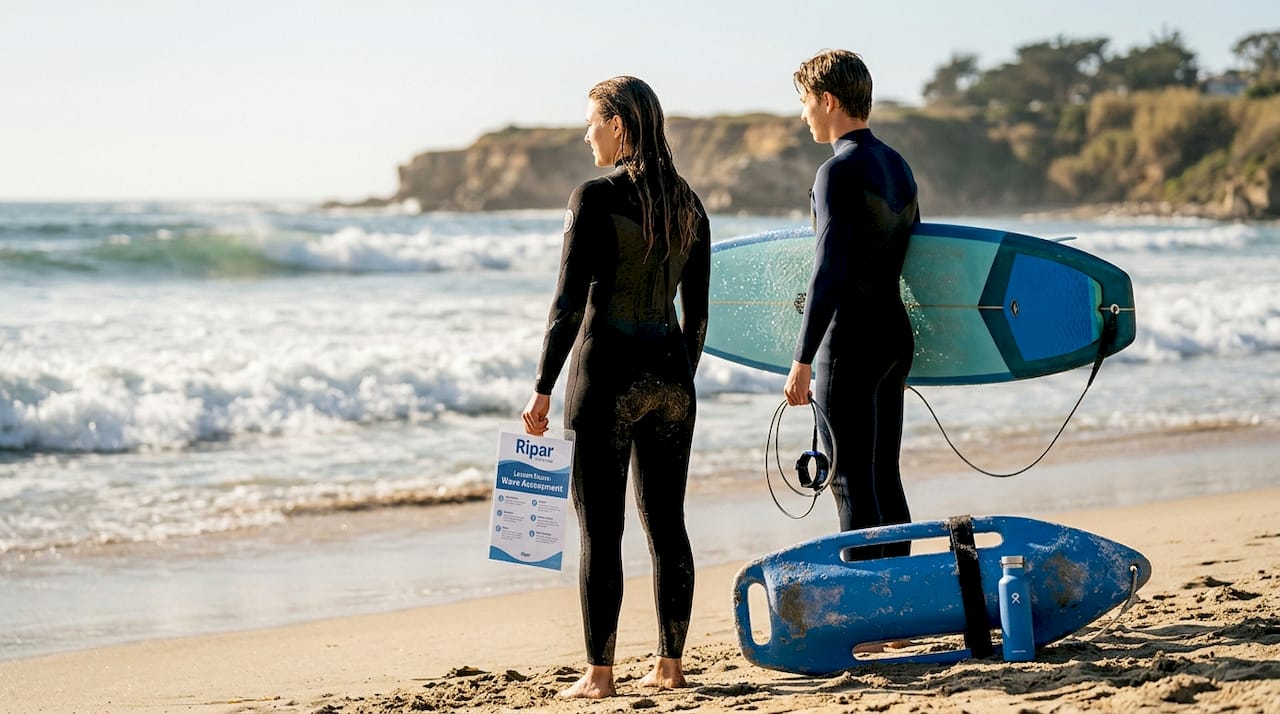
Start with the basics. Ask the surf school directly whether their instructors hold ISA or FPS certified credentials, and whether the school itself is affiliated with AESP/FPS/IPDJ. These affiliations confirm that lessons follow regulated safety standards. Schools that can’t answer this question confidently are a warning sign.
Here’s a practical checklist to run through before you commit to any instructor or school:
Verified certification: ISA, FPS, or nationally recognized equivalent, with documentation available on request.
First aid and lifeguard training: Non-negotiable for ocean safety. Many regulatory bodies require this alongside the surf coaching certificate.
Years of active teaching experience: A newly certified instructor can be great, but experience adds an instinct that no course can fully replicate.
Language skills: Portugal welcomes surfers from across the world. An instructor who communicates clearly in your language removes a major barrier to learning.
Positive, adaptive coaching style: The best instructors don’t use a single script for every student. They observe, adjust, and respond to what you actually need.
Student feedback and reviews: Online reviews from previous guests reveal patterns in teaching style, patience, and energy that a certificate simply can’t capture.
Learn more about what separates good from great in our guide to how to recognize great instructors and use the beginner lesson planning guide to set realistic expectations for your first sessions.
Pro Tip: Ask any instructor about their most recent training or professional development. Great coaches are always learning. An instructor who stopped updating their knowledge five years ago may still be technically certified but out of touch with modern coaching methods and safety practices.
A good instructor also reads the ocean conditions on the day and adjusts the session accordingly. On a bigger swell day, a quality Level 1 coach will keep beginners safely in the whitewash and modify the plan. A less experienced or uncertified teacher might push students into conditions beyond their ability, which is where accidents happen.
What to expect from each surf instructor level
Knowing what a certified instructor is allowed to teach is one thing. Understanding what a lesson actually feels like at each level is where the practical value lives. Here’s a realistic breakdown of what your experience will look like depending on who is teaching you.
Level 1 instructor lesson: You’ll spend your time in the whitewater. Your instructor introduces you to board handling, paddling mechanics, wave timing, and the pop-up. The session is structured, patient, and focused on safety. Expect a group format with a ratio of around one instructor to six students. The goal is a controlled, successful first stand. Progress feels rapid because the basics are genuinely achievable in a single session.
Level 2 / FPS Grade III instructor lesson: This is where coaching gets technical. Your instructor will work with you on reading unbroken waves, timing your paddle into the peak, and generating speed through your turns. They’ll give you specific feedback on your foot positioning, weight distribution, and body rotation. Sessions can be group or private. The coaching language shifts from “try to stand up” to “let’s fix your back foot placement on the takeoff.”
Progression Award instructor lesson: These coaches bridge the gap between beginner and intermediate. They work in slightly more challenging surf, helping you move from whitewater confidence to riding green waves consistently. The Progression Award framework requires coaches to understand intermediate technique and manage sessions outside the shore break safely.
Think of it this way. Upgrading your instructor level is like going from learning to drive in a quiet parking lot with a patient student driver instructor, to practicing rally techniques with a professional co-pilot who calls out every corner before you reach it. Both are valuable, but the second makes you dramatically better, faster.
Student level | Recommended instructor level | Typical session focus |
Complete beginner | ISA Level 1 | Whitewater, pop-up, board safety |
Confident beginner | Level 1 + Progression Award | Green waves, wave selection |
Intermediate | ISA Level 2 / FPS Grade III | Turning, speed, out-back positioning |
Advanced | Performance Coach | Maneuvers, competition prep |
Read more about how surf coaching works and find out more about your instructor’s background when booking a session in Portugal.
Choosing the right surf instructor level for your goals
Matching your current ability to the right instructor level isn’t complicated once you understand the ladder. The mistake most people make is defaulting to whatever the school assigns them, without asking whether that assignment fits their actual needs.
If you’re a complete beginner, a strong Level 1 certified instructor is exactly what you need. Don’t feel like you’re settling. The fundamentals of surfing take real skill to teach well, and a focused, experienced Level 1 coach will give you better results in two days than an advanced coach who isn’t comfortable working with brand-new surfers.
For intermediates and those already riding green waves, push for an ISA Level 2 or FPS Grade III certified coach. The technical feedback at this level is genuinely different. You’ll stop repeating the same mistakes and start understanding why they happen. This is the stage where a well-qualified instructor can cut months of frustrating plateau time down to a single focused week in Portugal.
Before booking any lesson or surf camp, run through these must-ask questions:
What certifications do your instructors hold, and are they current?
Is your school affiliated with AESP, FPS, or IPDJ?
Do your instructors speak English, or my language?
Are lessons available in group and private formats?
What is your student-to-instructor ratio for group sessions?
Can I be matched with an instructor based on my current ability level?
Whether a surf camp or surf school format suits you better also depends on your goals. Surf camps with multiple sessions per day benefit most from having higher-level instructors on staff who can adjust coaching across multiple days as your technique evolves.
The truth about surf instructor levels: What most guides don’t tell you
Here’s something the standard certification guides won’t say out loud. The highest-level certificate doesn’t automatically produce the best lesson. We’ve seen this firsthand over more than two decades on Portugal’s beaches. Some ISA Level 1 instructors teach with more heart, patience, and intuitive skill than coaches holding twice the credentials. Passion and communication drive results in ways that paperwork simply cannot guarantee.
Credentials matter. They establish a baseline. They tell you an instructor has been trained in safety, has studied coaching methodology, and has met a recognized standard. Without credentials, you’re taking a genuine risk with your safety and your learning. But credentials are the floor, not the ceiling.
What actually separates a good lesson from a transformational one is whether your instructor sees you. Do they notice that you’re nervous and adjust their tone? Do they recognize that you’re bored of the same drill and push you forward before you ask? Do they celebrate your small wins in a way that keeps you motivated through the frustrating moments? These are not things any certification teaches.
‘In Portugal, some Level 1 instructors teach with more heart and skill than seasoned Level 2 coaches. The best are always learning, and so should you.’
Review the surf instructor essentials that matter most when planning your Portugal surf trip, and pay as much attention to reviews and teaching reputation as you do to the letters after an instructor’s name.
Pro Tip: Observe a group lesson if you can before committing. Watching how an instructor interacts with students for even five minutes tells you more about teaching quality than any certificate ever could.
Ready to book your lesson? Find certified, passionate surf instructors in Portugal
At Ripar Surf School, every instructor on our team holds recognized certification and brings genuine passion to every session on the water. We’ve been based at Praia Areia Branca, between Peniche and Ericeira, since 2001, and our small-beach-village setting means you get a real surf community experience rather than a factory-style tourist operation.

Whether you’re stepping onto a surfboard for the first time or looking to fix the technical issues holding you back on green waves, we have the right instructor and format for you. Explore our group surf lessons for a social, energetic experience, or go deeper with all-levels private lessons for focused one-on-one coaching. When you’re ready, you can book surf lessons online in minutes. Portugal’s waves are waiting.
Frequently asked questions
Which surf instructor certification should I look for in Portugal?
Prioritize ISA or FPS-certified instructors at schools affiliated with AESP/FPS/IPDJ for safe, regulated, high-quality lessons that comply with Portuguese surf education standards.
What does an ISA Level 2 instructor offer over Level 1?
ISA Level 2 instructors can coach intermediates and advanced surfers outside the whitewater, covering wave selection and turning technique. The Progression Award framework confirms they have teaching experience, lifeguard certification, and competency in head-high surf.
Are all surf instructors in Portugal required to be certified?
Reputable surf schools in Portugal require instructors to hold recognized ISA or FPS certifications for compliance with IPDJ regulations, though not every operator on the beach follows this standard.
How do I verify my instructor’s certification?
Ask the school or instructor directly for documentation. Any qualified instructor working at a regulated school will provide their credentials without issue.
Do higher instructor levels guarantee better surf lessons?
Higher certification levels bring broader coaching capability and technical knowledge, but teaching quality also depends heavily on communication style, patience, and genuine enthusiasm for helping you improve.
Recommended
Comments