

Surf fitness explained: Foundations, training, and real progress

TL;DR:
Most surfing time is spent paddling and waiting, not riding waves.
Surf-specific fitness focuses on paddling endurance, stability, and rotational movements.
Consistent, simple training targets foundational movements and actual water practice for best progress.
Most people picture surfing as the act of riding waves, carving turns, and getting barrels. In reality, surfers spend about 51% of their time paddling and roughly 42% just waiting and repositioning, with actual wave riding accounting for as little as 4% of a session. That gap between expectation and reality shapes everything about how you should prepare your body. Surf fitness is a specific discipline with its own demands, its own benchmarks, and its own training logic. This article breaks all of that down in plain language so you can train smarter, paddle stronger, and actually catch more waves.
Table of Contents
Key Takeaways
Point | Details |
Surfing isn’t just riding | Most of your session is spent paddling and waiting, not just on the wave. |
Unique training needs | Surf fitness demands unstable, functional movement and targeted cardio and strength work. |
Specific preparation wins | Focus on paddle power, balance, and core—not just general gym work. |
Progress comes from basics | Simple, consistent practice beats complicated routines for rapid improvement. |
The reality of surf fitness: What does surfing demand from your body?
Now that you know surfing isn’t all about riding waves, let’s examine exactly what your body is doing during a typical surf session.
The 4% wave-riding figure is not a quirk of elite surfing. It reflects a fundamental truth about how the sport works. You paddle out through breaking whitewater, wait for a set, reposition constantly to stay in the right spot, paddle hard to catch a wave, and then do it all over again. Most of your energy goes into locomotion and positioning, not performance.
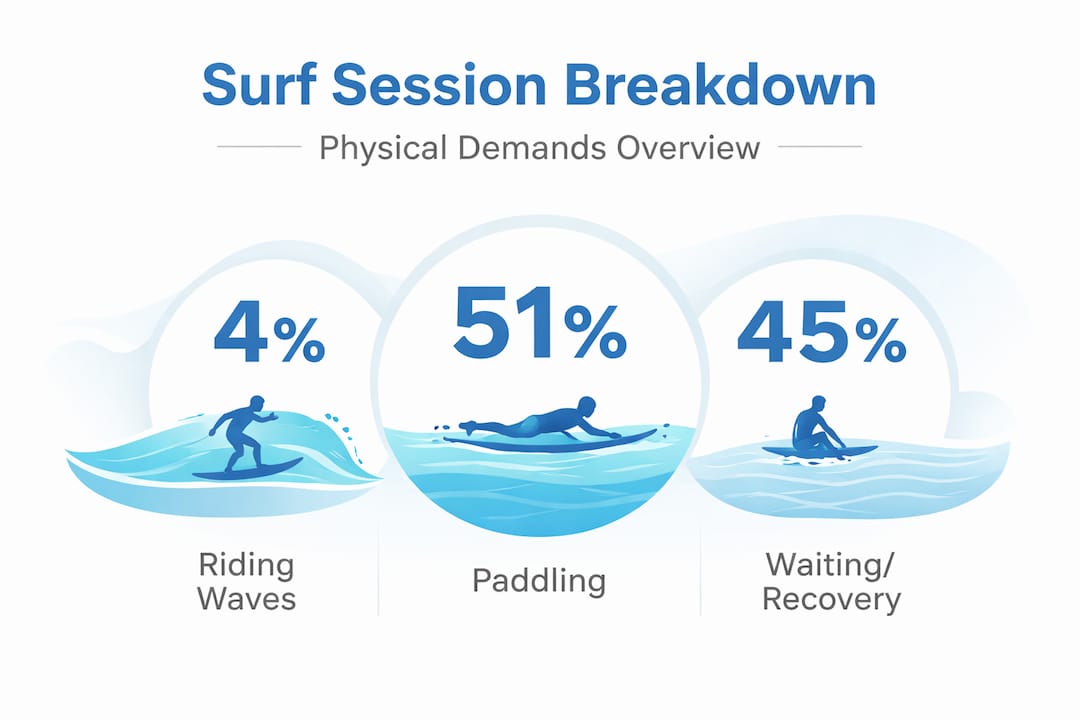
Here’s a simple breakdown of what that looks like over the course of a typical session:
Activity | % of session time | Primary physical demand |
Paddling | ~51% | Upper body endurance, aerobic capacity |
Stationary/waiting | ~42% | Core stability, balance, mental focus |
Wave riding | ~4% | Explosive power, balance, agility |
Miscellaneous | ~3% | Mixed |
What this table tells you is that paddling fitness is the foundation of everything else. If you can’t paddle efficiently for an extended period, you’ll be tired before you even get to your first wave. And when you are tired, your popup slows down, your positioning suffers, and your wave selection becomes reactive instead of proactive.
Surfing pulls heavily on the muscles of the upper back (latissimus dorsi, rhomboids, trapezius), the shoulders (deltoids, rotator cuff), the core (obliques, deep stabilizers), and the hips and legs for the popup and riding phases. Your cardiovascular system works across a wide intensity range, from moderate aerobic effort during sustained paddling to near-maximal intensity when duck diving through larger sets or sprinting to catch a fast-breaking wave.
“Surf fitness emphasizes functional, unstable, and rotational movements that mimic ocean dynamics, rather than maximal strength or muscle hypertrophy. Front crawl swimming is not interchangeable with surf paddling as a training method.”
This distinction matters a lot. General gym fitness, even a high level of it, doesn’t transfer cleanly to surfing. The instability of the board, the rotational demands of paddling, and the unpredictable nature of the ocean require a different kind of conditioning. Many gym-fit beginners are genuinely surprised by how exhausted they feel after their first real surf session. Exploring surf retreats and community benefits can also help you build fitness alongside fellow surfers in an environment specifically designed for progression.
How surf fitness differs from general fitness
With a clearer understanding of the unique physical profile of surfing, let’s see how surf fitness stands apart from traditional workouts.
A standard gym routine built around bench press, deadlifts, and machine exercises will make you stronger in isolated movement patterns. That has value. But it won’t train the kind of reactive stability, rotational endurance, or multiplanar coordination that surfing demands. The ocean doesn’t let you brace against a fixed surface. Every stroke, every popup, every turn happens on an unstable, moving platform.
Here’s how the two approaches compare side by side:
Fitness type | Focus | Key tools | Surf relevance |
Traditional gym | Max strength, hypertrophy | Barbells, machines | Low to moderate |
Surf-specific | Stability, endurance, function | TRX, boards, bodyweight | High |
Swimming (general) | Aerobic base, stroke technique | Pool | Moderate but limited |
Surf paddling | Paddle-specific power, endurance | Board, open water | Very high |
Research supports a specific training tool as particularly effective for surf performance. TRX suspension training is superior to traditional balance boards for developing the surf-specific balance and stability that elite surfers need. TRX works because it forces your stabilizer muscles to activate constantly throughout every movement, closely mimicking the instability of a surfboard in motion.
Swimming is also commonly misunderstood. Many surfers assume that regular pool laps will directly improve their paddle fitness. They won’t, at least not in the same way as actual paddle training. As research confirms, front crawl swimming engages different mechanics and muscle recruitment patterns than surf paddling. Swimming builds a general aerobic base, which is useful, but it doesn’t replicate the position, the arm pull angle, or the resistance profile of paddling on a board.
Pro Tip: If you want to build paddling endurance off the water, prone paddleboarding or using a swim bench with resistance bands in a prone position will transfer far better to your surfing than lap swimming alone.
Here’s a three-stage approach to starting a surf-specific fitness regimen without overwhelming yourself:
Build a base with low-intensity cardio (swimming, cycling, or light jogging) combined with bodyweight core work for four to six weeks. Get your joints used to the workload before adding instability.
Introduce instability using TRX, balance boards, and rotational exercises like woodchops and resistance band rows in a prone position. This is where surf-specific adaptation starts to happen.
Add intensity through interval paddling sessions in the water, high-rep pulling exercises, and explosive hip hinge movements that mimic the popup action.
Incorporating yoga for surfers is also a powerful complement to this progression. Yoga builds the hip mobility, spinal rotation, and shoulder flexibility that make every phase of surfing more fluid and less injury-prone.
Building your surf fitness foundation: Cardio, strength, and balance essentials
We’ve highlighted what makes surf fitness unique, so how do you actually start training for better performance in the water?
Start with aerobic capacity. Research using paddling-specific tests has established clear benchmarks: recreational surfers typically reach a VO2peak (the maximum oxygen your body can use during exercise) of around 37 to 40 milliliters per kilogram per minute, while elite surfers test at approximately 47 to 48 ml/kg/min. VO2peak is a reliable indicator of how long you can paddle before fatigue sets in. The higher your score, the longer and harder you can work before your form breaks down and your wave count drops.
For most beginners, even modest improvements in paddling-specific aerobic fitness will produce noticeable results in the water within a few weeks. You don’t need to reach elite numbers to feel the difference.
For upper body strength and paddle power, the evidence is clear. Maximal upper-body strength and high-intensity paddling intervals are the most effective training methods for improving paddling performance. That means structured pull-focused strength training (think pull-ups, lat pulldowns, and cable rows) combined with short, hard paddling intervals produces the best return on your training time.
Here’s a practical breakdown of the key training domains and the exercises that belong in each:
Cardio and paddling endurance:
Interval paddle sessions: 6 to 8 rounds of 30 to 60 second hard paddling followed by 90 seconds of easy effort
Prone paddleboard sessions lasting 20 to 40 minutes at moderate intensity
Aerobic swimming as a supplementary base builder
Upper body and paddle strength:
Pull-ups or assisted pull-ups: 3 to 4 sets of 6 to 10 reps
Prone resistance band rows mimicking paddle stroke mechanics
TRX rows and TRX fallouts for shoulder stability and anterior core
Core stability:
Plank variations: standard, side plank, and plank with arm reaches
Dead bugs and bird dogs for deep spinal stability
Rotational medicine ball throws for oblique and hip engagement
Dynamic balance:
Single leg squats on a balance pad or BOSU ball
TRX single-leg Romanian deadlifts
Indo board or balance board standing practice
Pro Tip: If you’re just starting out, don’t try to train all four domains in the same week from day one. Focus on cardio and core for the first two weeks, then layer in upper body strength and balance training. Overloading a beginner program leads to fatigue and skipped sessions, both of which defeat the purpose.
Staying at a location designed for surf learning can also accelerate your progress significantly. The right surf accommodation and fitness programs combine structured training with daily water time so that what you build in the gym actually gets tested and reinforced in real conditions.
Common myths, challenges, and what research still can’t answer
Before you dive into your new surf training routine, it’s vital to clear up some common misconceptions and look at what science still hasn’t figured out.
Myth 1: Surfing is mainly about balance and core strength.
This is one of the most persistent misconceptions among beginners. Balance and core matter, but paddling fitness dominates your actual session time. If your paddle endurance fails, you won’t reach the waves consistently enough for your balance and popup skills to even be tested.
Myth 2: Swimming will make you a better paddler.
We’ve touched on this, but it’s worth repeating because so many beginners invest heavily in pool training expecting direct carryover. Swimming builds aerobic capacity and general conditioning, but front crawl swimming does not mirror the biomechanics of surf paddling. Treat swimming as a supplement, not a substitute.
Myth 3: Strength training will make you too bulky to surf.
Functional, surf-specific strength training uses moderate weight and high repetitions with bodyweight and resistance tools. This builds tendon strength, endurance, and stability without adding bulk that would slow you down.
Here’s what research is still working through:
“Most surf fitness studies measure performance in pools or labs rather than actual wave riding. High-quality empirical data on how training interventions improve real-world surfing performance remains limited. Biomechanical research is growing, especially since surfing became an Olympic sport, but individual variation across surfers remains high.”
This research gap matters because it means many training recommendations in popular surf content are based on indirect evidence or expert consensus rather than controlled studies conducted in real ocean conditions. That’s not a reason to ignore the science, but it is a reason to treat your training as a personal experiment and pay close attention to how your body responds.
Working with expert surf instructors who understand both the practical and physical demands of surfing can help you close that gap between lab-based theory and real-world application. Instructors with experience coaching beginners understand how fatigue shows up in the water, where your form breaks down first, and what to prioritize before your next session. Reading about surf instructor essentials gives you a clearer picture of what to look for when choosing who to learn from.
Why simple, focused surf fitness beats complicated routines
With the science and myths addressed, it’s time for an honest perspective on what really works for beginner surfers.
We see this pattern constantly. A new surfer gets excited, watches professional training videos, builds a complicated program with five different balance tools, three types of interval training, and a rotation of 20 different exercises, and then burns out or gets confused within two weeks. The routine becomes the goal instead of the surfing.
The truth is that mastering a small set of foundational movements, done consistently over months, will outperform the most sophisticated periodized program done inconsistently. A beginner who paddles three times a week, does 15 minutes of core work every other day, and gets in the water twice a week will progress faster than someone who follows an elaborate program for three weeks and then stops.
Here’s the counterintuitive part. More variety in your training does not accelerate learning. It often slows it down. When you rotate through too many exercises, your nervous system never fully adapts to any of them. Surf fitness has a short list of truly essential movements: prone pulling, rotational core work, single-leg stability, and explosive hip extension. Nail those four categories, get in the water as often as you can, and then add complexity only when the basics feel automatic.
The best training for surfing is also surfing. No amount of dryland preparation replaces actual time in the ocean. The board beneath you, the moving water, the unpredictable energy of a wave, these are stimuli that no gym can replicate. Understanding how coaching makes surf fitness practical shows exactly how structured guidance in real conditions accelerates everything you’ve been building on the sand.
Ready to put surf fitness into action?
No workout replaces practicing in real waves with experienced guidance. The physical principles covered in this article become meaningful when you actually apply them in the water, with someone who can see what your body is doing and help you adjust in real time.

At Ripar Surf School in Praia Areia Branca, Portugal, our certified instructors have been helping beginners and returning surfers translate fitness into actual surfing skill since 2001. Whether you want to book a surf lesson for a focused single session, join our group surf lessons for an energetic and social learning environment, or fully commit to progress by deciding to join a surf camp, we’ll put you in the water at one of Portugal’s best surf locations with the guidance that turns effort into real results.
Frequently asked questions
What does surf fitness actually mean?
Surf fitness means training for the specific physical demands of surfing, including paddling endurance, upper body strength, core stability, and balance. Unlike general fitness, it emphasizes functional and rotational movements that match what your body actually does in the ocean.
Can swimming training replace surf paddling?
No, because front crawl swimming uses different mechanics and muscle recruitment patterns than surf paddling, meaning it builds general aerobic fitness but doesn’t directly transfer to paddling speed or efficiency on a board.
What are the main mistakes beginners make with surf fitness?
Most beginners focus only on balance or copy general gym routines instead of targeting paddle endurance and upper body power, even though maximal upper-body strength and high-intensity paddling intervals are the most effective methods for improving real paddling performance.
How fit should you be to start surfing?
You can start surfing with modest general fitness, but even basic improvements in aerobic capacity will help you paddle longer and enjoy your sessions more. Recreational surfers typically show a VO2peak of around 37 to 40 ml/kg/min on paddling tests, which is an achievable target for most active adults within a few months of consistent training.
Recommended
Comments