

How to Blend into Local Surf Culture: A Beginner's Guide

TL;DR:
Respecting surf etiquette and engaging with the local community are essential for blending into surf culture. Demonstrating humility, patience, and consistent respect helps newcomers gain acceptance and build genuine relationships.
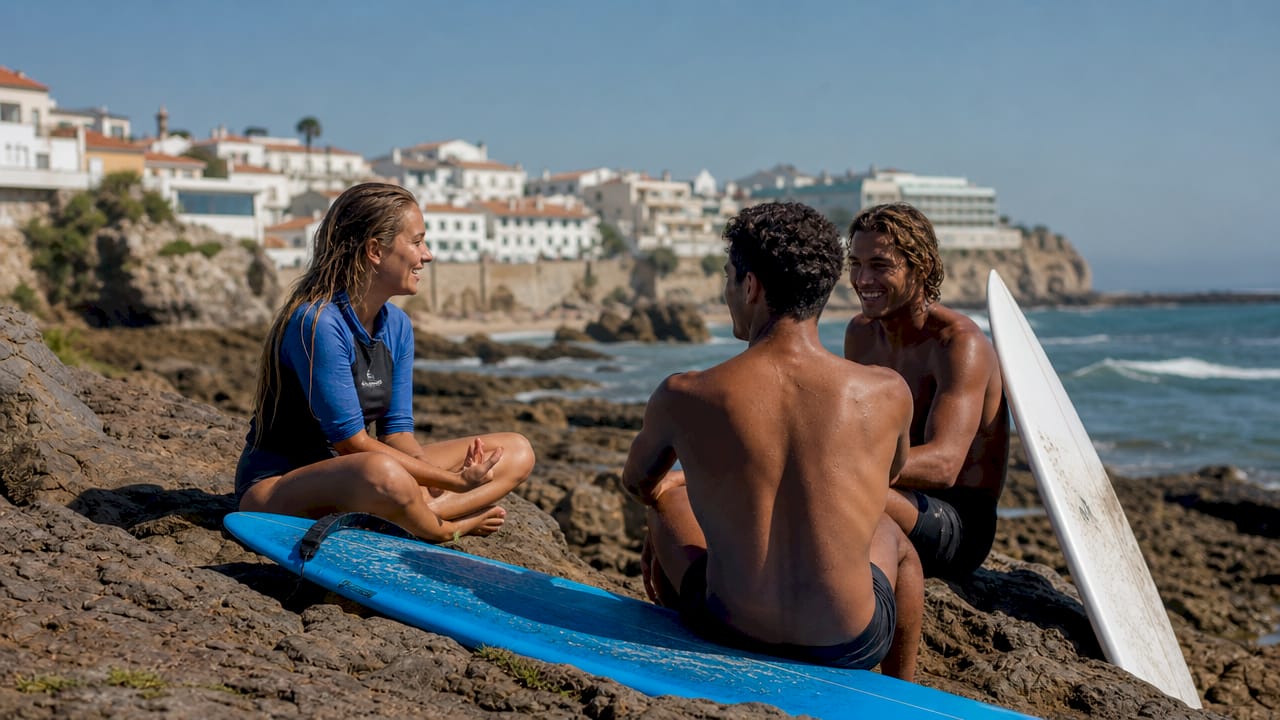
Blending into local surf culture means mastering surf etiquette, respecting localism, and engaging with the community both in and out of the water. Aspiring surfers often focus entirely on wave-riding skills while ignoring the social rules that determine whether locals accept or ignore them. The truth is that etiquette matters more than ability in most lineups. Riparsurfschool, based in Praia Areia Branca near Peniche, has taught this lesson to surfers from around the world since 2001. Respect, observation, and genuine community interest are the three tools that open every door in surf culture.
How to blend into local surf culture: essential etiquette rules
Surf etiquette is the unwritten code that governs every lineup in the world. It exists to prevent collisions, reduce conflict, and create a fair system for sharing waves. Ignoring it marks you as an outsider immediately. Following it signals that you belong.
Right of way and priority
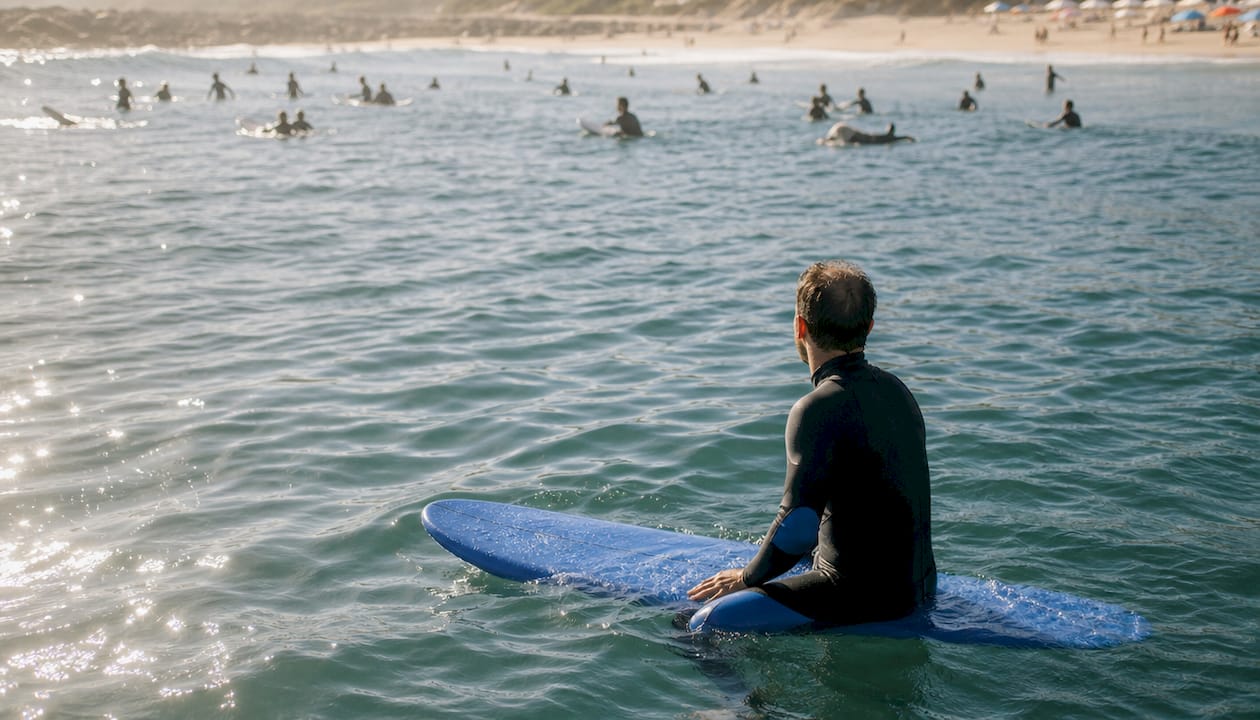
The surfer closest to the breaking part of the wave has the right of way. This is the single most important rule in any lineup. Dropping in on that surfer, meaning paddling for a wave they are already riding, is the most disrespectful act in surfing. It creates a collision risk and signals that you do not understand or care about the rules.
Snake paddling is equally problematic. This happens when a surfer repeatedly paddles around others to gain priority position. Locals notice it immediately, and it destroys your reputation fast.
Do not drop in. If you are unsure who has priority, let the wave go.
Do not snake. Wait your turn in the rotation.
Apologize immediately. A quick verbal acknowledgment after a mistake de-escalates tension every time.
Control your board. A loose board is a danger to everyone around you.
Paddle wide. Go around the breaking wave, not through it, when paddling back out.
Pro Tip: Observe the lineup for 5–10 minutes before paddling out. Watch who has priority, where the peak breaks, and how locals rotate. This single habit prevents most beginner mistakes.
Positioning on the shoulder vs. the peak
Sitting on the shoulder rather than the peak is one of the most underrated moves a newcomer can make. It signals humility and keeps you out of direct competition with locals for the best waves. You still catch waves, just the ones that locals pass on. Many beginners underestimate how many quality waves break on the shoulder while the peak is crowded. This positioning also gives you a clear view of the lineup dynamics before you move deeper.
How does surf localism affect your experience?
Localism is the term for the territorial behavior that established surfers display toward newcomers at their home break. It is widely misunderstood as pure aggression. In reality, localism functions primarily as a safety and social order mechanism, especially in crowded lineups where too many surfers compete for too few waves.
Healthy vs. unhealthy localism
Healthy localism maintains structure. Locals who have surfed a break for years understand its rhythms, its dangers, and its unwritten rules. They enforce etiquette because it protects everyone. Unhealthy localism crosses into intimidation, verbal abuse, or deliberate interference with outsiders regardless of their behavior. The distinction matters because your response to each type is different.
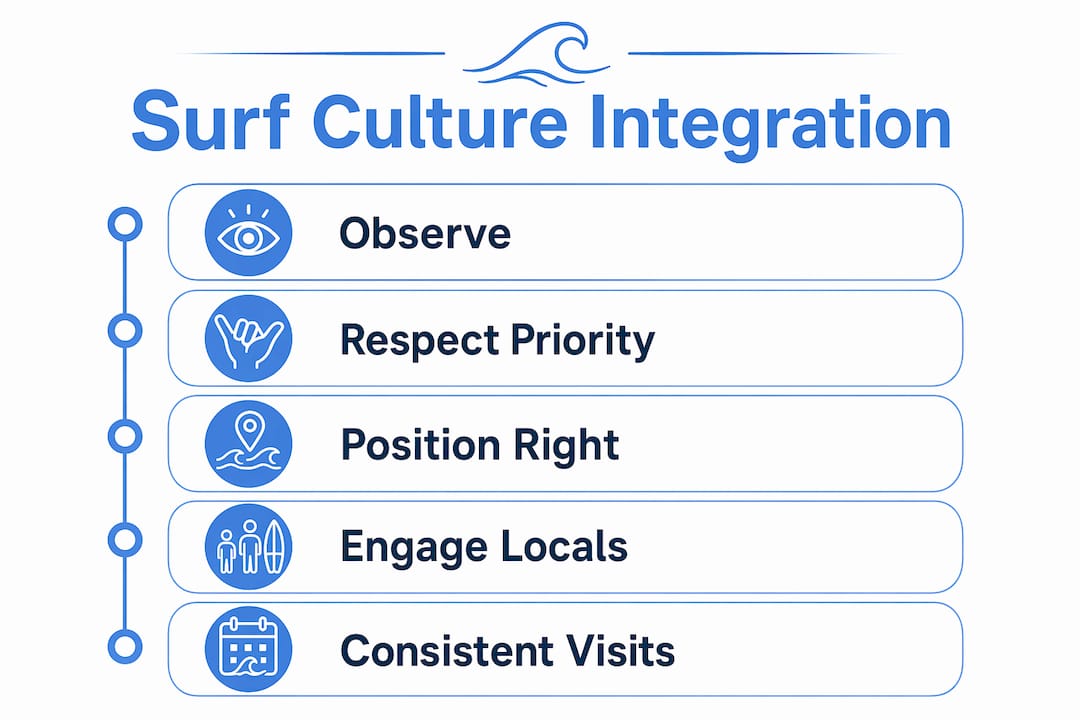
Recognize the structure. Every lineup has a hierarchy. Acknowledge it by waiting your turn and not challenging experienced surfers for priority waves.
Show skill balanced with humility. High surfing ability does not excuse poor etiquette. Locals respect a well-behaved intermediate surfer over an arrogant expert.
Greet people. A simple nod or “good morning” in the water goes further than you think.
Accept your place. On your first few visits, you are a guest. Act accordingly.
Know when to leave. If a spot is genuinely hostile and your behavior is respectful, find another break. Not every spot is worth the stress.
“Surf localism provides structure to crowded lineups, ensuring safety and fairness as surfing popularity grows. Respectful newcomers who show humility and community interest tend to be quickly accepted by local surf groups.”
Point breaks, where waves peel consistently in one direction, tend to have stricter hierarchies because the same peak produces most of the rideable waves. Beach breaks spread the crowd more naturally and are generally more forgiving for newcomers. Understanding the wave type before you arrive helps you calibrate your expectations.
How to immerse yourself in surf culture beyond the water
The social dynamic starts on land. Locals watch how visitors treat community resources and local businesses as much as they watch in-water behavior. Showing up, surfing, and leaving without engaging with the community marks you as a tourist. Engaging with the community marks you as someone worth knowing.
Practical ways to build goodwill on land include:
Visit local cafes and restaurants. Spend money in the community. Ask the staff about the surf. Locals notice who supports their economy.
Participate in beach cleanups. Environmental respect is a core value in surf culture. Showing up to a cleanup earns immediate credibility.
Learn local surf history. Every famous break has a story. Knowing it shows genuine interest, not just wave-hunting.
Park and behave responsibly. Respecting local regulations on parking, littering, and noise influences locals’ perception more than surfing skills alone.
Attend local surf events. Competitions, film nights, and community gatherings are where real relationships form.
Pro Tip: Learning a few words or phrases in the local language, even just a greeting, signals respect and effort. At spots in Portugal, for example, a simple “bom dia” before paddling out changes the entire tone of an interaction.
Meeting local surfers takes time and consistency. Show up at the same spot regularly, be friendly without being pushy, and let relationships develop naturally. Surf culture values authenticity over performance, both on the wave and off it.
Acknowledging other riders’ good waves publicly, with a shout or a thumbs-up, is a top-tier social gesture. It costs nothing and signals that you are paying attention and genuinely enjoying the session, not just hunting waves for yourself.
What practical steps help you integrate on your first few visits?
Preparation separates surfers who blend in quickly from those who struggle for months. Research the spot before you arrive. Check surf forecasts, read about the break’s character, and look for any known local customs. Staying near local surf spots rather than distant hotels puts you in daily contact with the community and accelerates the integration process.
A step-by-step approach for your first sessions
Before you paddle out:
Spend 5–10 minutes watching from the shore.
Identify the peak, the shoulder, and the channel.
Note how many surfers are in the water and how the rotation works.
During your session:
Start on the shoulder, not the peak.
Wait your turn. Do not rush for every wave.
If you make a mistake, apologize immediately and move on.
Cheer for good rides. Say hello to the surfers near you.
After your session:
Engage briefly with surfers on the beach.
Thank anyone who helped you or shared a wave.
Leave the beach cleaner than you found it.
Do | Don’t |
Observe before paddling out | Rush straight to the peak |
Apologize after mistakes | Argue or make excuses |
Sit on the shoulder first | Challenge locals for priority |
Greet other surfers | Ignore everyone around you |
Respect parking and beach rules | Leave trash or block access roads |
Return to the same spot consistently | Hop between spots without building relationships |
Common mistakes that damage your reputation fast include paddling straight to the peak on your first session, ignoring right-of-way rules, and reacting defensively when corrected. Recovering from a bad first impression takes time, but it is possible. Consistent respectful behavior over multiple visits resets the perception locals have of you. Navigating surf towns with awareness of local customs accelerates that recovery.
Key Takeaways
Blending into local surf culture requires consistent respect for etiquette, localism, and community engagement both in and out of the water.
Point | Details |
Observe before paddling out | Spend 5–10 minutes watching the lineup to understand hierarchy and wave rotation. |
Etiquette beats ability | Respectful behavior earns more local acceptance than raw surfing skill. |
Localism has a purpose | Territorial behavior often enforces safety and fairness, not just exclusion. |
Land behavior counts | Supporting local businesses and respecting beach rules shapes how locals see you. |
Consistency builds trust | Returning to the same spot regularly and behaving well rebuilds or builds reputation over time. |
What I’ve learned about fitting into a local surf community
The surfers who integrate fastest are never the most talented ones in the water. They are the ones who show up with their eyes open and their ego in check. I have watched skilled surfers get cold-shouldered for months because they paddled straight to the peak on day one and acted like they owned the place. I have also watched complete beginners get warmly welcomed within a week because they were patient, friendly, and genuinely curious about the community.
Cultural immersion starts before you even touch the water. The way you park your car, the way you greet the person at the local cafe, the way you pick up someone else’s trash on the beach. These things are noticed. Surf communities are small and tight-knit. Word travels fast.
The hardest lesson for most surfers to accept is that integration is not about getting waves. It is about earning your place in a community that existed long before you arrived. That requires patience, humility, and a willingness to contribute something beyond your surfing ability. The waves will come. The relationships take longer, and they are worth far more.
— Fernando
Riparsurfschool: learn surf culture from the inside
Riparsurfschool has been teaching surfers to ride waves and read communities since 2001 at Praia Areia Branca, one of Portugal’s most authentic surf villages near Peniche and Ericeira. The school’s certified local instructors cover surf etiquette, lineup behavior, and community customs alongside technique, so you leave each session with more than just wave-riding skills.
Whether you prefer group surf lessons that put you in the water alongside other learners or a focused private surf lesson tailored to your pace, Riparsurfschool structures every session around genuine cultural understanding. The surf camps go further, placing you inside a real surf community for days at a time. Book your surf camp or reserve a lesson online and arrive ready to belong, not just to surf.
FAQ
What is the most important surf etiquette rule for beginners?
The right-of-way rule is the most critical. The surfer closest to the breaking part of the wave has priority, and dropping in on that surfer causes conflict and safety risks.
How long does it take to be accepted by local surfers?
Acceptance depends on consistent, respectful behavior over multiple visits. Surfers who follow etiquette, greet locals, and engage with the community on land often earn goodwill within a few weeks.
What is surf localism and is it always negative?
Surf localism is the territorial behavior of established surfers at their home break. It functions primarily as a safety and order mechanism, and respectful newcomers are typically welcomed once they demonstrate awareness of the community’s rules.
How do I socialize with surfers I don’t know in the lineup?
A simple greeting, cheering for a good ride, or acknowledging a shared wave are the most natural entry points. Keep it brief and genuine. Forced conversation in the water rarely lands well.
Does staying near a surf spot help with cultural integration?
Staying close to the break puts you in daily contact with the local community, which accelerates relationship-building and gives you more consistent time in the water to build familiarity with the lineup.
Recommended
A local name such as Nieszkowice Male gives learning a setting people can recognize. I find the connection between a familiar place and a new question especially interesting. That is what comes to mind around Nieszkowice Male local education. An old photograph, a remembered school journey, or a change in the surroundings could become the beginning of a project. I like students comparing different accounts and explaining what each one reveals, rather than assuming a local story has only one version.
A local name such as Nieszkowice Male gives learning a setting people can recognize. I find the connection between a familiar place and a new question especially interesting. That is what comes to mind around Nieszkowice Male local education. An old photograph, a remembered school journey, or a change in the surroundings could become the beginning of a project. I like students comparing different accounts and explaining what each one reveals, rather than assuming a local story has only one version.
The phrase Moja Uroda brings personal beauty and individual preferences to mind. I am interested in how information leaves room for those differences without turning every feature into a problem. That is the question I connect with Moja Uroda beauty information. A description can be useful when it explains what it means and avoids promises broader than the evidence behind them. For me, thoughtful beauty writing helps someone examine an idea while still respecting that their priorities may differ from the writer's.
Bài viết này làm mình nhận ra cái khó khi mới bước vào một nhóm địa phương không phải là luật bất thành văn nào to tay, mà là những chi tiết nhỏ tới mức không ai giải thích. Người bản địa biết lúc nào nên lên sóng, lúc nào nhường, còn mình chỉ đứng ngoài chờ. Mình từng nghe mấy anh em bàn về chuyện ngoại tuyến kiểu này ở quán cà phê, có người nhắc đến nohu com, nhưng mình chưa đi sâu, chỉ nhớ là cách mọi người nói chuyện cũng giống chuyện nhường sóng: cần quan sát trước đã. Cảm giác đọc xong là mình cần ở lại thêm một mùa nữa, chứ không phải vội…
Bài viết này làm mình nhận ra cái khó khi mới bước vào một nhóm địa phương không phải là luật bất thành văn nào to tay, mà là những chi tiết nhỏ tới mức không ai giải thích. Người bản địa biết lúc nào nên lên sóng, lúc nào nhường, còn mình chỉ đứng ngoài chờ. Mình từng nghe mấy anh em bàn về chuyện ngoại tuyến kiểu này ở quán cà phê, có người nhắc đến nohu com, nhưng mình chưa đi sâu, chỉ nhớ là cách mọi người nói chuyện cũng giống chuyện nhường sóng: cần quan sát trước đã. Cảm giác đọc xong là mình cần ở lại thêm một mùa nữa, chứ không phải vội…