

Good surf conditions in Portugal: what you need to know
- Fernando Antunes

- Mar 27
- 9 min read
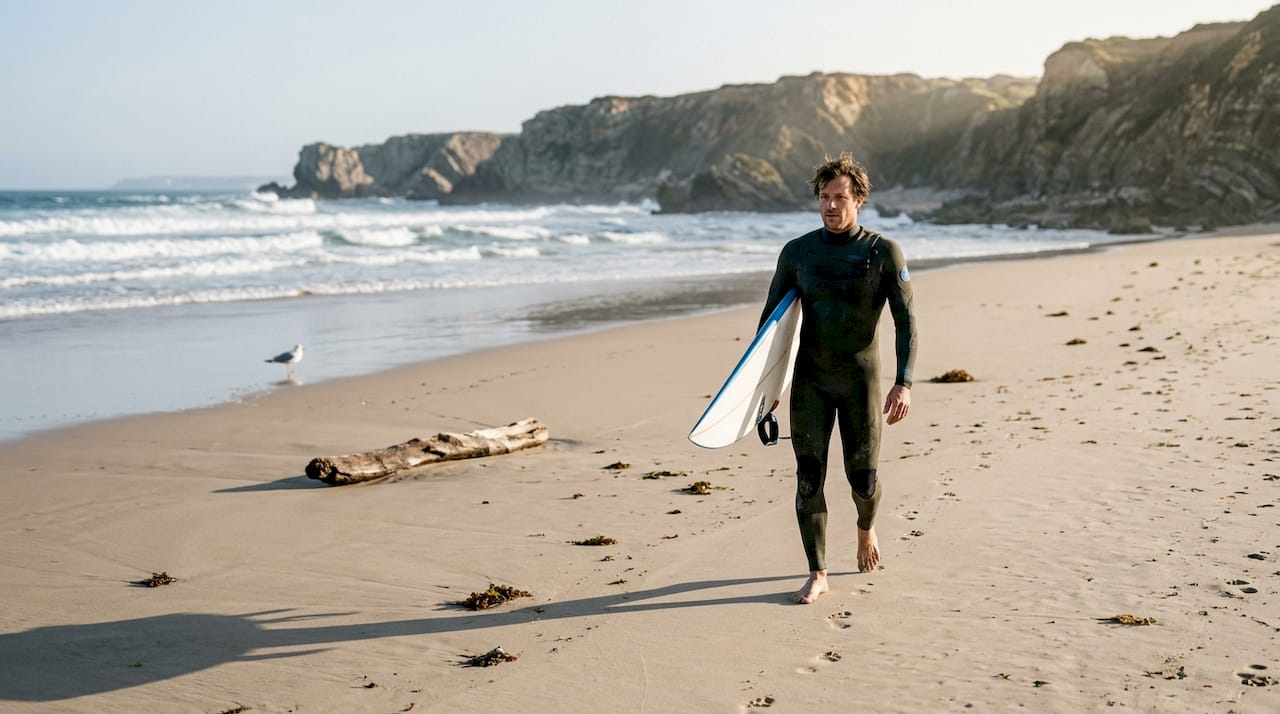
Most people assume that showing up at a Portuguese beach means great waves are guaranteed. Portugal has over 1,800 kilometers of Atlantic coastline, but not every wave is worth paddling into. The difference between a frustrating session and the best ride of your life comes down to understanding a handful of variables: swell, wind, tide, and the shape of the seabed beneath you. This guide breaks down exactly what makes surf conditions good or epic, how Portugal’s top spots behave across the seasons, and how to use forecasts and local knowledge to plan sessions that actually deliver.
Table of Contents
Key Takeaways
Point | Details |
Know your spot | Every surf spot has unique optimal conditions, so researching ahead improves your chances for great waves. |
Combine forecast and local advice | Surf forecasts are essential, but local insight helps you stay safe and maximize fun. |
Match skill with season | Portugal’s surf seasons offer ideal waves for each level—beginners in summer, intermediates and experts in autumn and winter. |
Use tide knowledge | Understanding tides ensures safer, more enjoyable sessions and avoids common hazards. |
Plan, but be flexible | Adapt your plans based on daily conditions and advice for the richest surf experience in Portugal. |
Essential factors that define good surf conditions
Surf conditions are not random. They are the product of several interacting forces, and once you understand each one, you can read any forecast and make smart decisions about where and when to paddle out.
Here are the core variables every surfer needs to know:
Swell height and period: Height tells you how big the waves are. Period (measured in seconds between waves) tells you how much energy they carry. A 2-meter swell at 14 seconds is far more powerful and organized than a 2-meter swell at 7 seconds.
Swell direction: The angle at which swell arrives determines which spots light up. Portugal’s west-facing beaches love northwest and west swells.
Wind direction and speed: Offshore wind (blowing from land to sea) grooms waves and holds them up. Onshore wind (blowing from sea to land) chops them up and makes them messy.
Tide: Rising, falling, high, or low tide changes the depth of water over the seabed, which directly shapes wave form and power.
Bathymetry: The shape of the seabed, whether sand, rock, or reef, determines how waves break. A consistent sand bottom creates forgiving beach breaks; a sharp reef creates hollow, fast barrels.
The gap between “good” and “epic” conditions is often just one variable being perfectly aligned. You can have a solid swell and clean wind, but if the tide is wrong for your spot, the wave either closes out or goes flat. Tide changes wave shape and power, which is why experienced surfers always check the tidal chart before choosing a spot.
For forecast interpretation, platforms like Surfline assign ratings from “Very Poor” to “Epic” based on wave height, wind, and machine learning models. But forecast ratings use height, wind, and ML models, so always cross-check with live buoys and webcams before committing to a session. A “Good” rating on a forecast app can still mean a frustrating paddle-out if local conditions shift.
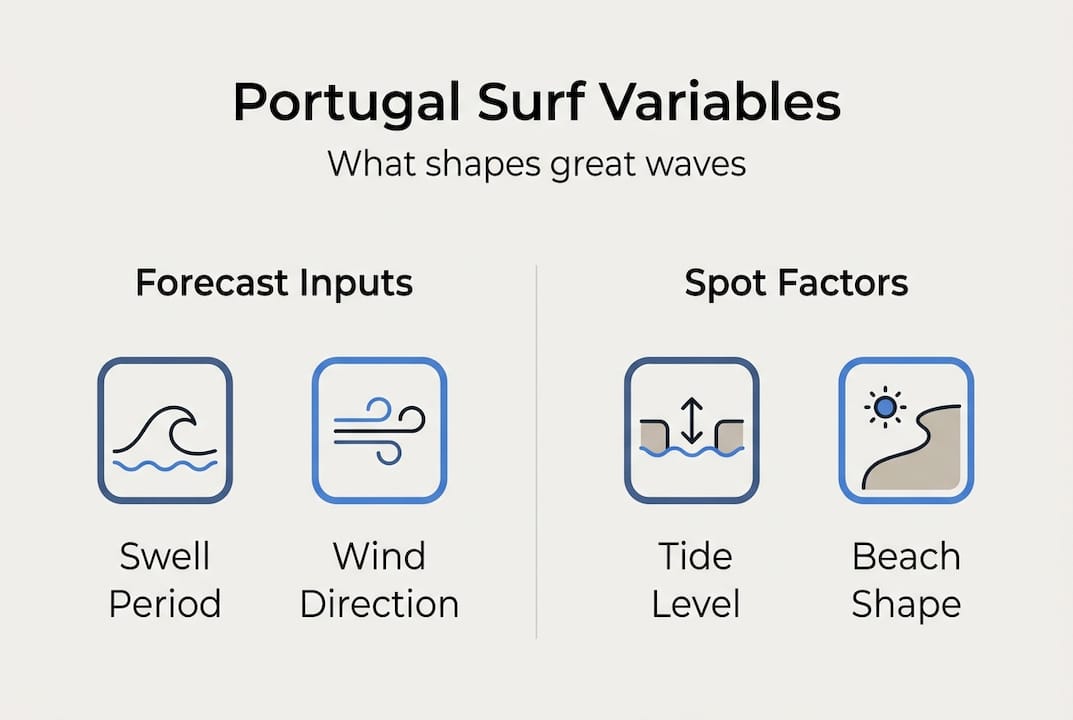
Here is a quick comparison of how each variable affects your experience:
Variable | Low/Poor | Ideal | Effect on waves |
Swell period | Under 8 sec | 12 to 16 sec | Longer period = more power and shape |
Wind | Onshore (choppy) | Offshore (light) | Offshore = clean, glassy faces |
Tide | Extreme low or high | Mid tide | Mid tide = consistent, rideable shape |
Swell direction | Side-shore | NW or W for Portugal | Correct angle = waves wrap into spot |
Seabed | Irregular rock | Sand or reef point | Consistent bottom = predictable break |
For more on how these variables shape your time in the water, the surf lesson planning guide covers how instructors factor conditions into every session. Understanding the local surf culture guide also helps you see how Portuguese surfers read and respect these conditions daily.
Portugal’s surf spot benchmarks and seasonal conditions
Portugal is not one surf destination. It is a collection of world-class spots, each with its own personality, optimal conditions, and ideal surfer profile. Knowing which spot suits your level and the current season is the difference between progression and frustration.
Ericeira is Europe’s only World Surfing Reserve, home to spots like Ribeira d’Ilhas, Coxos, and Foz do Lizandro. It works best on northwest swells with light offshore winds. Foz do Lizandro is a forgiving beach break ideal for beginners and intermediates, while Coxos is a powerful right-hand reef that demands expert-level surfing.
Peniche is home to Supertubos, one of the most powerful beach breaks in the world and a regular stop on the WSL Championship Tour. It fires on northwest swells and offshore east winds. Baleal, just north of Peniche, offers sheltered, beginner-friendly waves on most swell directions. The benchmark conditions at Peniche make it a reference point for what a world-class beach break should feel like.
Nazaré is in a category of its own. The underwater Nazaré Canyon funnels and amplifies Atlantic swells to produce the biggest rideable waves on the planet. Rodrigo Koxa set the world record at 24.38 meters in 2017, a record that still defines what big wave surfing means. Nazaré is strictly for experienced big wave surfers in winter.
Here is a breakdown of Portugal’s top spots by season and surfer level:
Spot | Best swell | Best wind | Best tide | Season | Surfer level |
Baleal (Peniche) | NW/W, 1 to 1.5m | E/NE offshore | Mid | Year-round | Beginner |
Foz do Lizandro (Ericeira) | NW/W, 1 to 2m | E offshore | Mid to high | Spring/Summer | Beginner/Intermediate |
Ribeira d’Ilhas | NW, 1.5 to 2.5m | E/NE offshore | Mid | Autumn/Spring | Intermediate/Advanced |
Supertubos (Peniche) | NW, 1.5 to 3m | E offshore | Low to mid | Autumn/Winter | Advanced/Expert |
Nazaré | NW, 4m+ | E offshore | Any | Winter | Expert/Big wave |
Seasonality matters enormously. NW and W swells are best year-round, with summer delivering smaller, manageable waves for beginners, autumn and spring offering consistent intermediate conditions, and winter producing powerful expert-level surf.
Here is how to match your skill level to Portugal’s spots and seasons:
Beginners (June to September): Head to Baleal or Foz do Lizandro. Small, slow waves, sandy bottoms, and plenty of space to practice.
Intermediates (March to May, September to November): Ribeira d’Ilhas and Areia Branca offer consistent, shapely waves with manageable crowds.
Advanced surfers (October to February): Supertubos and Coxos deliver fast, hollow waves that reward precision and experience.
Expert and big wave surfers (November to February): Nazaré is the destination, but only with proper safety equipment and an experienced team.
For a deeper look at what beginners can expect, Portugal beginner surf experiences covers the full picture. And if you are planning a longer stay, Portugal surf holiday essentials outlines everything you need to prepare.
Reading surf forecasts and local knowledge
A forecast app is a starting point, not a final answer. The best surfers in Portugal use technology as one layer of information and local knowledge as the filter that makes it actionable.
The main forecast platforms used in Portugal are Surfline, Magic Seaweed (MSW), and Windguru. Each uses slightly different models and data sources. Surfline ratings are spot-specific, running from “Very Poor” to “Epic,” and always benefit from a cross-check with live webcams and buoy data before you drive to the beach.
Here are the key signs that conditions are changing and you need to reassess:
Wind shifting onshore mid-session (watch the flag or feel it on your face)
Swell period dropping below 8 seconds (waves become weak and disorganized)
Tide moving toward extreme low or high (spot may go flat or become dangerous)
Sudden increase in crowd at a spot (locals know something changed for the better or worse)
Whitecaps appearing on the horizon (wind is picking up offshore)
“The forecast gives you a probability, not a promise. A live cam at the spot tells you what is actually happening right now. Use both, every time.” — Experienced surf instructor, Peniche region
Pro Tip: Before any session, check the forecast the night before for the big picture, then look at a live webcam or buoy reading 30 minutes before you paddle out. This two-step check catches the gaps that models miss.
One of the most common mistakes travelers make is trusting a single forecast app and ignoring local input. Portugal’s coastline creates microclimates where a spot 10 kilometers away can be completely different. The people who surf these breaks every day know which tide phase makes a spot dangerous, which wind direction turns a mediocre forecast into a magic session, and which spots to avoid after heavy rain. Connecting with local surf culture is not just about etiquette; it is a safety and performance advantage. Staying at a Portugal surf house puts you in daily contact with that knowledge base automatically.
Applying surf condition insights to your Portugal adventure
Knowing the theory is one thing. Turning it into a trip that actually delivers great waves requires a practical plan built around your skill level, your travel window, and the flexibility to adapt.
The biggest mistake surf travelers make is booking fixed daily plans that ignore conditions. Portugal’s weather and swell patterns shift constantly, especially in autumn and winter. The surfers who have the best trips are the ones who stay flexible and let conditions guide their daily choices.
Here is a step-by-step approach to maximizing your chances of good surf:
Choose your travel window based on your level: Beginners should target June through August. Intermediates get the best value in April, May, October, or November. Experts should plan for November through February.
Research two or three spots near your base: Having options means you can pivot when conditions favor a different break. Areia Branca, Baleal, and Foz do Lizandro are all within 30 minutes of each other.
Check forecasts three days out: This gives you enough lead time to plan transport and equipment without being locked into a decision too early.
Verify with cams and buoys on the morning of: Spot-specific tides and seasonal guidance are essential for making the final call on where to paddle out.
Build in a rest day: Fatigue leads to poor decisions in the water. A day off between sessions keeps your judgment sharp and your body ready.
Pro Tip: Book surf lessons or camps that adjust their session location daily based on conditions. A school that always surfs the same beach regardless of wind or tide is not giving you the best experience. Adaptive instruction means you always surf the best available wave for your level.
For detailed guidance on structuring your time in the water, planning surf lessons walks through how professional instructors factor tides, swell, and wind into every session. If you are ready to get in the water with a group, group surf lessons are a great way to learn fast while sharing the experience with other travelers.
Start your Portugal surf journey with expert support
Understanding surf conditions is the foundation, but applying that knowledge in real time, at real spots, with real Atlantic swell, is where having an experienced local team makes all the difference.

At Ripar Surf School, we have been reading these waves since 2001. Our certified local instructors adapt every session to the day’s conditions, choosing the right spot and the right moment so you spend more time surfing and less time guessing. Whether you are a first-timer or an intermediate looking to push your level, you can book online and join one of our all levels group surf lessons at Praia Areia Branca, right between Peniche and Ericeira. Small groups, local knowledge, and genuine Atlantic surf. That is the Ripar experience.
Frequently asked questions
Why is tide important for surf conditions?
Tide affects wave shape and power, making mid-to-high tide ideal for most beach breaks while reducing hazards at reef spots. Getting the tide wrong can turn a great forecast into a flat or dangerous session.
What is the best time of year to surf in Portugal for beginners?
Summer is ideal for beginners with small, slow waves at spots like Baleal and Foz do Lizandro from June through September. Conditions are forgiving, crowds are manageable at beginner-friendly breaks, and water temperatures are comfortable.
How can I tell if surf conditions are ‘good’?
Check forecast ratings and live cams for your specific spot, then confirm swell direction, wind, and tide are aligned. A good rating means little if the wind has gone onshore or the tide is at an extreme.
Are surf forecasts reliable for Portugal’s spots?
Forecasts are spot-specific and useful for planning, but real-time checks with webcams and local knowledge are essential for accuracy and safety. Models do not always capture the microclimatic shifts along Portugal’s coast.
Where should intermediates and experts surf in Portugal?
Autumn and spring suit intermediates best, with consistent swell at Ribeira d’Ilhas and Areia Branca. Experts should target winter at Supertubos, Coxos, and Nazaré for the most powerful and challenging conditions Portugal offers.
Recommended
Comments