

How to surf small waves: beginner guide for fun and progress

TL;DR:
Mastering small waves creates the essential foundation for advanced surfing by refining timing, balance, and wave reading.
Using high-volume, soft-top boards, along with proper positioning and technique, makes catching and riding small waves achievable and enjoyable.
Practicing consistently on small surf enhances skills that transfer directly to larger, more challenging waves, building long-term confidence and mastery.
You paddle hard, the wave lifts beneath you, and then nothing. The wave rolls under your board and you’re left sitting in flat water wondering what went wrong. Missing small waves is one of the most frustrating experiences in surfing, and it happens to almost every beginner. The good news is that small waves are not the enemy. With the right board, smart positioning, and a few key technique adjustments, they become the most powerful learning tool in the ocean. This guide covers everything you need to know to catch, ride, and actually enjoy small waves from day one.
Table of Contents
Key Takeaways
Point | Details |
Choose the right board | A high-volume soft-top board 8–9 feet long makes small waves easy for beginners. |
Master your paddling | Proper positioning and committing to extra strokes will help you catch more waves. |
Refine wave reading | Patience and spotting the best takeoff spot let you select the rideable small waves. |
Fix common mistakes fast | Identify and correct takeoff errors and missed timing early for rapid improvement. |
Use small waves for fun and progress | They’re perfect for building surfing skills and having a great time in the water. |
What you need to surf small waves
Now that you know why small waves are ideal for learning, let’s cover exactly what you’ll need to get started.
The single most important piece of gear is your surfboard. For small, mellow surf, you want a board that floats well, paddles easily, and gives you a large platform to stand on. According to surf technique experts, beginners should use soft-top boards that are 8 to 9 feet long, wide, thick, and built with high volume. Volume is the key word here. It refers to how much foam or buoyancy a board has, measured in liters. More volume means easier paddling and more stability when you stand up.
Pro Tip: A simple formula for finding your ideal board volume is to multiply your body weight in kilograms by 1.8 to 2.2. For example, if you weigh 70 kg, look for a board between 126 and 154 liters. This range works especially well for your first beginner surf lesson and makes catching waves feel much more achievable.
Beyond the board, here is what else you need:
A surf leash: This attaches your ankle to the board so it doesn’t drift away when you wipe out. It’s a safety essential, not optional.
Surf wax: Applied to the top of the board, it gives your feet grip. Without it, you will slide off constantly.
Comfortable swimwear: For Portugal’s Atlantic water, a 3/2 mm wetsuit is comfortable for most of the year, while summer months allow for boardshorts or a swimsuit.
Sunscreen: Portugal gets strong sunshine. Use a water-resistant SPF 30 or higher.
Choosing the right beach matters too. You want a sandy beach break with gentle, rolling waves that don’t close out all at once. A wave that “closes out” (breaks all at once across its full length) gives you no room to ride. Portugal’s coast near Peniche and Ericeira offers plenty of sheltered bays with exactly this kind of mellow, forgiving surf. Praia Areia Branca, where Ripar Surf School is based, is a great example of this. The wave there is consistent, manageable, and perfect for building confidence.
Feature | Ideal for beginners | Avoid for beginners |
Board length | 8 to 9 feet | Under 7 feet |
Board volume | 120 to 160 liters | Under 60 liters |
Board material | Soft-top foam | Hard fiberglass |
Wave height | 1 to 3 feet | Over 5 feet |
Wave type | Rolling beach break | Heavy reef break |
When you have the right setup, surfing small waves stops feeling impossible and starts feeling fun. That shift in equipment alone transforms the experience entirely.
Step-by-step techniques to catch and ride small waves
With the right equipment sorted, it’s time to get into the actual steps and techniques for small wave surfing.
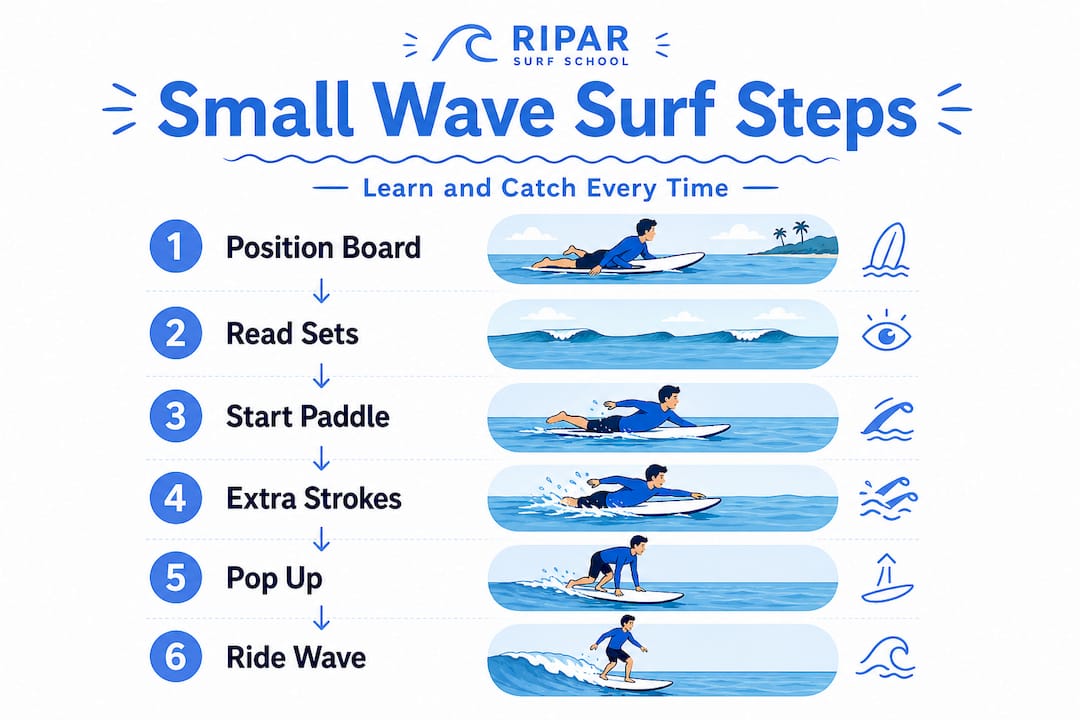
Step 1: Board positioning in the water. Lie on your board so your chest is slightly forward of the midpoint. This is more nose-forward than most beginners expect. If you’re too far back, the nose lifts and you drag water. If you’re too far forward, the nose sinks. Find the sweet spot where the board floats flat and level.
Step 2: Reading the lineup. Watch the horizon for sets of waves. Small waves often don’t give you much warning, so you need to watch for a slight darkening of the water or a shift in how the surface moves. Position yourself where the waves are peaking, not where they’ve already broken.
Step 3: Timing your paddle. This is where most beginners struggle. You need to start paddling earlier than feels natural. The wave has to be moving at roughly the same speed as you before it can carry you. As a guideline, paddle with long, deep strokes and keep your chest positioned forward of the midpoint. Commit fully as the wave starts to lift you.
Step 4: The extra strokes. The most common mistake is stopping too soon. Give yourself three more paddle strokes after you feel the wave lift. This keeps your momentum locked in with the wave and prevents it from rolling under you. Think of it as matching the wave’s speed, not just catching a ride.
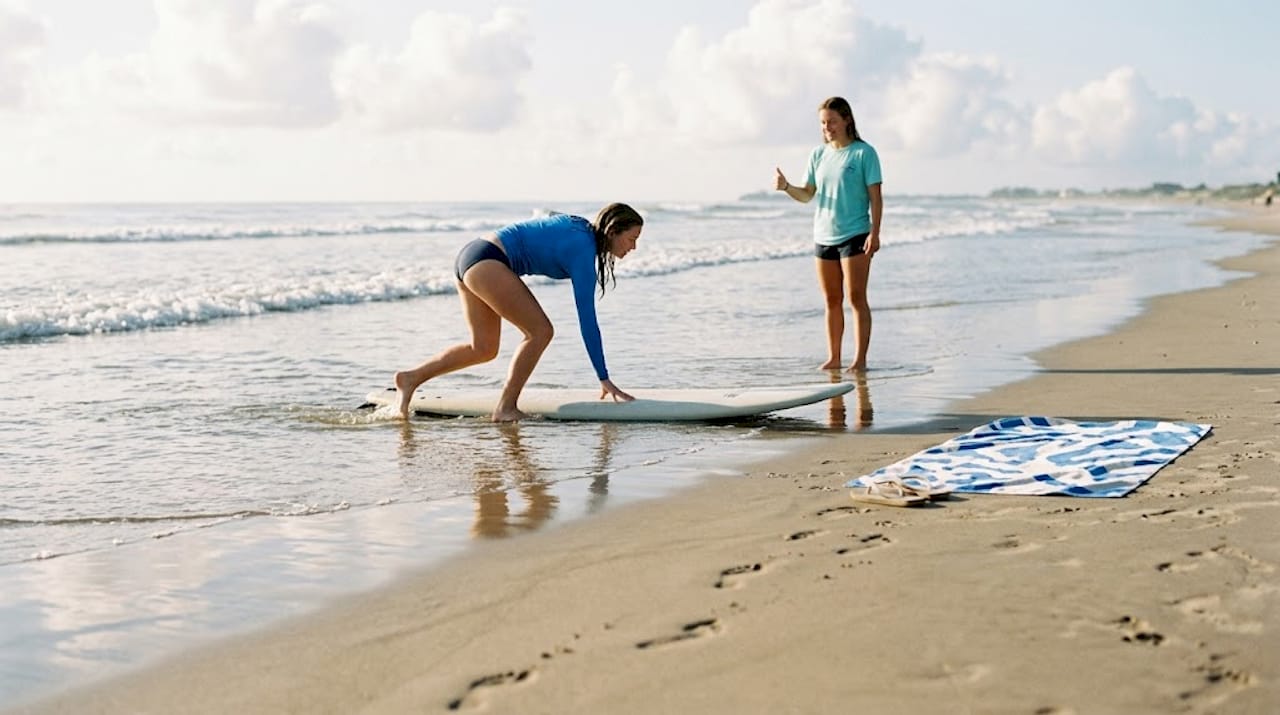
Step 5: Standing up (the pop-up). As the wave takes you, push up with both hands close to your chest, then bring both feet forward in one quick movement. Plant your back foot over the fins and your front foot roughly in the center of the board. Keep your knees bent and your arms out for balance.
Step 6: Trim and ride. Once you’re up, don’t just stand there. Lean slightly forward to maintain speed and stay in the power zone of the wave. Staying near the whitewater (the broken, foamy part) keeps you moving, as that is where the wave’s energy is concentrated. Trim in the sweet spot at the wide point of the board, and use gentle rail-to-rail shifting to keep momentum going.
Step | Key action | Common error |
1. Positioning | Chest forward of midpoint | Sitting too far back |
2. Reading waves | Track lip line and peak | Ignoring lineup patterns |
3. Timing | Start paddling early | Starting too late |
4. Extra strokes | Paddle 3 more after lift | Stopping at first movement |
5. Pop-up | One fluid movement to feet | Slow, tentative kneeling |
6. Riding | Stay near pocket, trim | Standing still, losing speed |
Once you’re on your feet and riding, the feeling is genuinely electric. Even a 2-foot wave feels fast and fun when you’ve nailed the technique. Taking a group surf lesson at a reputable surf school in Portugal is one of the fastest ways to lock in these steps with real-time feedback.
Pro Tip: When you’re on a small wave, always paddle a few extra strokes more than feels necessary. Small waves have less push than big ones, so extra commitment is the difference between a great ride and a missed opportunity.
Common mistakes and troubleshooting for small wave surfers
Even with a solid technique, it’s easy to run into snags. Here’s how to spot and fix the most common problems.
Paddling too early. If you start paddling long before the wave reaches you, you’ll run out of energy by the time the wave arrives. You might also position yourself wrong and end up in the flat water behind the breaking zone. Aim to start your paddle stroke when the wave is about 10 to 15 feet behind you.
Paddling too late. This is the more common error. The wave passes under you before you’ve built enough speed to match it. Practice reading the wave and committing to your paddle earlier. Small waves require more timing precision than big waves.
Stopping mid-paddle. As highlighted by experienced coaches, stopping mid-paddle or arching your back during the takeoff are the two biggest killers of a small wave ride. Once you commit, don’t hesitate. Stopping breaks the momentum connection between you and the wave, and the wave simply leaves you behind.
Pearling: This means nose-diving. Your weight is too far forward on the board. Shift slightly back or apply a subtle press with your back foot.
Popping up too slowly: A slow, hesitant pop-up lets the wave race ahead without you. Practice the pop-up movement on the beach until it’s fast and automatic.
Riding the shoulder: The shoulder of a small wave is the part farthest from where it’s breaking. It looks open and tempting but has almost no power. Stay close to the breaking part of the wave for speed and energy.
Standing upright: Straight legs make you rigid and unstable. Keep your knees bent throughout the ride to absorb small bumps and keep your center of gravity low.
“Stay busy on tiny waves. Aggressively work the face up and down to outrun closeouts. Small waves reward active surfers who use every bit of available energy.” Expert surf coaches consistently emphasize that passive riding kills small wave sessions.
When things go wrong, the best thing to do is turn to your surf instructor for immediate feedback. Watching someone who knows what they’re looking at observe your technique is worth hours of solo practice.
How to progress and have more fun on small waves
Once you’re catching waves consistently, use small surf days to master new skills and enjoy your time in the water even more.
The first progression step is learning to choose better waves. Not all small waves are equal. Some close out quickly while others offer long, rideable walls. Practice selecting non-closeout waves patiently by tracking the lip line. The lip is the top edge of the wave. When it starts to steepen sharply above you, that’s the moment to commit to your takeoff. Waves where the lip steepens gradually across their length offer the longest, most enjoyable rides.
Once you can read waves more reliably, try these progression exercises:
Rail-to-rail shifting: Gently transfer your weight from your heel side to your toe side as you ride. This creates a smooth, flowing S-shape and starts to teach you directional control.
Light tail presses: As you move along the wave, experiment with subtle pressure on your back foot to slow down or redirect slightly. This is the foundation of turning.
Riding further down the line: Aim to ride parallel to the beach rather than straight toward it. This keeps you in the wave’s power zone longer and gives you a more satisfying, extended ride.
Nose riding practice: On a longboard, try shuffling your feet slightly toward the nose during a stable section of the ride. This feels wild and teaches incredible balance.
Wipeout practice: Deliberately fall in different ways to learn how the leash behaves and where your board ends up. Comfort with wipeouts removes hesitation during takeoff.
Pro Tip: Small waves are actually the ideal place to experiment. There’s less power pushing you, which means mistakes are gentler and recovery is faster. Celebrate every new thing you try, even when it doesn’t work. Progress in surfing is built on a mountain of happy, low-consequence failures.
You can find plenty of inspiration and real stories from people just like you at surf camp stories from the Ripar community. Reading how others have progressed makes the journey feel tangible and exciting.
Why small wave mastery is the real surfing superpower
With techniques and troubleshooting under your belt, let’s take a step back for some big-picture insight on why focusing on small waves pays off long-term.
Here’s something most people get wrong about surfing. They assume that bigger waves equal better surfers. They chase size as a proxy for skill, and in doing so they skip the foundation that actually builds real ability. Small waves teach you everything. Timing, balance, wave reading, foot placement, and creative riding all get refined in small surf because small surf gives you zero margin for error. A big wave will carry you even if your technique is clunky. A small wave won’t.
At Ripar Surf School, we’ve watched thousands of students come through since 2001. The ones who progress fastest are almost always the ones who stay curious on small days instead of waiting for bigger swell. They use those sessions to feel things: the subtle push of a wave, the exact moment to pop up, the difference between trimming and stalling. That sensitivity can’t be rushed, and it can’t be taught on a 6-foot wave where raw power is doing most of the work.
There’s also a mindset dimension here. Surfers who embrace small waves stop being frustrated by conditions and start being resourceful. That mental shift carries over into every other area of their surfing. When bigger waves eventually arrive, these surfers are already sharp, already confident, already reading the ocean fluently.
Small waves are not a consolation prize. They are the real training ground. Don’t wait for perfect conditions to start learning. The perfect conditions are already here. When you’re ready to take this seriously, book surf lessons with instructors who have been teaching in this ocean for decades. It makes a bigger difference than you’d expect.
Ready to master small waves in Portugal?
If you’re excited to ride your first waves or take your skills further, direct instruction and community make all the difference.

Ripar Surf School, based at Praia Areia Branca near Peniche and Ericeira, has been helping complete beginners and returning surfers build real skills since 2001. Our certified local instructors know these waves inside and out, and they bring that knowledge directly into every session. Whether you want to book surf lessons for a single afternoon or commit to a full week of learning, we have options that fit. Our beginner surf lesson packages are specifically designed for people starting from zero, while our group surf lesson format creates a fun, supportive community atmosphere that keeps learning enjoyable every session.
Frequently asked questions
What is the best board size for learning on small waves?
A soft-top board 8 to 9 feet long with high volume calculated as your body weight times 1.8 to 2.2 liters is ideal for catching small waves easily and staying stable while you learn.
How should I position myself to catch small waves?
Lie with your chest slightly ahead of the board midpoint and use long, deep paddle strokes, committing fully without stopping as the wave begins to lift you.
Why do I keep missing small waves even after paddling hard?
Most often your timing is slightly off or you stopped paddling too soon. Try paddling three extra strokes after you feel the wave begin to lift you and match the wave’s angle during takeoff.
Are small waves worth practicing on if I want to surf bigger waves later?
Absolutely. Small waves sharpen the fundamentals of balance, timing, and wave reading that transfer directly to bigger surf. Trimming in the sweet spot and generating speed through rail movements are skills best developed in mellow, forgiving conditions.
Recommended
Comments