

Surfing Lessons in Portugal: A Beginner's Guide

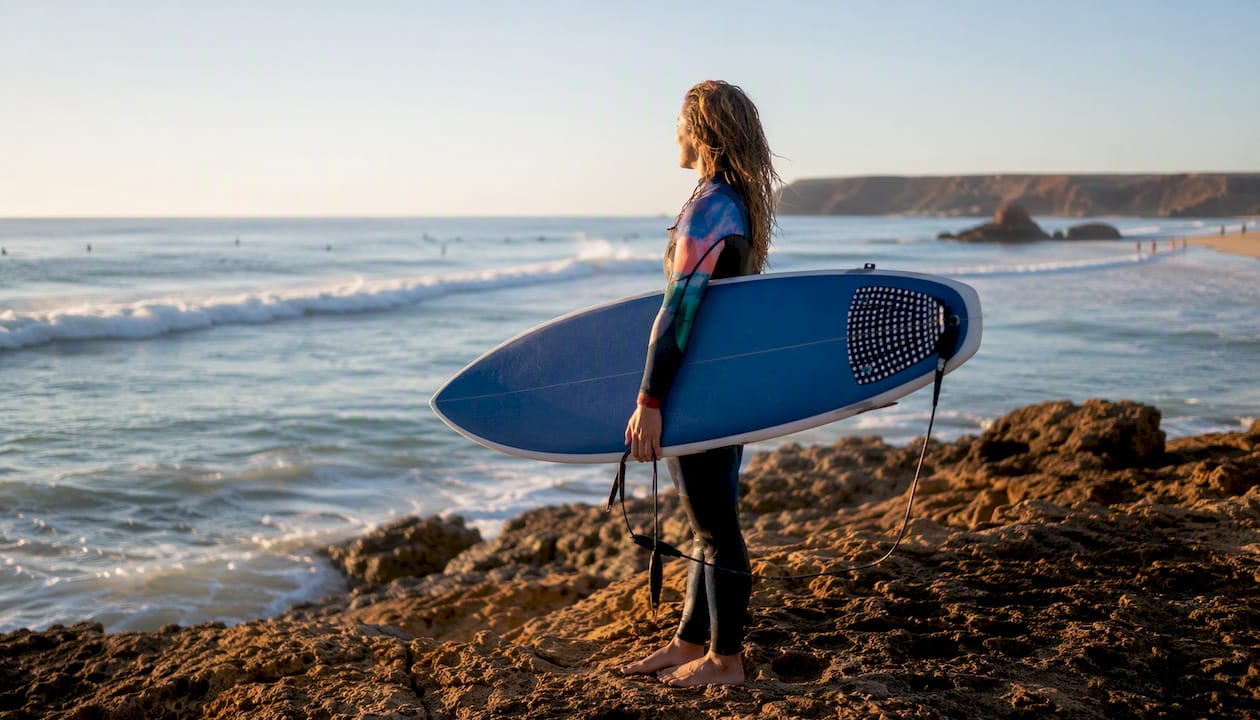
For first-time surfers, Portugal’s beach breaks around Praia Areia Branca, Peniche, and the Algarve offer the fastest, safest learning curve in Europe. The single best option for U.S. beginners is Riparsurfschool (Ripar Surf School & Surfcamp), based at Praia Areia Branca near Peniche and Ericeira. Book a small-group lesson or a 5-day beginner camp and you’ll be riding whitewater by day two.
Gentle, consistent beach breaks; certified local instructors who speak English; small groups with close coaching; and package options that bundle accommodation, transfers, and equipment into one price.
Riparsurfschool has been running lessons since 2001, which means the team knows exactly which conditions suit absolute beginners and how to progress them safely.
Check availability and book your surf lessons directly on Riparsurfschool’s booking page.
Table of Contents
Where should you learn to surf in Portugal?
Portugal packs a surprising range of beginner-friendly breaks into a relatively short coastline. The four areas below cover the most popular choices for learners, with honest notes on what each delivers.
Location | Best for | Wave type | Nearest airport | Transfer time |
Praia Areia Branca | All-level beginners, camps | Mellow beach break | Lisbon (LIS) | ~1 hr |
Ericeira | Beginners wanting variety | Mixed beach and reef | Lisbon (LIS) | ~45 min |
Peniche | Beginners to intermediate | Beach break, some reef | Lisbon (LIS) | 2–3 hrs |
Algarve (Arrifana, Meia Praia) | Families, summer beginners | Small, sheltered beach break | Faro (FAO) | 30–90 min |
Praia Areia Branca
This is where Riparsurfschool operates, and the location earns its reputation. The beach produces long, rolling whitewater waves that are ideal for learning pop-ups and riding straight. The village itself is small, meaning no crowds fighting for the same beginner section of the break. Accommodation, cafes, and the school’s deck with showers are all within walking distance, so you spend your energy surfing rather than commuting.
Ericeira and the Lisbon coast
Ericeira is a UNESCO World Surfing Reserve, which sounds intimidating but actually means the area protects a variety of breaks, including several that suit learners. Beginners in Portugal typically start on the beach breaks just outside the reserve boundaries, where the waves are softer and more forgiving. Lisbon’s airport is 45 minutes away, making this the easiest destination to reach from an international flight.
Peniche
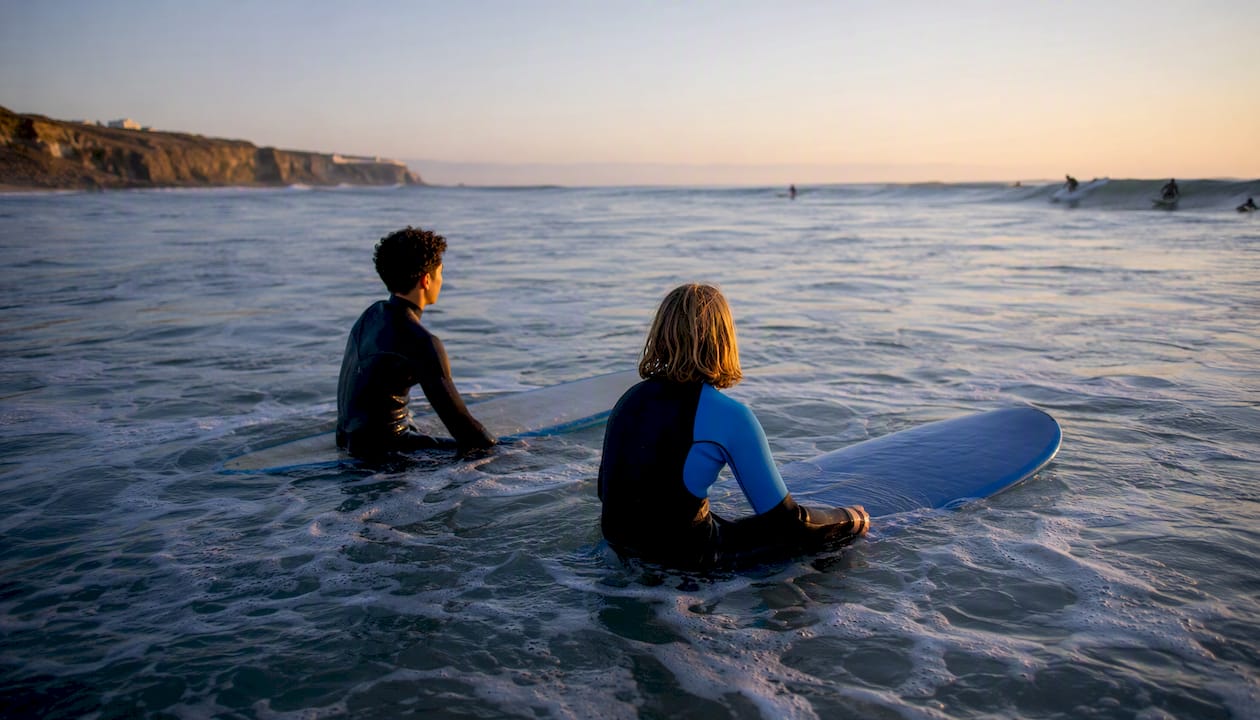
Peniche sits on a peninsula that catches swell from multiple directions, so there’s almost always a rideable wave somewhere. Supertubes, the famous reef break, is for experienced surfers only. Beginners head to the calmer beach breaks on the sheltered side of the peninsula. The town has a strong surf culture, plenty of surf shops, and a good selection of hostels and guesthouses.
Algarve
The southern coast trades the Atlantic’s raw power for smaller, warmer, more sheltered waves. Algarve beginner beaches like Arrifana, Meia Praia, Porto de Mós, Amoreira, and Monte Clérigo offer manageable conditions that suit families and anyone who wants to learn in the calmest possible environment. Faro airport is the entry point, and summer water temperatures here are noticeably warmer than the central coast.
Pro Tip: If your trip is 5 days or fewer, base yourself at one location rather than moving around. Praia Areia Branca gives you the best combination of beginner waves, school infrastructure, and village atmosphere without the logistics of town-hopping.
When is the best time to go for beginner surfers?
The short answer: June through September gives absolute beginners the most forgiving conditions. Smaller swells, warmer water, and longer daylight hours mean more time in the water and less time shivering on the beach.
Here’s how the seasons actually break down for learners:
Spring (March–May): Swells are still sizeable from the winter Atlantic storms. Water temperature sits around 15–17°C (59–63°F), so a 3/2mm wetsuit is the minimum. Conditions can be excellent for intermediate surfers but variable for beginners. Crowds are low and prices are lower than peak summer.
Summer (June–September): This is peak beginner season. Swells drop to 1–2 meters on most days, water warms to 18–20°C (64–68°F) on the central coast, and the Algarve pushes even warmer. A 2mm shorty or a light 3/2mm wetsuit covers most days, though some July and August days are fine in a rash guard alone. Expect higher prices and more competition for spots at popular schools.
Autumn (October–November): Swells start building again, and the water is still warm from summer. Experienced beginners who have already caught their first green waves can make real progress here. True first-timers may find the conditions less predictable.
Wetsuit guide by month:
June–September: 2mm shorty or 3/2mm fullsuit
March–May and October–November: 3/2mm fullsuit; booties optional in spring
December–February: 4/3mm fullsuit; booties and gloves recommended
Portugal’s central coast water temperature rarely drops below 14°C (57°F) even in winter, which makes it one of the most year-round-accessible surf destinations in Europe for learners who don’t mind a thicker wetsuit.
What types of surf lessons and camps are available?
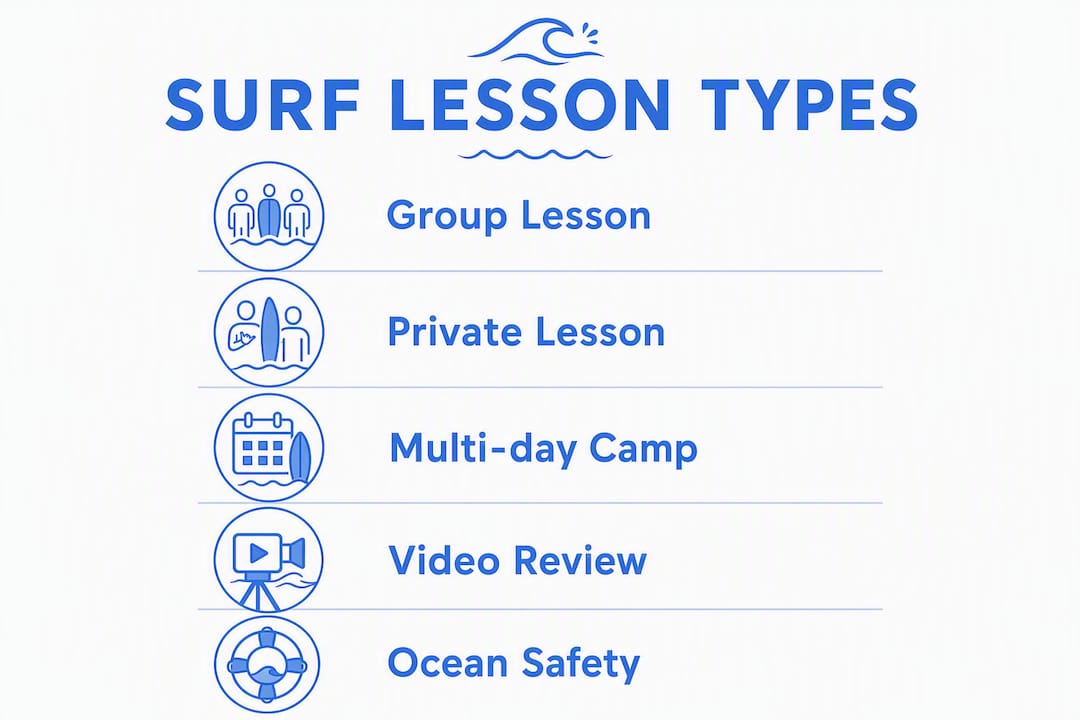
The format you choose matters more than most beginners realize. A single two-hour group lesson teaches you the basics. A 5-day camp actually gets you surfing.
Group lessons
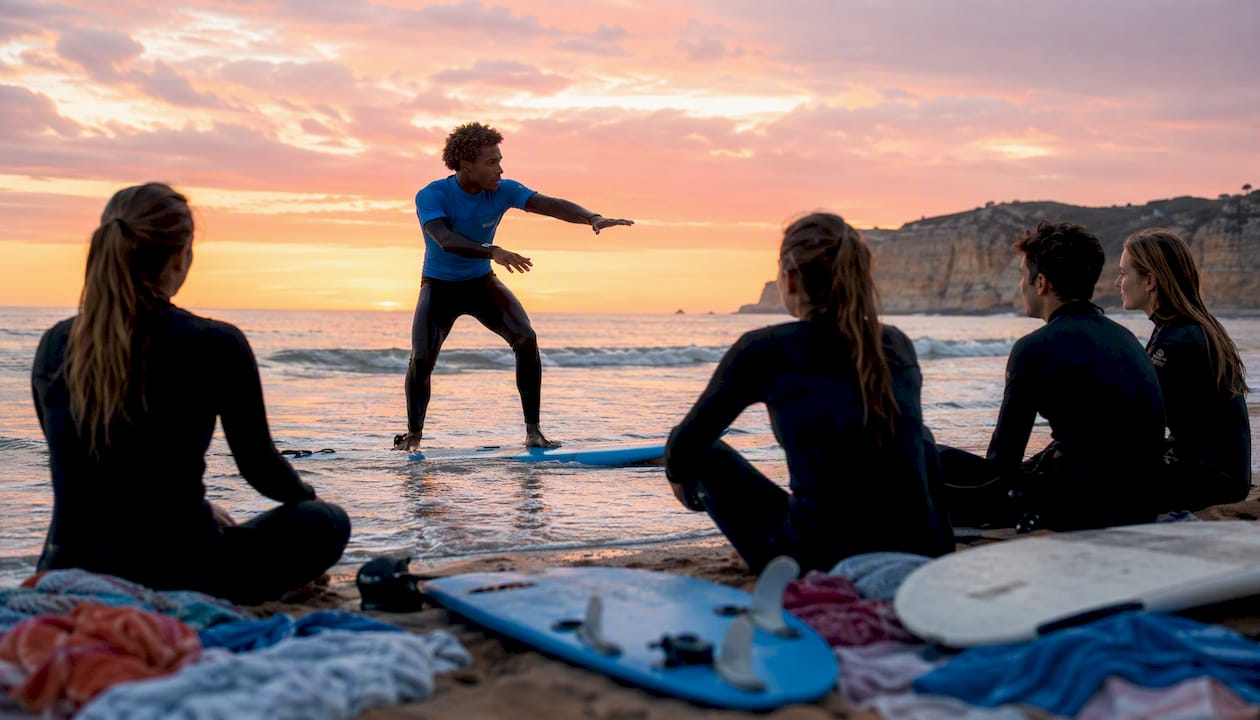
A standard group lesson runs two to three hours and covers ocean safety, paddling, pop-up technique on the sand, and then supervised time in the water catching whitewater. Groups typically cap at 6–8 students per instructor. This format suits travelers with limited time or anyone who wants to test the water (literally) before committing to a longer program. Riparsurfschool’s group surf lessons follow this structure and are the most popular entry point for first-timers.
Private lessons
One-on-one coaching compresses the learning curve significantly. An instructor can correct your pop-up mechanics in real time, adjust your positioning on the board, and push you toward green waves faster than a group setting allows. Private lessons cost more, but for learners with specific goals or physical limitations, the investment pays off quickly. Riparsurfschool also offers all-levels private lessons for students who want to progress beyond the beginner stage.
Multi-day surf camps
This is where real progression happens. A typical 5-day beginner camp follows a daily rhythm:
Morning theory and land session (30–45 min): safety briefing, paddling mechanics, pop-up practice on the sand
Water session (2–2.5 hrs): supervised surfing with instructor feedback in the water
Video review (30 min): footage of your session reviewed with the instructor; this is where most technique corrections happen
Afternoon free surf or optional activity (yoga, cultural tour, rest)
Evening recap: next day’s conditions, goals, and any gear adjustments
By day 5, most beginners who started with zero experience can catch whitewater consistently and are attempting their first green waves. The surf lesson planning guide from Riparsurfschool walks through this progression in detail.
Skill progression for beginners
The sequence schools follow is predictable and proven:
Ocean awareness and water safety
Paddling technique and duck-diving basics
Catching whitewater on a foam board
Pop-up mechanics and riding stance
Trim and direction control on foam waves
First attempts at unbroken green waves
What schools provide vs. what you bring
Schools typically provide: foam longboard or mini-mal, leash, wetsuit, and rash guard.
You should bring: reef-safe sunscreen, a quick-dry towel, flip-flops, a water bottle, and your passport or ID for registration. Some camps include photos; ask before you book.
Deciding between a camp and a standalone school? Riparsurfschool’s comparison of surf camps vs surf schools lays out the tradeoffs clearly if you’re still weighing options.
How much do surf lessons and camps cost in Portugal?
Prices vary by location, group size, and what’s bundled in. The table below reflects typical market ranges on Portugal’s central coast.
Product | Low end | Typical | High end | Usually included |
Single group lesson (2–3 hrs) | — | — | — | Board, wetsuit, instructor |
Private lessons (one-on-one coaching) | €60 | — | — | Board, wetsuit, 1:1 coaching |
5-day beginner camp (no accommodation) | — | — | — | Daily lessons, equipment, video review |
5-day camp with accommodation | — | — | — | Lessons, equipment, lodging, some meals |
Week-long surf camp (full package) | — | — | — | Lessons, accommodation, transfers, meals |
All prices in euros, the currency in which Portuguese surf services are commercially denominated.
What’s typically not included at the base price: airport transfers, travel insurance, personal wetsuit rental if the school’s stock runs out, and professional photo packages. Always ask.
Booking a 5-day camp rather than five individual lessons almost always saves money and produces better results. The daily repetition and video review sessions in a camp accelerate progress in ways that isolated lessons simply can’t replicate.
Value tips:
Book before May for June–September camps; early bookings often carry better rates or priority accommodation.
Ask whether photo packages are included or priced separately. Some schools charge €20–30 per session for photos that are worth having.
Off-peak (May and October) offers the same instruction quality at meaningfully lower prices and with smaller groups.
Riparsurfschool’s pricing and plans page shows current package structures and what each tier includes.
How do you pick the right surf school or camp?
The difference between a great surf experience and a frustrating one usually comes down to five things: group size, instructor credentials, what’s actually included, the cancellation policy, and verified reviews from real students.
The checklist
Group size: No more than 6–8 students per instructor for beginners. Larger groups mean less feedback and more waiting.
Instructor qualifications: Look for ISA (International Surfing Association) certification or national federation equivalents. Ask directly; a reputable school will tell you immediately.
Lifeguard presence: Is there a certified lifeguard on the beach during lessons? This is non-negotiable for beginner sessions.
Curriculum: Does the school follow a structured progression, or is it just “paddle out and try”? Ask for a sample daily schedule.
Equipment: Foam boards (longboards or mini-mals) for beginners. A school that puts first-timers on shortboards is cutting corners.
Included services: What’s in the price? Transfers, photos, equipment, wetsuit?
Cancellation policy: Can you reschedule if conditions are dangerous? A good school will never run lessons in unsafe surf.
Reviews: Check Google and independent platforms for recent, specific feedback. Generic five-star reviews with no detail are a yellow flag.
Questions to ask before booking
Copy these into an email or WhatsApp message to any school you’re considering:
“What is your maximum student-to-instructor ratio for beginner lessons?”
“Are your instructors ISA-certified or hold equivalent national credentials?”
“Is there a lifeguard present during all water sessions?”
“What happens if conditions are too rough for beginners on a lesson day?”
“What’s your cancellation and refund policy?”
Red flags
A school with no certifications listed anywhere on its site, groups of 15+ students with one instructor, no mention of a safety briefing, or a refund policy that says “no refunds under any circumstances” should all give you pause. Legitimate schools are transparent about all of these.
Pro Tip: Search the school’s name on Google Maps and read the most recent reviews first, not the average score. Specific mentions of instructor names, small group sizes, and what students learned are the most reliable signals of consistent quality. Vague praise tells you almost nothing.
For a deeper look at what separates good instructors from great ones, Riparsurfschool’s guide on surf instructor essentials covers exactly what to expect from qualified coaching.
Why Riparsurfschool is a strong choice for U.S. beginners
Riparsurfschool has been operating at Praia Areia Branca since 2001, which puts it among the most established surf schools on Portugal’s central coast. The location sits between Peniche and Ericeira, two of the country’s most celebrated surf zones, giving students access to a range of conditions without needing to travel far.
The school’s core offering covers group lessons, private lessons, multi-day surf camps, equipment rental, and accommodation partnerships. The surf house accommodations and the Neptune Surf House option give camp students the choice between a social surf-house atmosphere and a more private setup, both within easy reach of the beach.
For U.S. travelers specifically, a few things stand out:
English-speaking instructors who understand the questions first-timers actually ask
Small-group coaching that keeps the student-to-instructor ratio tight enough for real feedback
Package convenience that bundles lessons, equipment, accommodation, and transfers so you’re not piecing together logistics from scratch
A structured beginner curriculum that follows the proven progression from ocean safety through to green-wave attempts
The school’s photo gallery gives a realistic look at the conditions, group sizes, and typical lesson setup, which is worth checking before you book.
Practical travel tips for U.S. travelers heading to Portugal
Getting to Praia Areia Branca from the U.S. is straightforward. Fly into Lisbon (LIS), which has direct routes from New York (JFK), Boston (BOS), Miami (MIA), and several other major U.S. cities. From Lisbon, Praia Areia Branca is roughly 60–75 minutes by car or private transfer.
Transfer options from Lisbon:
Private transfer: The most convenient option, especially with surf gear. Riparsurfschool can advise on transfer arrangements when you book.
Rental car: Gives you flexibility to explore the coast. Parking at Praia Areia Branca is easy.
Bus: Rede Expressos runs coaches from Lisbon to Peniche, with local connections to Areia Branca. Budget about 2 hours total.
Packing list for a surf trip
Reef-safe sunscreen (mandatory at most Portuguese beaches)
Quick-dry travel towel
Flip-flops for the beach deck
A rash guard (even if the school provides wetsuits, a rash guard underneath adds comfort)
Travel adapter (Portugal uses Type F plugs, standard EU)
Travel insurance that covers water sports activities
Booking logistics
U.S. citizens do not need a visa for Portugal for stays under 90 days. Your passport must be valid for at least 3 months beyond your departure date. Portugal is in the Schengen Area, so entry is straightforward.
For peak-season camps (June–September), book at least 6–8 weeks in advance. Popular beginner camp slots fill up, particularly in July and August. Payment terms and cancellation policies vary by school; always confirm in writing before paying a deposit.
Pro Tip: Book your surf camp before you book your flights. Camp availability determines your travel dates, not the other way around. Trying to find a spot after you’ve already bought a non-refundable ticket is a stressful way to start a surf holiday.
The surf lesson planning guide covers pre-arrival preparation in detail, including what to expect on your first day.
Common beginner mistakes and how schools help prevent them
Most first-time surfers make the same handful of mistakes, and a good school catches all of them before they become habits.
Paddling with bent arms is the most common. Beginners tend to cup their hands and pull water with bent elbows, which generates almost no forward momentum. Instructors correct this on the beach before anyone gets in the water, demonstrating the straight-arm, high-elbow stroke that actually moves a board.
Looking down at the board during the pop-up is the second. The instinct is to watch your feet, but looking down shifts your weight forward and sends the nose of the board underwater. Schools drill the “chin up, eyes on the horizon” cue during land sessions until it becomes automatic.
Popping up too early or too late on a wave is harder to self-correct without feedback. Timing the pop-up to the moment the wave takes the board requires a feel that only comes from repetition and an instructor watching from the water. Video review sessions, which quality camps include, make this correction much faster than trial and error alone.
Standing too far back on the board stalls the board and makes steering impossible. Instructors mark the correct foot position during land drills and then watch for it in the water.
Ignoring rip currents and wave sets is a safety issue, not just a technique one. A structured beginner lesson always starts with ocean awareness: how to read a lineup, where rip currents form, and what to do if you get caught in one. This is the part of surf education that matters most and that self-taught beginners almost always skip.
Schools prevent these mistakes through a combination of land-based instruction, in-water supervision, and video review. The progression from foam board to green waves only works when technique is corrected early, before bad habits are reinforced by repetition.
Surf etiquette and local cultural tips in Portugal
Portuguese surf culture is welcoming to beginners, but there are unwritten rules that apply everywhere in the water.
Right of way: The surfer closest to the peak (the breaking part of the wave) has priority. Dropping in on someone who is already riding is the most serious breach of lineup etiquette. Your instructor will explain this before your first session, but knowing it in advance helps.
Don’t ditch your board. Throwing your board and diving under a wave sends a dangerous projectile toward anyone behind you. Learn to hold onto your board or push it to the side. Foam boards are forgiving, but the habit matters.
Wait your turn. Beginners in whitewater sections don’t compete with experienced surfers for the same waves, but within a beginner group, patience in the lineup is expected. Paddling around someone who is already paddling for a wave is bad form.
Respect the locals. Praia Areia Branca is a small village. The people who surf there year-round are not obstacles; they’re the community that keeps the beach alive. A friendly nod, a “bom dia” (good morning), and basic courtesy go a long way.
On land: Portugal runs on a relaxed schedule. Lunch is a serious affair, often running from 1:00 PM to 3:00 PM. Tipping is appreciated but not mandatory; rounding up the bill or leaving a euro or two is the norm. Most surf towns have a strong cafe culture, and the pastel de nata (custard tart) at the local bakery is not optional.
Water safety: Never surf alone as a beginner. Always let someone know where you’re going. Portuguese beaches with lifeguards fly a green flag (safe), yellow (caution), or red (no swimming). Respect the flags.
Key Takeaways
Portugal’s beach breaks around Praia Areia Branca and the Algarve give absolute beginners the most forgiving conditions in Europe, and Riparsurfschool’s small-group camps remain the most practical way for U.S. travelers to learn fast and well.
Point | Details |
Best locations for beginners | Praia Areia Branca, Ericeira, Peniche, and Algarve beaches like Arrifana and Meia Praia. |
Best months to go | June through September for the smallest, warmest, most consistent conditions. |
Typical cost range | Group lessons vary in price; 5-day camps with accommodation are available at a range of rates. |
How to choose a school | Verify ISA instructor credentials, confirm groups of 6–8 max, and check the cancellation policy before paying. |
Riparsurfschool | Operating since 2001 at Praia Areia Branca, offering small-group lessons, beginner camps, and accommodation packages for U.S. travelers. |
Why local, small surf schools produce better beginners
The conventional wisdom says any surf school will do as long as the beach is good. That’s wrong, and the reason matters for how you book.
Large surf operations with rotating instructors and groups of 12+ students optimize for throughput, not progression. You get in the water, you catch a few waves, you go home with a photo. That’s fine for a one-time experience. It’s not how you actually learn to surf.
What accelerates learning is repetition with correction. A small group where the instructor can watch every pop-up attempt, call out adjustments in real time, and review video footage afterward produces a different outcome than a crowded session where you’re mostly waiting your turn. The schools that have been operating in the same village for decades tend to understand this, because their reputation depends on students actually improving.
There’s also something to be said for the environment. A small beach village like Praia Areia Branca, where the school, the accommodation, and the beach are all within walking distance, removes the friction that kills momentum. You wake up, walk to the beach, surf, eat, rest, surf again. That rhythm is what a 5-day camp is actually selling, and it’s worth paying for.
My honest recommendation: if you have 5 days, book a camp. If you have 2 days, book a private lesson, not a group lesson. The group lesson is the right call only if you’re genuinely just testing the water and have no intention of continuing. For everyone else, the investment in more time and more coaching pays off in the water.
Ready to book your surf camp at Riparsurfschool?
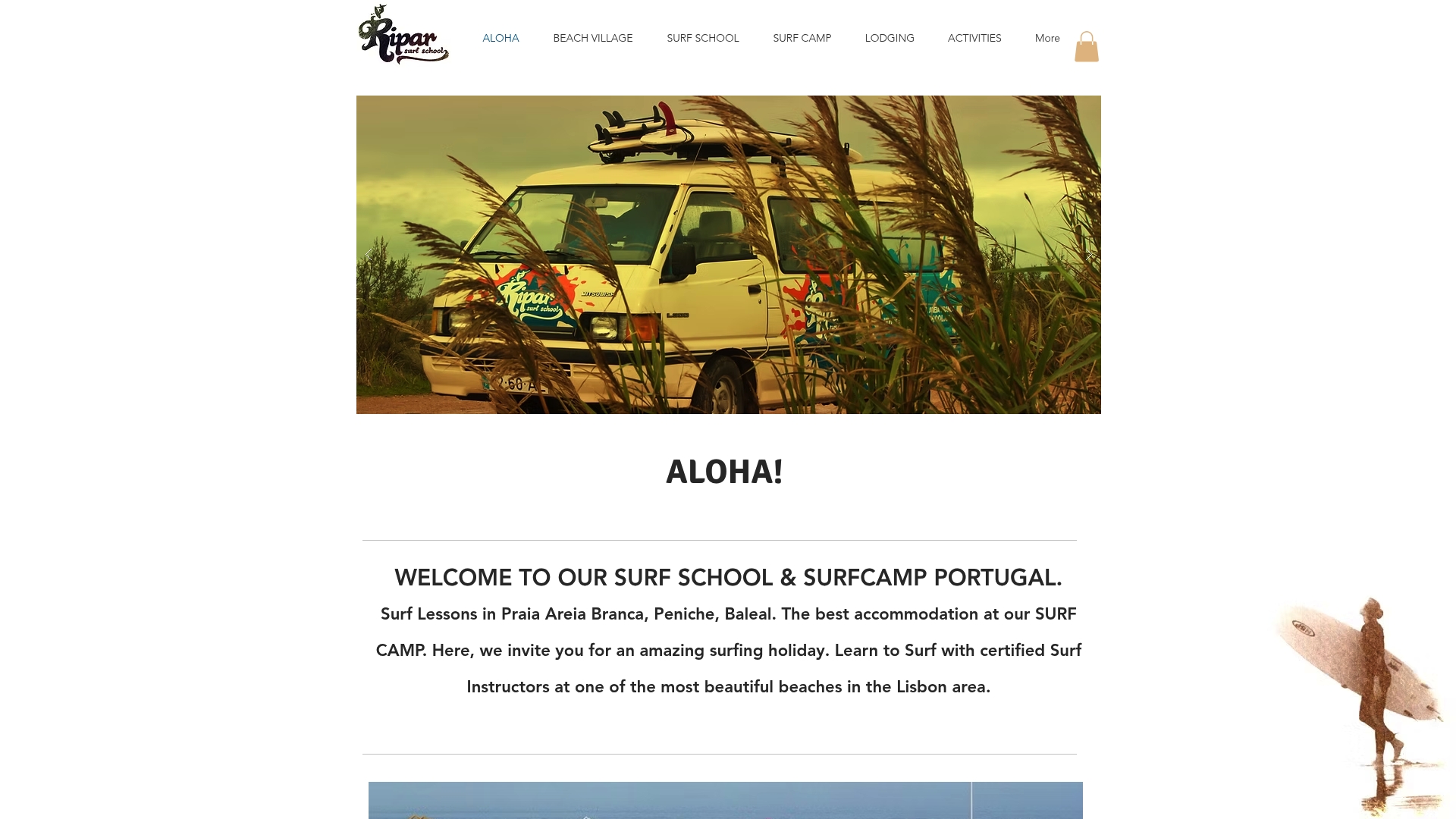
Riparsurfschool at Praia Areia Branca is the practical choice for U.S. travelers who want to learn to surf in Portugal without piecing together logistics from scratch. Since 2001, the school has run beginner camps that bundle certified instruction, equipment, small-group coaching, and accommodation into one package, so you arrive and focus entirely on surfing.
Choosing your format:
First time ever on a board? Book a 5-day beginner camp. It’s the format that actually gets you surfing, not just standing up once.
Limited to 1–2 days? A group surf lesson covers the fundamentals and gets you in the water the same day.
Want faster progress or specific coaching? A private lesson gives you one-on-one attention and a personalized correction session.
For peak-season camps (June–September), availability fills up weeks in advance. Book your camp online or schedule a lesson directly on Riparsurfschool’s booking page. Have your travel dates, flight arrival time, and preferred package ready when you go to reserve.
Where we looked — sources and further reading
The research behind this guide draws on the following resources:
Top 10 Beginner Surf Camps in Portugal — aggregated camp listings and reviews for beginners
Surf Schools in Portugal: r/surfing — community recommendations and real traveler experiences
Riparsurfschool homepage — school overview, services, and trust signals
Surf lesson planning guide for beginners in Portugal — pre-arrival checklist and sample lesson timeline
Surf camp vs surf school: Best for Portugal? — internal comparison of formats and expected outcomes
Surf instructor essentials for your Portugal surf holiday — what qualified instructors provide and how to verify credentials
Riparsurfschool pricing and plans — current package structures and inclusions
Recommended
Comments