

Peer Support in Surfing: Why It Matters for Your Camp
- Fernando Antunes
- 17 hours ago
- 8 min read
TL;DR:
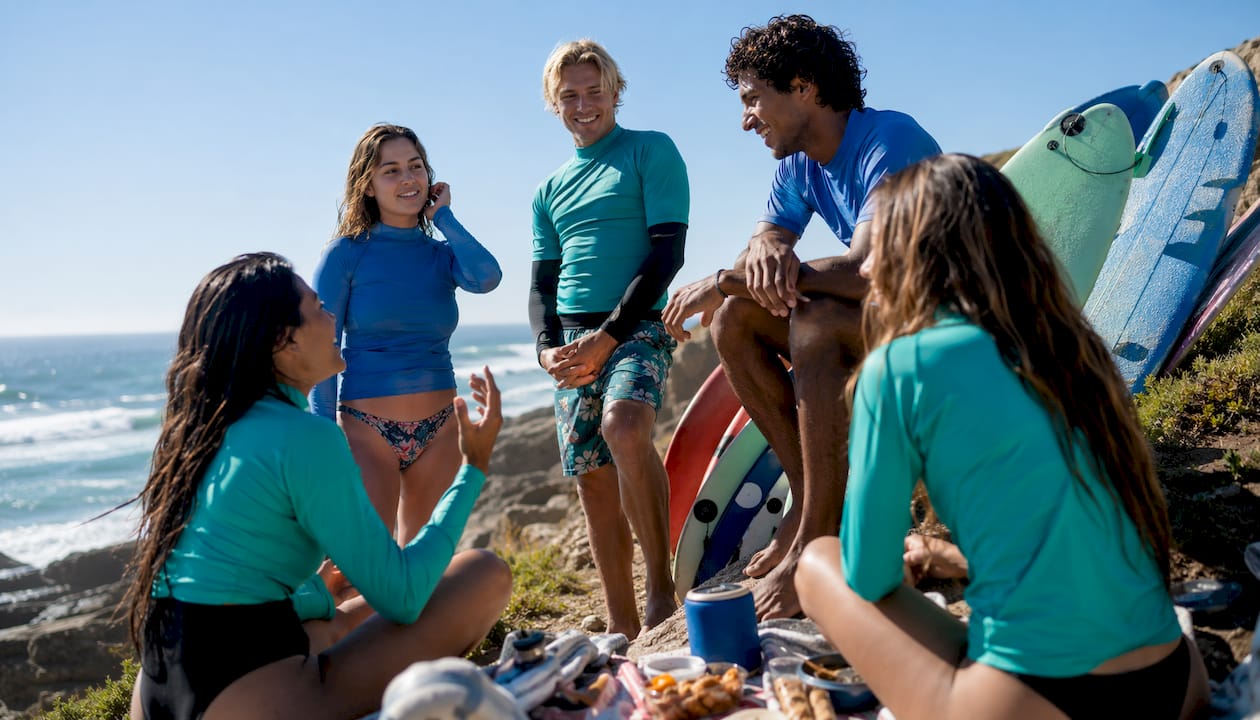
Peer support in surfing accelerates skill development and improves mental health through shared learning and social bonds. Structured programs with small groups and facilitator-led social activities provide reliable peer engagement and lasting confidence benefits. Choosing a surf camp that emphasizes level matching, buddy systems, and community fosters better skill growth and social connection.
Peer support is a core learning and wellbeing engine in surfing. It speeds skill acquisition, lowers anxiety, and builds the kind of social bonds that turn a week in Portugal into something you actually remember. Research across surf therapy programs like Waves of Wellness, Wave Project, and Waves for Change consistently shows that group surf settings reduce isolation, increase confidence, and help participants adopt coping strategies they carry long after the last session.
The short version:
Peer support in surf lessons and camps accelerates progress through vicarious learning, shared encouragement, and informal mentoring on lineup etiquette and safety.
The mental health benefits are real: surf therapy programs report reduced social isolation and sustained uptake of peer-shared coping strategies.
When booking, prioritize small-group, instructor-facilitated programs with level-matched cohorts and dedicated social time.
Table of Contents
How does peer support actually improve surfing and mental health?
The mechanisms are specific enough to be worth knowing before you book. Surf therapy research identifies at least four distinct pathways through which peer support delivers results.
Vicarious learning is the most immediate. Beginners who watch a peer stand up on a wave feel a measurable confidence boost, making them more likely to paddle out themselves. One qualitative study on surf therapy found that seeing similar others succeed motivated participants to return to the water after wipeouts, a direct demonstration of self-efficacy building through peer observation.
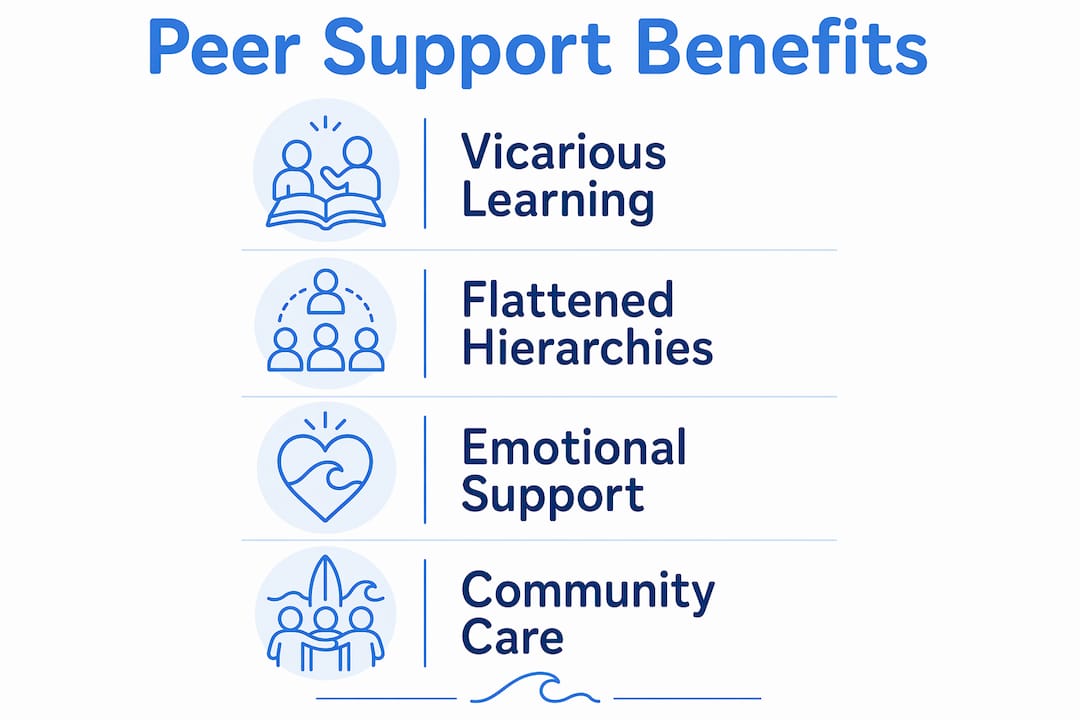
Flattening hierarchies is less obvious but equally powerful. Programs that shift focus from performance to group mastery remove the anxiety of being judged, which is exactly what a nervous tourist needs on day one. When nobody is ranked, everyone progresses faster.
Emotional and informational support work together. Encouragement after a wipeout is emotional support. A peer explaining how to read a wave or where to sit in the lineup is informational. Group surf settings increase perceived closeness in meaningful relationships while simultaneously reducing interest in non-supportive social groups.
Intentional community care is what separates a well-run camp from a random group of strangers on a beach. Programs that train instructors to facilitate peer check-ins cultivate social and emotional regulation skills that transfer beyond the session itself.
Mechanism | Effect | Representative Source |
Vicarious learning | Increased confidence and willingness to attempt new skills | Waves of Wellness / Swansea surf therapy study |
Flattening hierarchies | Reduced performance anxiety, faster group mastery | Frontiers in Psychology, Australian youth surf therapy |
Emotional support | Belonging, reduced isolation | Wave Project / Waves for Change |
Informational support | Faster skill transfer, lineup safety knowledge | Pendleton Surf Club program observations |
Intentional facilitation | Social-emotional regulation that outlasts the session | Waves for Change / W4C program data |
What peer support looks like on the beach and in the water
You will recognize it once you know what to look for. Some of it is structured by instructors; some emerges naturally when the group clicks.
Structured peer-support practices in well-run programs include:
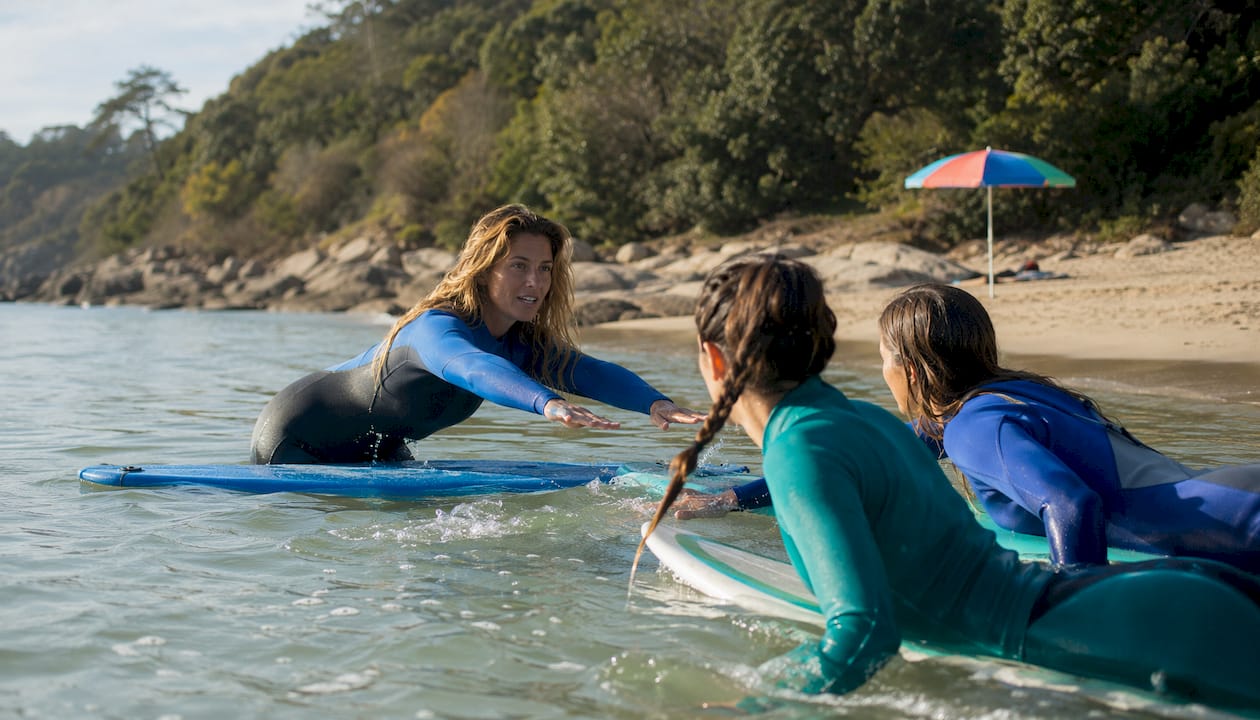
Buddy systems where pairs check in on each other before and after paddling out
Group warm-ups that mix ability levels and break down social barriers early
Post-session feedback circles where peers narrate what they saw each other do well
Shared video review, which turns individual attempts into group learning moments
Instructor-led safety check-ins that teach peer care as a habit, not an afterthought
Spontaneous peer support tends to show up as encouragement after wipeouts, informal tips on reading the break, and the quiet mentoring that happens when an intermediate surfer explains lineup priority to a beginner. Experienced peers informally teach unspoken local norms that no lesson plan fully covers.
The distinction between instructor-facilitated and spontaneously emergent peer support matters when you are choosing a program. Both are valuable, but only the former is reliable. A school that actively structures peer interaction will deliver it consistently; one that leaves it to chance will deliver it only when the group chemistry happens to work.
What you actually gain as a tourist or beginner surfer
The benefits translate directly into trip value, not just abstract wellbeing scores.
Faster progress. Watching peers land waves gives you a mental template before you try. Group-based surf programs generate mastery experiences and self-efficacy gains that carry into other areas of life, not just surfing.
Lower anxiety in unfamiliar surf. Portugal’s Atlantic breaks can feel intimidating on day one. A peer group normalizes the nervousness and gives you people to read the ocean with.
Safer sessions. Peer mentoring on lineup etiquette and wave priority reduces collisions and confusion. You learn the unwritten rules faster from a fellow beginner who just figured them out than from a formal briefing.
A ready-made social group. For solo travelers especially, the community atmosphere at surf camps is often the part of the trip they talk about longest. Peer-built friendships improve overall trip satisfaction and are a genuine driver of repeat bookings.
Confidence that outlasts the holiday. The self-efficacy built through peer encouragement and small-group surfing tends to stick. Beginners who transition from observation to participation in a supportive group are far more likely to surf again.
How to choose a surf school or camp that delivers real peer support
Not every group lesson is a peer-support environment. Here is what to look for and what to ask.
Evaluation criteria:
Group size small enough to ensure personalized attention, ideally fewer than ten students per instructor
Level-matched cohorts so nobody is left behind or bored
Explicit mention of buddy systems or safety check-ins on the provider’s website
Instructor facilitation style that is participatory, not just top-down demonstration
Dedicated social time built into the daily schedule (evening debriefs, shared meals, video review)
Evidence of a celebrative culture — public recognition of milestones, not just correction of errors
Questions to ask before booking:
“How do you form groups, and do you match by level?”
“Do you run buddy checks before students paddle out?”
“Is there a post-session debrief or video review?”
“What is your instructor-to-student ratio?”
“How do you handle a student who is struggling socially or with confidence?”
Red flags: very large groups with no sub-grouping, no mention of safety check-ins, a rigid single-skill-track approach, and instructors who only demonstrate rather than facilitate.
Trust signals to look for on provider pages: published instructor certifications, explicit group-size policies, guest testimonials that mention the social atmosphere (not just wave counts), and references to safety protocols.
Pro Tip: When booking, specifically request a level-matched cohort and ask whether the program includes an evening group debrief. These two structural features do more for peer bonding than any single in-water activity.
What a typical surf lesson or camp in Portugal looks like
Understanding the structure helps you see where peer support fits and how quickly the social benefits kick in.
Session type | Typical length | Common inclusions |
Single group lesson of typical length | Board and wetsuit, instructor briefing, shallow-water drills, group feedback | |
Multi-day lesson package of several days | Daily sessions, equipment, safety briefings, some social time | |
Surf camp (full package) spanning about a week | All lessons, accommodation, communal meals or spaces, evening activities, optional video review |
Most camps in Portugal run two sessions daily, with the social bonding happening in the gaps: shared meals, deck time, and optional evening activities. The peer-support benefits compound across days, which is why a five-day camp produces noticeably stronger group cohesion than five separate single-day lessons.
Pricing for group lessons and multi-day camps in Portugal varies by season, location, and inclusions. Verify exact current pricing directly with the provider at booking, as rates shift between shoulder season and peak summer.
How to get the most out of peer support during your trip
A few deliberate behaviors make a real difference, especially if you are traveling solo or tend toward introversion.
Before you arrive:
Request a level-matched group when booking.
Ask the school whether video review or evening debriefs are part of the program.
Pack a small action camera or ask whether the school provides video feedback.
On the beach:
Volunteer to be someone’s buddy on the first day. It removes the awkwardness of not knowing anyone.
Cheer specific attempts, not just successful waves. “Good paddle timing” lands better than generic applause.
Join the post-session circle even when you are tired. That is where the learning consolidates.
Respect local lineup etiquette from day one. Your peers will notice, and it builds trust faster than any icebreaker.
What not to do:
Skip the group warm-up to get extra water time. The social calibration that happens in warm-ups is worth more than an extra ten minutes of paddling.
Treat video review as optional. Group reflection converts momentary encouragement into durable skill gains.
Key Takeaways
Peer support in surf lessons and camps is a structured, research-backed mechanism that speeds learning, reduces anxiety, and builds social connections that outlast the trip itself.
Point | Details |
Peer support accelerates learning | Vicarious learning and group mastery experiences build self-efficacy faster than solo practice. |
Mental health benefits are documented | Surf therapy research links group surf settings to reduced isolation and sustained coping-strategy uptake. |
Program structure determines outcomes | Instructor-facilitated buddy systems and evening debriefs deliver peer support reliably; spontaneous group chemistry does not. |
Booking criteria matter | Ask about group size, level matching, buddy checks, and social time before committing to a program. |
Riparsurfschool as a peer-support camp | Riparsurfschool’s small-group format, certified local instructors, and communal spaces at Praia Areia Branca are designed to deliver these benefits. |
Why the social side of surfing is the part most schools underestimate
Most surf schools market wave counts and instructor credentials. Both matter. But the research is clear that the mechanism driving the deepest learning and the strongest wellbeing outcomes is what happens between students, not just between instructor and student.
The “flattening hierarchies” finding from Australian youth surf therapy research is the one I keep coming back to. When a program deliberately removes the performance-ranking dynamic, something shifts. Students stop watching each other to compare and start watching each other to learn. That transition, from competitive observation to collaborative learning, is where the real progress happens.
For tourists booking a week in Portugal, this has a practical implication: the best surf school is not necessarily the one with the most impressive instructor biography. It is the one that has thought carefully about how students interact with each other, not just how the instructor interacts with students. Ask about the group, not just the teacher.
Riparsurfschool: a surf camp built around the group experience
Riparsurfschool has been running surf lessons and camps at Praia Areia Branca, near Peniche and Ericeira, for many years. The school’s format is built around small groups, certified local instructors, and a communal beach setup that makes peer bonding a natural part of every day, not an afterthought.
When you book a surf camp with Riparsurfschool, you get level-matched cohorts, instructor-facilitated group check-ins, shared equipment, and access to communal spaces where the social side of the trip actually happens. The location itself, a small beach village away from mass tourism, keeps groups tight and the atmosphere relaxed. For travelers who want the peer-support benefits the research describes, this is the kind of setup that delivers them consistently.
Ready to book? Check available dates and reserve your spot directly on the Riparsurfschool site.
Recommended