

Stand Up in 1–3 Lessons: Learn to Surf at 30

Yes, you can learn to surf at 30, and thousands of adults do it every year. The fastest, safest route is instructor-led lessons, a beginner-friendly high-volume board, and a few weeks of progressive paddle fitness. Expect early soreness and a wobbly first session. Most adult beginners stand up on whitewater within their first one to three lessons if they show up prepared.
TL;DR:
Most adult beginners stand up on whitewater within their first three lessons if they arrive prepared and follow a progressive practice routine.
Building paddle fitness with swim intervals, core exercises, and mobility work reduces soreness and increases wave-catching ability, especially after age 30.
Choosing high-volume softboards, proper leash, and wetsuit suited to water temperature are crucial for early progress and safety during initial sessions.
Instructors with certification, small groups, safety briefings, land drills, and proper equipment checks significantly lower injury risks and enhance learning.
Consistent practice twice weekly over six weeks yields better progress than sporadic efforts, making scheduling and habit-building key to improvement.
Table of Contents
Aprender Surf Aos 30: Overcoming Fear and Limiting Beliefs
The biggest obstacle for adult beginners isn’t age. It’s the voice that says you’re too old, too stiff, or too far behind the twelve-year-olds ripping past you on the beach. That voice is wrong, and it’s worth naming specifically so you can argue back.
“I’ll look ridiculous” becomes “everyone falls constantly in week one, including the pros when they started.” “My body can’t handle this” becomes “surfing is low-impact and self-paced. You control how hard you paddle.” Adults actually carry real advantages into the water: better body awareness, more patience with a slow process, and the discipline to show up consistently rather than burning out after one heroic session. That patience is a documented edge, not a consolation prize; people who start later in life often stick with it longer because they’re not chasing instant mastery.
Small exposure builds confidence faster than pep talks do:
Watch a full lesson from the beach before you book one, so the whitewater and lineup stop feeling foreign.
Practice the pop-up motion on your living room floor for five minutes a day.
Try standing in ankle-deep water on a board before your first real session, just to feel the wobble.
Pro Tip: Film your first two sessions on your phone. Watching yourself paddle and pop up removes the mental exaggeration of “I looked terrible” and replaces it with what actually happened, which is usually better than you think.
Building Paddle Fitness and Preventing Injury After 30
Surfing works your shoulders, lats, and core through paddling, and your hip flexors and lower back through the pop-up. If you haven’t used those muscles in that pattern before, the soreness after session one is normal, not a sign something’s wrong.
The fix isn’t hitting the gym for hours. It’s a short, targeted routine:
Swim intervals — two sessions a week of 20 to 30 minutes, freestyle-focused, to build paddling endurance without joint strain.
Core circuits — planks, bird dogs, and rotational work three times a week to stabilize the pop-up and protect your lower back.
Mobility and yoga — 15 minutes daily for shoulder and hip flexibility, which directly reduces the neck and lower-back strain that catches adult beginners off guard.
Paddle fitness is usually the actual bottleneck for adult learners, not balance or courage. A focused regimen of swim intervals and shoulder mobility measurably reduces post-session soreness and increases how many waves you catch per outing. Pair that training with real recovery: sleep at least seven hours the night after a session, hydrate before you paddle out, and take a full rest day between sessions in your first month. If sharp pain (not muscle soreness) shows up in your shoulder or lower back, see a physiotherapist before your next lesson rather than pushing through it.
Group Lessons, Private Coaching, or a Surf Camp: Which Fits You?
Group lessons work well if you’re social, budget-conscious, and comfortable learning alongside other beginners. A group surf lesson typically costs less per person and adds a social element that keeps motivation high, though you get less individual correction.
Private lessons make sense if you have a specific physical limitation, a tight schedule, or you simply learn faster with one-on-one feedback. A private surf lesson means every wave gets you personalized coaching on your paddle timing and pop-up.
Surf camps suit anyone who wants the fastest possible progress through immersion. Multiple sessions over several days build consistency that a single weekly lesson can’t match.
Whichever format you choose, check for these quality signals before booking:
Certified instructors with visible credentials, not just “experienced locals.”
A safety briefing covering rip currents, board etiquette, and hand signals before anyone touches water.
Land drills for pop-up practice before entering the whitewater.
A small student-to-instructor ratio, ideally no more than four or five students per coach.
If a provider skips the safety briefing or crams fifteen beginners behind one instructor, walk away.
Choosing Your First Board, Leash, and Wetsuit
Board choice makes or breaks your early progress more than any other equipment decision. A higher-volume softboard in the 8 to 9 foot range gives you the stability to catch waves on your own paddle power instead of relying entirely on the instructor’s push. As a rough guide, riders under 160 pounds do well on an 8-foot board, while heavier or taller beginners often need 8’6" to 9 feet for enough float.
A few other basics matter more than people expect:
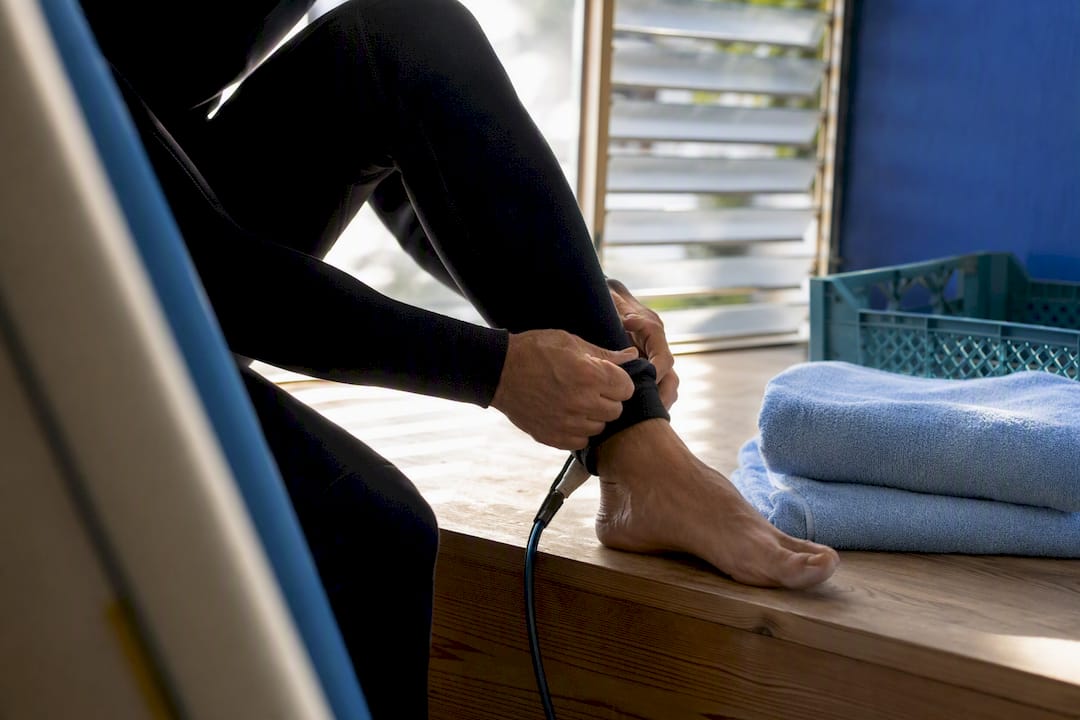
Use a leash matched to your board length, coiled leashes reduce drag but straight leashes are simpler for beginners.
In temperate water, a 3/2mm wetsuit covers most spring and fall conditions; go thicker for winter sessions.
Soft, rounded fins reduce injury risk if the board hits you or another surfer.
Renting through your school for the first several sessions beats buying immediately. Confirm the board size fits your weight and skill level, and ask whether the rental includes a leash and fin check before you paddle out.
What to Expect From Your First Surf Lesson
Pack light but pack right. Bring water, reef-safe sunscreen, a form of ID, a towel, and a light snack for after, low blood sugar makes for a miserable second session.
A well-run beginner lesson follows a predictable rhythm:
Land demo (15 to 20 minutes) — instructor walks you through paddling position, the pop-up motion, and basic safety signals.
Whitewater practice (30 to 40 minutes) — you catch broken waves closer to shore, where the water pushes you rather than a clean wave face.
Instructor feedback — between waves, your coach adjusts your foot placement, timing, and paddle angle.
Cooldown and debrief — a short recap of what worked and what to focus on next time.
Afterward, stretch your shoulders and lower back, rehydrate, and resist the urge to book a second session the same afternoon. Recovery time is part of the progression, not a delay of it.
How Fast Will You Actually Progress?
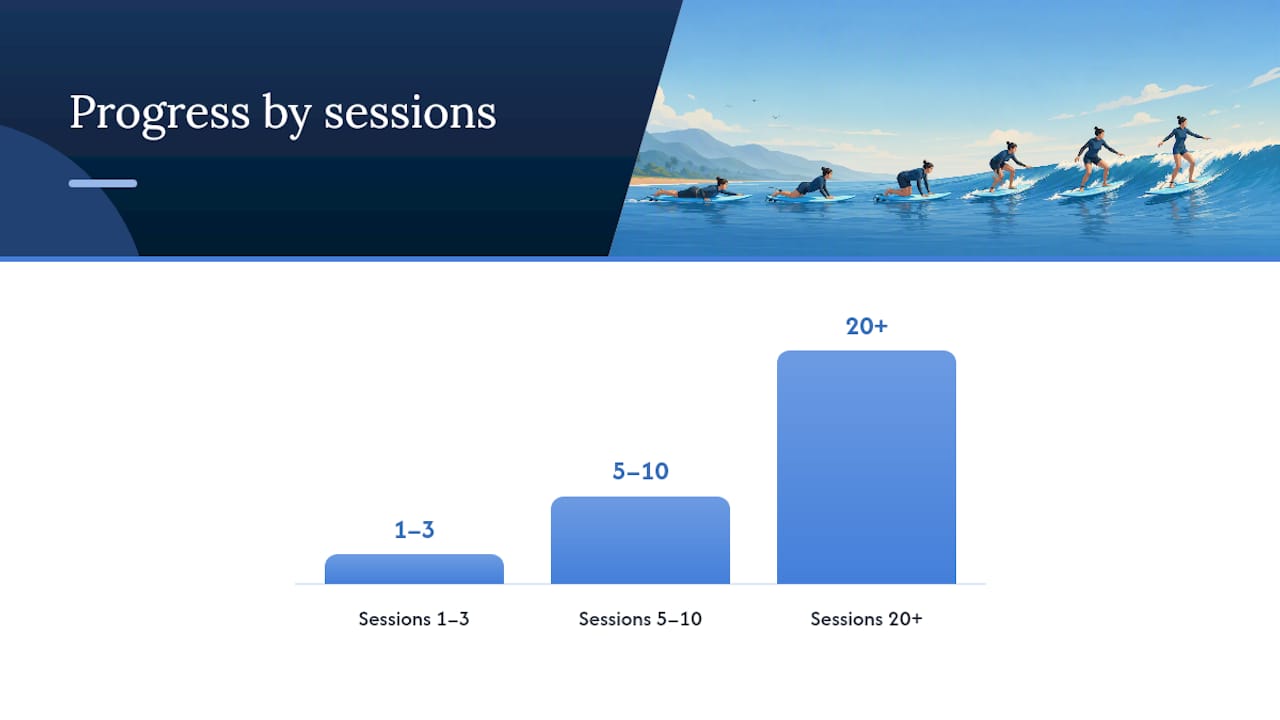
Progress in surfing doesn’t follow a straight line, but rough milestones help set realistic expectations. In your first one to three sessions, you’re mostly learning to stand up reliably on whitewater. By session five to ten, most adult beginners start reading small green waves and linking a few seconds of riding. Past twenty sessions, you’re usually turning, generating your own speed, and picking your own waves rather than waiting for a push.
Short, frequent sessions beat occasional marathon ones. Two 90-minute sessions a week build muscle memory faster than one exhausting four-hour outing every other weekend.
Skip the calendar and track real skills instead:
Can you pop up in the same spot on the board every time?
Are you paddling into waves without the instructor’s push?
Do you have video from session one to compare against session ten?
Progress measured by specific skills beats progress measured by weeks, because some weeks the swell is flat and there’s nothing to compare.
Ocean Safety and Surf Etiquette Every Beginner Needs
Rip currents cause more beginner panic than anything else in the water. If you’re caught in one, don’t fight it directly, swim parallel to shore until you’re clear, then angle back in. Fighting a current head on is how strong swimmers exhaust themselves.

Beginner-friendly conditions mean small, slow-breaking waves, a sandy bottom, and a beach with lifeguards or an instructor watching the lineup. Avoid crowded peaks where experienced surfers are competing for the same wave, you’ll get in their way and yours.
Basic etiquette keeps everyone safer:
Never drop in on someone already riding a wave.
Hold onto your board in whitewater rather than letting it fly toward other surfers.
Apologize and reset calmly if you make a mistake, everyone did as a beginner.
Pro Tip: Check the tide chart before you go. A dropping tide over a sandbar often creates cleaner, more predictable waves for first-timers than a pushing high tide.
Why Learn With Certified Instructors and Where to Start
Instructor-led lessons remove the guesswork that causes most beginner injuries and frustration. Riparsurfschool has operated in Praia Areia Branca since 2001, with certified local instructors who run every beginner lesson through the same structure: land drills, a safety briefing, and small groups before anyone paddles into whitewater.
That format matters because it matches exactly what adult learners need most, correction, not just encouragement.
Small-beach-village setting away from crowded tourist breaks.
Certified instructors trained in both coaching and ocean safety.
Progression paths from single lessons to multi-day surf camps for faster results.
If you want the immersive route, a surf camp stacks several days of guided practice back to back, which tends to compress months of casual progress into one trip.
Fitting Surf Sessions Around Work and Family
The math of adult life doesn’t leave much room for spontaneous ocean trips, so plan around it instead of hoping motivation shows up. Treat your surf sessions like any other recurring commitment. Block two fixed slots a week on your calendar the same way you’d block a client call or a kid’s soccer practice. A Tuesday evening and a Saturday morning session, repeated for six weeks, will teach you more than ten random sessions squeezed in whenever life allows.
Morning sessions before work often beat evening ones. Ocean conditions tend to be calmer at dawn, and you’re not mentally drained from a full workday before you even paddle out. If mornings aren’t realistic, look for a school offering flexible weekday slots rather than only weekend blocks, since weekend lineups get crowded fast with other adults doing exactly what you’re doing.
Bring your family into it when you can. A surf camp weekend doubles as a trip rather than competing with family time, and some schools offer lessons for partners or older kids alongside your own. That turns “I need to disappear to go surfing” into “we’re doing this together,” which removes a lot of the guilt that derails adult hobbies.
Don’t chase a rigid outcome timeline. Missing a week because of a work deadline or a sick kid doesn’t erase your progress. The muscle memory and ocean comfort you’ve built stick around longer than you’d expect, so pick back up where you left off rather than starting over mentally.
An Instructor’s Honest View on Adult Beginners
The adult students who progress fastest aren’t the fittest ones. They’re the ones who show up twice a week for six weeks straight instead of once a month for six months. Consistency beats athleticism every time in this sport.
One habit worth stealing: keep a simple log after each session, three lines on what worked and what didn’t. It turns vague frustration into specific fixes.
If you’ve been putting this off, the water isn’t going anywhere. Book the lesson.
— Fernando
Ready to Book Your First Lesson?
Riparsurfschool skips the guesswork that trips up most adult beginners elsewhere, no oversized tourist crowds, no instructors juggling twenty students at once. Every beginner lesson runs in small groups on a quiet stretch of Praia Areia Branca, with certified local instructors who’ve been teaching there since 2001.

That setting matters for exactly the reader who just read this far: someone starting later, wanting real correction instead of a rushed push into whitewater, and looking for a program built around a beginner-friendly structure rather than bravado. If a full immersion week fits your schedule better than scattered single lessons, the surf camp option stacks several days of guided practice into one trip, which tends to compress a season’s worth of casual progress into a week. For a slower, more independent pace, adults recovering from an old injury or coaching a hesitant partner often start with a private lesson instead.
Check available dates and book your first lesson online to get started.
Sources
Recommended
Comments