

What Is Foil Surfing? A Beginner's Complete Guide

TL;DR:
Foil surfing involves riding a hydrofoil-equipped surfboard that lifts above the water, offering a flying-like experience. Beginners should understand gear choices, proper techniques, and safety rules to progress safely and efficiently. Patience and structured practice on flat water are essential for mastering this sport.
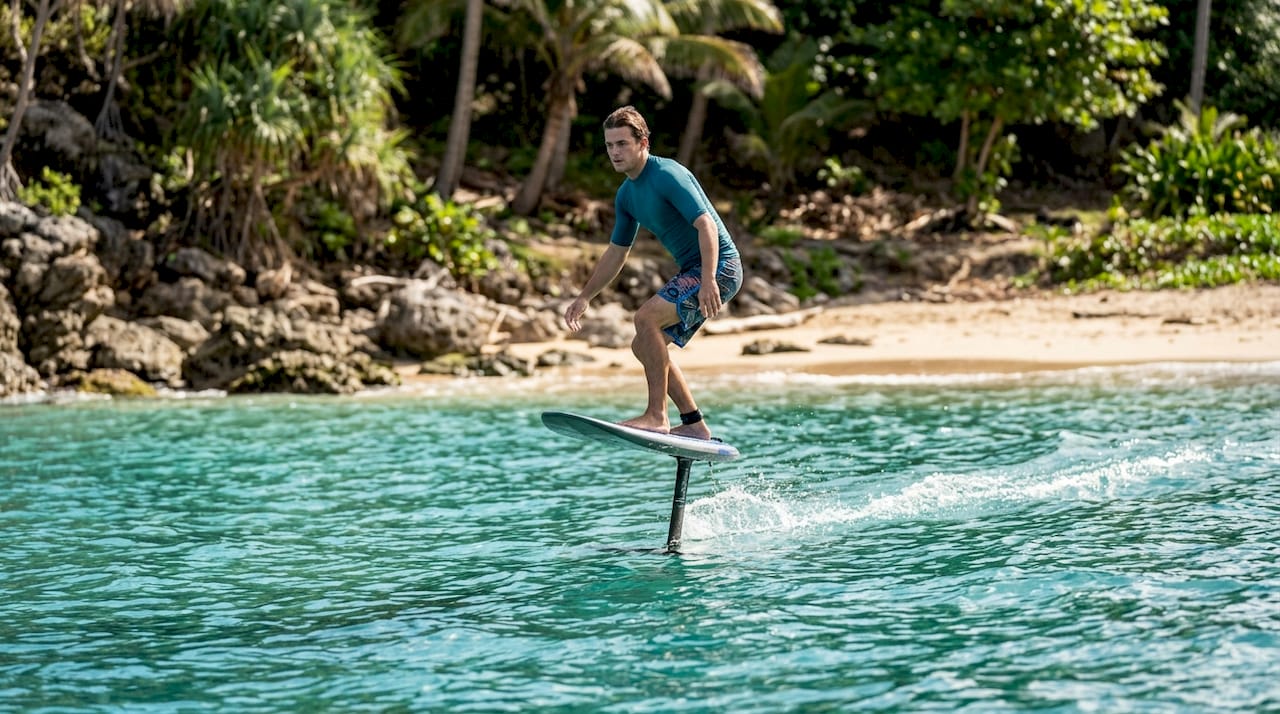
Foil surfing is defined as riding a surfboard fitted with an underwater hydrofoil wing that generates lift and raises the board above the water surface. The result is a ride that feels closer to flying than traditional surfing. The board lifts at roughly 6 mph, eliminating most water drag and allowing riders to glide over small, weak waves that a regular surfboard would ignore. For beginners curious about this sport, understanding the mechanics, gear, and techniques before you paddle out makes the learning curve far less steep. Riparsurfschool has seen firsthand how the right preparation transforms a frustrating first session into a genuine breakthrough.
What is foil surfing and how does it differ from regular surfing?
Foil surfing and traditional surfing share the same ocean, but almost nothing else. A standard surfboard stays on the water surface and depends on wave power to push it forward. A foilboard uses a hydrofoil assembly mounted below the deck to generate lift, pulling the board entirely out of the water once speed builds.
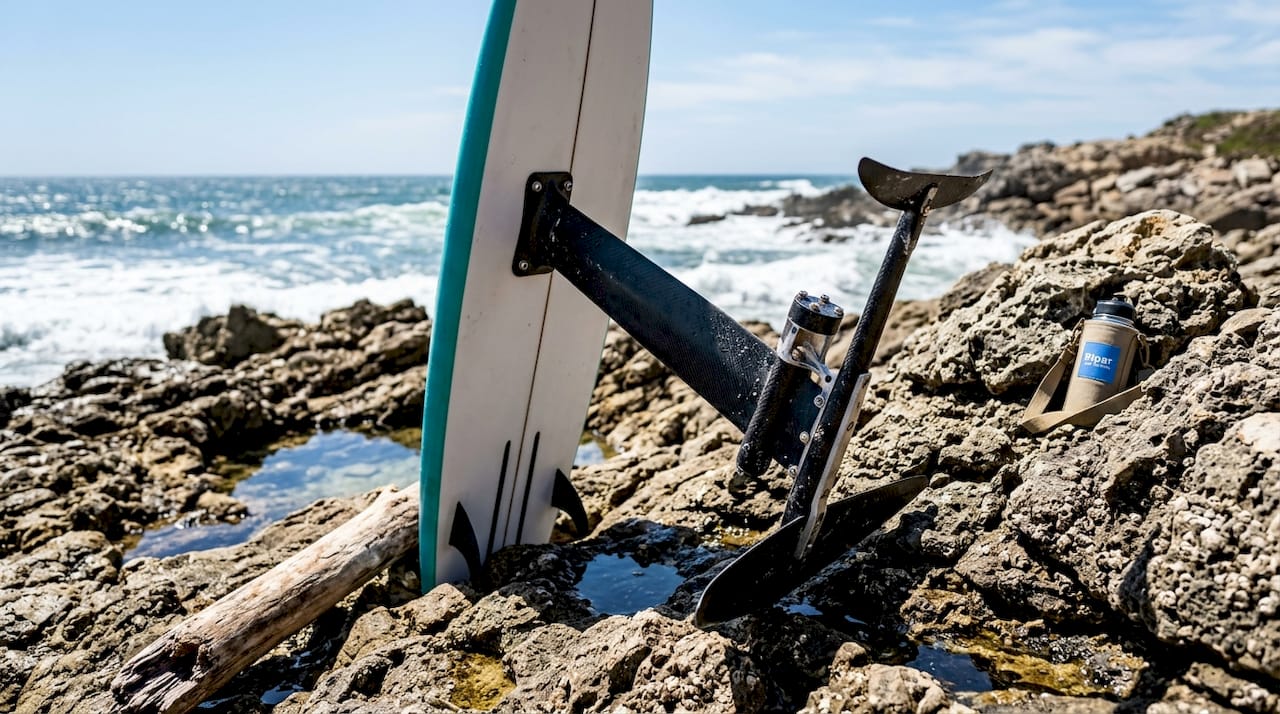
The physical difference is dramatic. On a regular surfboard, the hull drags through water with every movement. On a foilboard, only the narrow mast and wing stay submerged, cutting resistance to a fraction. That reduced drag means you can ride waves that break slowly or with little power, opening up spots that traditional surfers ignore.
The sensation is unlike anything else in wave riding. Riders describe it as a smooth, gliding flight with a slight bounce as the foil responds to shifts in weight. Foil boards respond immediately to weight shifts, demanding new balance and rhythm skills that regular surfing never develops. That responsiveness is what makes foil surfing exciting and, at first, humbling.
How does foil surfing work physically?
The hydrofoil wing works on the same principle as an airplane wing. Water moving over the curved top surface travels faster than water moving under the flat bottom surface. That speed difference creates a pressure differential, and the lower pressure above the wing pulls it upward. Newton’s third law reinforces this: the wing pushes water downward, and the water pushes the wing up.
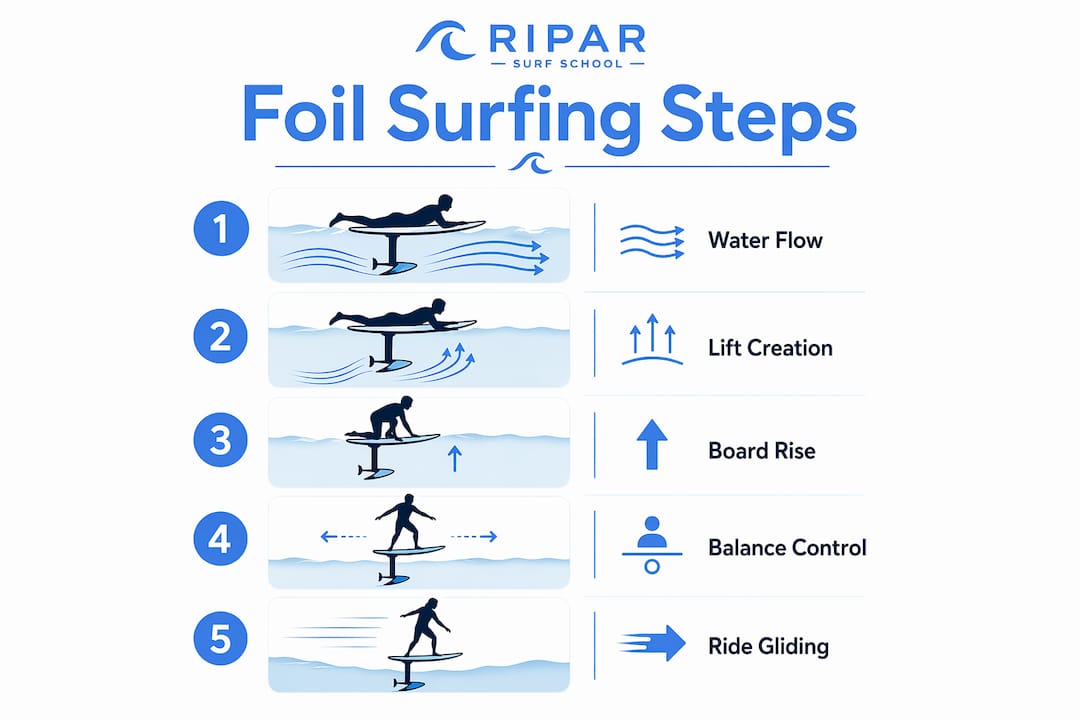
The board rises above the water at approximately 6 mph, which is the threshold where lift overcomes the board’s weight. Below that speed, the foil stays submerged and the board behaves like a heavy, sluggish surfboard. Above it, everything changes.
Controlling height and direction requires constant micro-adjustments. Foil surfing demands balance across three axes: pitch, roll, and yaw. That three-dimensional movement is what separates foil surfing from every other board sport. Shifting your front foot down lowers the nose and drops the board toward the water. Shifting weight back raises the nose and climbs higher. The margin between a smooth ride and a sudden splash is surprisingly small.
Pro Tip: Think of your ankles as the steering wheel. Large body movements overcorrect and cause crashes. Small, deliberate ankle pressure changes keep the foil stable.
What gear do you need for foil surfing?
Foil surf equipment has five core components: the board, the mast, the fuselage, the front wing, and the stabilizer wing. Each part affects how the setup performs, and beginners benefit from understanding what each one does before spending money.
Choosing the right board and mast
The board for foil surfing is thicker and more buoyant than a standard shortboard. Extra volume helps you paddle and pop up before the foil generates lift. Mast length controls how high the board flies above the water. Beginners should start with a medium mast length of 60–85 cm to keep the board close to the surface and reduce the consequences of a fall. Shorter masts limit height and feel more forgiving. Longer masts allow more clearance but amplify every balance error.
Front wing size and its effect on lift
Wing size directly controls how much lift the foil generates. Larger front wings provide more lift at lower speeds, making it easier for beginners to get the board flying without needing a powerful wave. A front wing around 1,500 cm² is a common starting point for new riders. As skills improve, riders move to smaller, faster wings that require more precise technique.
Safety gear you should not skip
Helmet: Protects against impact with the board, mast, or water surface during falls.
Impact vest: Absorbs shock from high-speed water contact, which feels like hitting concrete at speed.
Leash: Keeps the board close after a fall, though you must know how to fall safely first.
Booties: Protect feet from the sharp edges of the foil components in shallow water.
Foil rig components are sharp and rigid, making protective gear non-negotiable for anyone learning the sport. Skipping a helmet because the water looks calm is the kind of decision beginners regret quickly.
Pro Tip: Rent gear before buying. A full foil setup is a significant investment. Renting from a surf school lets you test different mast lengths and wing sizes before committing. Check out surfboard rental options to understand what to look for.
What are the fundamental foil surfing techniques for beginners?
Learning to foil surf follows a clear progression. Skipping steps leads to repeated crashes and slow improvement. The following sequence reflects how experienced instructors at Riparsurfschool structure beginner sessions.
Start on flat water. Before chasing waves, practice on a calm lake or flat bay. Flat water and tow foiling isolate balance and trim control without the added complexity of wave timing. This is where you learn what the foil feels like underfoot.
Nail your stance. Proper stance places roughly 60% of your weight on the front foot and 40% on the back foot. That front-weighted position prevents the nose from climbing too steeply and throwing you backward. Most beginners instinctively lean back, which causes the board to shoot skyward and stall.
Use micro-adjustments, not big movements. Foil surfing punishes overcorrection. Small ankle and knee adjustments control pitch and roll far more effectively than shifting your whole body. Practice standing still on the board on land to feel where your weight naturally falls.
Learn the pumping technique. Pumping is the rhythmic weight shift that keeps the foil flying between waves or on flat sections. Pumping requires coordination, a forward gaze, and rhythmic unweighting and pressure shifts. It is not about raw leg strength. Think of it as a smooth, cyclic bounce rather than a hard stomp.
Catch smaller waves first. Foil surfing shines on waves that regular surfers ignore. Start with slow, rolling swells where you have time to find your balance before the foil lifts. Steep, fast waves give you no time to react and lead to hard falls.
Expect nose bogging. New foilers frequently bog the nose, meaning the front of the board dips and drags in the water. This happens when weight shifts too far forward or speed drops below the lift threshold. Recognizing the feeling early helps you correct it before the board stalls completely.
Pro Tip: Keep your eyes on the horizon, not the board. Looking down shifts your weight forward and drops the nose. A forward gaze naturally centers your balance and keeps the foil flying longer.
For a broader view of building water skills progressively, the surf progression guide at Riparsurfschool covers transferable principles that apply directly to foil work.
What are the safety rules every foil surfer must follow?
Foil surfing carries real risks that traditional surfing does not. The foil assembly sits on a rigid mast and can cause serious cuts or impact injuries during falls. Treating safety as optional is the fastest way to end a session early.
Never ride in crowded lineups. The foil extends well below the surface and can injure other surfers who cannot see it. Beginners belong in open water with clear space around them.
Do not release the board during a fall. Releasing the board during a fall risks injury from the rigid, sharp foil bouncing back. Hold the board and try to fall away from the foil assembly.
Avoid shallow water. The mast and wing need depth to operate safely. Riding in water shallower than the mast length risks hitting the bottom at speed.
Wear your protective gear every session. Helmets and impact vests are not just for beginners. Experienced foilers wear them too, because the consequences of a high-speed fall are the same regardless of skill level.
Foil surfing safety starts before you enter the water. Check your gear, know the depth, and give other water users a wide berth. The foil is not forgiving of careless decisions, but a disciplined approach makes it one of the most rewarding sports you can learn.
Controlled environments and protective gear drastically reduce hazards for learners. Choosing the right location matters as much as choosing the right equipment. For families considering water sports together, the family surfing safety guide at Riparsurfschool covers how to approach ocean activities with confidence. Planning a relaxed day on the water also helps. A stress-free day on the water starts with preparation, not improvisation.
Key Takeaways
Foil surfing requires the right gear, a disciplined stance, and a safety-first mindset to progress from crashing to flying with confidence.
Point | Details |
Lift threshold | The board rises above water at roughly 6 mph, driven by hydrofoil lift. |
Beginner gear | Start with a 60–85 cm mast and a large front wing for stability at low speeds. |
Stance fundamentals | Keep 60% weight on the front foot to prevent the nose from climbing too steeply. |
Safety is non-negotiable | Wear a helmet and impact vest every session; never ride in crowded lineups. |
Practice environment | Flat water or tow foiling builds balance faster than jumping straight into waves. |
Why patience is the real skill in foil surfing
I have watched hundreds of beginners step onto a foilboard expecting it to feel like surfing with a twist. It does not. The foil is its own discipline, and the riders who progress fastest are the ones who accept that early on.
The most common mistake I see is rushing toward wave riding before mastering flat water balance. Foil surfing is a multi-phase process where “flight training” on calm water builds the muscle memory that waves will later demand. Skipping that phase is like learning to drive on a highway before you have touched a parking lot.
The sensation when it clicks is genuinely unlike anything else in surfing. The board rises, the drag disappears, and you are suddenly gliding in near silence. That moment is worth every frustrating session before it. The riders who get there quickest are not the most athletic. They are the most patient and the most willing to take structured lessons from someone who has already made every mistake.
If you are coming from traditional surfing, reset your expectations completely. Your pop-up, your wave reading, and your paddle fitness will help. Your surfing stance and instinct to lean back will work against you. Treat foil surfing as a new sport that borrows some vocabulary from surfing, and you will progress far faster.
— Fernando
Learn to foil surf with Riparsurfschool in Portugal
Riparsurfschool has been teaching water sports at Praia Areia Branca, near Peniche, since 2001. The team of certified local instructors builds beginner programs around safety, progressive skill development, and small group sizes that give every student real attention.

Whether you want a private surf lesson with one-on-one coaching or prefer learning alongside others, Riparsurfschool structures each session around your current level. The location on Portugal’s Atlantic coast offers consistent, manageable conditions that suit beginners learning to find their foil balance. Book your lesson online and arrive knowing exactly what to expect from your first session on the water.
FAQ
What is foil surfing in simple terms?
Foil surfing is riding a surfboard with an underwater wing that lifts the board above the water surface once you reach enough speed. The result is a smooth, low-drag glide that feels nothing like traditional surfing.
Is foil surfing hard for beginners?
Foil surfing has a steeper learning curve than regular surfing because the board responds to three-dimensional balance shifts. Most beginners need several sessions on flat water before attempting wave riding.
What gear do I need to start foil surfing?
You need a foilboard, a mast in the 60–85 cm range, a large front wing, and safety gear including a helmet and impact vest. Renting before buying is the most practical approach for new riders.
How fast do you need to go to foil surf?
The board lifts above the water at approximately 6 mph. Below that speed, the foil stays submerged and the board behaves like a standard surfboard.
Can I learn foil surfing without prior surfing experience?
You can, but basic ocean comfort and board balance skills shorten the learning curve significantly. Starting with traditional surf lessons builds the foundation that foil surfing later demands.
Recommended
Nhiều hướng dẫn trên mạng chỉ nói “vào trang, gõ mã, xem điểm”, nghe đơn giản nhưng người lần đầu vẫn vướng ở chỗ chọn đúng kỳ thi. Mình đã chọn nhầm đợt thi thử rồi ngồi thắc mắc vì sao điểm lạ. Sau đó mình chú ý dòng tiêu đề kỳ, năm học và hội đồng trước khi nhìn số. Có công cụ tra cứu điểm hiện đủ các lớp đó thì đỡ phải đoán. Mình cũng thích khi trang ghi rõ dữ liệu lấy từ đâu. Không cần giao diện cầu kỳ, chỉ cần không để người dùng hiểu sai kỳ.
Nhiều hướng dẫn trên mạng chỉ nói “vào trang, gõ mã, xem điểm”, nghe đơn giản nhưng người lần đầu vẫn vướng ở chỗ chọn đúng kỳ thi. Mình đã chọn nhầm đợt thi thử rồi ngồi thắc mắc vì sao điểm lạ. Sau đó mình chú ý dòng tiêu đề kỳ, năm học và hội đồng trước khi nhìn số. Có công cụ tra cứu điểm hiện đủ các lớp đó thì đỡ phải đoán. Mình cũng thích khi trang ghi rõ dữ liệu lấy từ đâu. Không cần giao diện cầu kỳ, chỉ cần không để người dùng hiểu sai kỳ.
Khi tìm hiểu nạp xu tiktok, mình quan tâm đến tốc độ xử lý nhưng vẫn ưu tiên sự rõ ràng. Một giao dịch tốt nên cho biết mệnh giá, số xu dự kiến, phương thức thanh toán và kết quả cuối cùng. Nếu có vấn đề thì người dùng cũng cần biết đang chờ hay phải thực hiện lại bước nào.
Khi tìm hiểu nạp xu tiktok, mình quan tâm đến tốc độ xử lý nhưng vẫn ưu tiên sự rõ ràng. Một giao dịch tốt nên cho biết mệnh giá, số xu dự kiến, phương thức thanh toán và kết quả cuối cùng. Nếu có vấn đề thì người dùng cũng cần biết đang chờ hay phải thực hiện lại bước nào.