

What Is a Foamie Surfboard? Your 2026 Beginner's Guide


A foamie surfboard, also called a soft-top or softboard, is a surfboard built with a high-density EPS foam deck and a slick HDPE underside rather than a fiberglass or epoxy shell. The result is a board that is buoyant, stable, and forgiving, sitting high on the water so waves are easier to catch. Most foamies are typically several feet long, with beginner models often designed longer to provide extra volume. You’ll hear them called foamies, foamys, or softboards interchangeably. They are rigid enough to perform well in the surf, just without the hard edges that make a wipeout painful.
Key characteristics at a glance:
Deck: High-density EPS foam, soft to the touch
Base: Slick, hard HDPE bottom for speed and reduced drag
Length: Typically several feet, often longer for beginners
Core: Usually EPS foam, sometimes reinforced with a wood stringer
Outer layer: EVA foam or similar protective coating on the deck
Who should ride a foam surfboard?
Foamies are the go-to board for anyone just starting out, and for good reason. A beginner learning to surf has a narrow window of practice time in the water, and a stable, buoyant board makes every session count by improving the odds of actually catching waves. Surf schools worldwide rely on them precisely because the soft deck dramatically reduces injury risk during falls and collisions in crowded lineups.
That said, foamies are not strictly for beginners. Intermediate surfers use them for casual sessions, small-wave fun, or practicing new maneuvers without the pressure of protecting an expensive board.
Ideal riders:
Complete beginners building paddling and balance skills
Kids learning to surf safely
Budget-conscious surfers wanting a durable first board
Anyone surfing crowded, beginner-friendly breaks
Surfers who want a low-stakes board for playful, small-wave days
Pro Tip: Go longer than you think you need. Choosing a longer board with more volume is the single fastest way to catch more waves and build confidence in your first sessions.
What are the real benefits of riding a foamie?
The biggest advantage is stability. Because foamies float high and wide, you spend less energy balancing and more energy actually surfing. That translates directly into more waves caught per session, which is how skills develop.

Safety is the other major factor. The soft foam construction means a board to the head or body after a wipeout is far less dangerous than taking a hard fiberglass edge. For crowded lineups or group lessons, that matters.
Beyond safety and stability, foamies are:
Durable: They handle dings, drops, and rough treatment without cracking
Affordable: Consistently cheaper than traditional hard boards
Low maintenance: No waxing required on most models; EVA decks grip naturally
Encouraging: The forgiving ride promotes experimentation, letting you try new moves without fear
Modern foamies have also closed the performance gap considerably. Improved fin systems and refined shapes mean today’s soft-tops are more responsive and agile than the waterlogged boards of a decade ago.
What sizes and types of foam surfboards are available?
Foamie construction varies more than most beginners realize. The two main categories are soft-tops with a foam core and protective skin, and solid foam boards like the R-Series.
Standard soft-tops: Foam core with an EVA or similar deck skin and a slick bottom. The most common beginner option.
R-Series boards: Solid foam throughout with a 5mm deck pad and fin boxes. No skin means no waterlogging risk if the surface gets punctured.
Kids’ foamies (5–6 feet): Shorter, lighter, and lower-volume for smaller riders.
Performance foamies (6–7 feet): Narrower templates with harder rails, designed for surfers stepping up from pure beginner boards.
Finless foamies: Stripped-down boards for small, playful waves; they deliver a completely different sliding sensation.
For most beginners, a 7–9 foot soft-top with generous volume is the right starting point. Length and volume are what give you the stability to pop up and ride.
How do foamies compare to epoxy softboards and hard boards?
Each board type serves a different stage of surfing. Here’s how they stack up across the dimensions that matter most to new surfers:
Feature | Foamie | Epoxy softboard | Hard board (fiberglass/PU) |
Durability | Excellent; resists dings and rough use | Good; harder shell than foamie | Lower; chips and dings easily |
Performance | Stable, less responsive | More responsive than foamie | Highest responsiveness |
Affordability | Most affordable | Mid-range | Most expensive |
Best for | Beginners, kids, casual surf | Progressing intermediates | Advanced surfers |
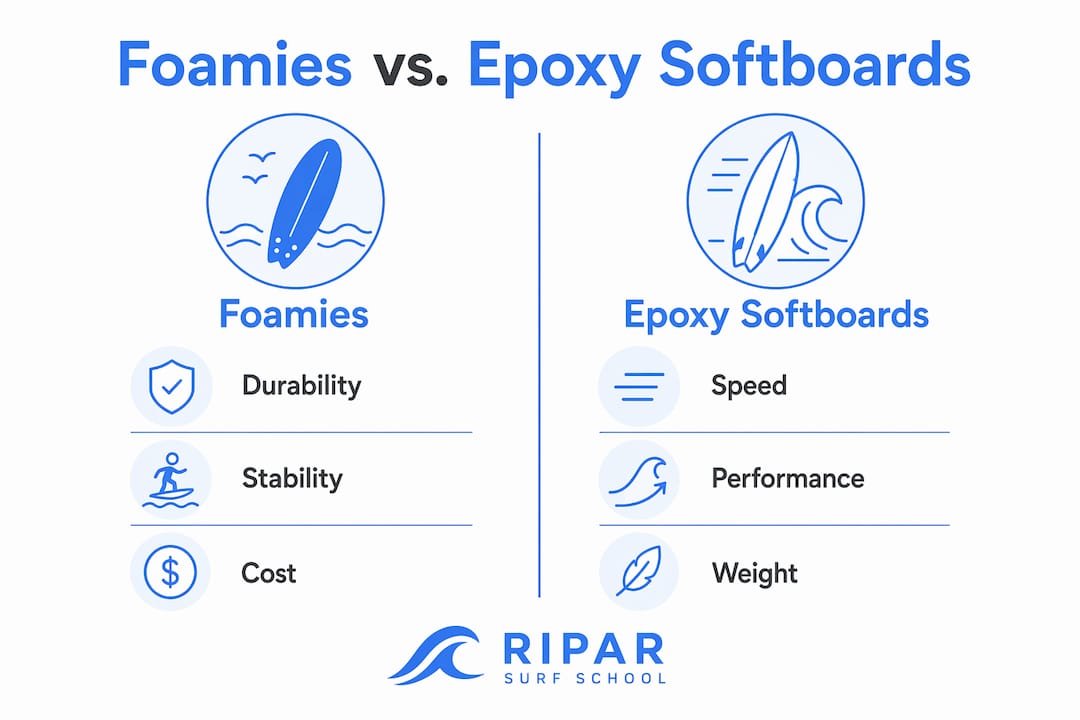
Foamies sacrifice some speed and snap compared to hard boards, but for anyone still learning to read waves and time their pop-up, that trade-off is completely worth it. Epoxy softboards sit in the middle: they have a harder outer shell for more drive, making them a natural step-up once you’ve outgrown the foamie stage.
What Riparsurfschool’s instructors say about foamies
At Riparsurfschool, foamies are the foundation of every beginner lesson. The instructors at Praia Areia Branca have watched thousands of first-timers progress, and the pattern is consistent: students who start on a properly sized foamie build muscle memory faster and stay motivated longer.
Practical guidance from the Riparsurfschool team:
Start on a board at least 2 feet taller than your height for maximum stability
Don’t rush the transition to a hard board; surf schools recommend extended foamie use to lock in fundamentals
Rinse your foamie with fresh water after each session to extend its life
Check the deck pad and fin boxes periodically for wear
When you’re consistently riding to the beach and trimming the wave, that’s your cue to consider stepping up
Curious what a beginner surf lesson on a foamie actually looks like? Riparsurfschool’s certified instructors walk you through every step at one of Portugal’s best learning breaks.
How much does a foamie surfboard cost?
Foamies are the most affordable entry point into surfing. Entry-level soft-tops from mainstream brands are available at prices well below those of traditional fiberglass boards.
Several factors affect the price:
Size: Longer boards cost more material to produce
Construction: R-Series solid foam boards and hybrid soft-tops with HDPE decks tend to cost more than basic EVA-deck models
Brand: Established surf brands charge a premium over generic retail options
Fins: Boards with quality fin systems (Futures or FCS boxes) carry a higher price tag
Compared to quality fiberglass shortboards, foamies represent a more budget-friendly and forgiving investment.
Where can you buy a foamie surfboard?
Foamies are widely available both online and in physical stores across the United States.
Retail options:
Local surf shops: Best for trying boards in person and getting sizing advice from staff who surf
Big-box sporting goods stores: Chains like REI and Dick’s Sporting Goods carry entry-level soft-tops
Online retailers: Amazon, Evo, and brand-direct sites offer the widest selection and competitive pricing
Secondhand marketplaces: Facebook Marketplace and Craigslist regularly list used foamies in good condition for well under retail
Brands worth knowing: Catch Surf, Wavestorm (widely available at Costco), and Almond Surfboards each offer distinct construction approaches across different price points. For types of surfboards beyond foamies, Riparsurfschool’s board guide covers the full spectrum.
If you’re planning a surf trip to Portugal, Riparsurfschool provides all equipment as part of its lessons and camps, so there’s no need to travel with a board.
Key Takeaways
Foamies are the most practical, safe, and affordable way to start surfing, and modern designs make them useful well beyond the beginner stage.
Point | Details |
Core construction | EPS foam deck with a slick HDPE base; rigid enough to perform, soft enough to be safe. |
Best size for beginners | Go longer and higher-volume; a board at least 2 feet taller than your height gives the stability you need. |
Safety advantage | Soft foam construction reduces injury risk in falls and crowded lineups compared to hard boards. |
Cost advantage | Foamies are consistently the most affordable surfboard category, with entry-level models significantly cheaper than traditional hard boards. |
When to step up | Once you’re trimming waves consistently, an epoxy softboard is the natural next move before a hard board. |
Ready to try one in the water? Book a surf lesson with Riparsurfschool and get hands-on time with a properly fitted foamie at Praia Areia Branca.

Recommended
Comments