

Beach Orientation in Surfing: What Every Surfer Must Know


TL;DR:
Beach orientation determines how swell and wind interact to shape wave quality at a given coastline.
Understanding this helps surfers select the best beaches for current conditions and avoid inefficient sessions.
Two surfers check the same forecast, drive to different beaches 3 miles apart, and one rides perfect chest-high waves while the other finds windblown mush. Beach orientation in surfing is the reason. A 10-degree swell direction change can completely transform wave power and quality at a given break. Most beginners never hear about this, and it quietly kills otherwise great surf sessions. This article breaks down exactly what beach orientation means, why it matters more than most forecasts let on, and how you can use it to find better waves every single time you paddle out.
Table of Contents
Key Takeaways
Point | Details |
Orientation shapes wave quality | The compass direction a beach faces determines how swell and wind interact with it to produce waves. |
Small angle shifts matter | A 10-degree change in swell direction significantly alters wave power and ridability at the same break. |
Wind direction beats wind speed | Whether wind is offshore or onshore depends entirely on the beach’s orientation, not just how hard it blows. |
Seasons change everything | Dominant swell and wind directions shift across seasons, making some beaches ideal in summer but poor in winter. |
Local landmarks create shelter | Headlands and rocky points create wind shadows and protected surf pockets even on messy weather days. |
What beach orientation in surfing actually means
Beach orientation is simply the compass direction a beach faces. A north-facing beach opens toward north swells. A west-facing beach catches west swells directly. That sounds simple, but the consequences for surfing are massive and often misunderstood.
Think of beach orientation as a filter. Swell direction filters differently depending on which way a beach faces, so two breaks just miles apart can look completely different on the same day. One might be firing with head-high clean walls. The other might be flat or blown out. This is why regional forecasts can mislead you without local orientation knowledge.
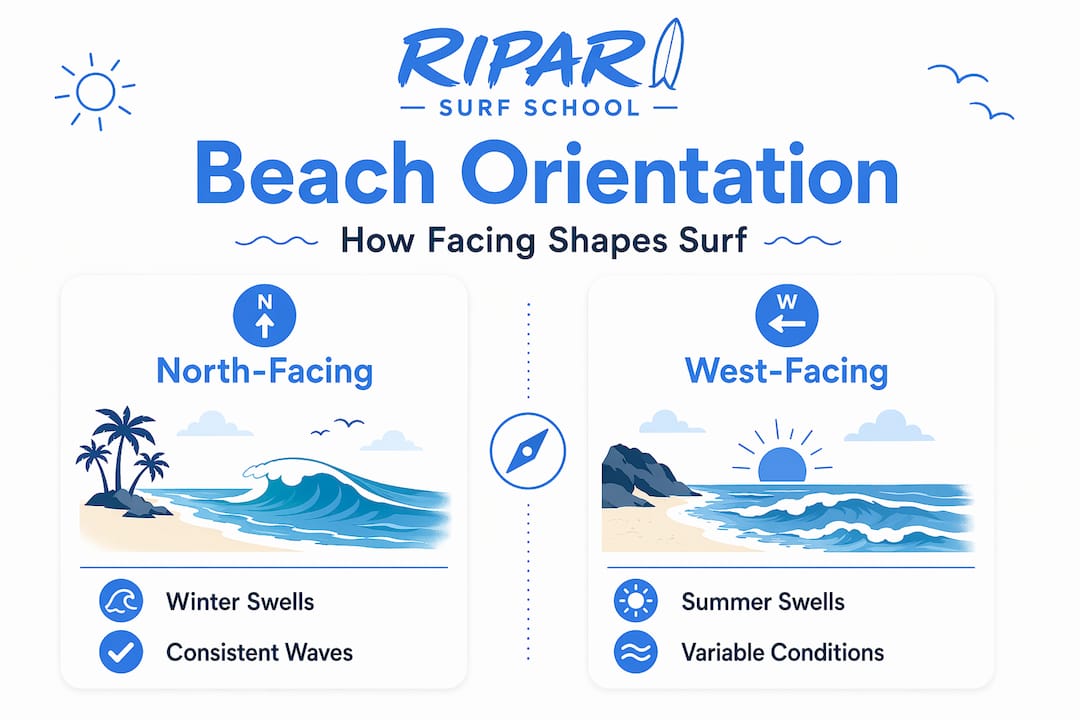
How swell direction interacts with the beach
When a swell arrives at an angle that matches your beach’s orientation, the waves break with full energy and predictable shape. When the swell approaches at an angle that’s slightly off, waves might break unevenly, close out quickly, or barely form at all. Surfers who read swell direction relative to orientation stop wasting sessions chasing the wrong beach.
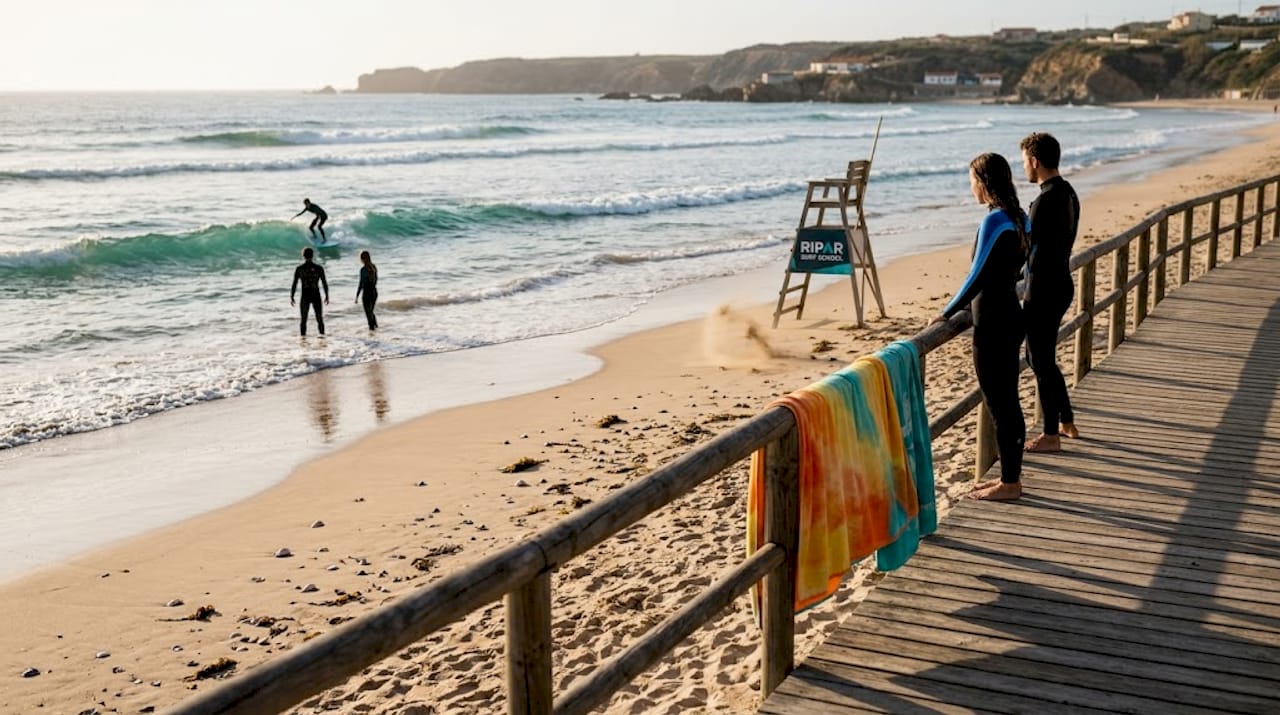
Underwater topography, called bathymetry, also plays a role. A sandy floor that slopes gradually in line with the beach’s orientation creates long, rideable waves. Abrupt or irregular bottoms create unpredictable breaks. This is why beach layout for surfers is about more than what you see above the waterline.
Wind and beach orientation
Wind direction’s relationship with your beach’s orientation is often more important than wind speed. Offshore winds improve wave shape even when swell size is modest, because they hold the wave face up and create clean conditions. Onshore winds, those blowing from the sea toward the land, degrade the surface and make waves crumbly and hard to read.
Whether wind is offshore or onshore at your specific beach depends entirely on which direction that beach faces. A northwest wind is offshore at a southeast-facing beach and onshore at a northwest-facing one. Wind direction relative to orientation is more crucial for surf quality than the raw wind speed number on your app.
Pro Tip: When checking a forecast, always note the wind direction alongside the beach’s compass facing. If the wind blows from the land toward the sea at your spot, you’re looking at cleaner conditions regardless of whether it reads “light” or “moderate.”
How seasons shift the equation
Beach orientation is not a static advantage. Seasonal shifts in swell and wind patterns change which beaches perform well throughout the year. A beach that delivers consistent waves in summer might turn into a blown-out mess in winter when the dominant swell and wind directions rotate.
Here’s what seasonality means in practice for surfers:
Summer swells in the Northern Hemisphere typically come from the south or southwest, favoring south-facing beaches with gentle, mellow conditions.
Winter swells arrive more powerfully from the north and northwest, lighting up north and west-facing beaches while exposing them to rawer, heavier energy.
Wind patterns shift too. Prevailing winds change with the seasons, which can turn an offshore wind at a summer spot into a direct onshore wind by December.
Beginner windows open and close. A beach that is perfect for learning in May may demand experience and caution in January due to a different swell angle hitting its orientation directly.
Understanding these shifts helps you plan smart. Portugal’s Atlantic coast, where Riparsurfschool operates near Peniche and Ericeira, benefits from south and southwest-facing exposures that stay manageable for learners during spring and early summer before the full force of autumn Atlantic swells arrives.
Pro Tip: Before booking a surf trip, look up the dominant swell direction for your target month, then cross-reference it with the orientation of the beaches you plan to surf. A two-minute check can be the difference between a great trip and a week of fighting unfavorable conditions.
Local landmarks and the wind shadow effect
Headlands, rocky points, and cliffs do something that rarely gets explained to beginners. They create wind shadows and protected corners where clean waves form even when the main stretch of beach is choppy. This is a micro-climate effect that experienced surfers use constantly.
If you’re at a beach and the main peak looks blown out, walk toward any headland or rocky outcropping at the edge of the bay. The land mass blocks onshore wind for a section of the break, and that corner can be glassy while everything 200 yards away is rough. Experienced surfers combine orientation knowledge with landmarks to find these pockets reliably.
Comparing beaches by orientation and conditions
The clearest way to understand surfing spot orientation is to compare real beaches side by side. Not every beach suits every surfer, and orientation is a major reason why.
Beach | Orientation | Typical conditions | Best for |
Cowell Beach, Santa Cruz | West-facing, sheltered | Mellow, slow-breaking waves | Beginners |
Steamer Lane, Santa Cruz | West-facing, exposed point | Powerful, fast, hollow waves | Advanced surfers |
Praia Areia Branca, Portugal | West-facing, Atlantic open | Consistent swells, variety of peaks | All levels |
Bells Beach, Australia | Southwest-facing | Long walls, ground swell focused | Intermediate/advanced |
Peniche, Portugal | Multiple orientations | Works in most swell and wind conditions | All levels |
Cowell Beach is favored by learners specifically because its protected orientation diffuses strong swells before they reach the lineup, creating the mellow, forgiving waves beginners need. Steamer Lane sits close by but faces the open Pacific with a different angle, producing the kind of powerful waves that have hosted professional competition for decades. Same region. Completely different experience because of orientation.
Beach orientation also governs sand movement and shoreline stability. Beaches oriented at certain angles to dominant wave energy can experience width variations of up to 90 meters depending on seasonal sand movement. More sand means a flatter, more forgiving beach break. Less sand can expose harder bottom features and change the wave’s character. This is not just a geology fact. It directly affects whether a session feels safe and consistent or unpredictable.
Coastal infrastructure adds another layer. Seawalls can accelerate beach erosion by disrupting natural sand movement patterns, which changes the underwater profile and can alter how waves break at that spot over time. When you notice a once-reliable beach producing inconsistent or closing-out waves, coastal development upstream is often part of the explanation.
Using orientation when planning sessions
Knowing what beach orientation means is one thing. Putting it to work in real session planning is where most surfers fall short. Here is a step-by-step process that actually works:
Identify your beach’s compass direction. Use Google Maps or any satellite tool. Look at which way the beach faces open water. That’s your orientation reference point.
Check swell direction, not just swell size. A 4-foot swell hitting your beach at a favorable angle is better than a 6-foot swell arriving at an oblique angle that causes closeouts.
Compare wind direction to your beach orientation. If the wind blows from land toward sea at your spot, you have offshore conditions. If it blows the other way, expect choppy faces.
Look for protected zones. Use satellite view to spot headlands, piers, or rocky outcroppings that might create a sheltered corner worth checking.
Check surf lesson planning resources for your destination to understand which beaches favor beginners and why orientation plays into that recommendation.
Adjust on arrival. Conditions change. Walk the beach, observe where waves are breaking cleanest, and be willing to shift from your planned spot if the orientation of a nearby peak is working better.
Tools like Windguru, Magic Seaweed, and Surfline all allow you to filter by swell and wind direction. The key is that you need to know your beach’s orientation before those numbers mean anything useful to you. A north-northwest swell reading of 6 feet at 14 seconds is excellent news for one beach and irrelevant for another just down the coast.
Pro Tip: When reading surf reports, look for arrow indicators showing swell direction and wind direction, then visualize those arrows hitting the coastline of your target beach. If the swell arrow points toward the beach’s face, you’re in business. If it’s parallel or pointing away, reconsider your spot.
For beginners, understanding surf lineups and wave direction becomes much easier once you connect it to orientation. Waves don’t just appear randomly. They arrive based on where swell came from and how your beach is positioned to receive it.
My honest take on beach orientation after years in the water
I’ve watched hundreds of surfers arrive at a beach, look at the waves for thirty seconds, decide it’s “not that good,” and drive away. Nine times out of ten, they were at the wrong beach for that day’s conditions. Not the wrong region. The wrong beach.
In my experience, ignoring beach orientation doesn’t just waste sessions. It creates a false idea that surfing is more luck-dependent than it actually is. When you understand orientation, you stop leaving good surf to chance. You start arriving at the right beach at the right moment because you did the work before you left the house.
The mistake I see most often with beginners is trusting a surf app’s regional rating without filtering it through local knowledge. A forecast saying “3 to 4 feet, clean” for a stretch of coastline might be perfect for one beach and flat for another two miles away. Regional forecasts don’t account for orientation filtering across closely spaced beaches.
What changed my own surfing was learning to look at a beach not as a static location but as a dynamic system. The orientation is fixed, yes. But the swell angle, the wind direction, the sand profile, the season, and the presence of local landmarks all interact with that orientation in ways that shift constantly. Once you see it that way, reading beach conditions becomes a skill you actively develop rather than a mystery you accept.
Embrace the local knowledge. Talk to instructors who surf the same breaks year-round. Their understanding of how a specific beach responds to different conditions is worth more than any app.
— Fernando
Learn to read conditions with expert guidance

Understanding beach orientation gives you a real advantage on the water, but applying it confidently comes from surfing with someone who already knows the local breaks inside out. At Riparsurfschool, based at Praia Areia Branca near Peniche and Ericeira, every lesson factors in current beach conditions, swell direction, and orientation before you ever get near the water. Instructors with over two decades of experience at these specific beaches know exactly which peaks work for beginners and which spots to avoid on any given day.
Whether you’re booking a private surf lesson for focused one-on-one coaching or joining a group surf session alongside other learners, the team builds your understanding of beach conditions into every session. You don’t just learn to stand up. You learn to read the ocean. Ready to put orientation knowledge into practice? Book your lesson and surf smarter from day one.
FAQ
What is beach orientation in surfing?
Beach orientation is the compass direction a beach faces, which determines how incoming swells and wind interact with it to produce waves. A beach facing west receives west swells directly, while a swell from a different direction may barely register at that same spot.
Why does beach orientation matter for beginners?
Beginners benefit most from beaches with orientations that diffuse or soften incoming swell energy, creating slower and more forgiving waves. Choosing the right orientation for your skill level is one of the most practical surfing location tips for anyone starting out.
Can two nearby beaches have completely different conditions?
Yes. A swell direction that produces great waves at one beach can leave another beach just miles away flat or blown out due to its different orientation. Orientation filters swell energy differently across closely spaced breaks.
How do I find out which direction a beach faces?
Open Google Maps or any satellite mapping tool, locate your target beach, and observe which direction the shoreline opens toward the water. That direction is your beach’s orientation and your starting point for reading any forecast.
Does beach orientation change over time?
The compass direction is fixed, but sand movement and coastal erosion alter the underwater profile and beach width over seasons. Coastal infrastructure like seawalls can accelerate these changes, shifting how waves actually break at a spot even when the orientation stays the same.
Recommended
Comments